

Writer: Kieron Gillen
Artist: Caspar Wijngaard
Cover Artist: Caspar Wijngaard
There are finales that close a chapter, and then there are finales that feel like they could close the entire book. The Power Fantasy #16 does both. Kieron Gillen reveals in the back matter that this is only the end of the first part of the saga, but if the series had stopped here, I would have walked away satisfied. This is not because everything is clean or neatly resolved, but because this issue detonates the emotional and thematic payload with such precision that it feels definitive. It is apocalyptic in scale, intimate in the grief it portrays, daring in the structure, and absolutely fearless in the closing choice. For me, this is a 10/10 comic book.
Since the debut, The Power Fantasy has consistently expanded its scope without sacrificing its emotional core. Across sixteen issues, Gillen and Caspar Wijngaard have constructed a world where godlike beings posture as geopolitical superpowers. Every action reverberates on a global scale, and the cost of power is measured not only in casualties but in betrayal and personal devastation. What makes this series remarkable is not just the ambition, but the discipline. Even at the largest moments, it never loses sight of the people trapped inside the spectacle.
The Aftermath of Eliza Hellbound
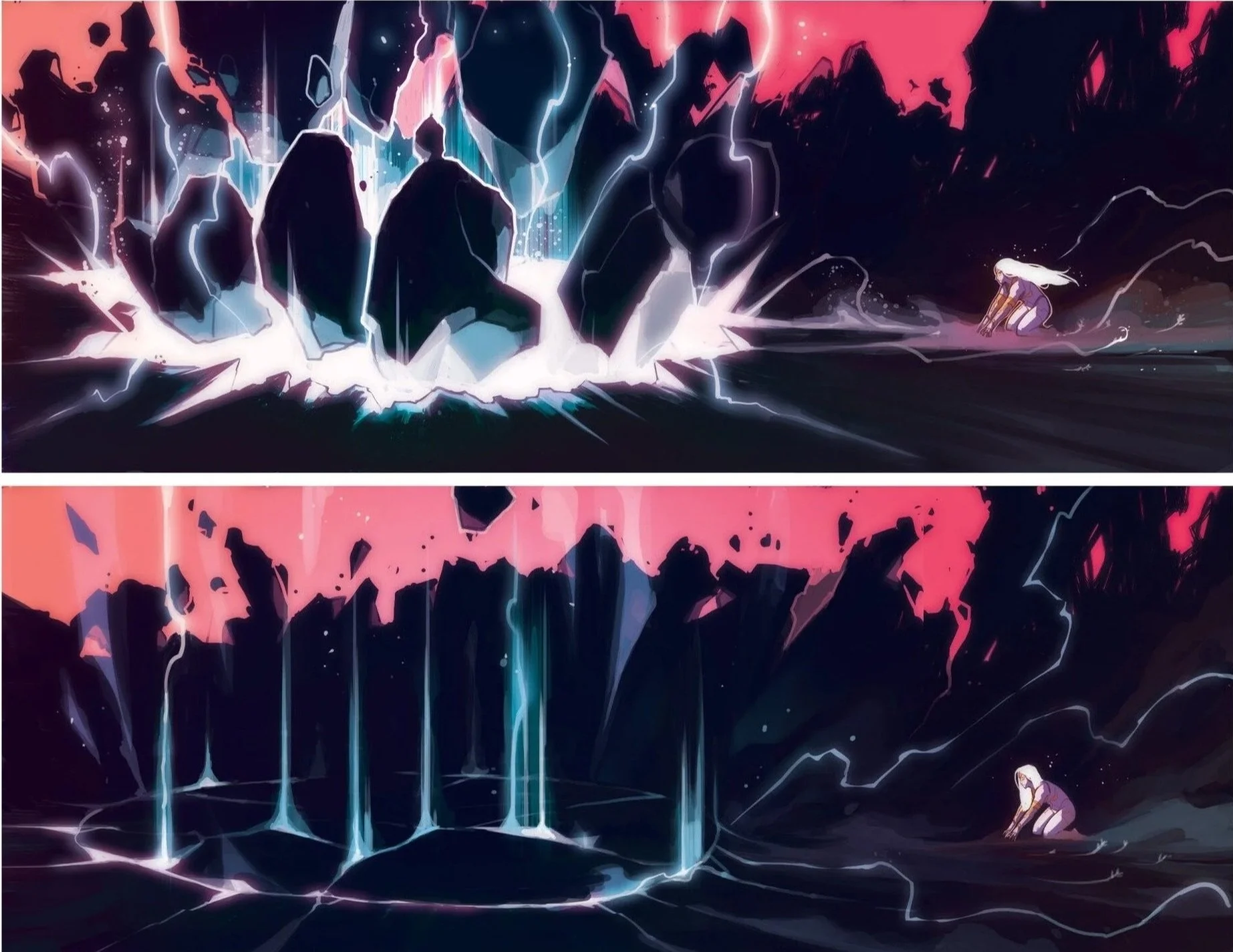
Valentina and the Pyramid defeat Eliza.
This issue opens in the immediate aftermath of a catastrophe. Eliza Hellbound, once a tragic figure manipulated by forces beyond comprehension, stands at the center of a reality-threatening disaster. In the previous issue, Heavy implanted a miniature black hole in the head of Eliza in a desperate attempt to neutralize her. Eliza retaliated, killing Heavy. By the time we see her here, she already carries that black hole within her body.
And then, almost as quickly as she appears, she is gone.
We do not linger with Eliza as she tears reality apart. We do not watch her spiral further into cosmic annihilation. Instead, we spend barely a page with her before Valentina makes the unbearable decision to end the life of a friend. The Pyramid seals the dimensional rupture Eliza has created, containing the damage before all existence collapses inward.
It would have been easy for Gillen to stretch this into a prolonged battle sequence, to give readers pages of spectacle as reality buckled and burned. Instead, he chooses swiftness. Finality. The emotional impact comes not from drawn-out combat, but from the knowledge that Valentina understands exactly what she is doing. She is not reacting blindly. She is choosing to kill someone she loves because the alternative is universal extinction.
That choice is the core of the issue.
Thirty Million Dead
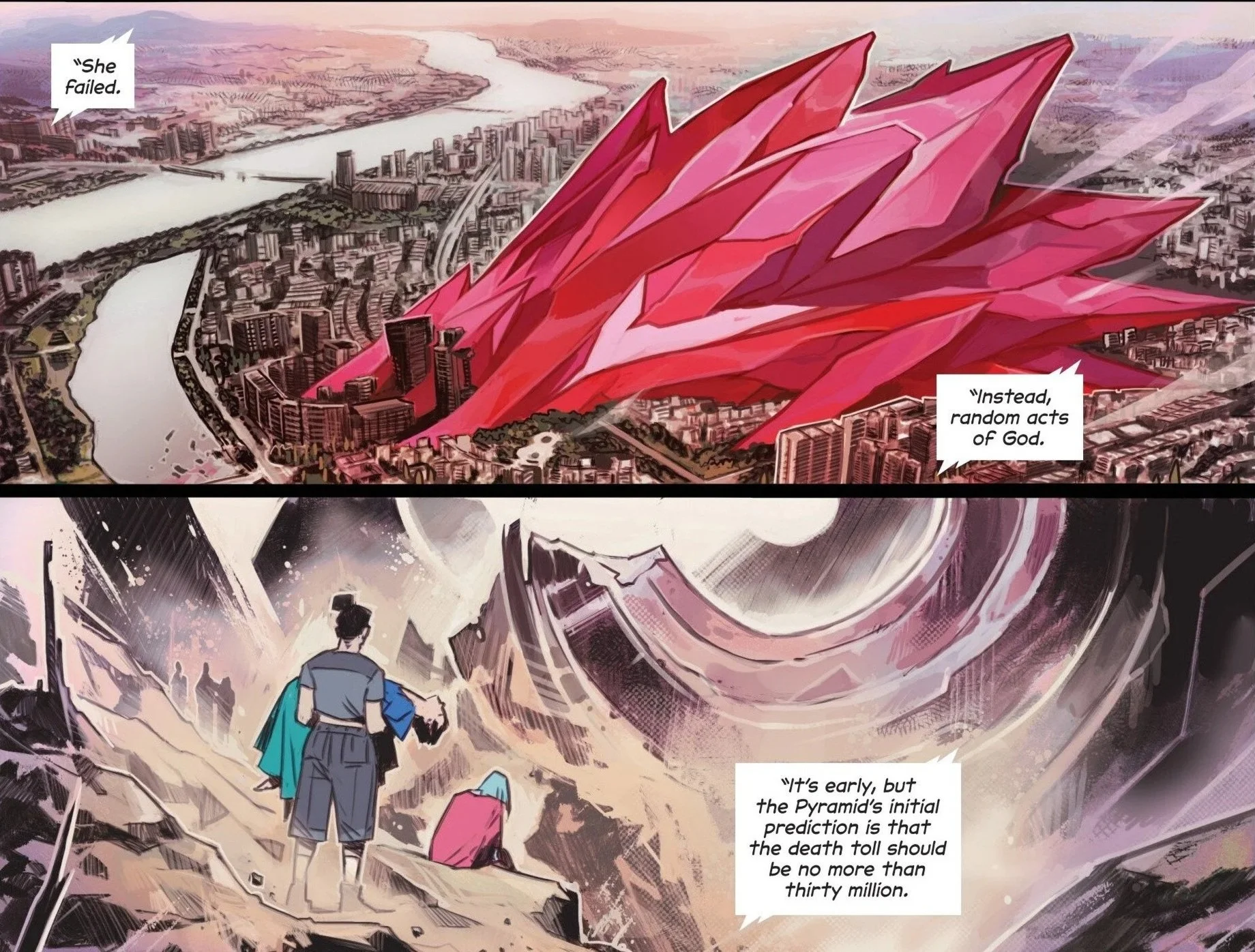
The aftermath of Eliza’s outburst at the end of her life.
After the dimensional breach is sealed, the narrative pivots in one of the most unsettling tonal shifts the series has attempted. A news talk show host interviews Dr. Eldritch, a representative of The Pyramid, who calmly estimates that the death toll will likely not exceed thirty million people. He contextualizes this by referencing the Second Summer of Love in 1989, which resulted in nearly a billion deaths when The Queen attempted to drill into Hell. Compared to that, he suggests, humanity has been exceedingly lucky.
The comparison is staggering. Thirty million lives are reduced to a statistical relief.
The scene does not need dramatic punctuation to land. The horror is embedded in the framing. By placing this bureaucratic assessment immediately after the devastating act of Valentina, Gillen underscores the emotional dissonance between institutional pragmatism and personal grief. For The Pyramid, this is damage control. For Valentina, it is the loss of a friend and the weight of irreversible action.
This has always been one of the sharpest instincts of The Power Fantasy. It shows how systems metabolize catastrophe while individuals are left to absorb the emotional residue. The world moves on. The talk show continues. But Valentina cannot move on so easily.
The Dissociation Kaiju
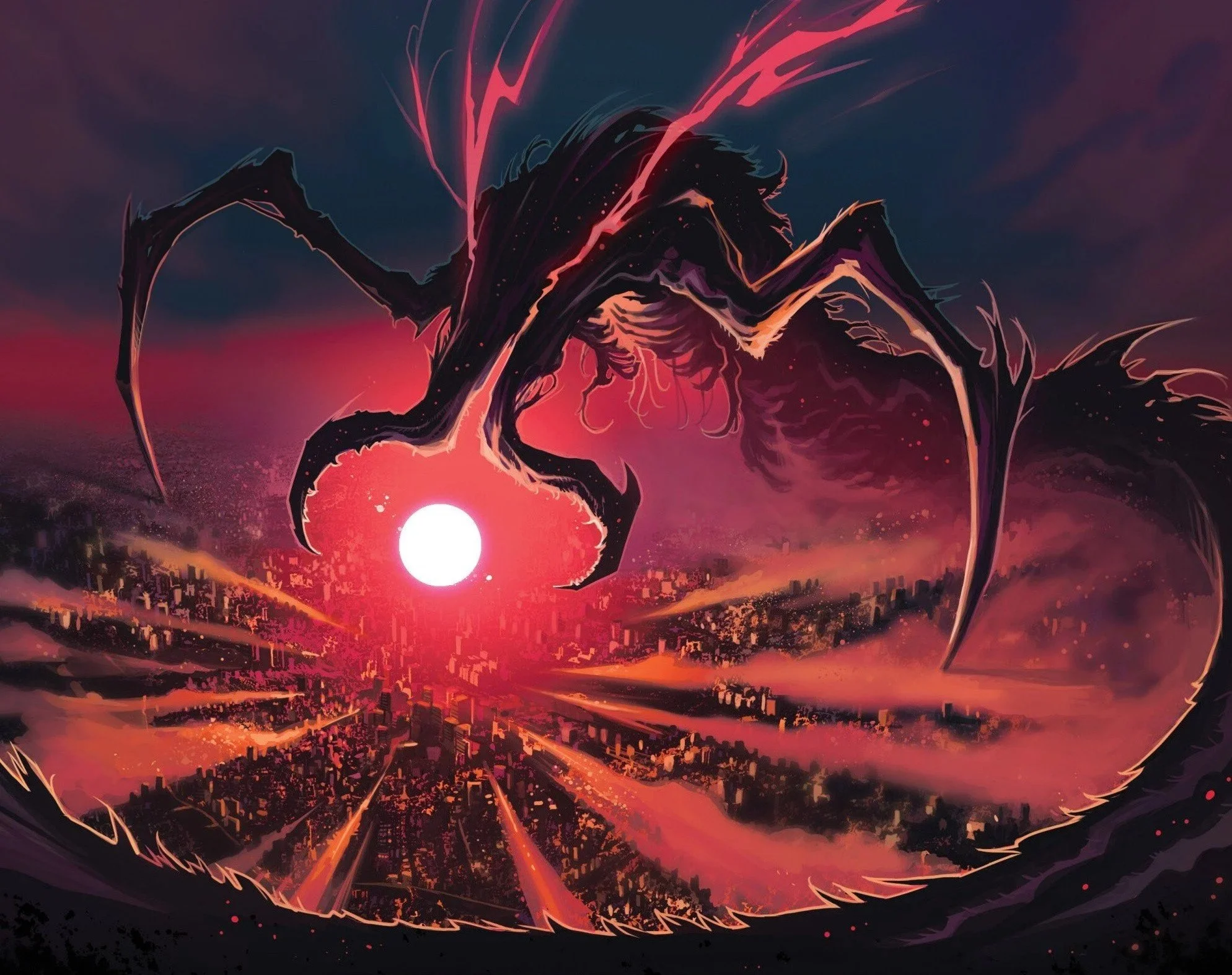
The dissociation kaiju wreaks havoc on Earth.
Yet even before the narrative settles fully into institutional spin and political calculus, the issue offers one of the most haunting images: Masumi and the emergence of the dissociation kaiju. In the psychic and emotional fallout of the collapse of Eliza, Masumi manifests something enormous. This is not an invading monster or an enemy combatant. It is a kaiju born of fracture. It is a dissociative response made literal.
It is a striking reminder that the damage in this series is never purely physical. The Superpowers fracture continents, rewrite borders, and bend reality, but the people around them absorb the shockwaves internally. The kaiju of Masumi reads less like an attack and more like a defense mechanism that has grown too large to contain. It is trauma externalized and survival instinct scaled to monstrous proportions.
What makes the moment resonate is how quietly it sits within the larger catastrophe. The book does not frame it as the next big threat. Instead, the story frames it as fallout and consequence. It is another life reshaped by proximity to gods. Placed between the sterile announcement of thirty million dead and the decision of Valentina to rewrite causality itself, the manifestation of Masumi underscores the human debris left behind when the powerful wage careful wars. Reality may be stabilized, but the emotional landscape is anything but.
Valentina’s Burden
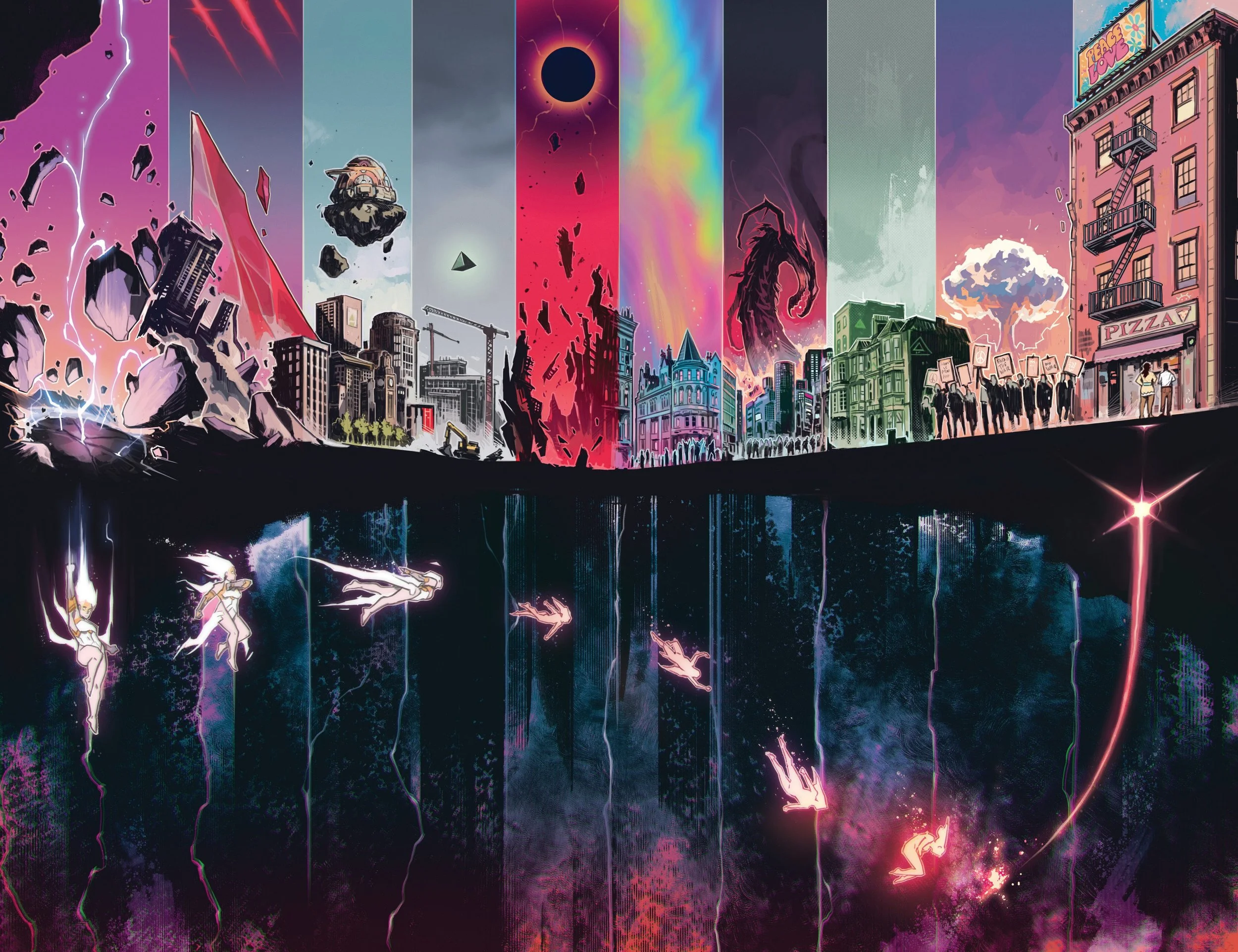
Valentina goes back to the beginning.
Much of the focus of the issue rests on Valentina and what she does next. Rather than retreat into mourning, she chooses motion. She travels to an alternate timeline to recruit Etienne, the Atomic, whose past actions have already destabilized global politics and contributed to an immense loss of life. The implication is clear. Valentina is attempting to rewrite events, or at the very least, to intervene earlier in the chain reaction that led to the unraveling of Eliza and the deaths of millions.
This is where the thematic layering becomes especially potent. The Superpowers have always justified their actions through necessity. They manipulate, deceive, and neutralize one another in the name of maintaining balance. Now, Valentina is stepping into that same moral gray zone, but the motivation feels different. It is not about dominance or deterrence. It is about grief. It is about love.
The title of the issue, The Things We Do For Love, resonates most strongly here. The decision of Valentina to kill Eliza was an act of love twisted by circumstance. The decision to risk further temporal instability by involving Etienne may also be rooted in that same impulse. Love, in this universe, is not soft. It is combustible. It reshapes reality.
The Legacy of Conflict
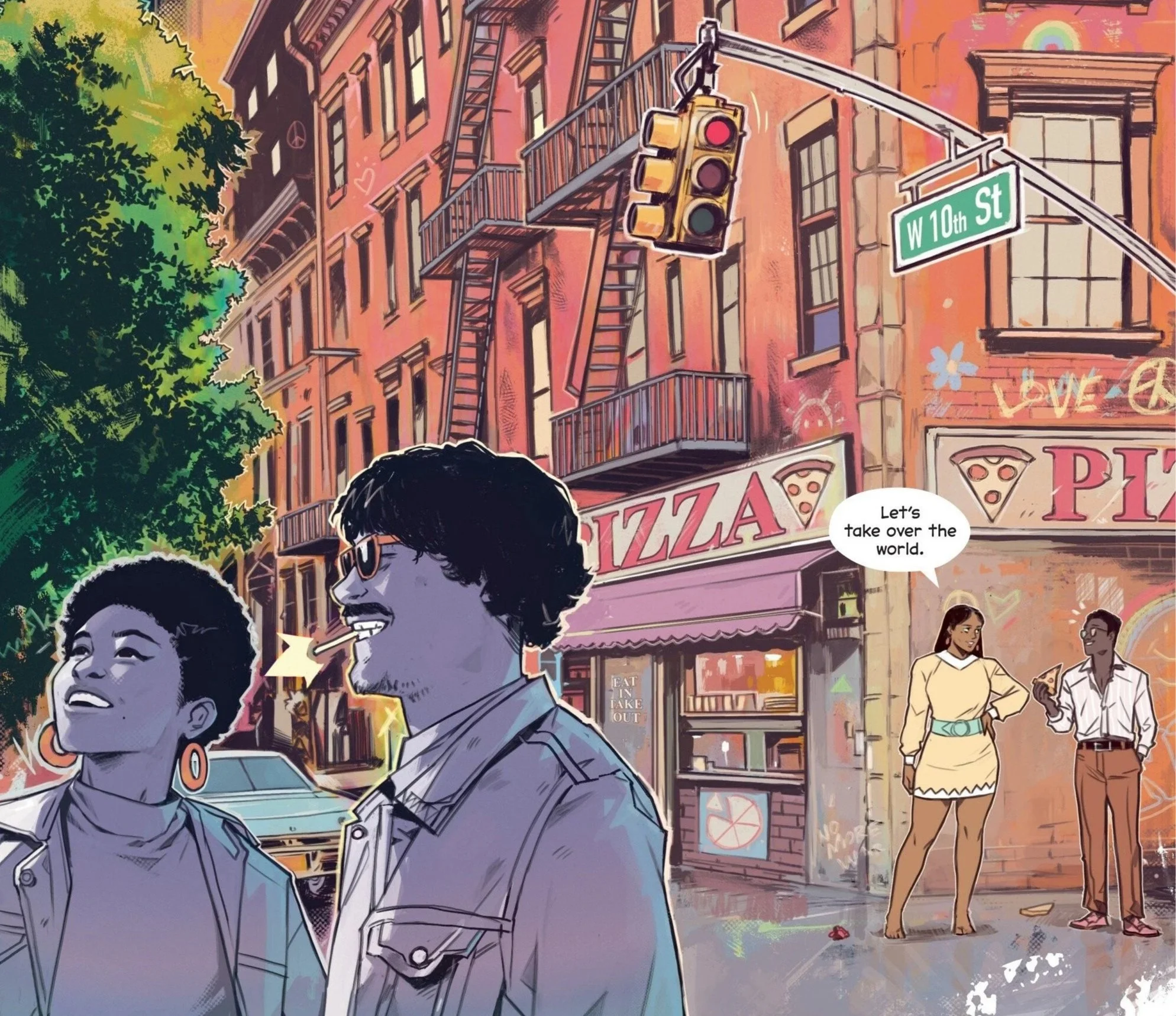
Valentina changes her mind about what Etienne said in the first issue.
To fully appreciate the weight of this issue, it helps to consider the broader tapestry the series has woven. The Superpowers have spent sixteen issues locked in an uneasy dance of mutual assured destruction. They have lied to each other, betrayed alliances, and occasionally united to prevent reality from collapsing.
When The Queen attempted to breach Hell during the Second Summer of Love, Europe was annihilated in the battle to stop her. When Etienne assassinated the sitting U.S. President, the Atomics turned on one of their own. The scale has always been immense, but it has never felt abstract. Each cataclysm leaves scars. Each compromise reshapes relationships.
The descent of Eliza was not sudden. It was the culmination of manipulation, withheld truths, and existential despair. The fate of Eliza here feels tragic, not because she becomes a villain, but because she was failed repeatedly before she ever posed a threat.
Art That Carries the Apocalypse
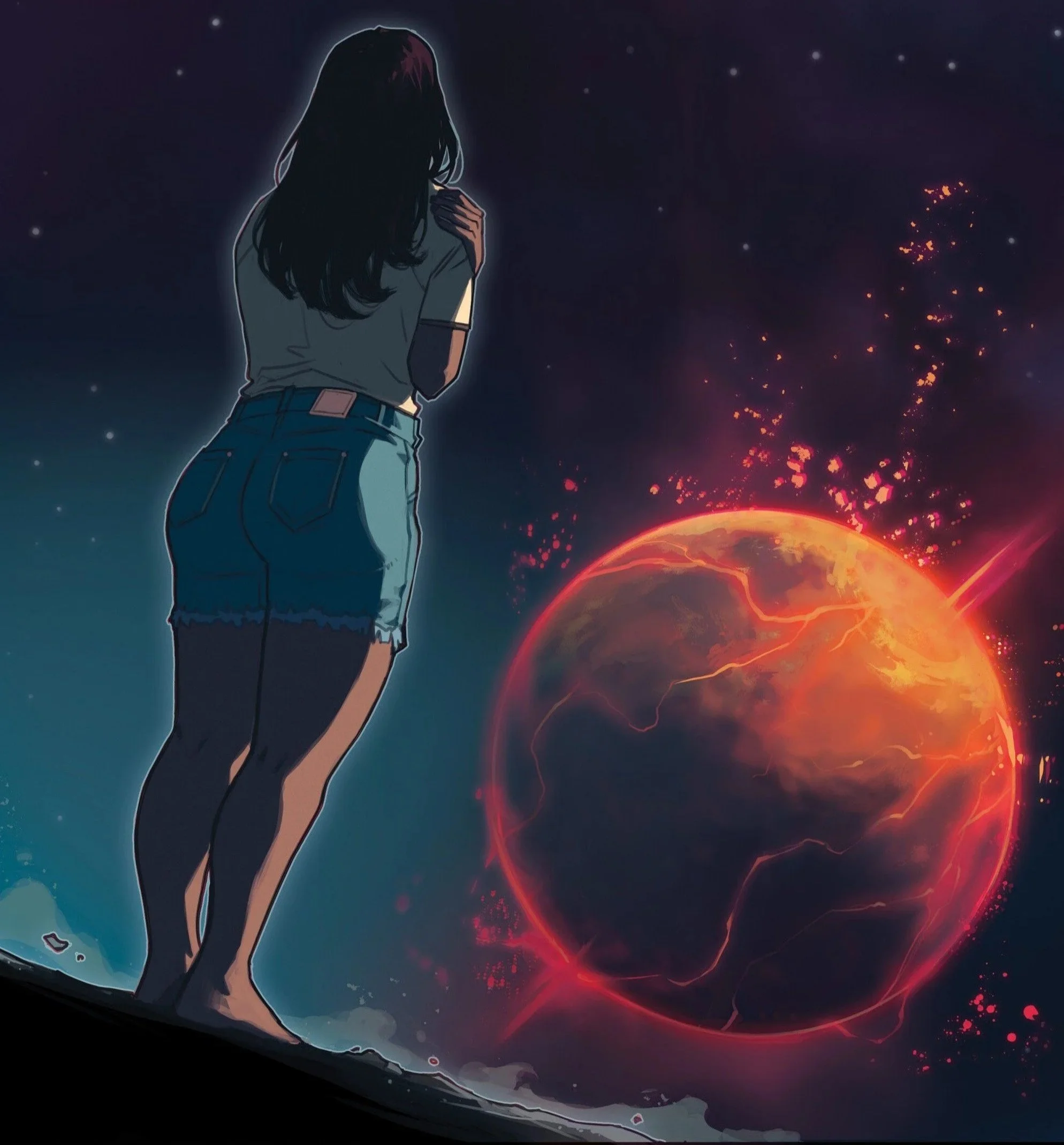
Valentina watches as the world ends.
Caspar Wijngaard and the art he provides continue to distinguish this book from nearly everything else on the stands. The use of color and composition gives even static conversations a sense of grandeur. The cosmic elements feel appropriately incomprehensible, yet the moments for the characters remain grounded and readable. When the black hole sits in the head of Eliza, it is not merely a visual flourish. It is a symbol of implosion and of grief collapsing inward until nothing remains.
The scale of destruction is conveyed without indulgence. Wijngaard does not need splash pages of exploding continents to communicate devastation. The weight is present in expressions, in posture, and in the quiet panels that follow the storm.
A Pause Before the Next Movement

The Power Fantasy…to be continued.
In the back matter, Gillen confirms that this is not the end of the series, but there will be a pause before it returns. The creative team intends to map out the next phase carefully before solicits resume. Knowing this, the issue reads even more like a deliberate stopping point. It closes the first movement of a symphony while hinting at darker variations to come.
If this had been the final issue, it would have stood as a bold and uncompromising conclusion. Instead, it serves as a threshold. The decision of Valentina to seek out Etienne suggests that the next arc may interrogate causality itself. Can tragedy be undone, or does intervention only compound the damage? In a world where power bends reality, what does responsibility truly mean?
Final Thoughts and Rating
The Power Fantasy #16 succeeds because it refuses comfort. It allows the characters to make impossible choices and then forces them to live with the consequences. It juxtaposes intimate grief with institutional indifference. It trusts readers to sit with moral ambiguity rather than resolving it neatly.
This issue is apocalyptic without losing humanity. It is structurally daring without becoming convoluted. Most importantly, it understands that the true stakes of a story about godlike beings are not the survival of the universe, but the emotional cost of preserving it.
Rating: 10/10
For me, this is not just another strong installment in an already impressive run. It is the moment the series crystallizes into something undeniable. A story about power, yes, but even more so about love, and the terrible, necessary things we do in its name.