
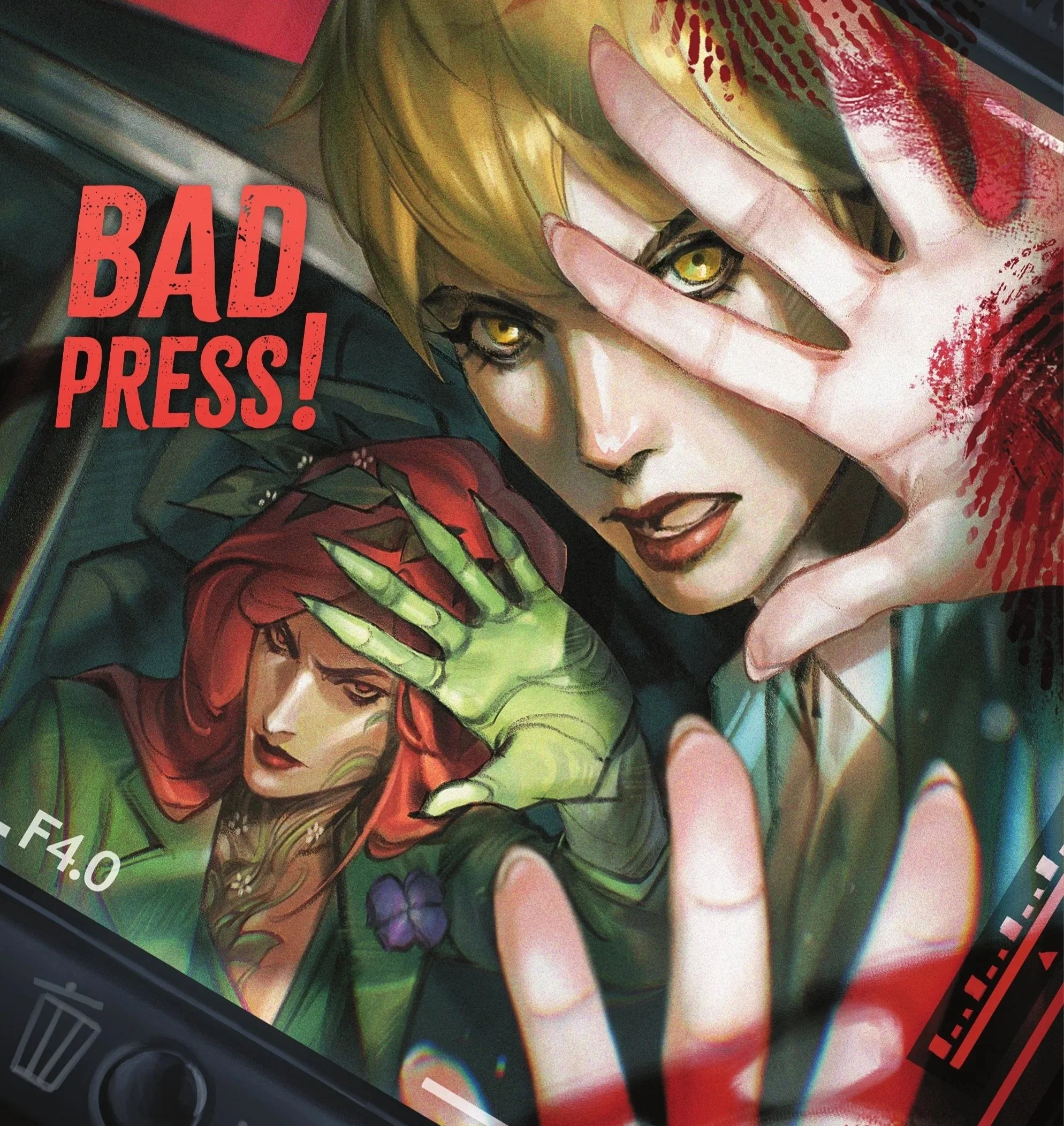
Writer: G. Willow Wilson
Artist: Jaime Infante
Colorist: Arief Prianto
Cover Artist: Jessica Fong
Poison Ivy #44 continues the increasingly tense storyline surrounding Pamela Isley’s time as Mayor of Gotham City, and this chapter makes it clearer than ever that Ivy’s hold on power may already be beginning to collapse. While previous issues focused on the emotional sacrifices Ivy made to obtain and protect her political position, this installment shifts toward the mounting consequences of her leadership style. Gotham’s political elite, the press, the city council, and even supernatural forces connected to The Green are all beginning to turn against her at once.
The result is one of the densest and most politically charged chapters of the series so far. Nearly every scene in the issue revolves around conflict, pressure, or opposition, creating the sense that Ivy is being cornered from every direction. At the same time, the story continues to explore one of the run’s most compelling ideas: what happens when someone who once operated entirely outside the system suddenly attempts to wield institutional power from within.
Rather than softening Ivy or making her more traditionally heroic because she now occupies public office, the series continues leaning into her flaws. Ivy remains impulsive, uncompromising, and convinced that her goals justify extreme actions. That approach makes her increasingly difficult to defend politically, but it also makes her fascinating to watch.
The Parliament of Trees Returns
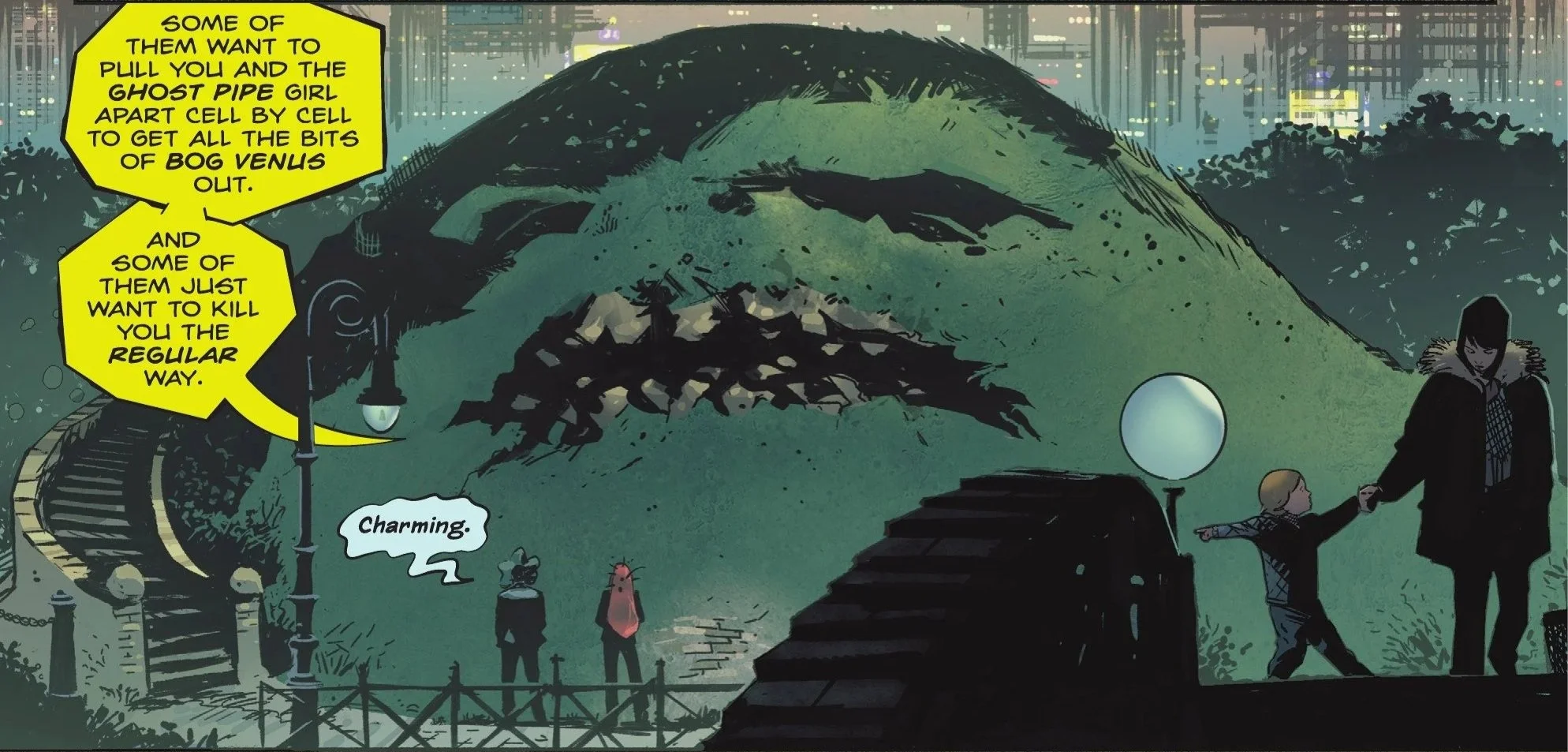
One of the issue’s most important developments involves the return of the Parliament of Trees storyline that has quietly been building throughout the run. Following the events of Poison Ivy #38, where Ivy killed and consumed Bog Venus, the Parliament has finally responded directly.
The issue opens with Ivy being visited by a talking hill acting as a representative of the Parliament of Trees, and the encounter immediately establishes the growing tension between Ivy and the elemental forces connected to The Green. The Parliament demands accountability for Ivy’s actions and warns her that consequences are coming if she refuses to make amends.
Importantly, Ivy refuses to back down.
Even when Peter Undine urges her to reconsider and attempt some kind of reconciliation, Ivy dismisses the idea entirely. Undine’s warning—that her hubris will become her downfall—feels especially significant because it directly connects to one of the central themes of this mayoral storyline.
Ever since taking office, Ivy has increasingly behaved as though she alone understands what Gotham needs. She sees resistance not as disagreement, but as obstruction. Whether those obstacles come from political rivals, wealthy elites, or ancient elemental entities tied to plant life, Ivy’s instinct is always confrontation rather than compromise.
That stubbornness is what makes the conflict with the Parliament so effective. The issue suggests that Ivy’s greatest weakness may not be corruption or malice, but rather her inability to believe that she could ever be wrong.
Ivy vs. Gotham’s Political System
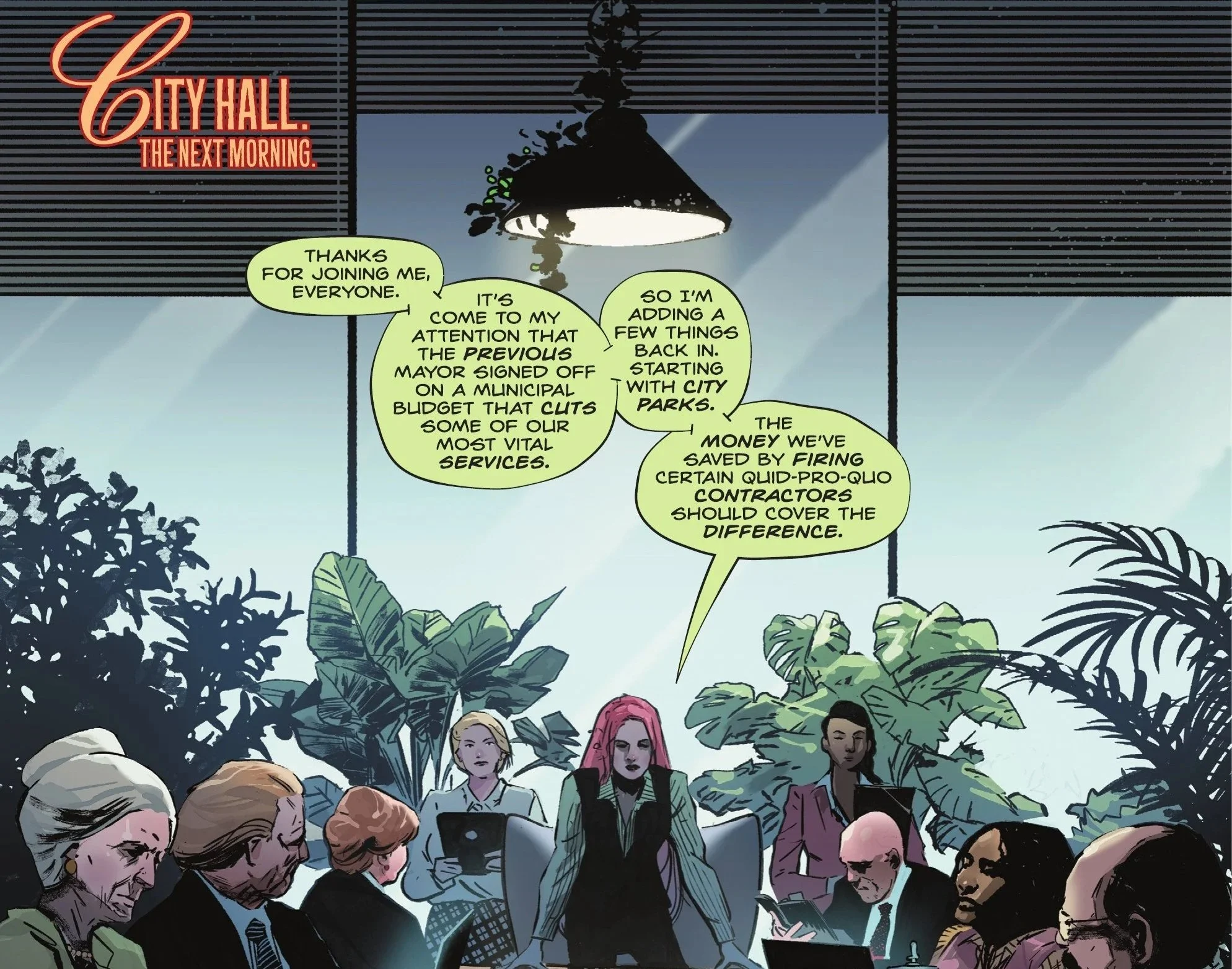
The political side of the story becomes even more complicated once Ivy learns that Gotham City Hall has cut funding for the parks department. Rather than working through normal governmental procedures, Ivy immediately restores the funding herself without consulting the council or following proper channels.
The moment perfectly captures both Ivy’s strengths and her weaknesses as Mayor.
On one hand, her motivations are understandable. Ivy genuinely wants to improve Gotham and protect the environment, and she views bureaucratic obstacles as part of the same broken system that has failed the city for generations. From her perspective, acting decisively is simply more efficient than allowing political gridlock to continue.
On the other hand, her behavior reinforces the growing criticism that she governs through force of will rather than collaboration.
The furious reaction from the city council helps emphasize that point. One councilor warns Ivy that public support can disappear quickly, especially when leaders begin overstepping their authority. It’s a strong moment because it highlights how little experience Ivy actually has operating inside democratic institutions.
As Poison Ivy, she could impose her will directly. As Mayor, she’s supposed to negotiate, persuade, and compromise.
Those are not skills Ivy naturally possesses.
The issue repeatedly reinforces the idea that Ivy still approaches politics with the mentality of an eco-terrorist. She treats opposition as something to eliminate rather than something to engage with, and that attitude is beginning to isolate her from both allies and constituents.
The Press Turns Against Ivy
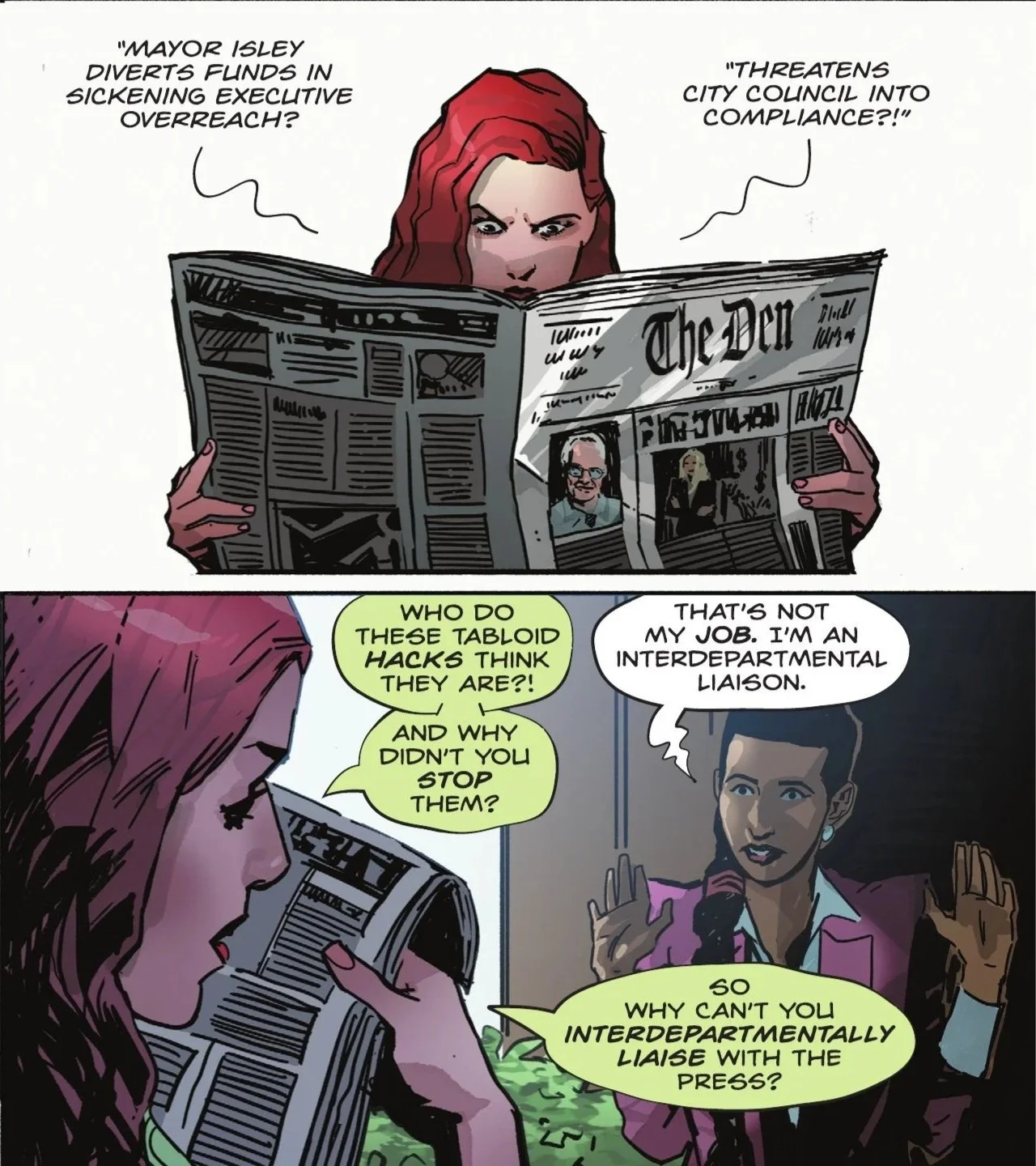
One of the most interesting developments in the issue involves Gotham’s media beginning to openly challenge Ivy’s administration. A local newspaper called The Den publishes a harsh article criticizing Ivy’s leadership, accusing her of executive overreach and intimidation tactics.
The story’s use of the press works especially well because it introduces a new kind of enemy for Ivy—one she can’t simply overpower physically.
When Ivy reads lines accusing her of threatening the city council and abusing her authority, her immediate instinct is to “handle” the problem personally. Janet quickly pushes back, reminding Ivy that government is not supposed to function as a one-woman wrecking ball.
That exchange may be one of the issue’s most important moments.
It cuts directly to the heart of Ivy’s leadership style. She views political office as a weapon she can use to enforce change, but the issue repeatedly questions whether meaningful reform can actually happen through authoritarian methods, even when the goals themselves are noble.
The storyline also does an excellent job showing how fragile political support can be. Gotham’s citizens elected Ivy because they were desperate for systemic change, but public opinion becomes much more complicated once idealistic rhetoric collides with the realities of governing.
The issue never fully condemns Ivy’s goals, but it increasingly questions her methods.
Gotham’s Real Power Structure
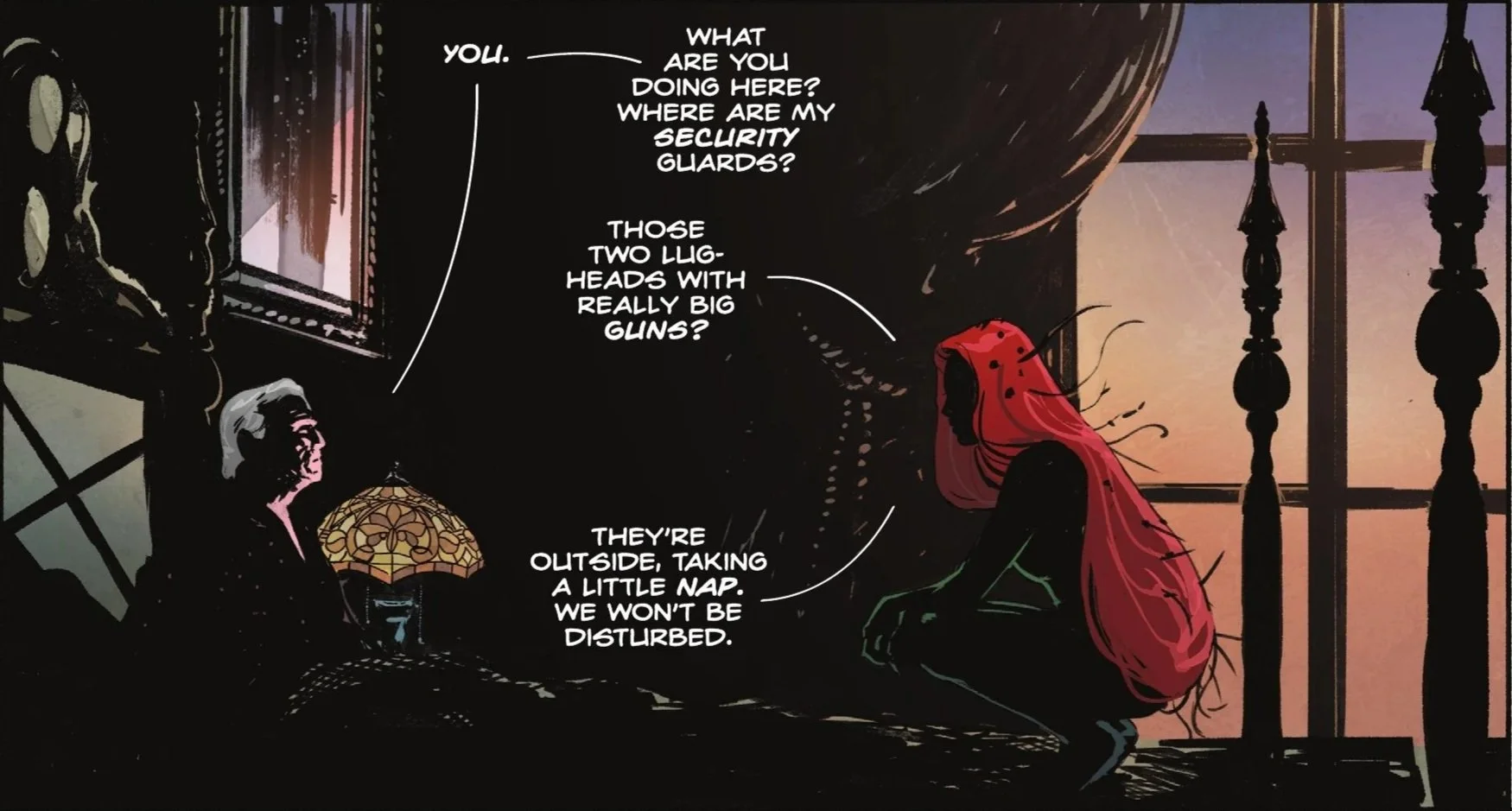
The conflict with The Den eventually leads Ivy to Ned Crannack, the paper’s owner and publisher. Crannack’s connection to Marie Henley—the Crime Prevention Tech Czar Ivy murdered in Poison Ivy #40—adds another layer of tension to the story and reinforces the idea that Gotham’s elite are quietly organizing against her.
Crannack represents the kind of entrenched institutional power Ivy has spent her entire life fighting.
The issue frames Gotham as a city secretly controlled by wealthy and influential figures operating behind the scenes, using money, media, and political influence to maintain their control. Ivy recognizes that system immediately, and she sees Crannack as part of the larger machine poisoning Gotham from within.
What makes the confrontation compelling is that both sides view themselves as protectors of the city.
Crannack argues that people like him keep Gotham functioning, while Ivy insists Gotham only depends on elites because those same elites have spent decades holding the city hostage. Their debate becomes less about individual morality and more about competing visions of power and control.
At the same time, the issue strongly implies that Ivy may be underestimating the forces aligned against her. Gotham’s ruling class has survived countless crises, villains, and political upheavals. Ivy may currently hold office, but the people opposing her have far deeper institutional roots.
That imbalance creates an increasing sense of inevitability surrounding her downfall.
Batman’s Brief but Effective Appearance
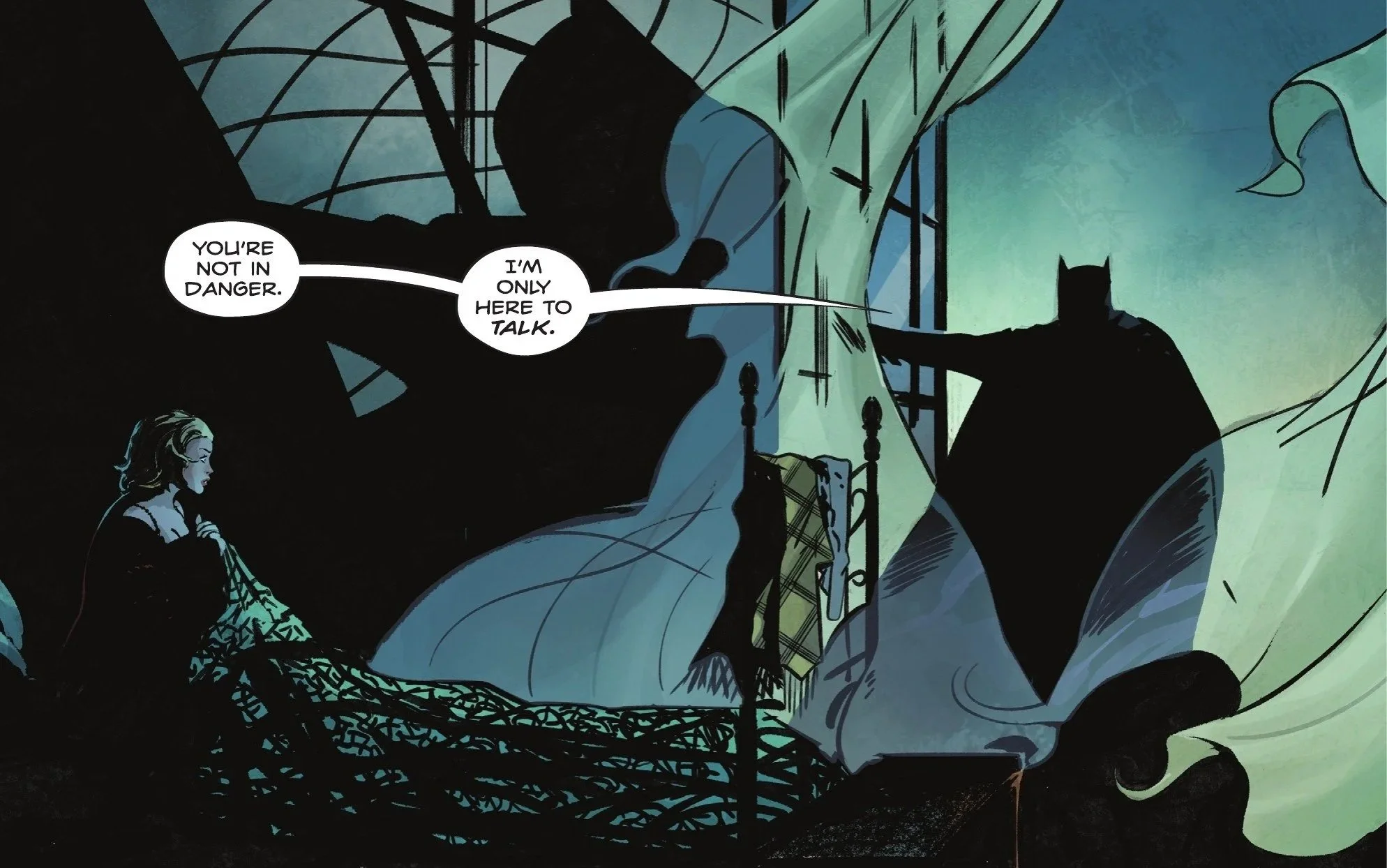
Another standout moment comes near the end of the issue when Batman visits Janet and asks her to convince Ivy to resign as Mayor. His appearance is brief, but it’s handled extremely well.
The scene works because Batman approaches the situation pragmatically rather than emotionally. He offers Ivy a chance to leave Gotham as a free woman if she steps down peacefully, suggesting that even Batman recognizes how dangerous the situation is becoming.
Importantly, Batman doesn’t come across as cruel or hostile. Instead, he feels genuinely concerned about where Ivy’s actions are leading.
The interaction also reinforces how far Ivy has drifted from the rest of Gotham’s heroes. Even people who may sympathize with parts of her mission no longer trust her judgment.
That growing isolation gives the issue much of its emotional weight.
Art That Reinforces the Tension
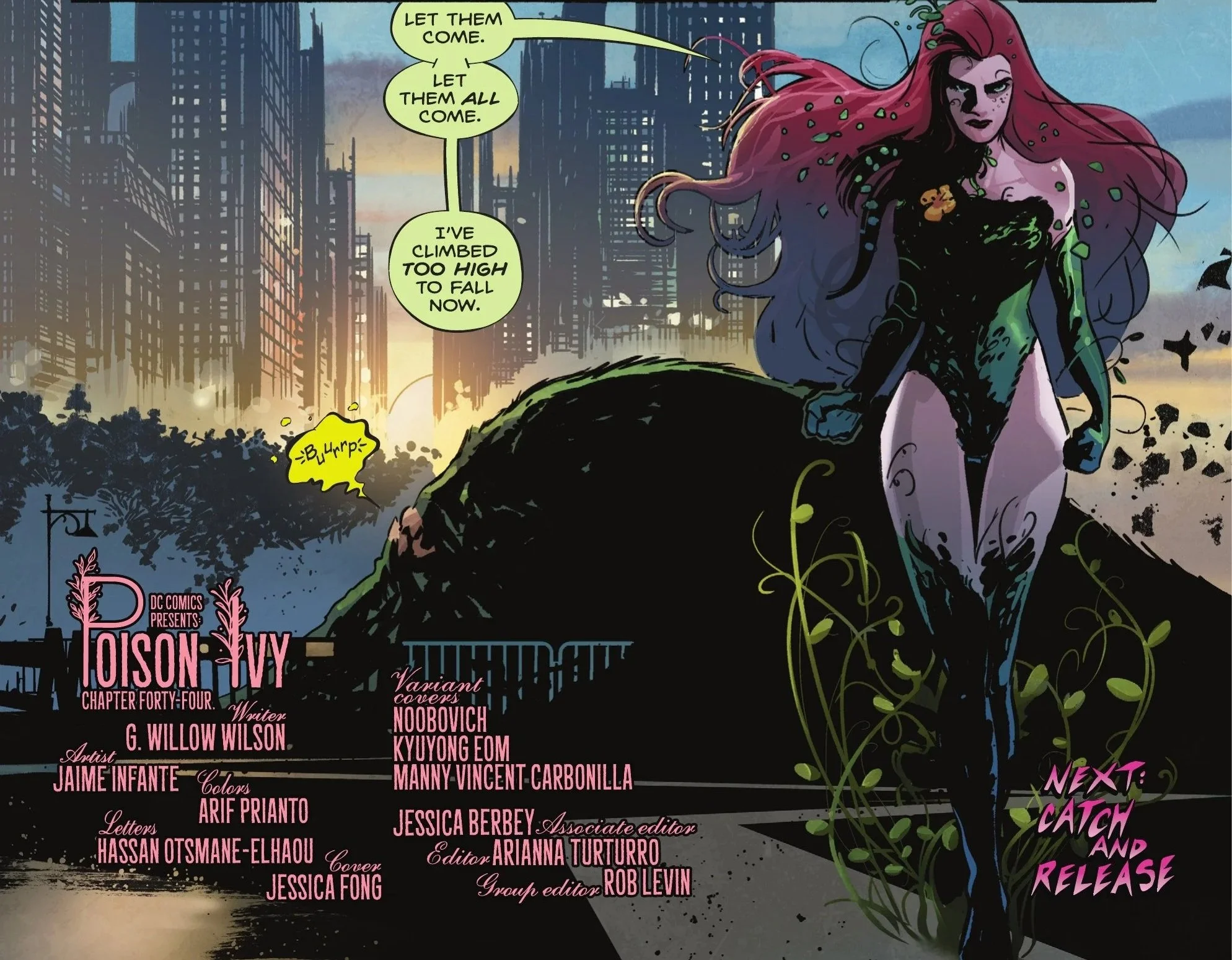
Artist Jaime Infante continues to deliver strong visual storytelling throughout the issue, particularly during the political confrontations and quieter character moments. Much of Poison Ivy #44 relies on conversations rather than action sequences, but the artwork consistently maintains tension through facial expressions, posture, and atmosphere.
Ivy herself often appears exhausted, frustrated, or quietly furious, which reinforces the growing pressure surrounding her administration.
The issue also does an excellent job visually contrasting Gotham’s cold political institutions with Ivy’s vibrant connection to plant life. Whenever Ivy’s powers emerge, the pages suddenly feel more alive and chaotic, almost as though nature itself is pushing against Gotham’s rigid structures.
Colorist Arif Prianto continues strengthening that contrast with heavy greens against muted urban tones, helping maintain the series’ distinct visual identity.
Together, the art team keeps the issue visually engaging even during its most dialogue-heavy scenes.
Final Thoughts and Rating
Poison Ivy #44 is one of the strongest chapters of the current mayoral storyline because it fully embraces the political and personal consequences of Ivy’s rise to power. Nearly every conflict introduced over the past several issues begins escalating simultaneously, creating the sense that Ivy is approaching a breaking point.
What makes the issue especially compelling is that it refuses to simplify Ivy into either a hero or a villain. Her environmental goals are often admirable, and Gotham’s corrupt institutions clearly deserve criticism, but Ivy’s increasingly authoritarian behavior makes it harder and harder to ignore the damage she may cause in pursuit of those ideals.
The issue also continues one of the run’s greatest strengths: allowing Ivy to remain flawed, messy, emotional, and unpredictable. Rather than sanding down those edges, the series leans into them, which makes her one of the most fascinating characters currently being written at DC
Between the Parliament of Trees conflict, the growing political backlash, the pressure from Gotham’s elite, and Batman’s warning, the story now feels like it’s rapidly building toward a major collapse.
The question is no longer whether Ivy’s position as Mayor will cost her something.
The question is how much she’s willing to destroy before she finally loses it.
Rating: 9/10
Poison Ivy #44 delivers a tense and politically charged chapter that pushes Ivy closer to the edge from every possible direction. By focusing on the consequences of power, the fragility of public support, and Ivy’s increasingly reckless leadership style, the issue transforms Gotham’s newest mayor into one of DC’s most compelling and dangerous protagonists.