
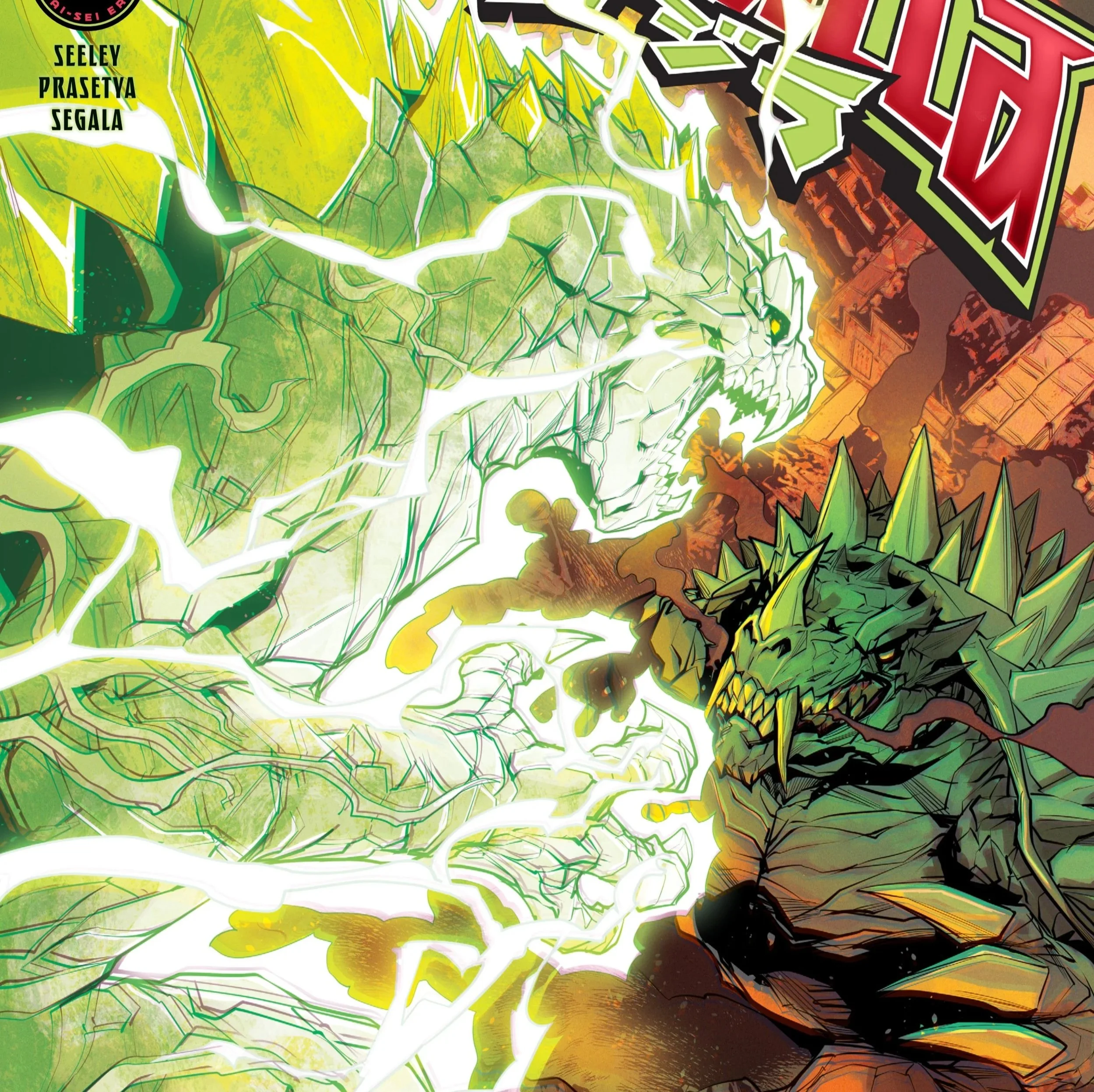
Writer: Tim Seeley
Artist: Hendry Prasetya
Colorists: Francesco Segala w/ Gloria Martinelli
Godzilla #8 is the first issue in this run that genuinely feels like it is building toward something larger. The scale increases, the monster count spikes, and several character threads finally start to feel purposeful rather than repetitive. It does not fix every lingering problem, and some of my core frustrations remain intact, but this is a clear step up. If the previous issue flirted with potential, this one begins to act on it.
Picking Up the Fallout
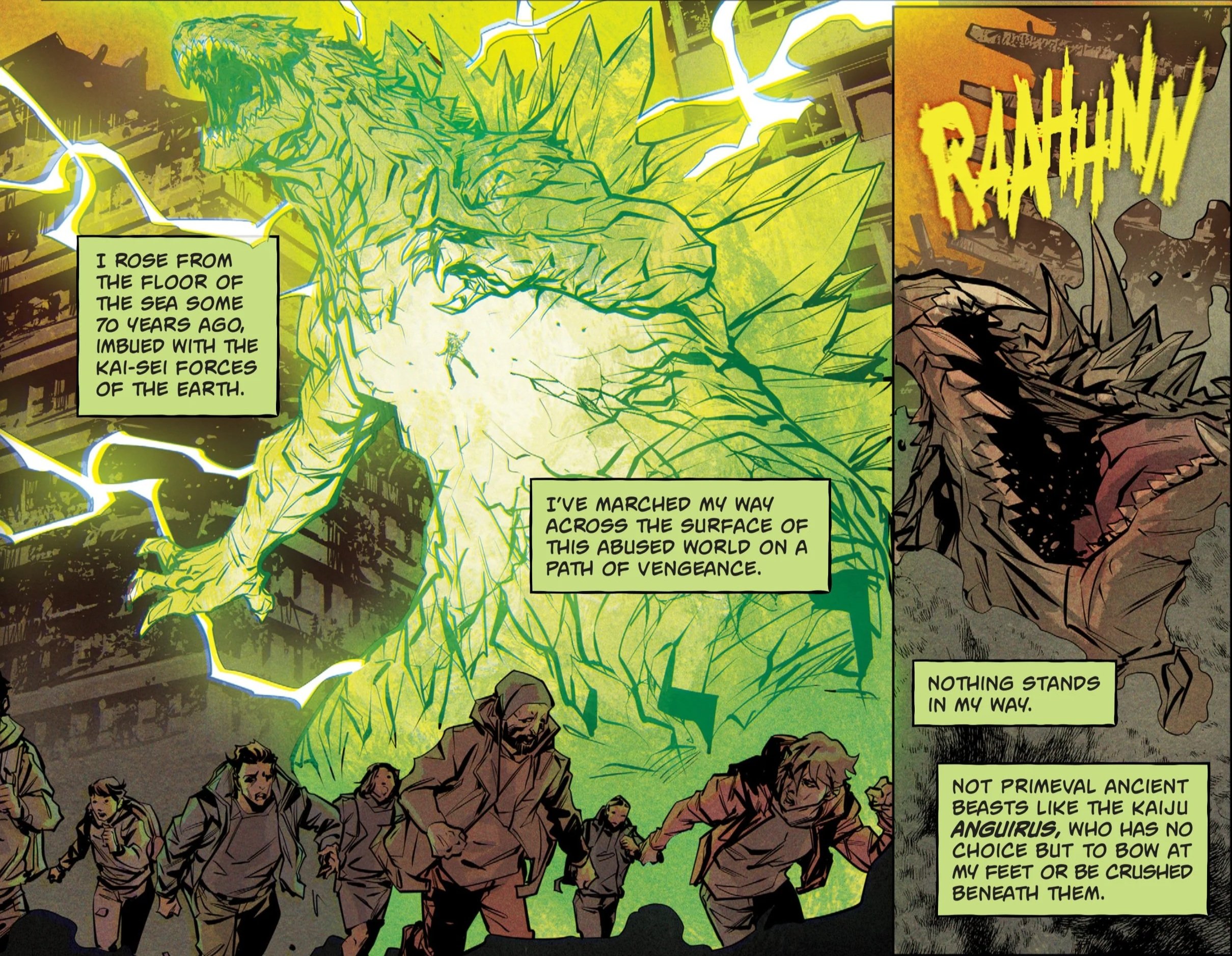
Jacen surrounded by Godzilla’s Kai-Sei avatar.
Godzilla #8 picks up exactly where the last issue left off. The Kai-Sei energy version of Godzilla is tearing across the battlefield and absolutely wrecking Anguirus. It is a strong, chaotic opening that immediately feels bigger in scope. Anguirus is left with a broken spine, G-Force scrambles to contain the fallout, and Jacen collapses after the glowing green specter separates from him. After several issues that felt like they were circling the same ideas, this one finally commits to escalation.
The aftermath sends Jacen straight into custody at G-Force HQ in San Diego. There, he continues seeing and speaking to the green, floating visage of Godzilla that only he can perceive. The biggest issue of the reviewer with this series still stands. Godzilla is not physically present. For a comic titled Godzilla, that absence continues to feel like a strange choice. However, this is the first issue where the internal dynamic between Jacen and the spectral Godzilla genuinely works.
The conversations do a lot to shade in the character of Jacen. The hatred of Godzilla, the grief over both parents, and the refusal to accept the transformation all come through more clearly here than before. The green Godzilla does not just feel like an energy projection. It feels like a separate entity pressing against the identity of Jacen. That tension gives these scenes weight. I still want the actual King of the Monsters stomping through cities, but if the book insists on this psychological angle, it is finally starting to justify the direction.
Anguirus, Jet Jaguar, and Character Friction
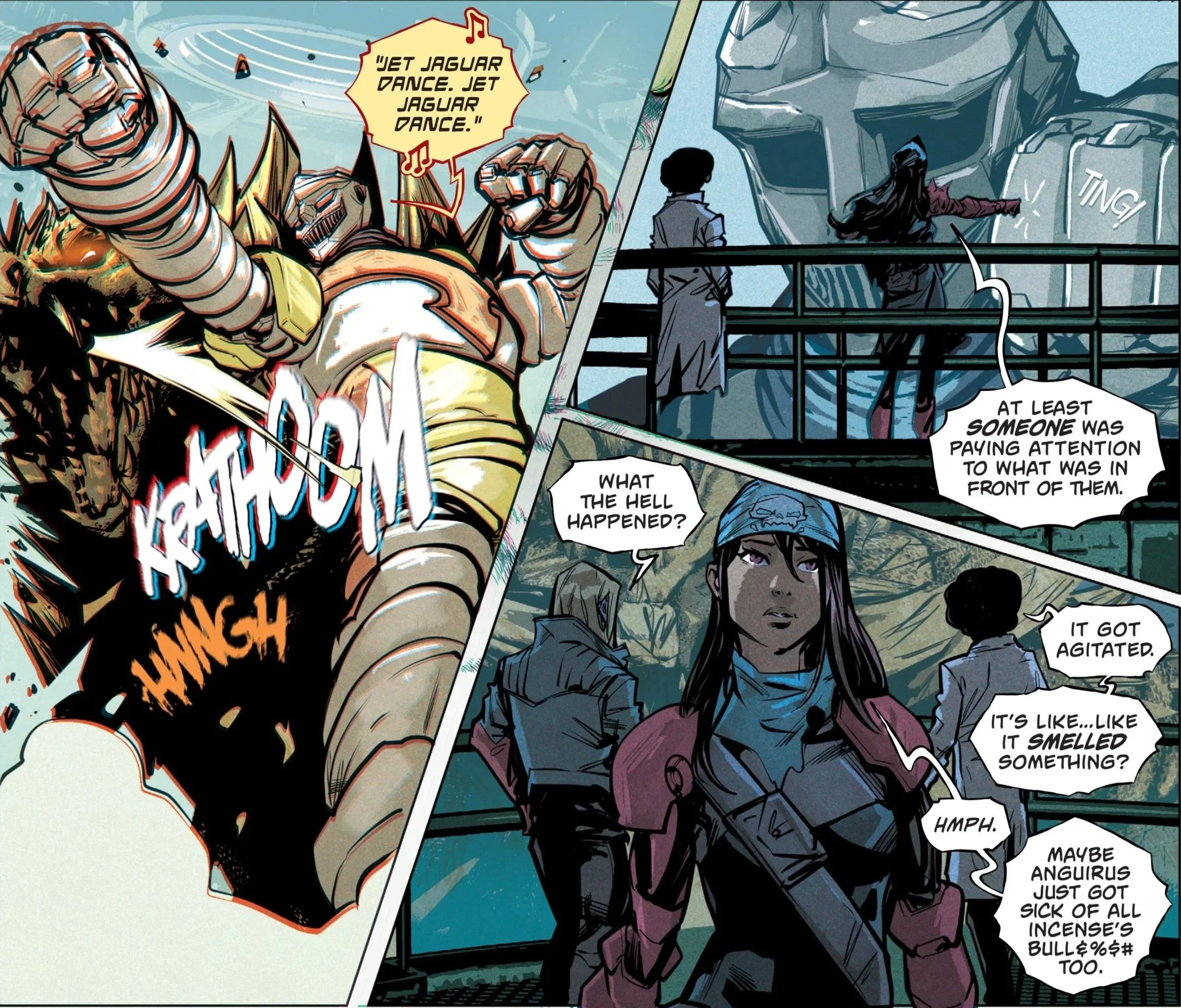
Jet Jaguar puts Anguirus down and fist bumps Nuki.
Meanwhile, Anguirus is being held in a G-Force off-site detention facility under heavy sedation. The fact that he has a broken spine from the attack of the energy Godzilla adds real consequences to the opening fight. Anguirus has been one of the more reliable kaiju presences in the series. Seeing him reduced to this state makes the power of what came out of Jacen feel dangerous in a way that earlier issues sometimes struggled to convey.
Nuki and Incense are there with Jet Jaguar to reinforce security. When Anguirus briefly wakes, Jet Jaguar grows in size and subdues him again. There is a small, almost throwaway moment where the giant Jet Jaguar fist bumps Nuki. It is one of the favorite beats of the reviewer in the issue. It is quick and understated, but it gives Jet Jaguar personality without undercutting the tension. Nuki continues to be one of the more enjoyable human characters in the book. The jabs at Incense are deserved, especially since Incense has now solidified the position as the least favorite character in the series. He is not annoying in an interesting way. He comes across as an over-the-top stereotype without nuance. Riviera, who once filled the macho military role, at least feels like he is evolving. Incense just feels loud and obnoxious.
Command Decisions and a Promising New Face
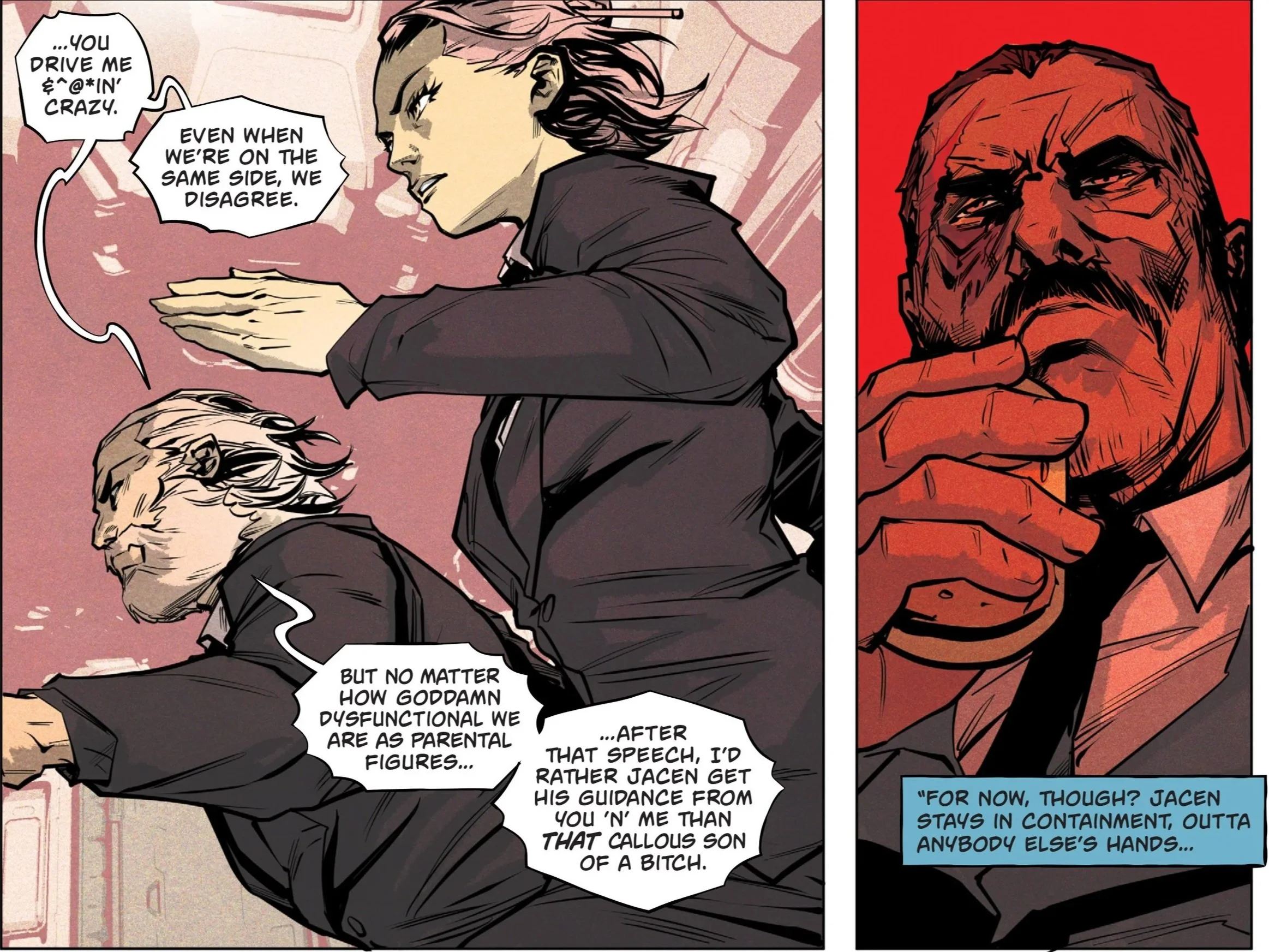
Riviera and Chiba jump to action while Onishi CONTEMPLATES.
At the G-Force U.S.A. Regional Command Office, Dr. Chiba and Riviera, who is now asking to be called Commander Stine, meet with Major General Onishi. Onishi is immediately more compelling than most authority figures we have seen so far. He was in Japan during the first appearance of Godzilla in 1954, witnessed his father being killed by the heat ray, and fled to the United States with his mother as refugees. He carries a massive scar over the right eye, which is a constant reminder of that moment. That history gives him weight before he even says much.
Onishi makes it clear that he wants Jacen kept on the team because Jacen killed Godzilla, which is something no other country can claim. It is a cold, pragmatic stance that reframes Jacen as a geopolitical asset rather than a liability. The argument between Chiba and Stine over who is responsible for bringing Jacen into G-Force adds tension, but Onishi cuts through the noise by focusing on optics and advantage. I am intrigued by him, though I am cautious. There is always the risk that he becomes another one-note military hardliner. For now, the backstory and demeanor suggest something more layered.
Biollante Blossoms
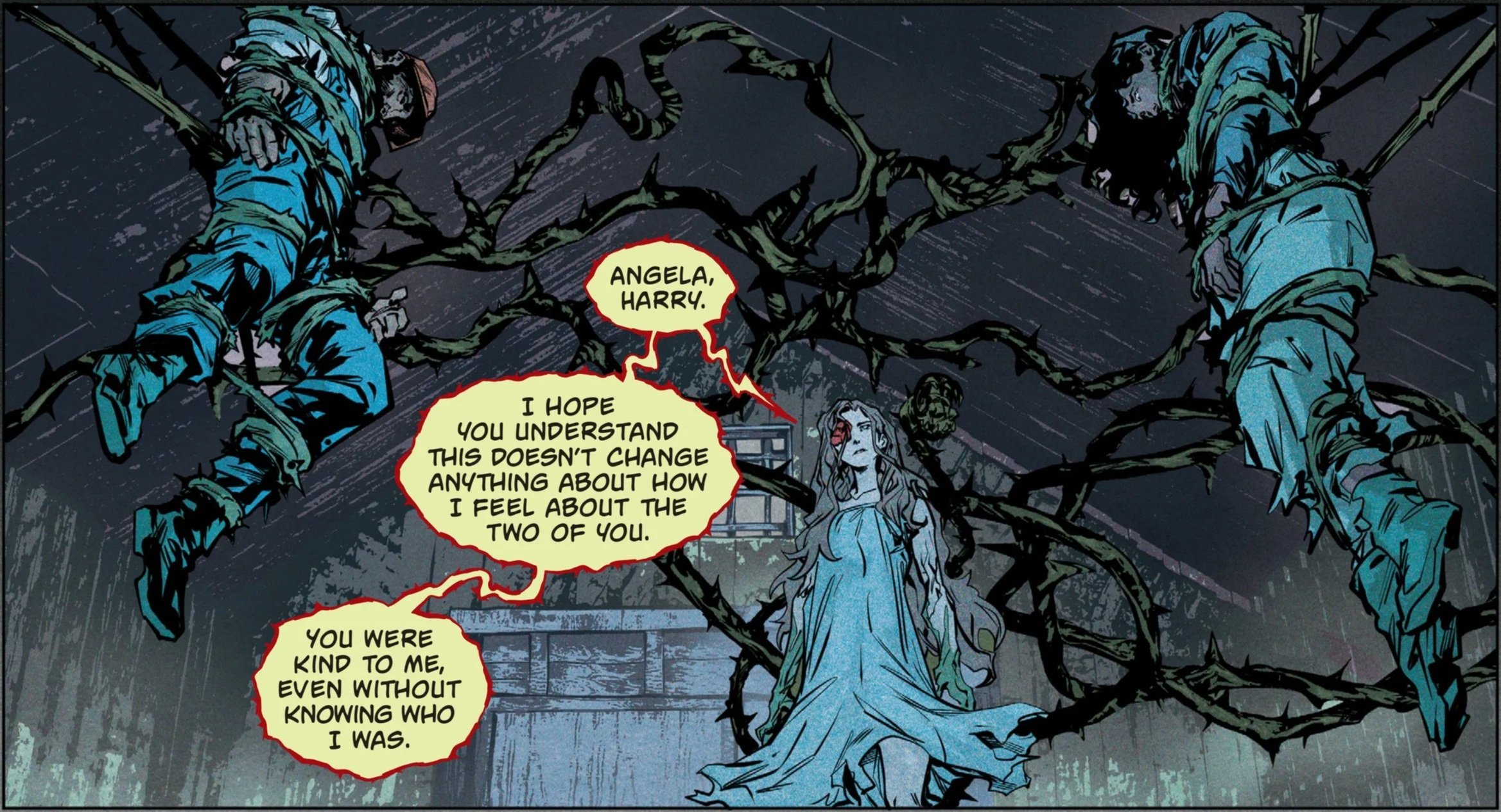
May reveals her true form to her “parents.”
Back in Minnesota, the narrative returns to the Biollante storyline. Angela and Harry bury the bandits that May skewered with vines in the previous issue. Through a flashback, the reader sees how they first found her curled up in the field surrounded by sudden green growth in otherwise dead land. Harry mentions being cut by thorns both before and after discovering her. This hints that the presence of the girl has been affecting the environment from the start.
These scenes continue to be effective, even if I still wish the book featured the full kaiju Biollante rather than a human avatar. May feels derivative of Poison Ivy, but she is undeniably unsettling. When she wraps Angela and Harry in vines inside the barn and calmly explains the concept of kaiju hitonami, meaning monster stampede, the tone becomes genuinely eerie. She tells them she loves them and appreciates that they cared for her without knowing what she was. She promises she will not hurt them, but she says the time has come. She has fully blossomed into Biollante, and she now knows Godzilla still lives.
The Kaiju Hitonami Begins
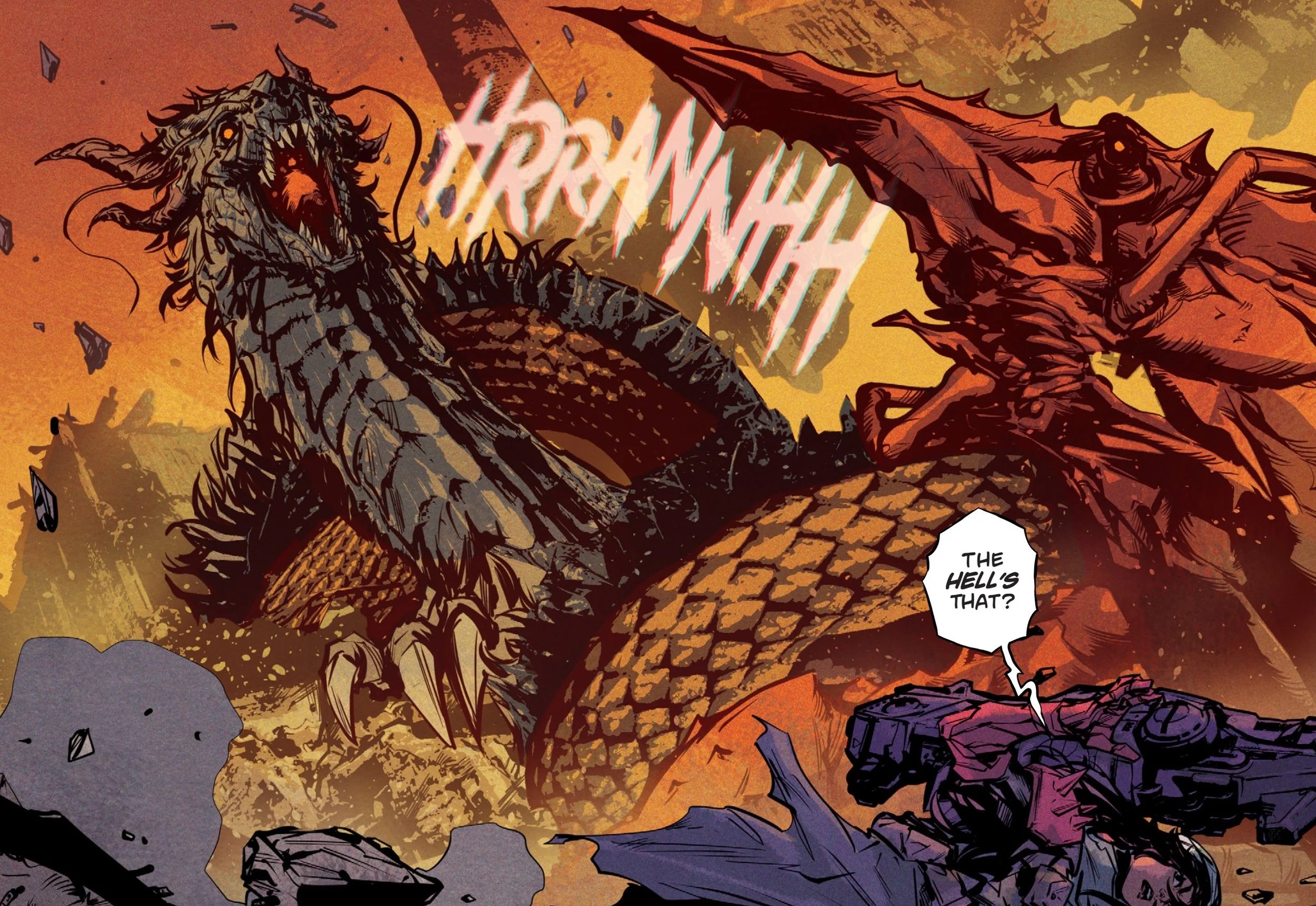
Manda and Ebirah go at it in Houston.
The scale of the issue expands dramatically after that. In Houston, Ebirah, Horror of the Deep, appears on land, which immediately raises questions since deep sea kaiju do not typically emerge without cause. As the fight unfolds, Manda arrives, another sea-based monster that rarely leaves its domain. Then Rodan appears, a creature known for staying on Monster Island unless something disturbs the balance. G-Force is caught off guard and struggling to contain the situation, using fire to try to corral the monsters while scrambling for answers.
The cameos escalate the sense of a global crisis. Styrga is seen in Lake Superior. Ursogar appears in Chicago. Black Hart surfaces in Bismarck. Biollante’s call is spreading worldwide, irresistible to the other kaiju. She declares herself Queen of Monsters, positioning herself not just as a threat, but as a rival to Godzilla’s legacy.
This is the kind of scope the series has been missing. Multiple monsters moving at once, cities at risk, and the suggestion of a coordinated kaiju uprising finally make the world feel unstable. It is not just one isolated incident. It is a shift in the balance of power.
Art That Sells the Scale
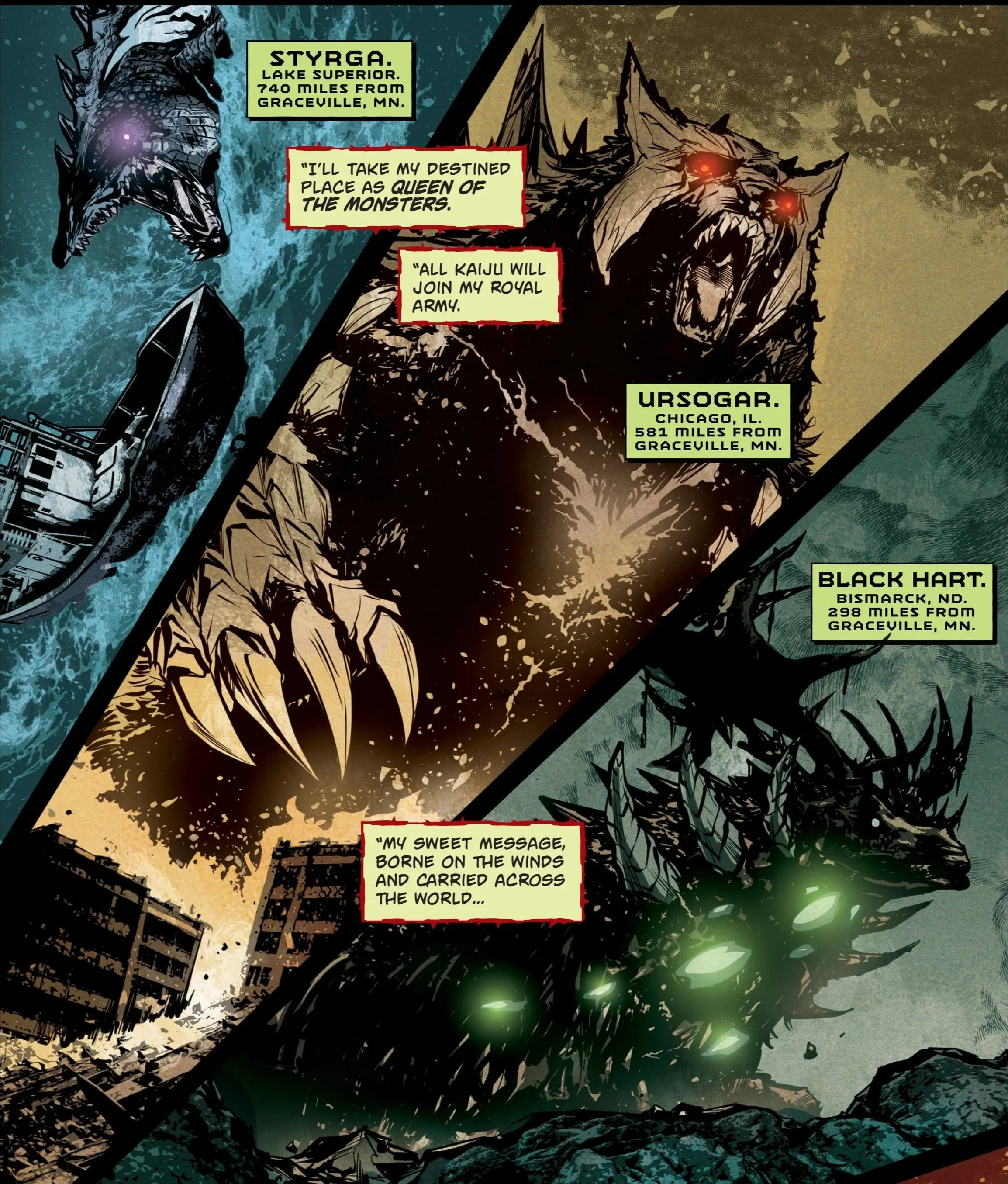
Styrga, Ursogar, and Black Hart emerge at the call of Biollante.
One area where this issue consistently delivers is the artwork. The larger scope of the story demands bigger visuals, and the art team rises to that challenge. The opening destruction feels chaotic without becoming unreadable, and the reader feels the damage.
The Houston sequences benefit the most from the expanded scale. Multiple kaiju sharing the page could have easily turned into visual clutter, but the layouts remain clear and dynamic. Each monster has space to breathe, and the movements of the monsters are easy to track even as the situation spirals. The sense of mounting panic comes through not just in the dialogue, but in the composition of the panels.
The scenes involving May in Minnesota also continue to lean into atmosphere. The vines feel invasive and alive, and the barn sequence balances horror and restraint effectively. The art sells the transformation without overindulging in spectacle. This keeps the tone unsettling rather than cartoonish.
Even if the writing still holds back from fully unleashing the monsters, the visuals consistently make them feel powerful and dangerous. When this book works, it often works because the art understands the scale and weight that a Godzilla story demands.
Final Thoughts and Rating
This issue closes with Marco waking Jacen to tell him he is needed in the field because kaiju are on the move everywhere. The final panel, where Jacen calls Godzilla the King of the Monsters and says, “The king is dead. Long live the king,” leans into operatic drama. It is a bit heavy-handed, but it works as a declaration that something has changed.
Godzilla #8 is not free of the series’ larger problems. Godzilla is still not physically present. Biollante is still filtered through a human lens. Incense remains a weak link. Those frustrations do not disappear. What does change is the energy. This issue feels like the beginning of an actual event rather than another chapter treading water. The kaiju presence is stronger, the stakes feel higher, and Jacen’s internal struggle is more compelling than it has been so far.
For the first time in a while, I am not just frustrated. I am cautiously invested.
Rating: 6.5/10
A stronger entry that finally embraces escalation and kaiju chaos, even if some core structural issues still hold it back.
Promo Line: Godzilla #8 is the first issue in this run that genuinely feels like it is building toward something larger. The scale increases, the monster count spikes, and several character threads finally start to feel purposeful rather than repetitive.