
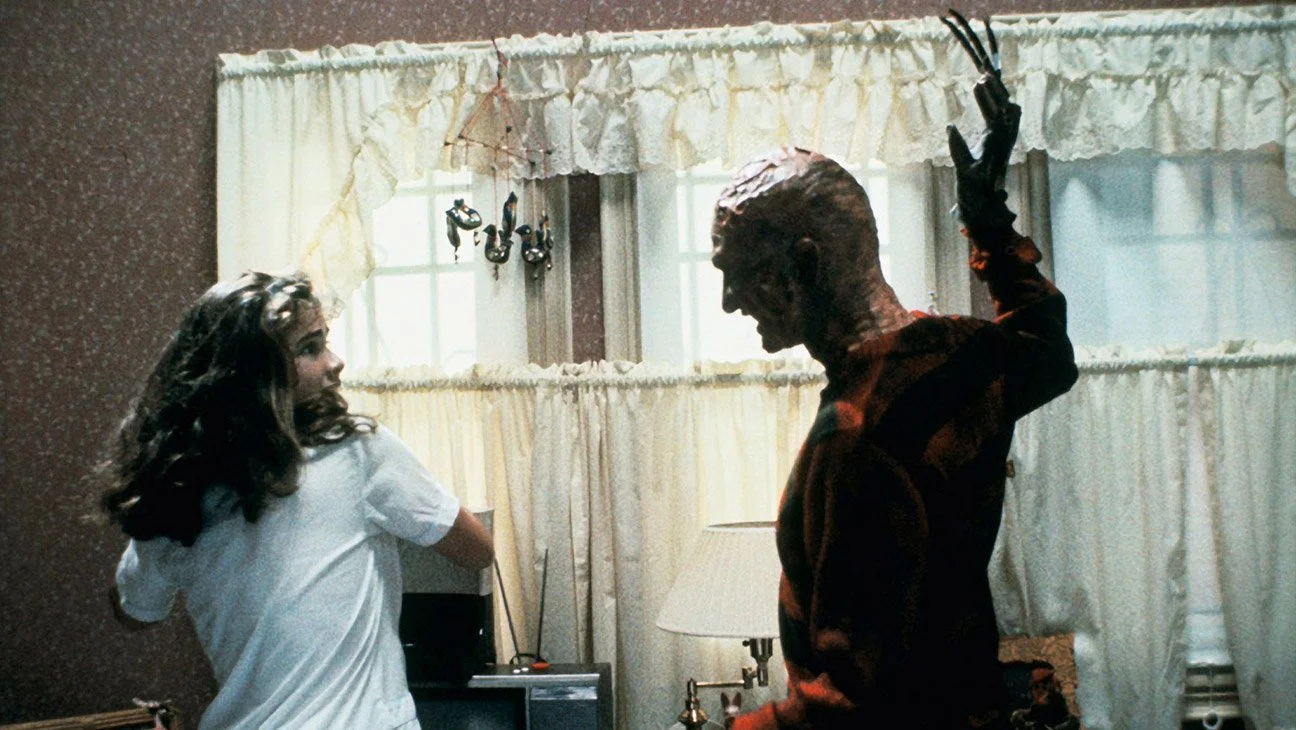
Photo credit: New Line Cinema
As Paramount’s newest label, Paramount Primal, gears up to create a New Nightmare, no, not that sequel, to Wes Craven’s Nightmare on Elm Street franchise, the first question to ask ourselves is “what’s the point?”
It’s easy to say horror is hot at the box office. In the past year and change we’ve seen Obsession, Backrooms, Weapons, and Sinners become cultural phenomenons that capture lightning in a bottle. In an environment where every film has to perform like a tentpole, four-quadrant blockbuster to justify its very existence, horror has carved out its own little niche over the past twenty or so years, a niche that really began with Insidious in 2010, and exploded in 2013 with a different Patrick Wilson franchise, The Conjuring. Since, it feels like every year we have at least one new horror classic, and independent studios such as A24 and NEON have staked their very existence on finding original horror. This begs the question: is horror a nostalgia-driven genre in this day and age?
Alien: Romulus had quite a bit to say on the corporate exploitation of its workers, a trend that continued in the Alien: Earth Hulu program. It had a lot to say about grief in a modern age. Sure, sequels and reboots can work, but what did the last Nightmare film do? What have the recent Halloween films done? In fact, when was the last big slasher film?
In the late 1960s and throughout the 1970s, The Zodiac Killer, Son of Sam, The Co-Ed Killer, John Wayne Gacy, The Hillside Strangler, The Unabomber, and a myriad of others created the ‘Golden Age of Serial Killers.’ Horror, as I’ve mentioned before on the 2:17 Horror Podcast, always reflects the social experience that people live through. To terrify somebody, you have to make them feel unsettled, and to make them feel unsettled is to understand the part of the brain that stresses somebody out. As societal stressors at large change, so should the films they inspire, which is why today our hits are more contemporary. The Substance, for instance, uses its body horror elements to tell a narrative that hits the anxiety of aging in a modern world where the proliferation of makeup, botox, cosmetic surgeries, among other things utilize the societal condemnation of a woman’s youth, or lack thereof, to convince them to elect into these businesses. Obsession uses the manosphere and lack of social development in young men to examine their problems dating, and how much easier it’d be to be able to control the dynamic, ultimately feeding into the general unease women feel about the patriarchy in a post-third wave political climate. A Quiet Place uses its extra-terrestrial threat to tell an allegory regarding how the system has left middle class families behind, almost eradicating them entirely. Weapons touches on gun violence, Knock at the Cabin uses the mistrust of our news within its villainous motivations, Red Rooms examines the dangers of unfiltered internet access. A Nightmare on Elm Street film can, at best, focus on trauma? In a dated way while films such as Hereditary or Get Out go deeper into specific traumas and their causes than any Nightmare film ever did?
As the social anxieties become far deeper and far more unsettling in a world that became significantly more expansive post-9/11, post-dot-com boom, it’s hard to imagine a traditional slasher breaking through the noise, especially for an IP like Nightmare, where in a post-9/11 world that saw fear of the unknown and fear of who’s watching really take over, the idea of a literal boogeyman no longer had its appeal, an appeal that one could argue was so damaged that Wes Craven himself had to go out of his way to make fun of the tropes he created in 1996 just to maintain some semblance of a career.
There will surely be some people that go to see this based on the nostalgia factor of Freddy Krueger, but to expect this to be the kind of film that launches a label just feels absurd in an era where Halloween films are barely cracking $100M at the box office. The most recent Leatherface movie had been tracking so poorly, its theatrical release was transformed into a VOD release, and the next Texas Chainsaw Massacre that followed went directly to Netflix. Perhaps the Crystal Lake Peacock show and upcoming Glen Powell/A24 Texas Chainsaw shows can provide a lifeline for the slasher icons of yesteryear, but even still, there’s a significant difference in using television at home to pass the time and prioritizing the expense of going to the cinema for these characters. As somebody in their 20s, anecdotally speaking, the youth around me aren’t clamoring to re-live the eighties. To expand beyond horror, we just saw that Masters of the Universe did not have the power. As explained in many DSR Box Office Reports, the He-Man cartoons were never nearly as popular in real-time as fans of the show like to boast, and it’s a niche within a niche, granted. But that doesn’t explain Tron: Ares, The Running Man, Springsteen: Deliver Me From Nowhere, or any of the number of ‘80s nostalgia cash grabs that are falling flat.
Regardless, Paramount is making a new Nightmare film as they continue to use the Paramount brand to prostitute IP rather than bring new, inventive ideas to the table, even in the most inventive genre in Hollywood. This strategy has yet to work out for them, but for everybody else’s sake with everything currently happening, let’s hope that changes.
Jameus Mooney is an entertainment writer for Comicbook Clique, having covered the entertainment industry for years. You can follow him on Twitter here, and Letterboxd here. You can also listen to his horror podcast, The 2:17 Horror Podcast, at the DeathArts XIII YouTube channel.