
SPOILERS AHEAD!
Initial Thoughts on The Deadman #1
The Deadman #1 is the newest installment in the DC: All In line, set to remake the DC universe post-DC K.O. In this paranormal, comedic, and self-aware retelling of the deceased Boston Brand’s--The Deadman and Costian of Spirits--story, writer W. Maxwell Prince, artist Martin Morazzo, and colorist Chris O’Halloran bring to life (lol) the more obscure yet just as interesting parts of the DC universe: the dead, heaven, hell, and purgatory. These stores, while still just as big in scale as the state of heaven and earth, tend to be more intimate and hit closer to home, making Deadman #1 the perfect example.
Give me more of this, please. These odd, side-mission stories that round out some of the more obscure characters in a rich DC stable always make me really happy. Death is such a scary topic to talk about as a human being; however, it's something we all have to deal with. When such a difficult topic is presented in a funny, digestible format, I will read it and enjoy it, 10 out of 10 times. The art is the perfect companion to the story, to me. DC continues to experiment with its art and artists, and I think it's been paying off. It gives DC a fresh look and gives artists who might not have gotten a chance at a major company a chance to shine.
There is enough excitement here to get everyone excited about where this title goes, and enough to make me recommend it to everyone reading this.
Excited for the Next Chapter
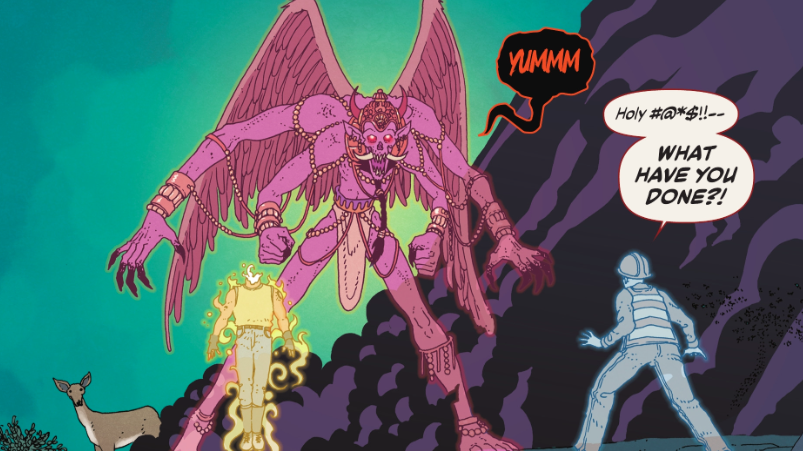
That rich bad guy looks intense, right? Man, those sequences with what I presume to be the big bad for this series were skin-crawling—but in the best kind of way. I just know that Deadman is going to have to fight this battle on three fronts: on an Earthly plane, purgatory/hell, and his inner self. That conflict feels like the heart of the series. Humor is often used as a coping mechanism to mask something deeper or a character flaw. We will, hopefully, delve deep into Brand’s inner workings and how that ultimately changes after beating the big bad vampire.
While Brand has already been pretty open about much of his story, I still think there is a lot to discover. Just enough is given to us about what lies ahead for Brand and the rest of his cohort to keep the suspense strong and make me really excited to read the second issue, which is the ultimate goal for an opening book in a new series. You're supposed to get your reader hooked for the rest of the series, and I think The Deadman #1 did that. There wasn't too much revealed in The Deadman #1, which sets the tone for a mystery-thriller that will have us wondering what could possibly happen between the first issue and the second.
Existential, Yet Funny
This book felt like the start of something special—at least to me. The world-building feels different: unique, fascinating, and laced with horror and existentialism that make you think. That’s how I felt after putting down The Deadman #1. There was so much to like about this book that it’s hard to pick just one thing. If I had to, I’d say the best part is the juxtaposition of humor and self-awareness with the ability to make me think about my own mortality. When something can make me laugh while questioning my existence, that is an interesting read 10/10 times. Death is scary, yet we all deal with it. Having something to cope with the eventuality of death is comforting. If Boston Brand is waiting for me after I die, it makes it a little easier.
You might ask, “How does it question my existence?” Well, if there is a “custodian” for souls after we pass, determining whether it is our time or not—especially when it contradicts what Western society has taught us—that is incredibly interesting to me. Reading something that contradicts your core beliefs should at least make you uneasy. But I like that feeling. I believe it helps you grow as a person. Even if you think it’s all mambo jumbo, it’s a fun mental exercise.
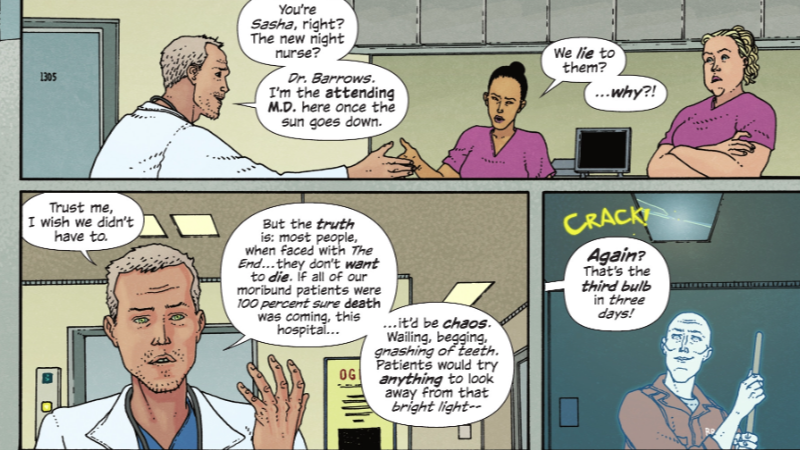
Also, a great question is posed at the start of the book: Would you rather be lied to about the truth that will spare you emotional pain, or would you prefer the truth, even though you know it will wreck you? Is that anybody’s responsibility but yours? I had too much fun with this book and thinking about some very deep existential questions. There were even points that made me feel utter sadness. For example, Kiera, the high school senior, was about to die from bone cancer. The first thing she said when she died was, “Am I going to miss prom?!” That hits hard. She is a child, and that is the most important thing to her before she dies. Exquisitely written.
There are levels to writing a character who breaks the fourth wall and is self-aware and self-deprecating. There is the low-hanging fruit: unsubtle, unfunny writing that bashes you over the face. On the other side of the spectrum, it’s too subtle for anybody to get the joke. I think The Deadman and W. Maxwell Prince’s plotting and dialogue hit the sweet spot. The perfect porridge, if you will.
Overall, a very satisfying first issue for The Deadman #1.
You Gotta Work For It
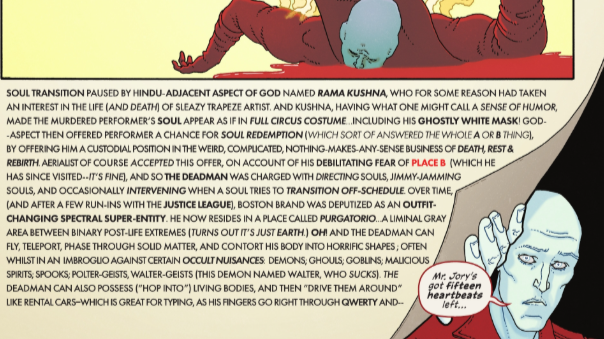
There is a lot of reading in The Deadman #1. That isn't necessarily a bad thing; we should all read more. Still, I can see some people being turned away after reading all the bubbles. I didn't even notice it after my first read. It really didn't hit me until my second reading that there were so many dialogue bubbles. Personally, I never felt this slowed or hindered the story. I like being fully immersed in my comic book reading.
The dialogue and exposition never felt disjointed, and it flowed pretty seamlessly between Morazzo and O’Halloran’s art and coloring. As I praised above, I think this adds to the world Prince is trying to build, and it shows us the world through the art as much as the exposition does, which I think is a good combination. I guess, visually, it does take up a lot of the art's real estate, which can limit the room the art has to play with. And there was A LOT of reading during the expositional part of Deadman’s origin story, but there is only so much space to give to each creative team. But again, I don't think that was an overall issue with the story. For such a great first issue, there wasn't much to criticize from it, so I picked something, while trivial, that some people might push up against.
The Art Is The Perfect Match
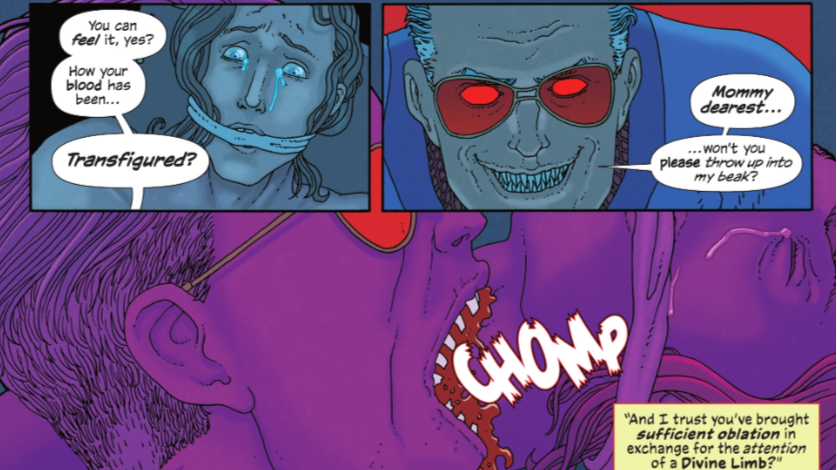
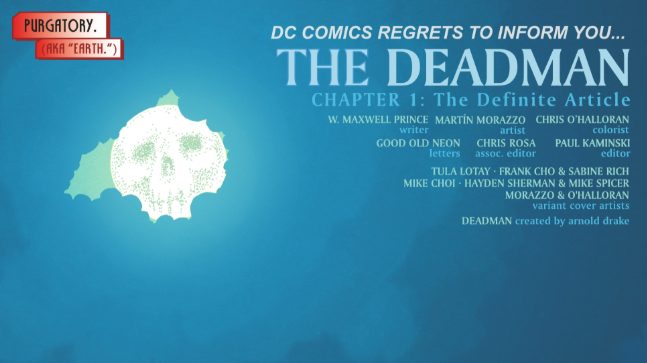
What a visual to open the book on the first page. The soul zooming past the stars to heaven gives us a taste of what’s in store. Minimalism can sometimes be overused and uncreative, but here it was used so skillfully that it immediately made me feel something. I wasn’t sure at the time, but after reading the book, I found it comforting. Martin Morazzo is a master at his craft and knows how to elicit the right feelings in The Deadman #1. The unease in the characters makes them look and feel “weird,” and that isn’t meant as a pejorative. The occult, spiritual world of DC has always been off-kilter, and the art brings that to life.
As I mentioned in my initial thoughts, I think DC’s experiment with artists who might not usually get looks from the big 2 companies is not only giving them an opportunity at DC, but also smashing it. Martin Mozarro's art is the perfect fit for this type of story. For those who are a little longer in the tooth (older), do you remember the cartoon, “Ahh, Real Monsters!”? That is exactly what the art style reminds me of. The "squiggly lines" around the characters, especially the demons and anyone considered an evil entity, add an extra layer of unease and surrealism. The coloring from Chris O’Halloran fits exceptionally well with Morazzo’s art, and the tones and hues are used effectively for the characters and the world.
The Final Verdict
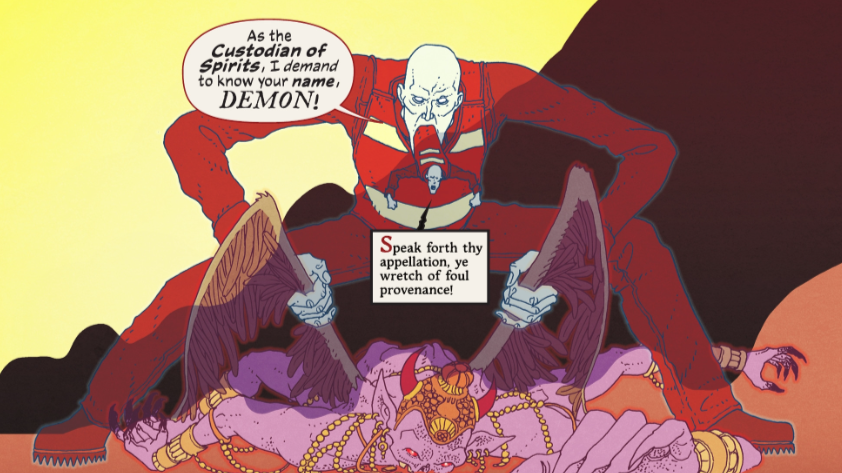
The Deadman #1 is a dynamic start to a series that will challenge the way we talk about death and the looming anxiety it evokes. This was a great reintroduction of the character and is a great example of how to find the right spot for a character who might not always have the spotlight thrust upon them. The world-building in The Deadman #1 was unique, creating a world that feels lived in and weighty. It was a perfect combination of the story by W. Maxwell Prince, art by Martin Morazzo, and color by Chris O’Halloran.
DC (and Vertigo) has been on a majestic run lately, with incredible first issues that offer new perspectives on old characters. The Deadman #1 is another example of how in-rhythm DC is with all of their titles right now. The All In era of DC has been a smashing success thus far, and this issue proves that DC is revolutionizing what we think a mainstream comic book can be