More than 26 years in, Juggalo Championship Wrestling is still here, which means the joke has outlived a lot of people who thought they were above it.
That survival alone should make it worth taking seriously. The Faygo, clown paint, blood, and proudly deranged match stipulations all work in this particular squared circle once you give them a chance, but the survival is the point. JCW has spent most of its life being easy to dismiss. It has also lasted long enough to make the easy dismissal feel thin.
There’s an essential distinction between chaos and incoherence. JCW has survived because, beneath the mess, it knows the difference.
JCW launched in 1999 as Juggalo Championshit Wrestling, an Insane Clown Posse project that treated wrestling the way ICP treated music: as theater, provocation, inside joke, community ritual, and blood-splattered spectacle, but never as something easy. Beneath the clown paint was a real love for the craft, the timing, the talent, and the nerve it takes to make the whole beautiful mess work.
The first show ran at St. Andrew’s Hall in Detroit with The Iron Sheik, King Kong Bundy, and Abdullah the Butcher on the card. Clearly, subtlety was never the point, and maybe that’s why it’s outlasted so many promotions built to look respectable and not much else.
JCW isn’t patrician. This company isn’t dressing up for the balcony seats, which is exactly why I’ve come to love it. Propriety is easy enough to fake in wrestling. Put enough sanitary lighting on a show, book enough technically competent, good-looking talent, keep the creepiness and the sexiness at a homogenized and family-friendly distance, and you might build a serious-looking promotion.
But is wrestling supposed to be that serious? Or, at the very least, is it always supposed to be?
There are a lot of fantastic indie promotions in 2026, and we’re lucky to have companies that run the gamut. That’s exactly why JCW is worth looking at clearly. JCW’s gore, gross-out comedy, and blown-out carnival atmosphere aren’t arbitrary; they’re architecture. If the timing, craft, and internal logic are easy to miss, that’s because the promotion is good at making design look like combustion.
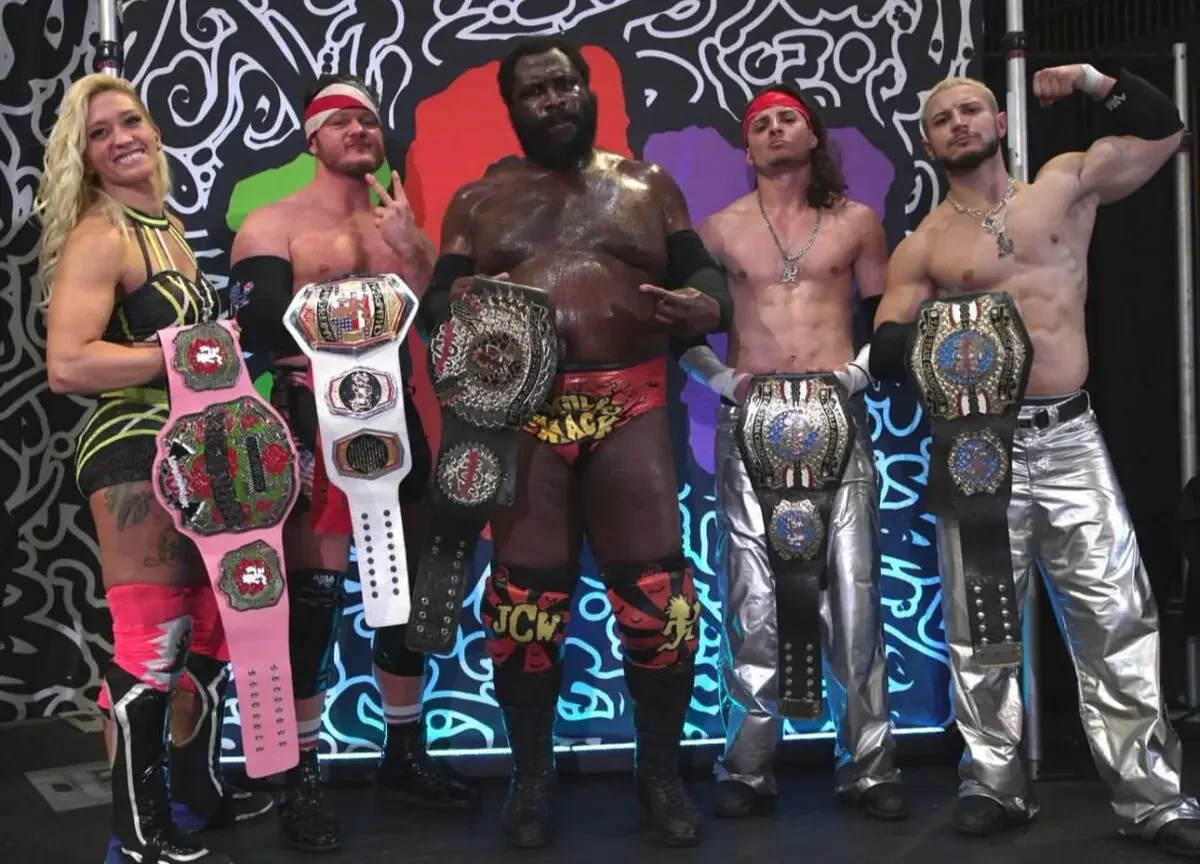
The same goes for the roster. JCW gets talked about like the gimmick is the whole product, but the gimmick only works because the people inside it can wrestle. The current Lunacy orbit includes technicians, bruisers, flyers, deathmatch veterans, TV names, and homegrown weirdos who can develop the bit rather than be swallowed by it. The joke lands harder because the work underneath it is real.
JCW taps into something old-school promotions understood in their bones: the match matters, but the heat needs to spread, the debts must come due, and the damage has to follow people out of the ring. World Class Championship Wrestling knew that. The Von Erichs and the Fabulous Freebirds didn’t become one of wrestling’s defining rivalries because one cage match ended badly. They became one because that betrayal kept moving through the territory, turning a title match into a family war, and a family war into the kind of weekly obsession that made a territory feel alive.
Even today, when we’re all hip to kayfabe, maybe especially now, we’re still hungry to be under the spell.
JCW doesn’t look like WWE, AEW, TNA, MLW, or GCW. It doesn’t need to. It shouldn’t. What matters is that JCW has doubled down on one of episodic wrestling’s most foundational concepts: stories have to keep happening after the show ends.
Wrestling trains its audience one way or another. When angles vanish, fans learn not to invest too deeply. When betrayals burn hot for a week and then cool into background noise, the world starts to feel temporary. Sometimes that’s the right business decision. AEW’s Nightmare Collective, for example, was introduced with hair-cutting, recruitment, and women’s division interference before Brandi Rhodes later confirmed the story was over because it wasn’t working. That happens. Bits don’t always work for anyone, and good promotions course-correct.
But course correction still teaches the audience something.
JCW wants to haunt you. It lets the eccentricity that is its trademark rot, bloom, and crawl back into the room with teeth, unresolved business, and sometimes Barnabas the Bizarre’s zombies, trying to get clean because even the undead apparently have to work the program.
Take Matt Cardona’s title run, which didn’t just evaporate when his WWE return forced the belt loose. JCW turned the vacancy into another debt, sending James Storm and Mr. Anderson back toward each other after Anderson had already helped screw Storm out of the title. That’s the useful sickness of it. In JCW, the mess leaves fingerprints. The show keeps a ledger.
That doesn’t mean every idea lands or every segment is graceful. Nothing about JCW is elegant, and God help us if it ever tries to be. But the promotion understands that wrestling isn’t only about the match in front of you. It’s about accumulation. A grudge should leave residue. A title picture should bend when the real world elbows its way in. An authority figure should make problems that don’t vanish after one episode. We’re not always supposed to love the heel. A stipulation shouldn’t just decorate a card. It should open another trapdoor.
That kind of episodic buy-in gives a promotion more than one pulse. Indie wrestling can be dangerously dependent on a single booker, founder, draw, or myth-holder, and when that person leaves, the spell can leak out of the room fast. A lived-in wrestling world doesn’t make a promotion bulletproof, but it gives the audience more to hold onto: grudges, factions, title pictures, recurring weirdos, and unfinished business that can keep moving when reality kicks a hole in the card.
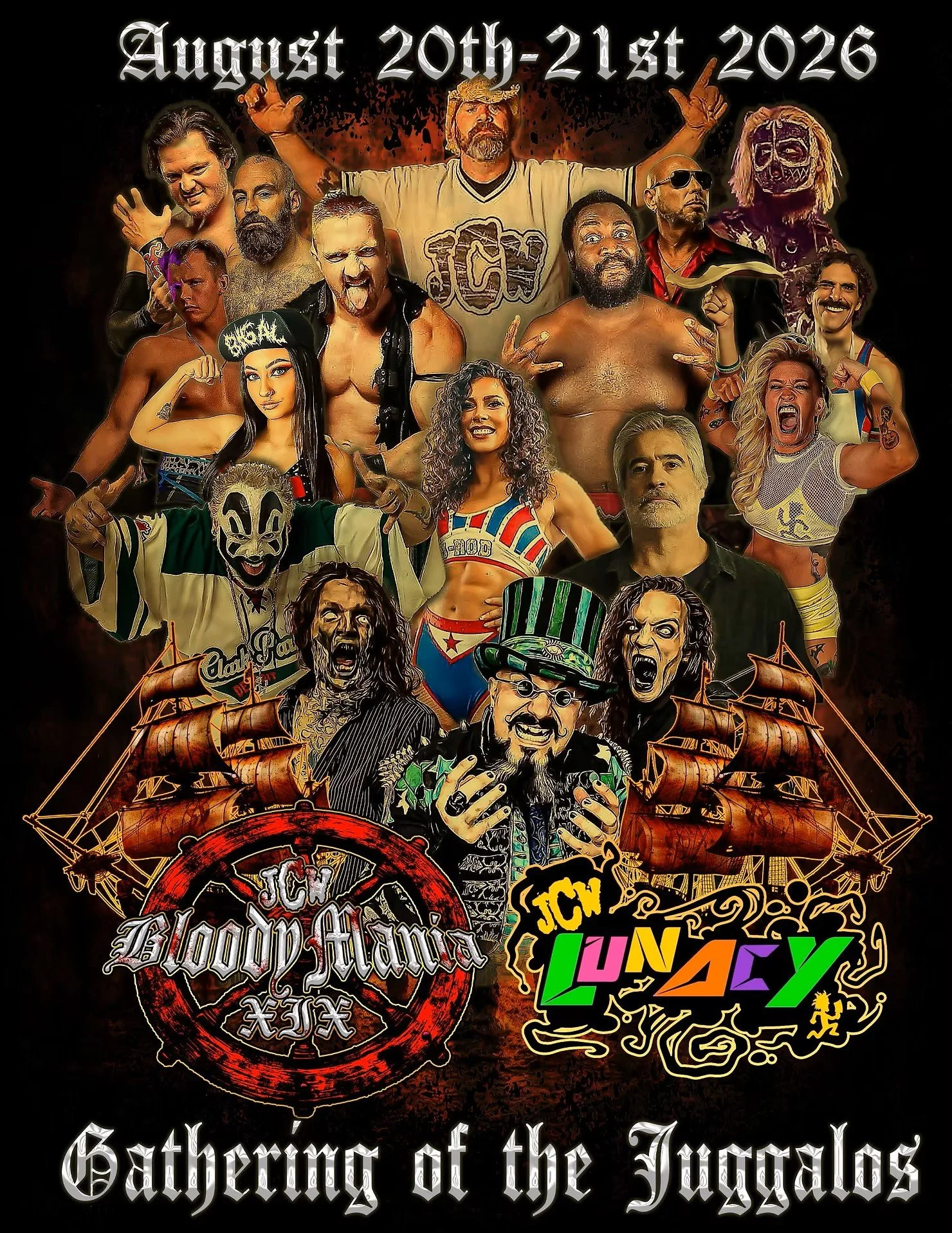
The current Lunacy era has made that commitment more visible. JCW isn’t just popping up once a year to run a wild card at the Gathering of the Juggalos or one-off tour stops for a very niche fan base. It’s built a weekly YouTube show around the idea that this world continues even when we’re not watching. Bloodymania is positioned as the place where a year’s worth of Lunacy storylines finally crash into each other, which is exactly how a major wrestling event should feel. Not just bigger or flashier. Consequential.
JCW is often described through the language of spectacle, and fairly so. This is a company where spectacle is the bloodstream. JCW’s trick is that the nonsense never just sits there. It builds, stains, mutates, and eventually comes due. A control-of-the-company angle with Violent J, Big Vito, and Vince Russo is absurd on paper. It’s also wrestling at its most legible. Who controls the promotion? Who gets humiliated? Who has power? Who gets to stay? Who has to pay for what they did?
Those are clean stakes. Wrestling can survive almost anything if the stakes are clean.
The Lunacy era gets over because it alchemizes incompatible wrestling histories under the same tent specifically because they are incompatible. Name acts arrive with baggage, underground fixtures bring credibility, and JCW’s own formidable stable keeps the place from feeling like a random booking experiment. The weirdos bring the atmosphere. The mismatch isn’t a problem to solve. That’s the draw. There’s some Juggalo-love logic in there, too, about the kind of loyalty that shifts misfit energy into an operating system, but that’s a separate story.
That’s another way of saying JCW feels like a wrestling promotion. Matt Riddle, Nic Nemeth, PCO, Vampiro, Rob Van Dam, KENTA, The Good Brothers, Willie Mack, Matt Cross, Kerry Morton, Mickie Knuckles, Caleb Konley, Big Vito, Vince Russo, Violent J. On another card, that lineup might feel like a bucket of names dumped onto a poster. In JCW, it feels like a traveling carnival where every tent is hiding something you probably shouldn’t want to see, but absolutely do. That’s not an insult. That’s the appeal.
The result feels less like prestige wrestling than folk wrestling in the old carnival sense: passed around, patched together, half ritual and half hustle, full of memory, inside jokes, grudges, borrowed monsters, cult loyalty, and the stubborn belief that the wrestling that lasts is usually the wrestling with dirt under its nails.
Professional wrestling has become very good at looking expensive and talking like it matters. It can produce a clip, a discourse cycle, and a ranking before the blood is dry. What it can’t always do is feel like a place. JCW does. A strange place, sure. A place where the dressing rooms might be haunted and the parking lot could probably cut its own promo.
But a place, nonetheless.
That’s the real comparison to golden-era wrestling. Not that JCW looks like Memphis, ECW, or late-’90s television. It doesn’t need to, and it’s not trying to. The connection is structural. JCW understands that audiences don’t only follow winners and losers. They follow unfinished business: the humiliation that demands revenge, the faction that keeps getting away with it, the boss they hate, the clown they trust, the monster they want turned loose, the old name they remember, and the new freak they didn’t expect to care about.
That’s wrestling. Not just athletic performance. Not just booking. Not just lore. A shared hallucination with rules.
JCW’s problem, if it has one, is the same thing as its strength. It isn’t trying to translate itself for people who need everything to be respectable before they can admit it works. That limits the ceiling. It also protects the soul. The promotion can be sloppy, excessive, crude, and occasionally impossible to explain without sounding like you’ve suffered a mild head injury. But the deeper truth is this: JCW isn’t confused about what it’s selling.
It’s selling escalation.
It’s selling follow-through.
It’s selling the idea that if you watch this week, you’ll understand more next week, and if you skip too much, you might miss the moment when the whole stupid, beautiful machine lurches forward.
That used to be the basic contract of wrestling television. JCW still honors it.
So no, JCW isn’t the cleanest promotion in the country. It isn’t subtle. It isn’t polite. It isn’t built to win over the kind of fan who thinks wrestling should apologize for being wrestling. It’s not here to prove it deserves to be in the room.
Good.
It’s here to lure the freaks under the tent flap, from inside and outside the fanbase.
Because what JCW does have is becoming rarer: a lived-in world, a loyal audience, an appetite for melodrama, and the nerve to make even its dumbest ideas matter. In a wrestling culture full of dropped threads and temporary heat, that counts for more than polish. Because we want to be lured and tricked, and, at the risk of waxing poetic, we want to belong.
JCW may still be lunacy. But right now, lunacy has continuity.
And continuity, in wrestling, is gold.
Jenny Catlin is a sports and pop culture writer in the square states. She’s a contributing writer to The Athletic, a Lighthouse Writers Book Project Fellow, and an award-winning essayist obsessed with obsession. You can find her on Instagram or Substack.