
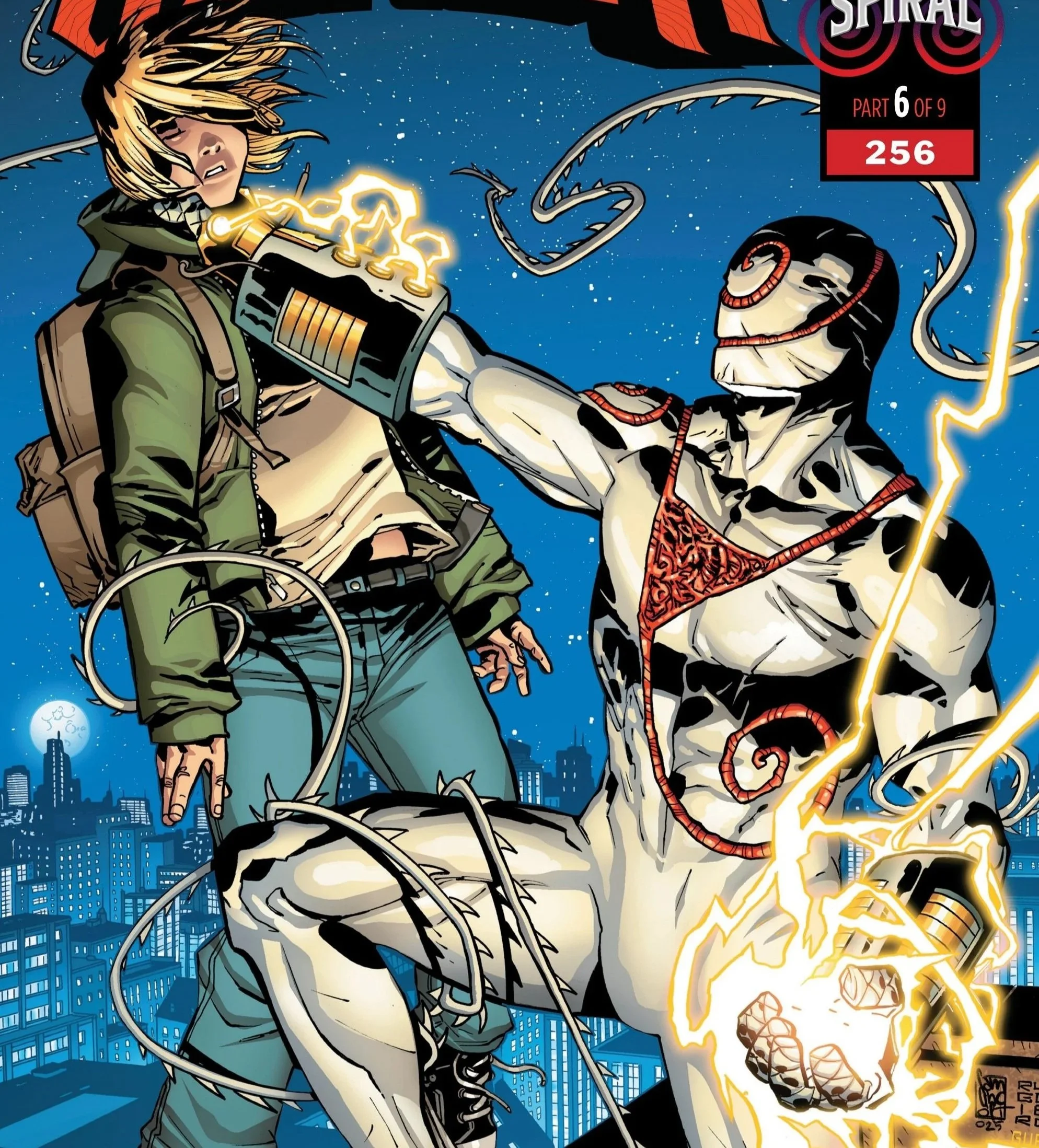
By now, you’ve probably heard the “good news” when it comes to a certain “fan-favorite” biting the dust in the pages of this comic. So yes, let’s get that out of the way first and foremost. HE’s dead. Hallelujah! Shout it out, get it out of your system. Cool? Good. But is that all there is to this issue, especially considering this is still part 6 of a 9-part event? Fortunately, there’s a LOT to actually love in this issue beyond that.
Now, to be clear, while Venom #256 does have that one specific moment that everyone will be talking about above all else, what’s a surprisingly good thing is that it’s only one small part of the entire book. After the longest time, this particular chapter feels like there’s some legitimate heat to the proceedings, which is the least you should be getting when you consider all the players and the circumstances involved. With all that said, let’s get into the meat and bones of things!
One Death to Rule Them All
**SPOILERS AHEAD for Venom #256**
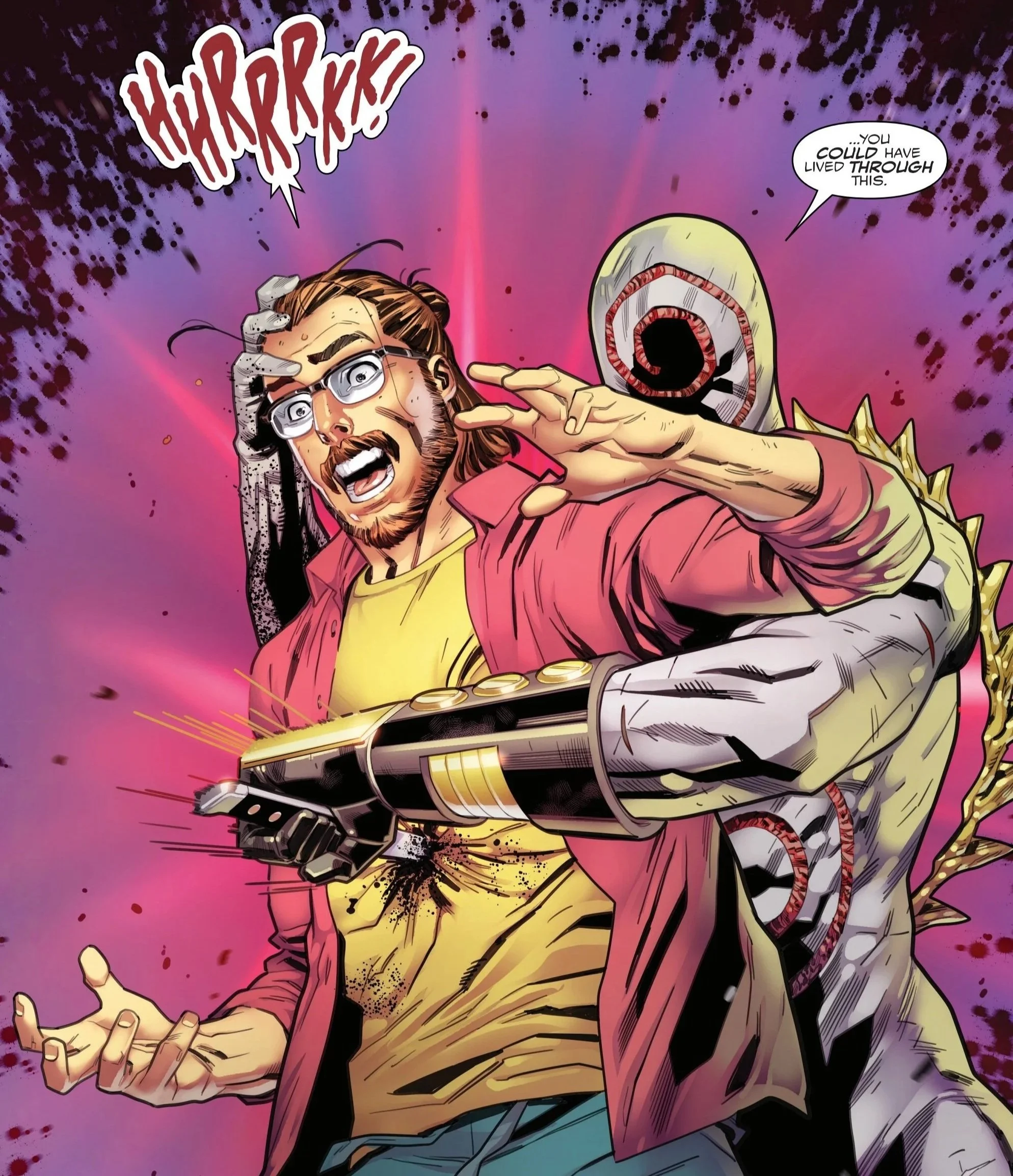
We start off the issue right in the hot seat where things left off in Amazing Spider-Man #25: Torment has tracked down Dylan Brock and intends to take him out as part of his “I’m so edgy, I kill entire families in a spiral pattern for funsies” shtick. Before he can actually get down to some good ol’ murdering, Paul rushes in to protect Dylan, valiantly stalling Torment to allow Dylan to get away. That ends in the most tragic way possible, when Torment fatally stabs Paul. That shocks even the usually hostile Dylan, who also tries his best to fight back and save both himself and Paul. But Paul does probably the most heroic thing in this book and allows Dylan to escape while he distracts Torment some more.
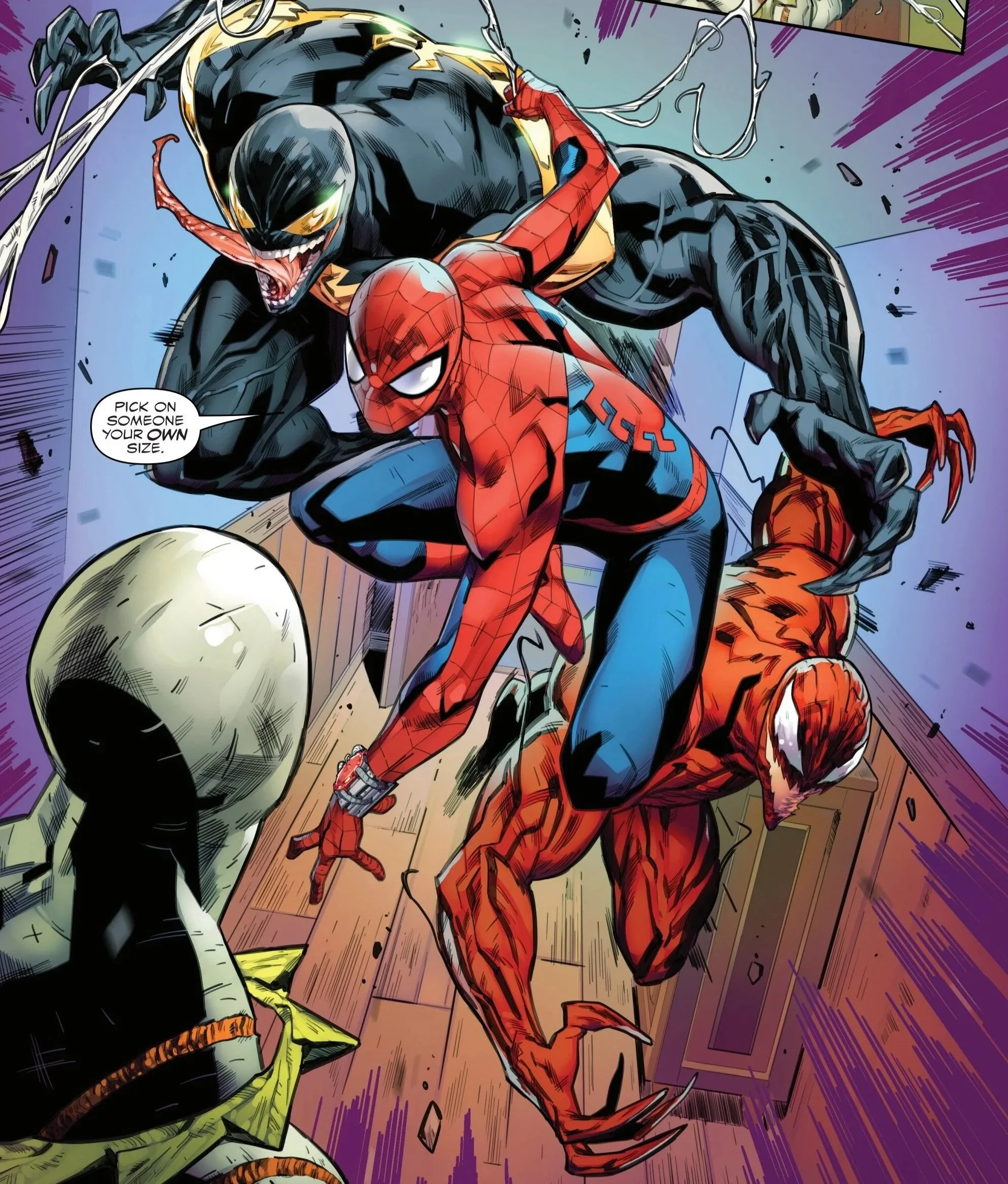
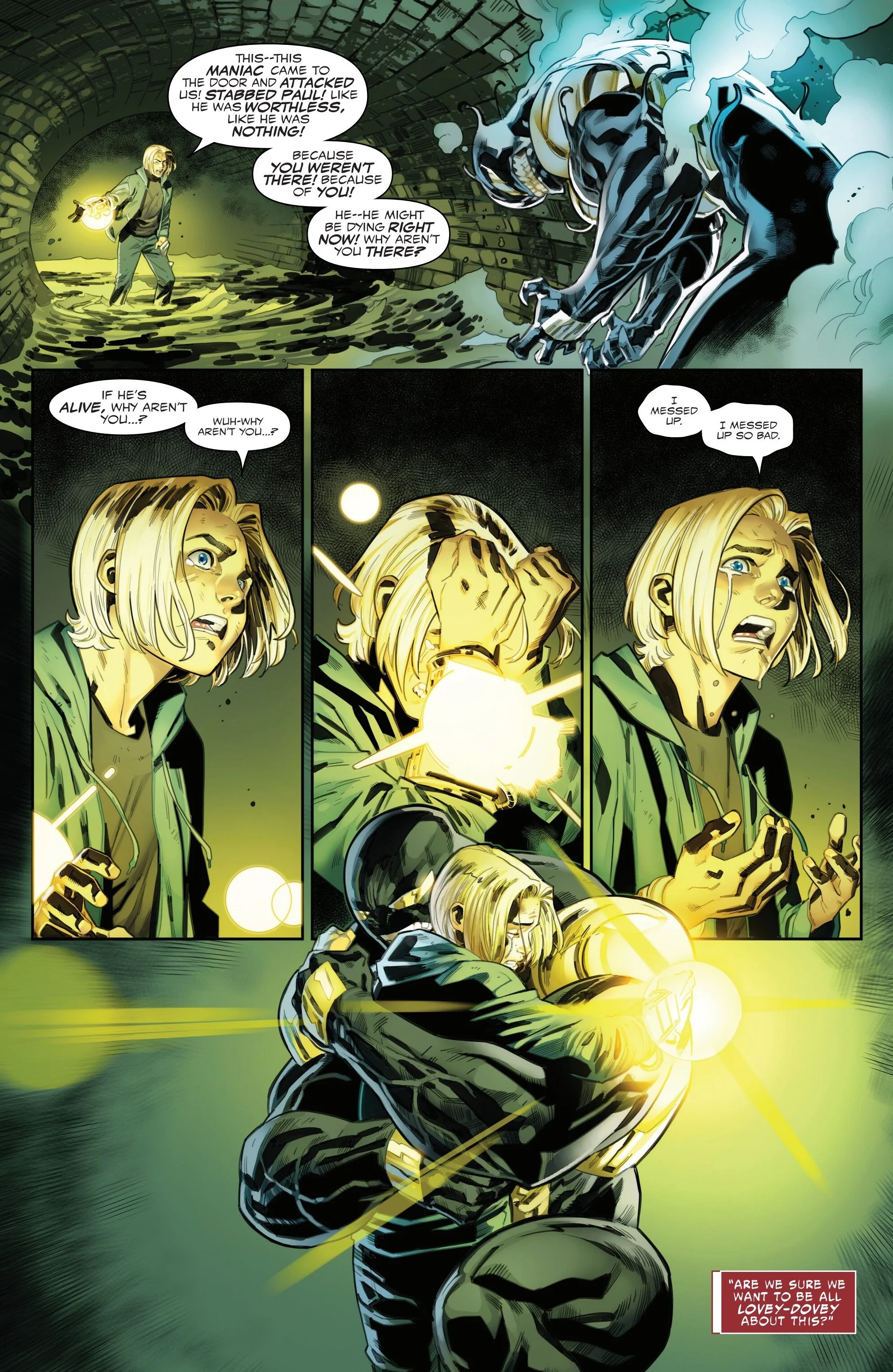
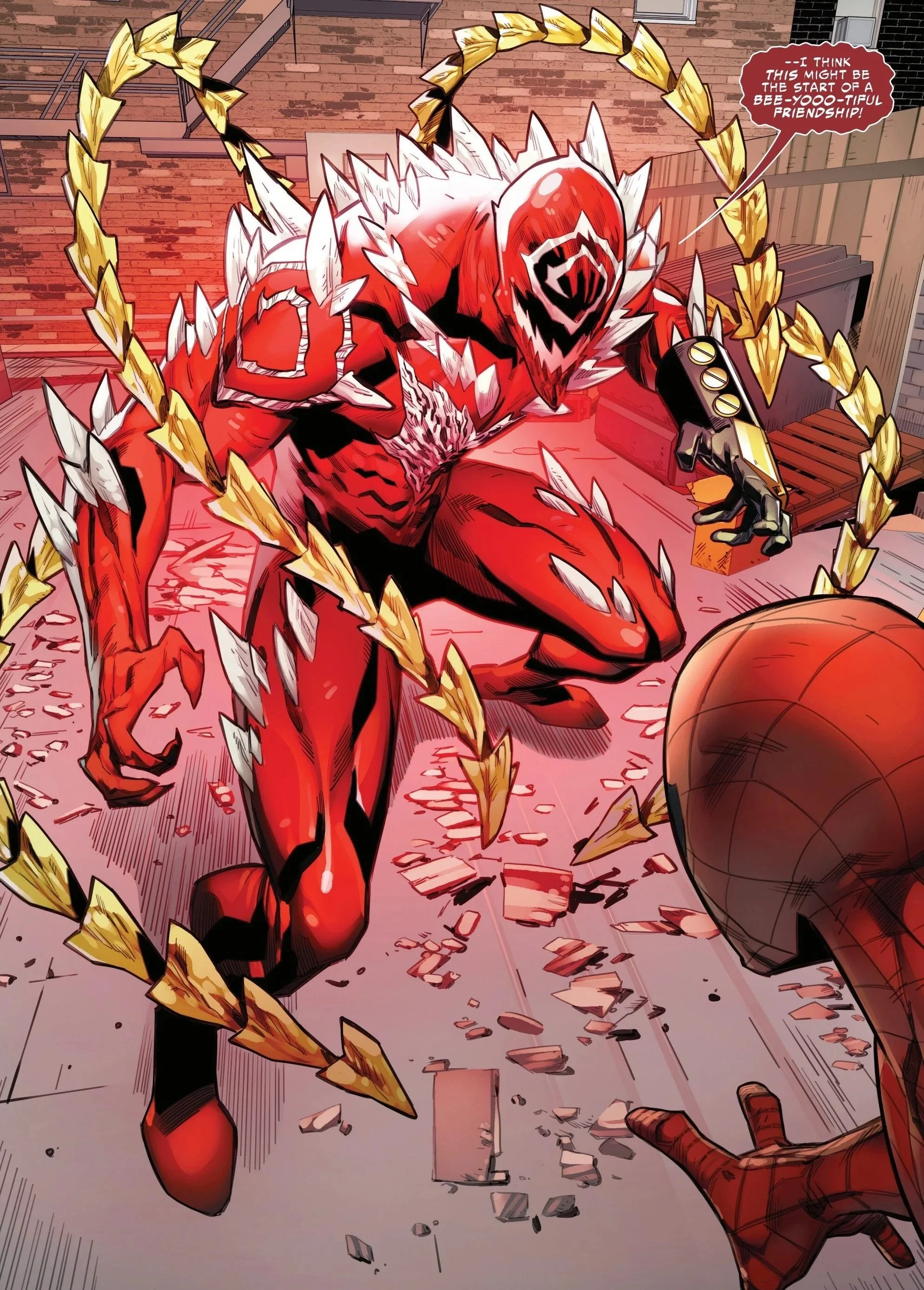
Before he can lay down the deathblow, Venom, Spidey, and Carnage all arrive, which gives Torment the opportunity to scurry off again when things get too heated. It’s a hot mess—in a good way—with Paul dying in Venom/MJ’s arms, while Spidey looks on in ineffectual horror, and Eddie freaks out about Dylan being missing. But it’s Venom who goes after Dylan, quickly finding him in the sewers and reuniting with him in genuinely heartfelt fashion after all the trouble they’ve suffered through. Meanwhile, Spidey and Eddie/Carnage corner Torment in an alley, and while the red terrors are more than willing to put the final nail in the serial killer’s coffin, Spidey manages to convince Eddie not to take the “lethal” approach despite everything that’s happened and the lives lost. Eddie seems to agree with this. But you know who doesn’t? That’s right. Carnage is finally sick of all this pacifist mollycoddling he’s had to put up with and abandons Eddie to die—whose body can’t survive without the symbiote keeping it alive. But doesn’t Carnage have the same problem, you may ask? Well, not anymore! Because our crimson cretin is tired of waiting for permission and instead just decides that he’s gonna make Torment his new BFF for life—and Death. And the results are quite something…that will have to be dealt with in the next chapter.
The Inciting Incident
Honestly speaking, I really didn’t expect Al Ewing to pull off the real marquee moment of this book the way he did. Sure, I loved the little jabs that his run started taking at Paul, but they didn’t really amount to much of anything other than really petty, high-school-level taunts after a certain point. Sure, there were some real zingers, but the whole “meta” narrative of running Paul down really wore thin after the first two or three times you wring that towel dry. And yet here we are: Ewing gets the opportunity to kill off Paul Rabin—a guy who had the kind of nuclear levels of “go tf away” fan hatred that editors could only dream of—and makes it actually feel like an inciting incident. Not the death itself, mind you, since very few of us actually feel like this will be a permanent thing. But in the moment after, the number of wheels that start turning from this one incident is where the real beauty in Ewing’s narrative starts to work.
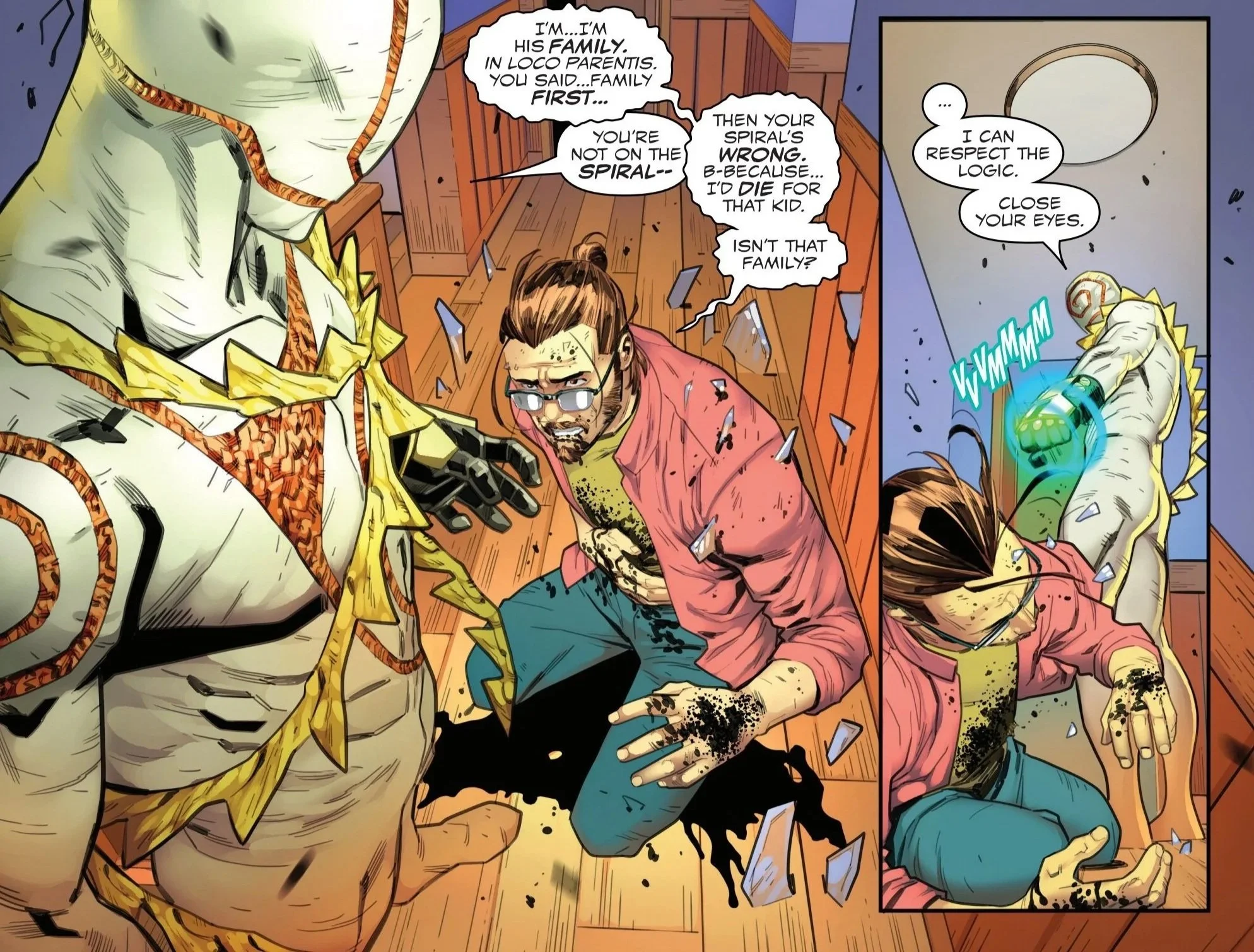
First of all, Paul’s death is probably one of the most heroic things imaginable. For all his faults—both real and imagined—Paul has always stuck his neck out for people to a fault. It’s an infuriating trait when contextualized against, say, Peter Parker, in the way it was that truly created the original fan ire in the first place. But here? Where he puts himself in the line of fire against a super-powered serial killer to save Dylan Brock—a kid who’s been hating on him since day one—is almost… poetic? Dylan himself can’t seem to believe it either, and I think this entire part gets overshadowed a lot whenever this book is discussed, because everyone only talks about Paul dying. In either case, there’s a lot happening here that I think holds real emotional weight: Torment mocking Paul for not really having “any connections to anyone,” hence no “spiral” to exploit, which feels like another meta-jab at the character. But then you have Paul turn that around to buy Dylan time to escape, arguing that he’s Dylan’s family too and that he’d die for him, thus making him “eligible” for Torment’s spiral. It’s some great storytelling that does more to humanize Paul in 2–3 pages than he’s ever been in the last few years since his introduction, and it holds tragic weight because in the end… Paul did die for Dylan. And he died well and truly heroically, regardless of how the fanbase feels about him. I think that in itself is an achievement.
Slightly less so is Spidey’s reaction to Paul’s death, which while understandably conflicted, feels far more callous than I’d expect from even Peter to normally give. Mind you, we’re talking about a guy who was just a few issues back mourning the deaths of both Shocker and Eddie Brock’s father—two arguably far more problematic people than Paul could ever hope to be. There are moments where Peter is like “noooo, just hold on Paul” in the most seemingly “oh shucks, well that happened” kind of way (the art doesn’t help in this department either), and also the egregious bit where he’s literally like “Paul wasn’t my buddy, but he was a human being who did his best,” which feels wildly and unintentionally comedic with how it’s delivered. Like again, Spidey, you were literally calling the Shocker your good buddy two issues ago. Barring Peter’s wild out-of-place antics, the rest of him is on brand, as he tempers down his rage against senseless slaughter to try and bring Torment to justice. Very on-brand and, of course, true to character, that moral fortitude ends up causing more trouble than it’s worth in a situation like this. I’m pretty sure Carnage was having Maximum Carnage PTSD flashbacks at this point, because he really was sick of Peter’s “justice” lecture.
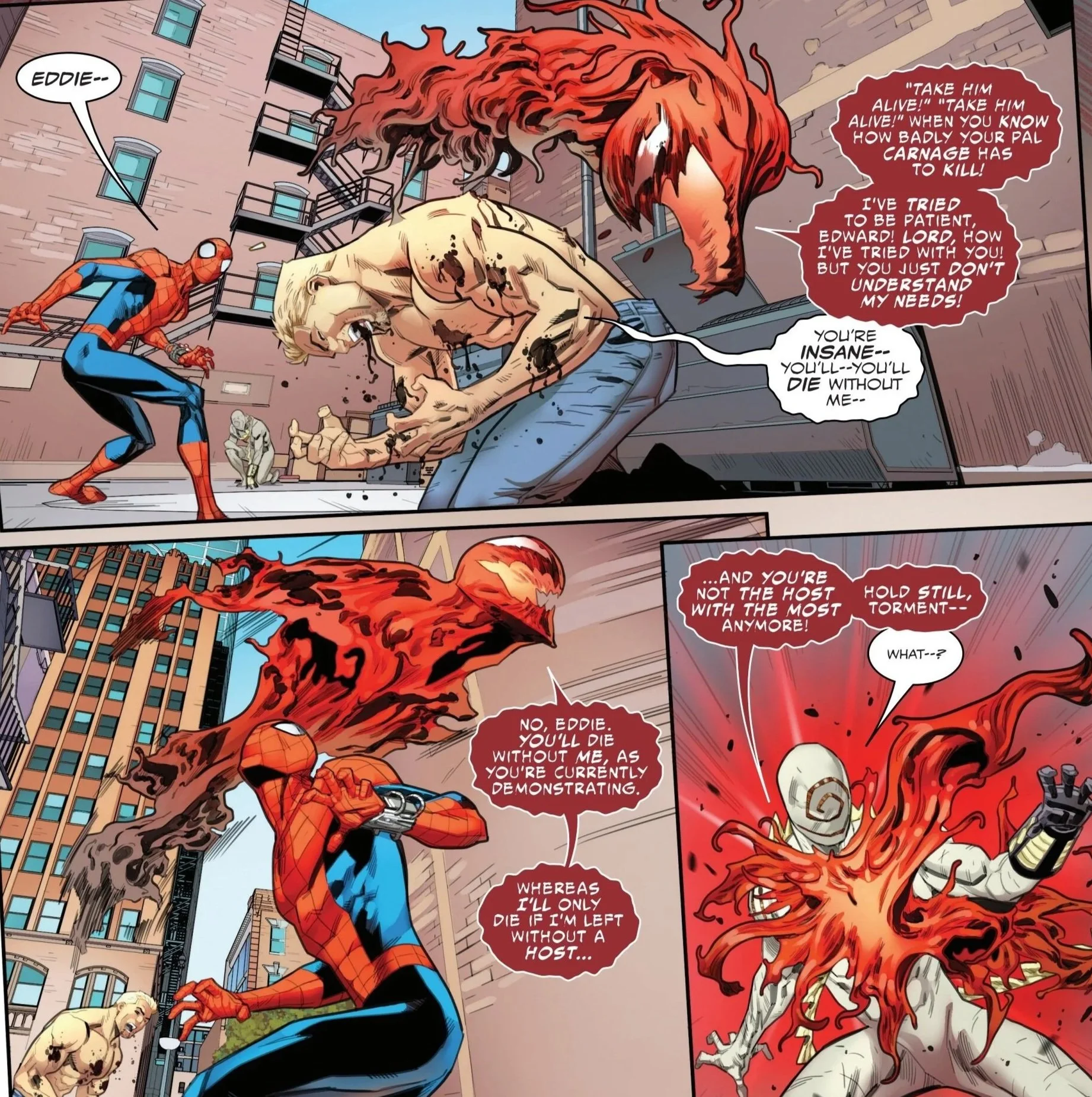
Speaking of symbiotes, this is a Venom book, right? Well, there’s not much Venom does here, but what little there is does matter. Dylan is the core focus for our characters—the ones trying to save him and the one trying to end him. It’s Venom who’s at the wheel for most of this book, and it’s a bit of a missed opportunity that MJ wasn’t the one primarily reacting to Paul’s death, but rather the symbiote. In either case, with the symbiote at the wheel, the main focus shifts to Dylan, and there’s a touchingly familiar moment when symbiote parent and son are reunited and Dylan allows himself to be vulnerable about Paul’s death (which he feels was his fault) to Venom. On the other end of the spectrum, Carnage is also feeding off Eddie’s impulses for revenge rather than looking for his son—but they seem to be more in sync with each other than, say, Venom was with MJ in the moment. I’m wondering if this will play into the narrative later on, that Eddie chose bloodshed over his own flesh and blood right then, but it’s an interesting dynamic bit to explore with just how much Carnage has influenced Eddie in both conscious and unconscious ways up till this point. Eddie is still his own man, and he demonstrates this aptly when he chooses to heed Peter’s words and avoid violence, but Carnage, true to his nature, was having none of that. All in all, you could say there were a lot… spiraling consequences that came out of Paul’s death. And everyone involved was feeling it.
Oh, and of course, there’s Torment himself. Yes, I’m sure he’s practically a folk hero to a good section of the fanbase after this episode for what he did, but barring that, this is probably the most unforgiving he’s actually felt since the start of this event. For the most part, Torment has felt like he’s on the back foot and just going through the most cliché’d of serial killer motions. And to be honest, conceptually he is very milquetoast in that regard. If not for a really cool visual design and some marginally interesting bits to his storytelling, Torment wouldn’t really be able to hold things together even with Marvel overhyping him the way they have. But this issue does more than most to uplift the character to the point where Carnage forcefully taking him over almost feels like something akin to “concern.” Once again, an achievement in terms of Ewing making me feel positive things I wasn’t expecting to feel.
Going for the Gold
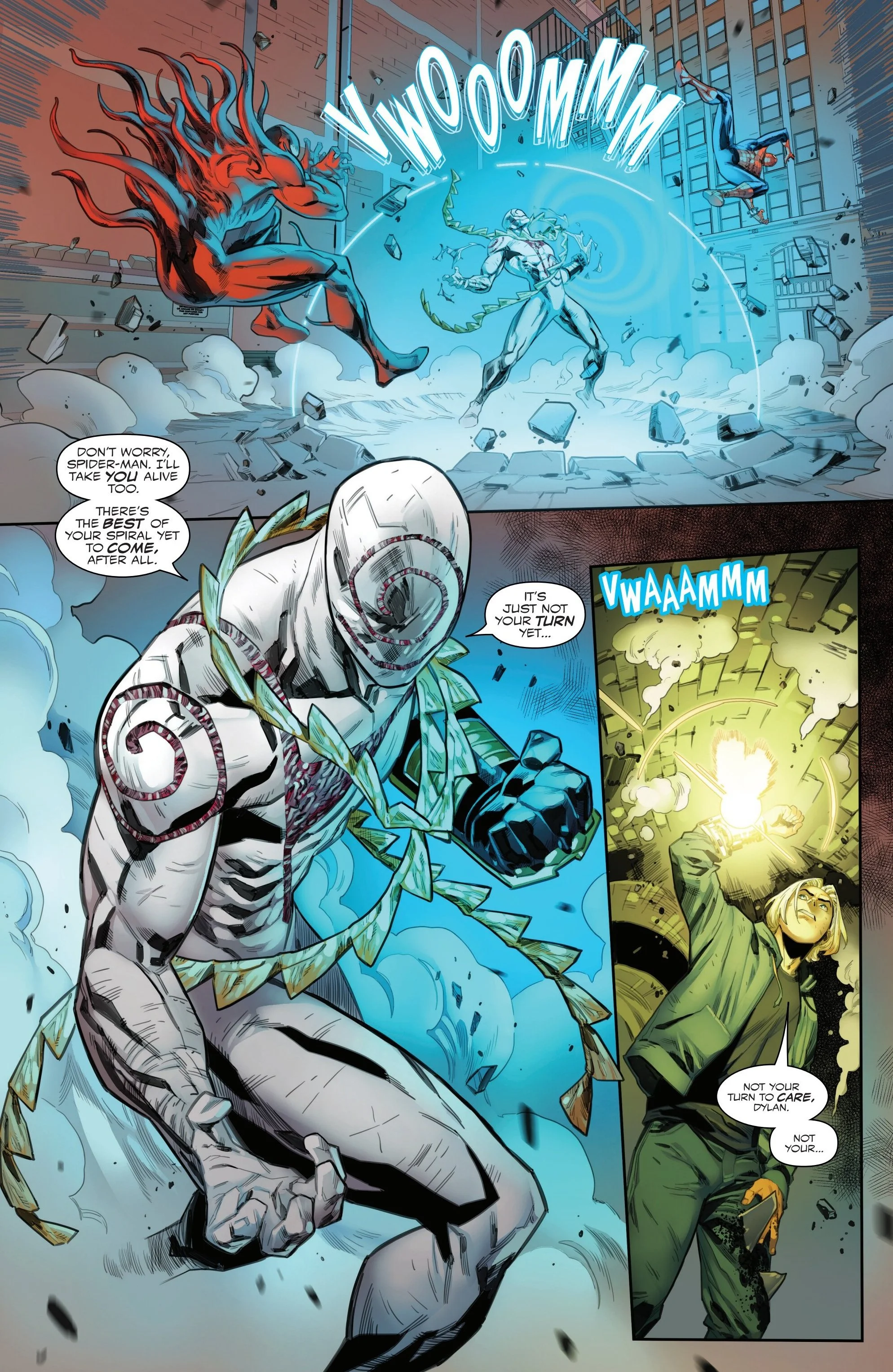
Carlos Gómez and Frank D’Armata bring a gorgeously kinetic energy to Venom #256 right from page 1. There’s a certain tempo that the art manages to capture perfectly, from Torment’s attack all the way up to Carnage making his new partnership. The visual energy is fast-paced throughout, loosening just enough to let the heavier emotional moments sink in without sacrificing tension, and then ramping up naturally again. It’s really something to see alongside the narrative working so seamlessly together in that regard.
Gómez’s linework for Torment is some of the best yet, especially in the entire bulk of the book being the “fight” between Paul, Torment, and Dylan. It feels appropriately desperate and tense throughout, and Paul’s actual death, and the drawn-out segment that follows, is also done impeccably—transitioning so well from brutal action to heavy emotional weight. From a visual standpoint, the death of Paul was done exceptionally well, and I’m glad Gómez gave it his all in that regard. Additionally, Torment is drawn at his most aggressive yet, showcasing a more intense energy than his previous appearances, while still retaining some semblance of that cool, sinister swagger that’s felt a lot more try-hard in previous issues (barring when Saiz draws him). Spidey, Venom, and Carnage are also drawn impeccably, each exuding their own unique energy and instantly recognizable silhouettes. And by the time the issue ends, Gómez gets to also showcase a truly gnarly Carnage redesign that’s sure to make for a pretty cool toy sometime soon.
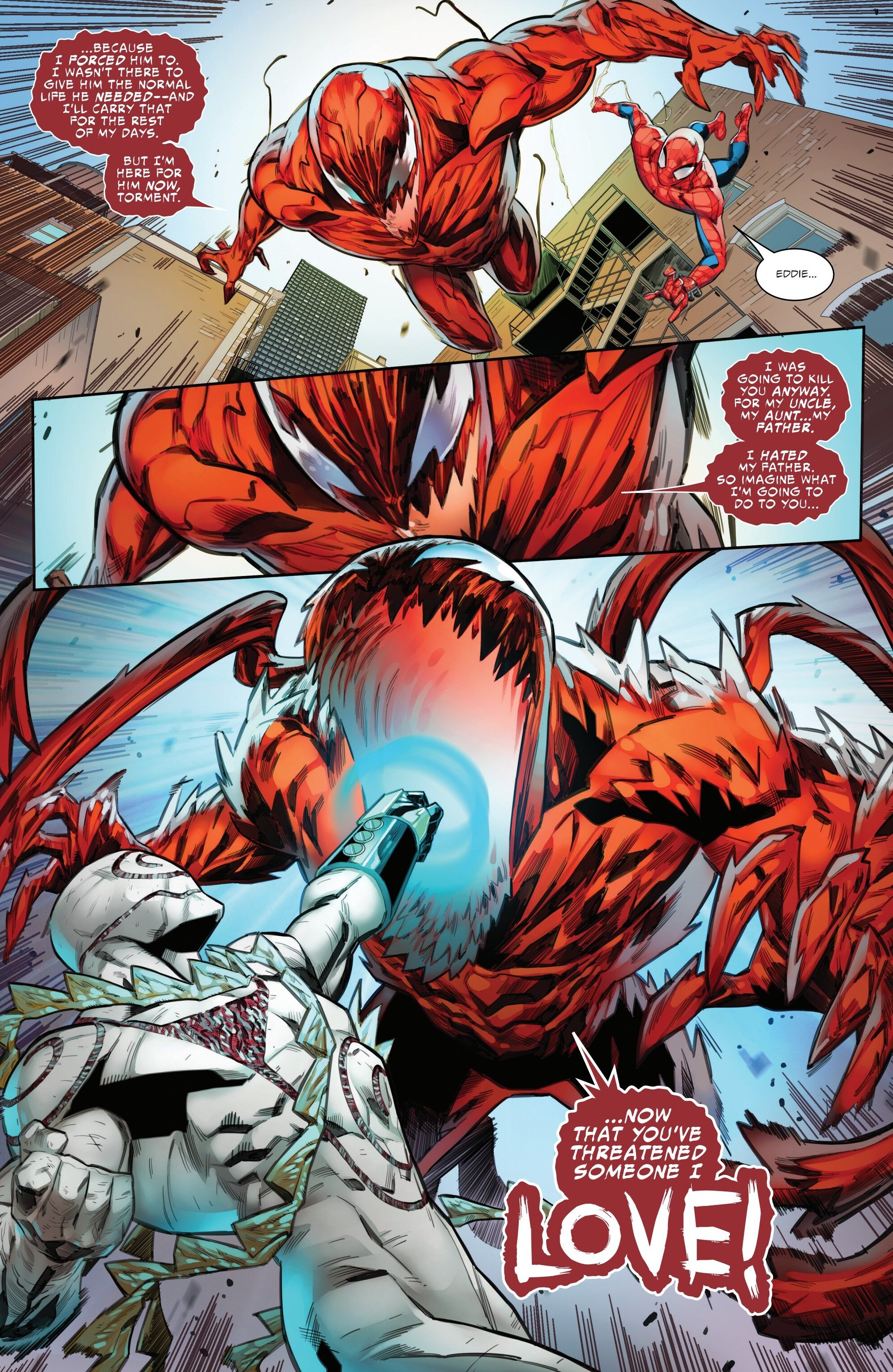
D’Armata also brings a lively selection of colors to Gómez’s linework, with a lot of interesting palettes also thrown into the mix. There’s a fun little toxic miasma effect, with a blue-green hue in several pages where Torment is involved: this is because Paul damaged one of the Shocker gauntlets during the start of the issue, which has been leaking gaseous energy ever since. It’s a very neat little touch that gives some of the sequences a very unique shade, while the usual more dominant reds from Spidey and Carnage take center stage later on in the book. It’s the little and big things like this that make D’Armata stand out as a colorist of repute, and I’m all here for it.
The End and the Death
Venom #256 might be remembered for all the “wrong” reasons, but there’s a lot more to love in this chapter of Death Spiral compared to previous ones, since this moves so many of the characters and story in such a meaningful way. Every single character is directly impacted by Paul’s murder in a massive way, and that energy is what Ewing uses to really catapult the story in an engaging way that kind of felt like it was missing the plot for a good chunk of this event so far. And while the lack of Venom in a Venom book might feel very jarring (it does, let’s not really beat around the bush on that), there’s enough to compensate for that in this issue in genuinely meaningful ways that keep things engaging either through actual emotion or some gorgeous action.
Ultimately, once again, I hope this momentum does continue (even though I know it probably won’t from writer to writer), but it doesn’t pain me in the least to say that for a character who people really couldn’t stand, he did end up mattering to someone’s story more than anyone could’ve bargained for.
That’ll do, Paul. That’ll do.
Final Verdict: Venom #256 may be remembered for that one notable death, but offers a whole lot more tension and emotional weight if you’re willing to look beyond the surface level shock-value at something potentially greater.