
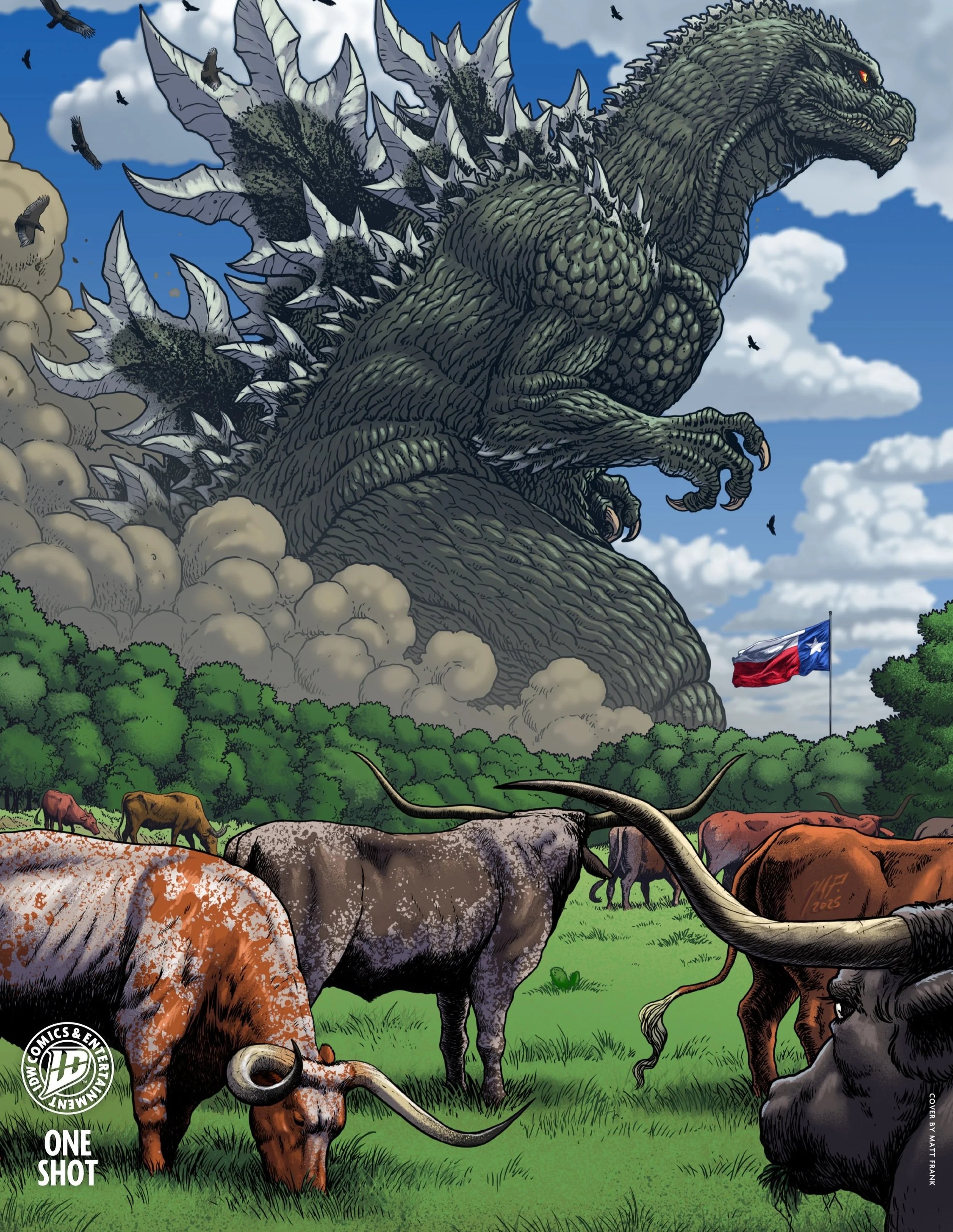
Cover Artist: Matt Frank
The Godzilla vs. America: Texas #1 anthology takes a noticeably different approach from some of the earlier entries in the series. While books like Portland often focused heavily on atmosphere and local eccentricity, Texas aims for something broader and more varied, using Godzilla as a lens through which to explore different aspects of the state’s identity. The result is a collection that feels more ambitious thematically, even if that ambition occasionally comes at the expense of Godzilla himself.
Across its four stories, the issue jumps between wildly different tones and genres. There is political satire, noir-inspired capitalism critique, giant robot spectacle, and a quieter story built around Texan stubbornness and pride. Some stories land more effectively than others, but the sheer range keeps the anthology consistently engaging. More importantly, each creative team approaches Texas from a completely different angle, helping the book avoid feeling repetitive despite its shared setting.
At the same time, the issue also highlights one of the recurring challenges of these anthology books: balancing local storytelling with the expectation that readers are here to see Godzilla. Several stories treat him less like an active character and more like a looming force shaping the people around him. That approach works surprisingly well in places, but there are also moments where it leaves you wishing the King of the Monsters had a more direct presence within the narratives themselves.
Even so, the issue remains a fun and creative entry in the series overall.
Deep in the Podcast of Texas
Writer & Artist: Matt Frank
Colorists: Heather Breckel & Matt Frank
Flatter: Tommy Shelton
Special Thanks: Kaston Kolbachinski
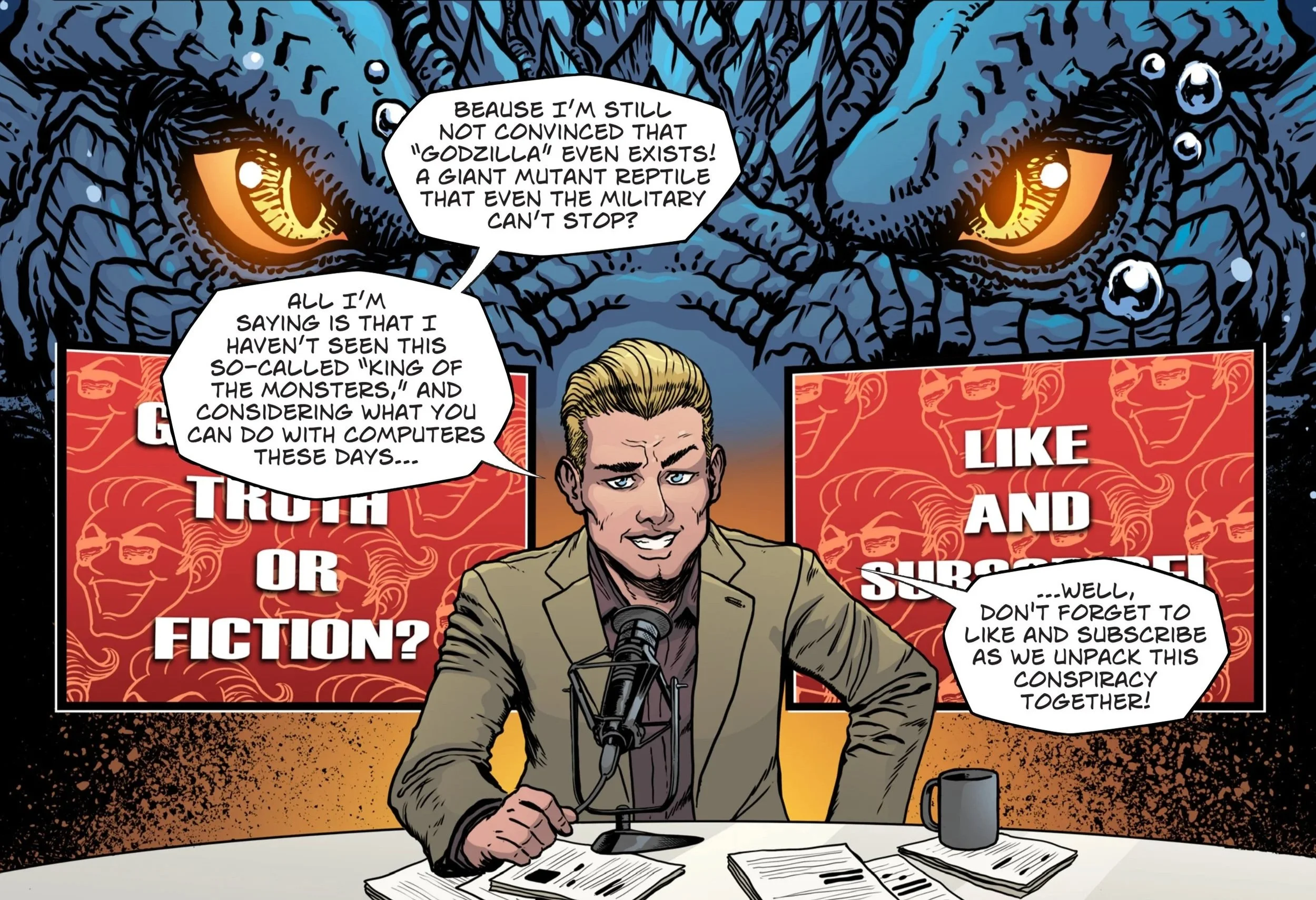
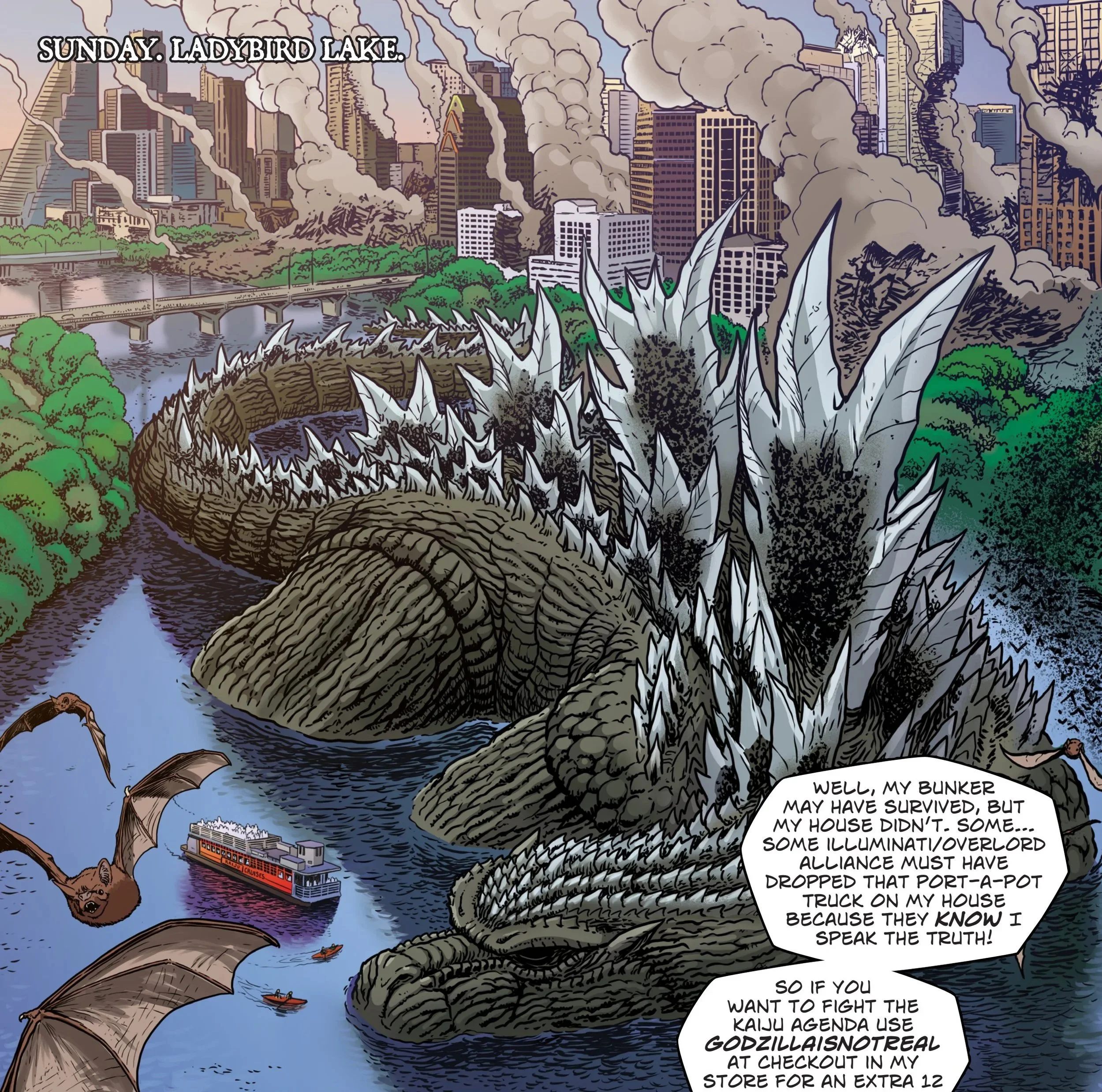
The opening story is probably the most topical and potentially divisive entry in the anthology. Framed around a conspiracy-minded podcaster dismissing Godzilla’s attack as a manufactured hoax, the story feels intentionally tuned into modern internet outrage culture and influencer politics.
The parallels are not exactly subtle, but that directness is part of what gives the story its energy.
There is an uncomfortable familiarity to the way the podcaster twists increasingly obvious destruction into content for his audience, prioritizing engagement and product sales over reality itself. At times, it almost feels less like a traditional Godzilla story and more like social media satire with a kaiju backdrop.
What really elevates the story, though, is the artwork. The visual style is energetic and exaggerated in a way that perfectly complements the absurdity of the premise. Even when the satire becomes a little heavy-handed, the art keeps the story entertaining and visually dynamic throughout.
Godzilla himself is used more as an unstoppable consequence than an active participant, but the story still succeeds because of how sharply it captures the chaos and performative outrage culture it is parodying.
Crude
Writer, Artist, & Colorist: Devin Kraft
“Crude” is easily the standout story in the issue.
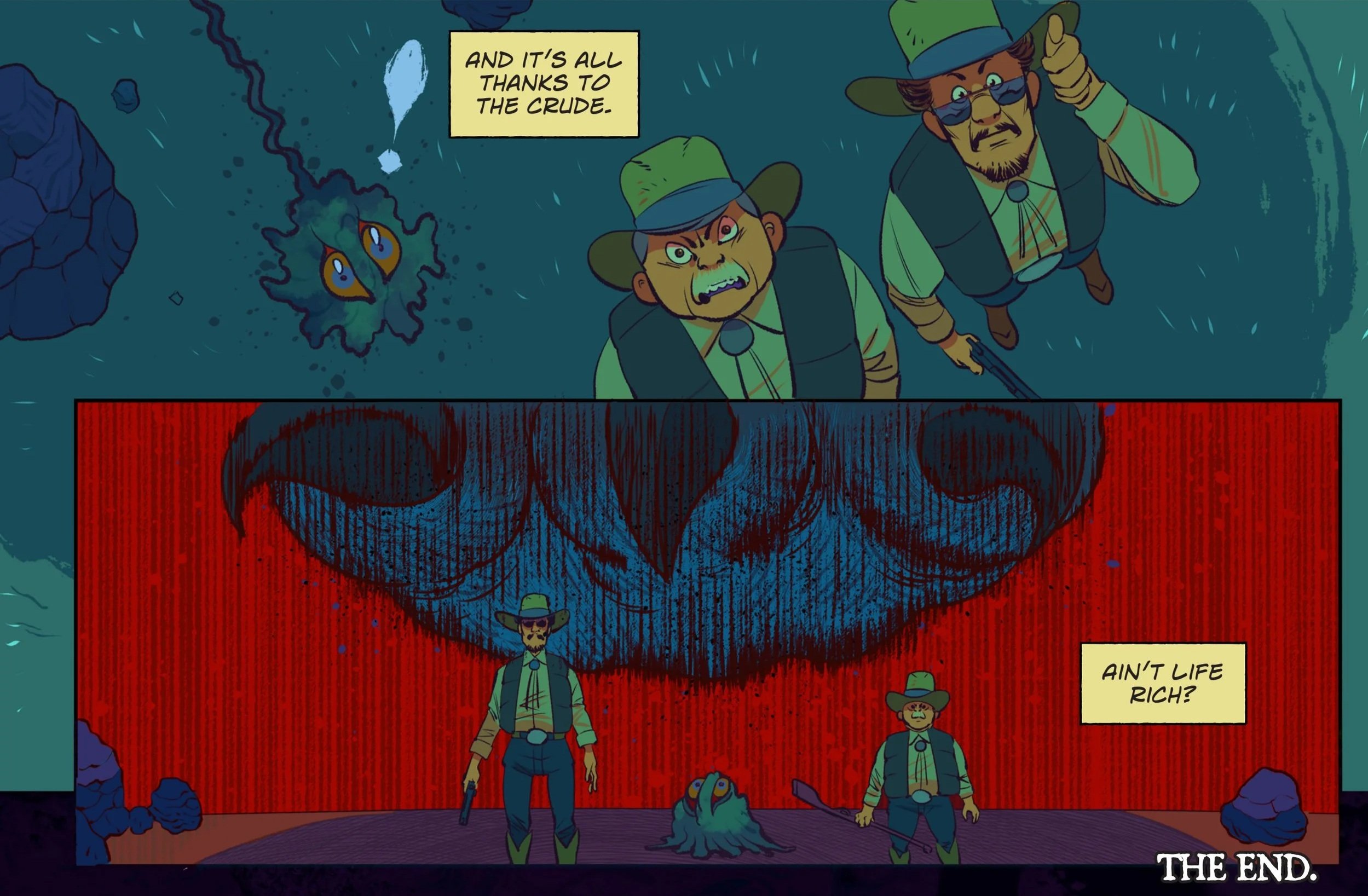
The narrative leans heavily into noir and anti-capitalist themes, following powerful oil businessmen whose greed and cruelty eventually attract catastrophic consequences. Of all the stories in the anthology, this one probably feels the most like a classic morality tale, almost functioning like a twisted The Twilight Zone episode filtered through a Godzilla lens.
What makes the story especially effective is how naturally Godzilla fits into its themes. Rather than simply appearing to destroy things randomly, he becomes a force of karmic correction against systems built on exploitation and excess.
The appearance of Hedorah is also a huge highlight. As one of the franchise’s most visually distinct and thematically loaded monsters, Hedorah fits perfectly into a story centered on pollution, greed, and environmental destruction. The cameo adds an extra layer of excitement while reinforcing the underlying themes rather than distracting from them.
The atmosphere throughout the story is excellent as well. The pacing is slower and more deliberate than some of the other entries, but that slower approach allows the tension to build naturally toward its payoff.
This is the story that most successfully balances strong thematic material with the larger-than-life energy expected from a Godzilla anthology.
Godzilla vs. Tex-Mech
Writer & Artist: Joe Eisma
Colorist: Heather Breckel
After the heavier themes of “Crude,” the anthology shifts gears completely with its giant robot showdown story.
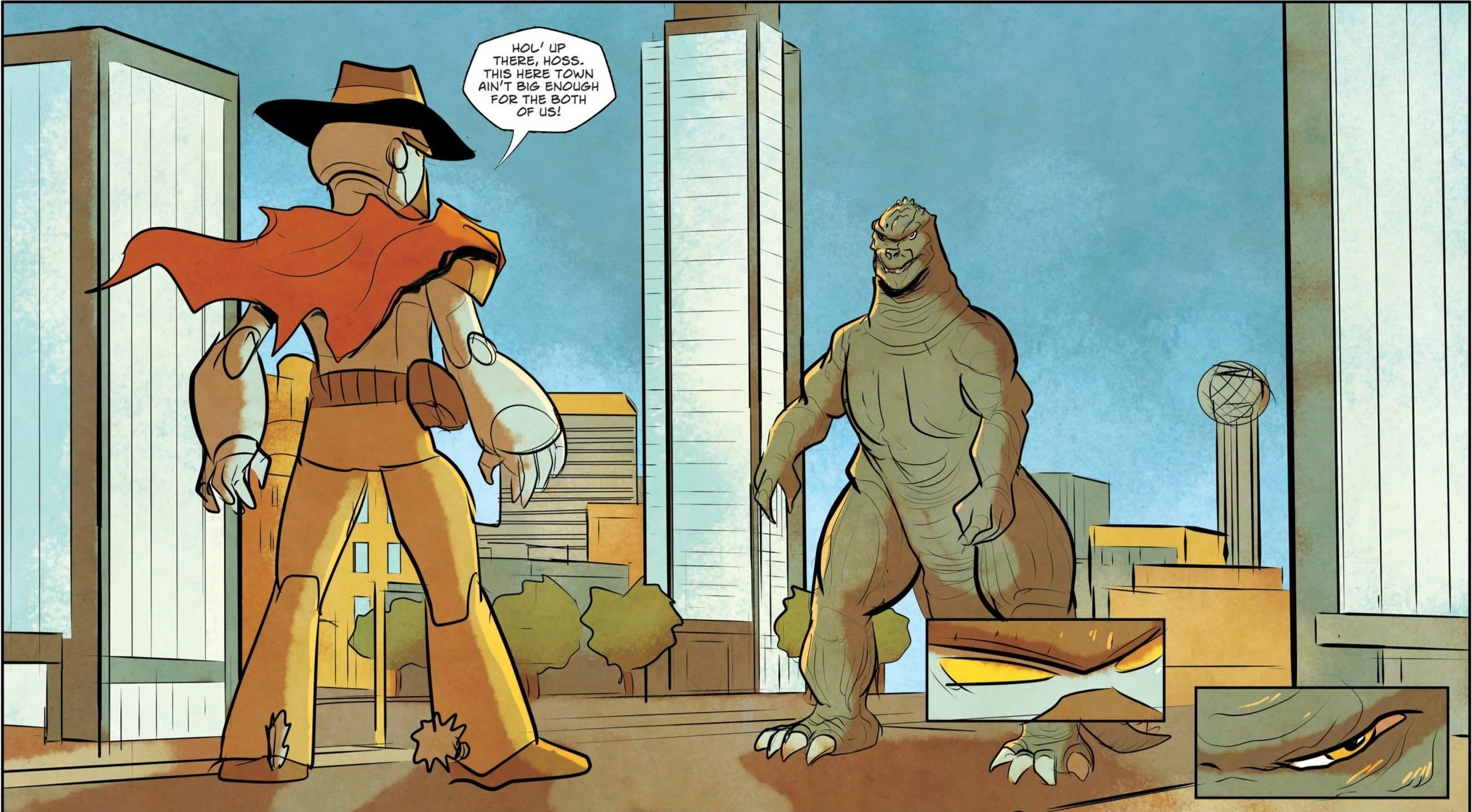
This is easily the most straightforward entry in the issue, embracing pure spectacle as Texas deploys the absurdly wonderful Tex-Mech to battle Godzilla directly. The concept feels ripped straight out of a classic Showa-era film, complete with exaggerated action, oversized personality, and an almost gleeful embrace of ridiculousness.
The art here is somewhat simpler than in other stories, but that simplicity actually works in the story’s favor. The stylized approach gives the action a clean, energetic quality that makes the fight choreography easy to follow while emphasizing the larger-than-life tone.
More importantly, the story understands exactly what kind of fun it wants to deliver. It does not overcomplicate itself with heavy themes or layered symbolism. It just throws a giant Texas-themed mech into battle with Godzilla and fully commits to the bit.
Sometimes that is all a Godzilla story really needs.
You Missed It!
Writer & Artist: John Lucas
Colorist: K.J. Díaz
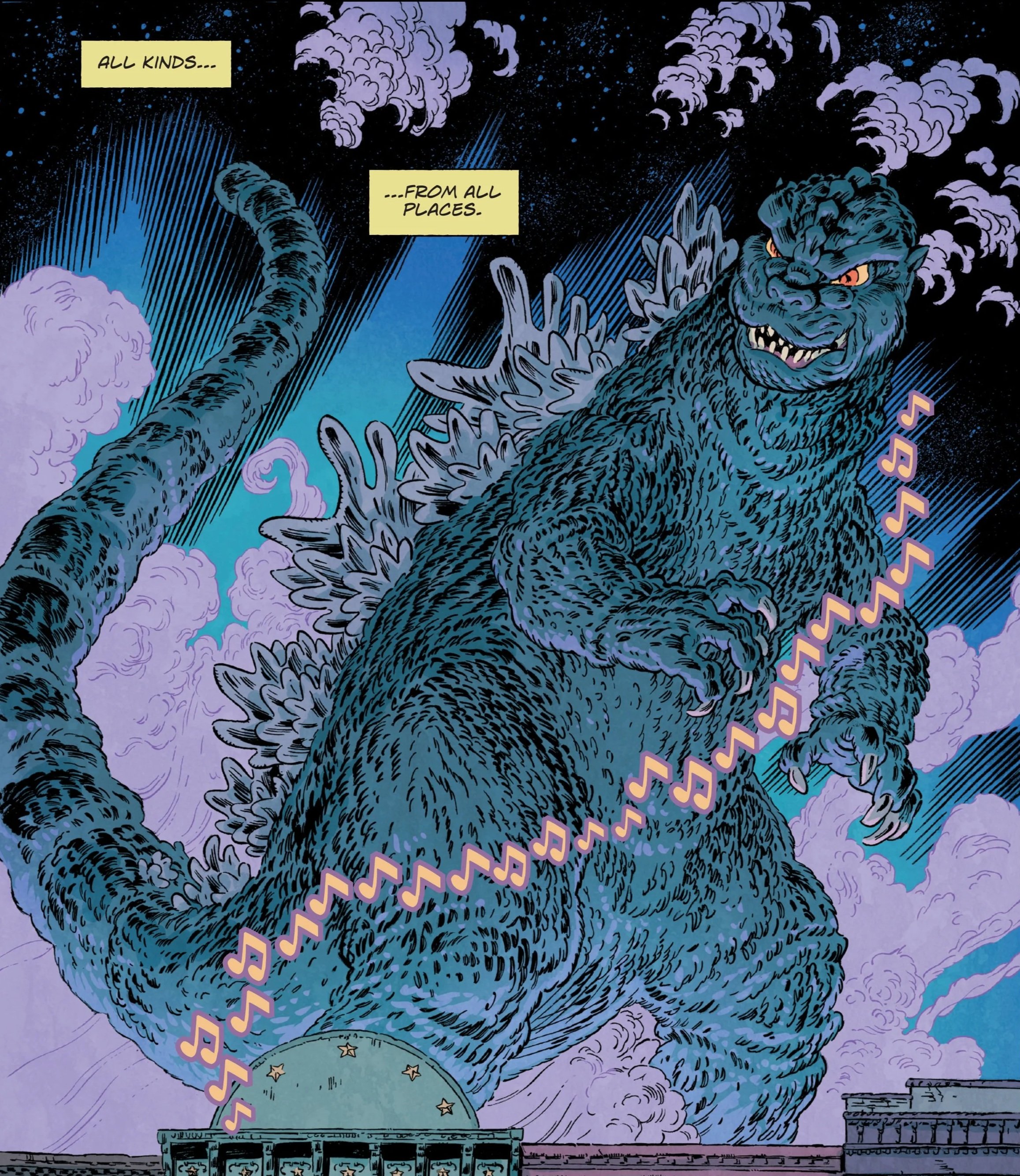
The anthology’s final story takes the most restrained and metaphorical approach of the collection. Rather than focusing on physical conflict, the narrative frames Godzilla almost as a challenge to the Texan identity itself.
The story becomes less about defeating Godzilla and more about enduring him.
That approach is interesting because it turns the conflict into something almost philosophical. The stubbornness and independence associated with Texas become the true focus, creating a quieter story where emotional resilience matters more than direct confrontation.
It is also the entry where Godzilla feels most distant from the narrative itself. He is less a character than a looming symbol hovering over the story’s themes. That works conceptually, but it also reinforces one of the anthology’s biggest weaknesses overall: there are times when Godzilla feels more like scenery than the actual centerpiece.
Even so, the story succeeds at capturing a very specific atmosphere and closes the anthology on a thoughtful note.
A Stronger Focus on Texas Than Godzilla
What ultimately defines Godzilla vs. America: Texas #1 is how committed it is to exploring different interpretations of Texas itself. Every story reflects a different piece of the state’s cultural identity, whether through political commentary, capitalism, larger-than-life spectacle, or sheer stubborn pride.
That focus gives the anthology a strong sense of personality and variety. Even weaker stories remain interesting simply because they feel so distinct from one another.
The trade-off is that Godzilla sometimes feels secondary within his own book.
For some readers, that may be disappointing, especially those hoping for nonstop kaiju destruction. But when the stories work best, they use Godzilla not just as a monster, but as a force that exposes the values, flaws, and anxieties of the people reacting to him.
That thematic approach gives the anthology more depth than expected, even if it occasionally comes at the expense of pure monster action.
Final Thoughts and Rating
Godzilla vs. America: Texas #1 is a fun, varied, and surprisingly thoughtful anthology that captures the oversized personality of Texas through four very different creative lenses. The stories do not all land equally, but the collection rarely becomes dull thanks to its constant tonal shifts and strong visual identity.
“Crude” stands out as the clear highlight thanks to its excellent atmosphere, sharp anti-capitalist themes, and memorable appearance by Hedorah, while the Tex-Mech story delivers the kind of unapologetically ridiculous kaiju fun the franchise excels at.
At the same time, the anthology occasionally loses sight of Godzilla himself. In several stories, he functions more as an environmental force or thematic backdrop than an active character, which can make the book feel slightly less satisfying as a pure Godzilla comic.
Even so, the creativity on display and the affection each story has for its setting make the issue well worth reading
Rating: 7.5/10
A creative and entertaining anthology full of personality and thematic variety, even if Godzilla sometimes feels more like scenery than the star of the show.