
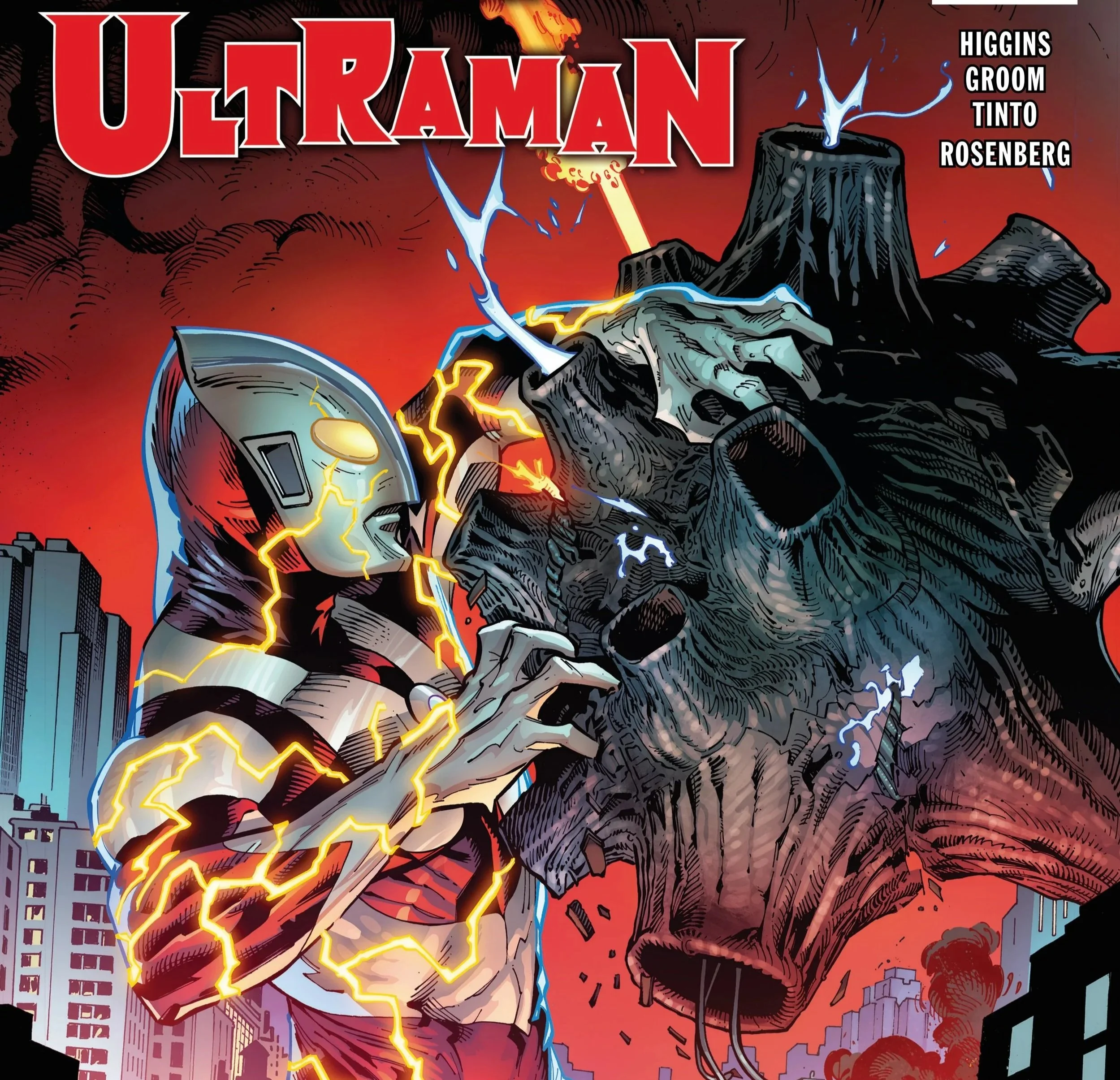
Writers: Kyle Higgins & Mat Groom
Artist: Davide Tinto
Colorist: Rachelle Rosenberg
Cover Artist: Netho Diaz, Jay Leisten, & Fer Sifuentes-Sujo
When Marvel first partnered with Tsuburaya to bring Ultraman into comics, it felt like a genuinely exciting creative swing. Putting the character in the hands of Kyle Higgins and Mat Groom only raised expectations. Over the course of this run, they carved out a distinct corner of the Marvel universe for the Ultras, blending tokusatsu spectacle with grounded character drama in a way that felt distinct from the rest of Marvel’s line. Now, with The Fall of Ultraman #1, that saga reaches its conclusion in an issue that is ambitious and heartfelt, but ultimately held back by its limited page count. It delivers the scale you expect from a finale, yet leaves you wishing it had allowed its biggest moments more space to resonate.
A Future Written in Light
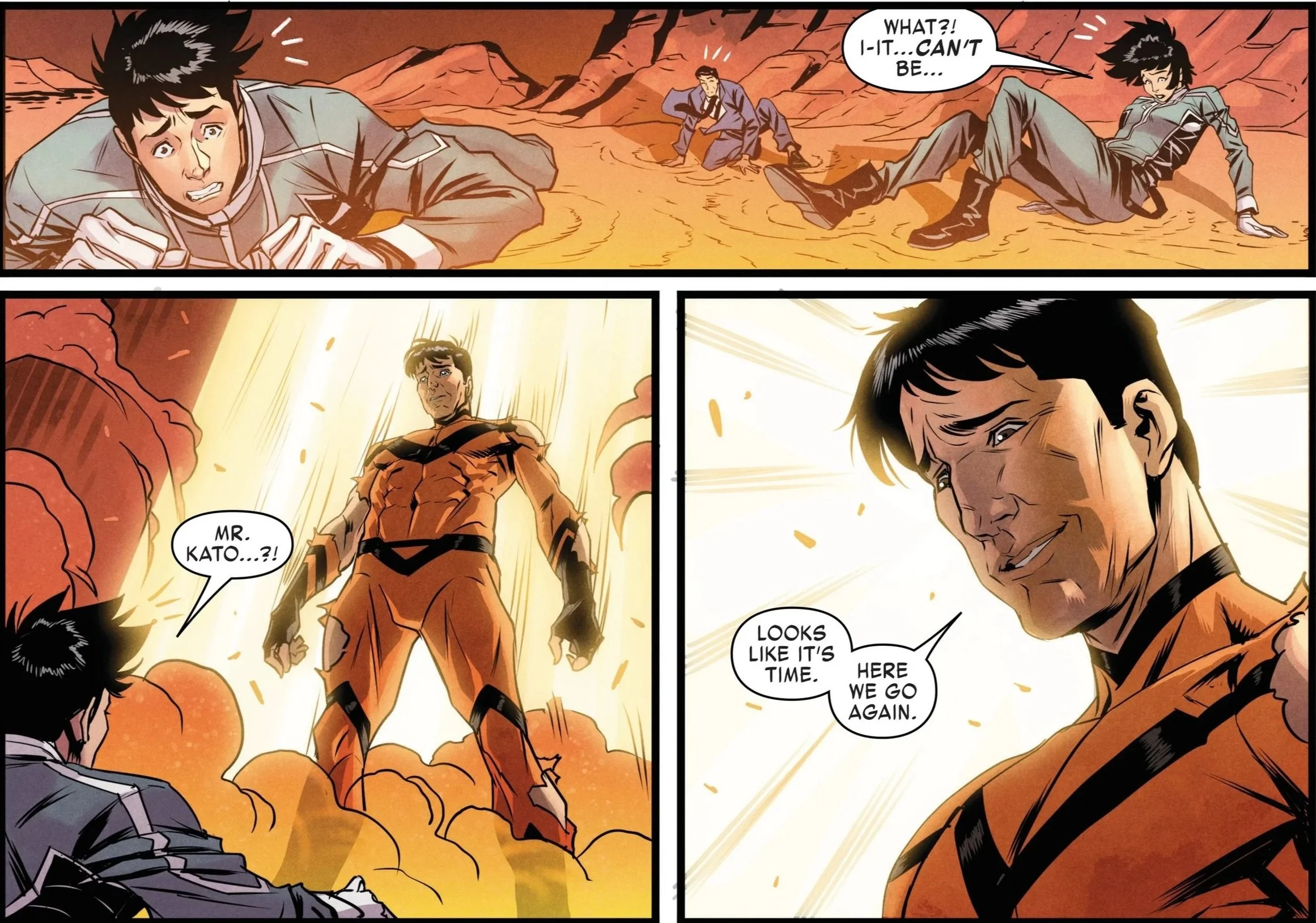
Future Kato arrives to give us our exposition dump.
The present-day plot centers on Shin Hayata and the Ultra Guard as they struggle to stop Morheim, the secretly alien director of the United Science Patrol. Hayata’s frustration is palpable. For all of Ultraman’s cosmic power, they still cannot seem to decisively corner this threat. The tension is not merely external. There is a sense that Hayata feels the weight of every failure more heavily now, knowing how much rests on the bond he shares with Ultraman.
That stalemate is broken when a future version of Dr. Kato arrives with answers, pulling the narrative into a vision of what may lie ahead. From that point forward, the issue becomes something much bigger in scope. The majority of the action unfolds within this possible future timeline, delivering exactly what the title promises. Ultraman battles towering kaiju, and he clashes with cosmic entities that feel closer to gods than monsters. Entire cityscapes crumble, and space itself feels unstable under the force of these confrontations.
There is no shortage of spectacle here. If anything, the book almost overdelivers on that front. The problem is not a lack of action; it is density. The future vision contains what feels like four or five issues’ worth of story compressed into one. Major sacrifices, emotional turning points, and cosmic revelations come in rapid succession. Each beat is strong on its own, but they move so quickly that you barely have time to process one before the next arrives. It creates an experience that is thrilling in the moment, but slightly unsatisfying in hindsight. The story is epic, but breathless. It feels like it needed more pages to truly land.
Unity Above All

All the Ultras take on the kaiju shooting out of Bullton.
Where Higgins and Groom truly succeed is in capturing Ultraman’s core theme: unity. The partnership between Hayata and Ultraman remains the emotional center of the story. Their bond is not treated as a gimmick or a convenient power source; instead, it is framed as a shared responsibility. Hayata is not merely a host. He is a partner. That distinction matters.
The Ultra Guard also plays a meaningful role, reinforcing that this has never been a one-hero narrative. Even in the midst of cosmic chaos, the story consistently returns to collaboration and trust. Humanity is not portrayed as helpless. Instead, it is depicted as an active participant in its own survival. That perspective has always been central to Ultraman as a concept, and this issue honors that legacy.
The theme extends outward to the broader community of Ultras. By the end of the issue, the decision for the Ultras to continue partnering with Earth feels less like a plot twist and more like a reaffirmation. Humanity shapes Ultraman, just as Ultraman protects humanity. The relationship is reciprocal. Thematically, it works. Even if the pacing stumbles, the message lands. The heart of the story is intact.
Cosmic Scale, Personal Stakes
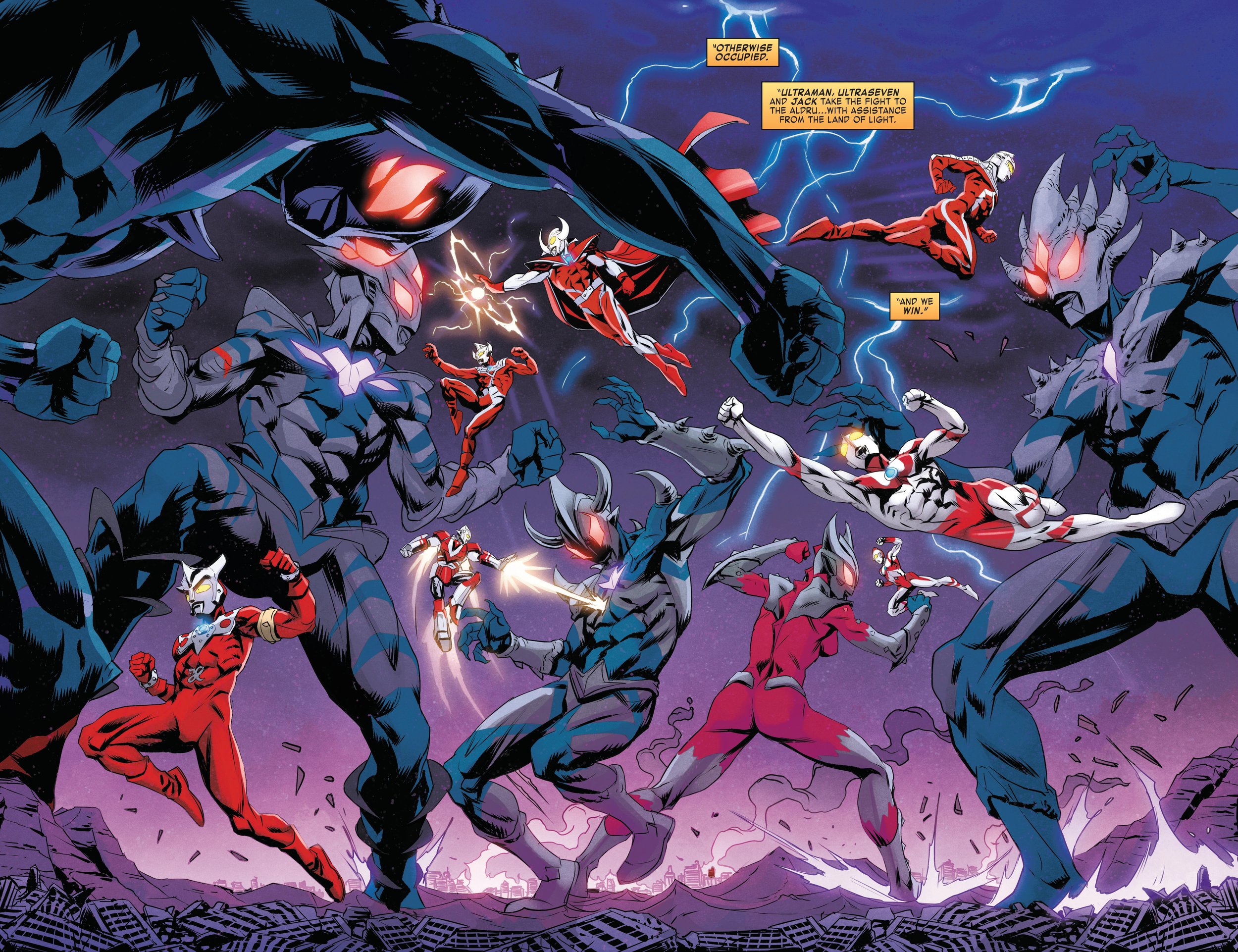
The Ultras take on the Aldru for the fate of the Earth.
A character like Ultraman demands an artist who can handle grandeur, and Davide Tinto absolutely rises to the occasion. The splash pages are easily the highlight of the issue. Kaiju loom with intimidating mass, and energy beams slice across panels with violent brilliance. When Ultraman stands against godlike threats, he feels both small against the cosmos and impossibly defiant within it. The scale is exactly what you would hope for in a book titled The Fall of Ultraman.
Colorist Espen Grundetjern enhances that scale by giving each Ultra a distinct hue, reinforcing their individuality while maintaining their shared identity as beings of light. Letterer Ariana Maher adds another subtle layer by differentiating how the Ultras speak. Ultraman’s words carry his signature red-and-white presence, while the other Ultras glow with a golden tone befitting cosmic entities. These are small artistic decisions, but they support the larger themes beautifully.
Yet, even here, the compression issue returns. Some of the biggest emotional beats occur on stunning splash pages that beg for follow-up quiet moments. Instead, the narrative moves quickly to the next escalation. The art sells the magnitude of the events, but the script does not always allow those moments to breathe. The result is a finale that looks enormous, but feels slightly rushed.
Final Thoughts and Rating
The Fall of Ultraman #1 is not a failure. Far from it. It contains powerful ideas, impressive visuals, and a clear understanding of what Ultraman represents. Higgins and Groom clearly care about this character and the mythology they helped build within Marvel’s line. The themes of partnership, sacrifice, and unity are handled with sincerity and respect. The art team delivers spectacle worthy of a cosmic finale.
But as a closing chapter, it feels constrained by its page count. The emotional beats arrive too quickly. The sacrifice feels meaningful, but not quite as devastating as it could have been. The scale is there. The heart is there. What is missing is time. More pages. More space. More room for the fall to truly land.
That tension is why this lands at a 7.5 for me rather than something higher. I admire it. I enjoyed it. I just cannot shake the feeling that it could have been greater with slightly more room to unfold. It is an ambitious finale that understands Ultraman’s legacy, even if it does not fully capitalize on its own potential.
Rating: 7.5/10
I just wish it had been more, well, more.
Promo Line: “[The Fall of Ultraman #1] delivers the scale you expect from a finale, yet leaves you wishing it had allowed its biggest moments more space to resonate.”