
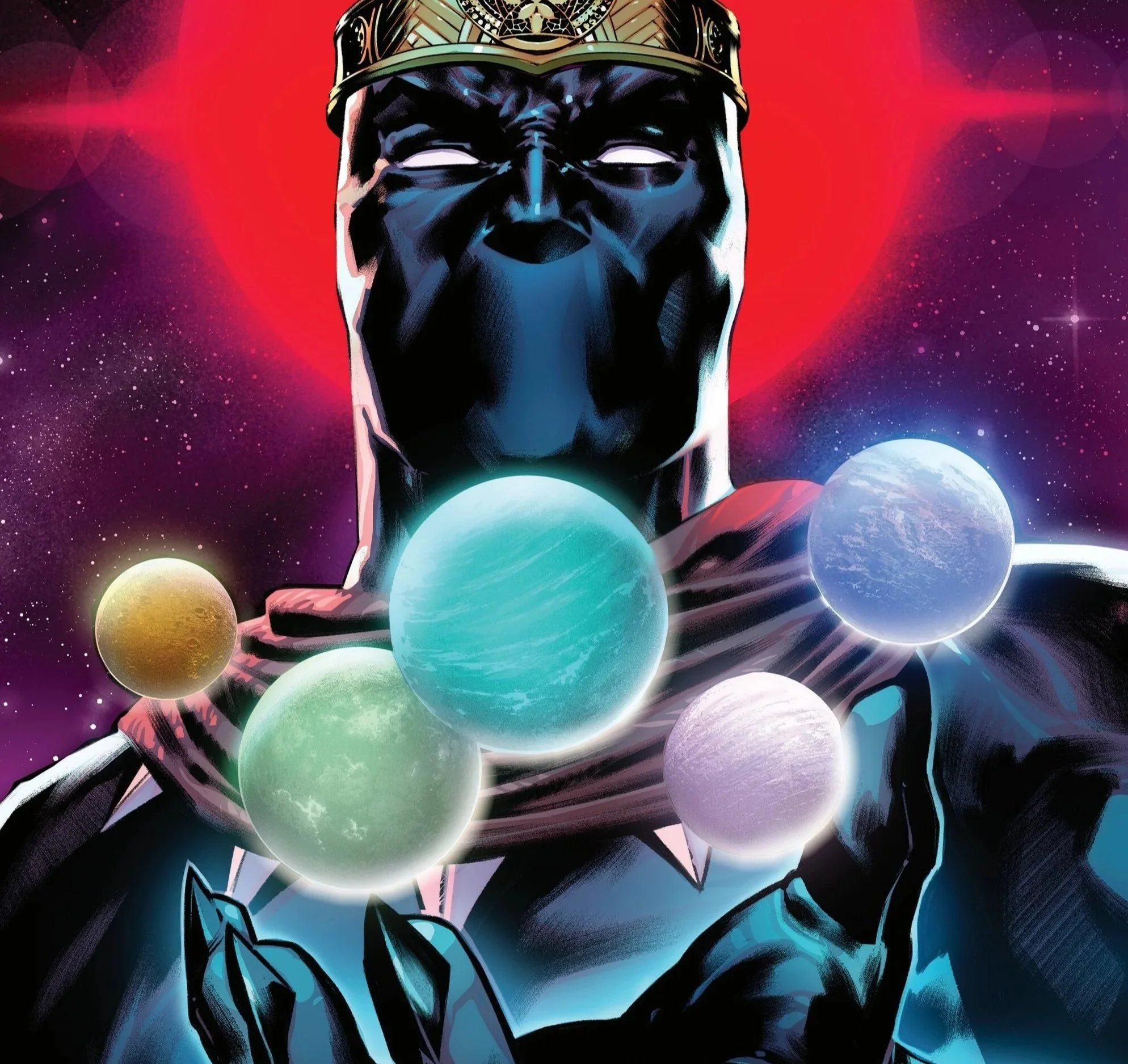
So here we are, finally, at the abrupt end to this little run of T’Challa’s latest cosmic foray. What did he accomplish here that was particularly space faring and could’ve just as easily been told on Earth? I dunno, not much really. Were there some interesting concepts to be told here? Sure, who doesn’t love a story of mechanized constructs mimicking heroes you know with a weird world-mind type AI doing strange stuff. Was this story cut short? VERY, considering Marvel editorial’s baffling reason to kill off all the post-Imperial books before they even really had a chance to get going anywhere interesting. Was this a satisfying finale? Not in the slightest.
From the beginning of this run, Black Panther Intergalactic was already fighting a pretty large uphill battle with a story that had a lot of ambition but almost little to nothing in terms adding anything really new. That battle got steeper with each issue offering even less than the last, and now here we are the unceremonious finale in issue #4 where all these plot points from before come to a head…and then get almost immediately thrown in the gutter. It's a truly disappointing end, even by rushed cancellation standards, and just goes a long way in reminding readers of just how lifeless this series was from the word go.
Planetary Peril
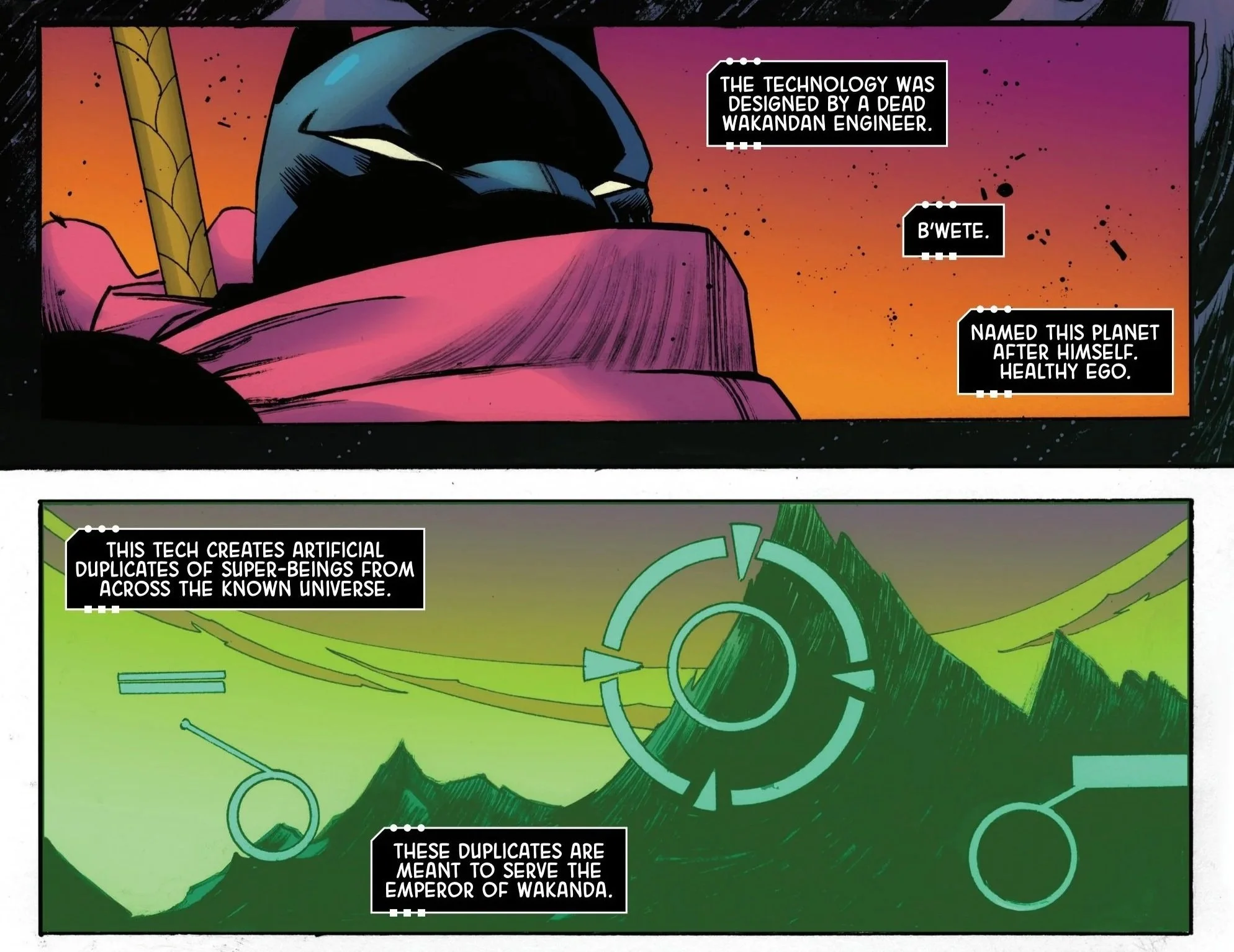
Our “thrilling” finale picks up on multiple fronts with T’Challa racing for the mountain at the heart of Planet B’wete. There resides the core of the technology that’s been terraforming the planet and is responsible for creating all the villain+Black Panther robot hybrids that have been popping up since T’Challa got here. But he’s not the only one headed there either. On the one hand, Shuri also makes a quick escape from Femi and Juggernaut-Panther (who also decide to follow her). On the other hand, the robo-clone T’Challa is also on the way to the mountain, determined to capture its power for his empire and to kill the real T’Challa and become the one true ruler of the Intergalactic Empire of Wakanda. Oh, and M’Baku shows up in a robot gorilla suit, so that’s definitely pretty cool too.
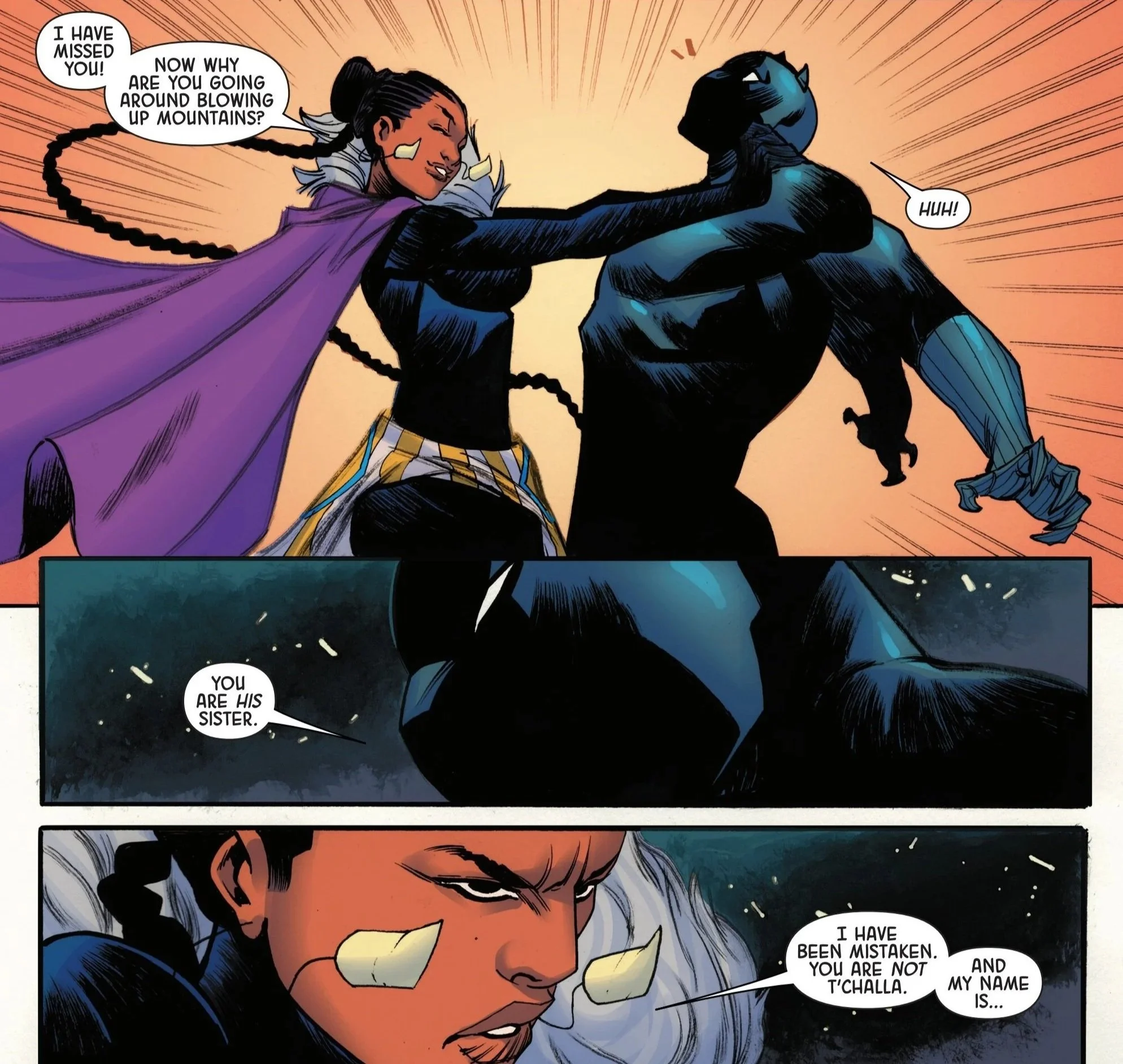
T’Challa makes it to the mountain first and finds a couple more Black Panther clones, this time resembling Archangel and Emma Frost, the former of whom he quickly incapacitates in a deadly aerial duel. At the same time, Shuri runs into the Robo-Imposter T’Challa and quickly figures out he’s not her real brother (he doesn’t really do a good job hiding it either). They get down to some quick semi-sibling rivalry and just when it looks like Robo-T’Challa has the upper hand; M’Baku shows up to save the day literally knock the fake king’s head from his shoulders. All that big talk about being the one true ruler and everything in the last issue? Yeah all that’s done, barely an inconvenience. Eventually, all our players are reunited: Femi, Shuri, M’Baku and T’Challa are all together, surrounded by the Robo-Panther Clones who are now loyal to Femi as part of his father’s failsafe. Whatever happened to Femi being mad and blaming T’Challa for his father’s death? Not really much, because all of that is forgiven in two shakes of a panther’s tale as Femi hands T’Challa the Planet’s core to do with what he will. T’Challa chooses to destroy it instead of using it, citing some noble kingly stuff. The book ends with T’Challa and his new army of pantherized-clone-robot bodyguards joining his empire and swearing to uphold peace and protect the empire from all who oppose it. And yes, that ending is exactly as abrupt as it sounds.
Thy Name Be Mish Mash
Look, I honestly can’t be too harsh on Victor LaVelle for the kind of situation he was put in. There was clearly a plan for a much larger, more logically drawn out storyline for this book, and to have that cut down to four issues is enough to derail any story. That being said, Black Panther – Intergalactic #4 does a good job wrapping up everything in a somewhat cohesive manner, even though the tools it had to play with were flawed from the very beginning.
As I’ve stated since the first issue of this series, there’s no real new ground being treaded here. It’s a story we’ve seen T’Challa go through a hundred times over, and the rushed cancellation of that only further exposes the cliches at the heart of this narrative. LaVelle may have had some lofty space-based concepts that cribbed off of Blade Runner or Forbidden Planet, but none of them could ever reach the point of anything beyond lazy parodies even before we reached this rushed curtain call on the series. But issue #4 in particular really brings out the worst in every character, with literally no consistency between issues for almost any of our characters. T’Challa himself is fine and stoic throughout this series, but that’s all he is. There’s really no new lessons learned. No new challenges faced – either physically or emotionally. And there’s certainly nothing of value being said here either, which is the real travesty in a book about Black Panther.
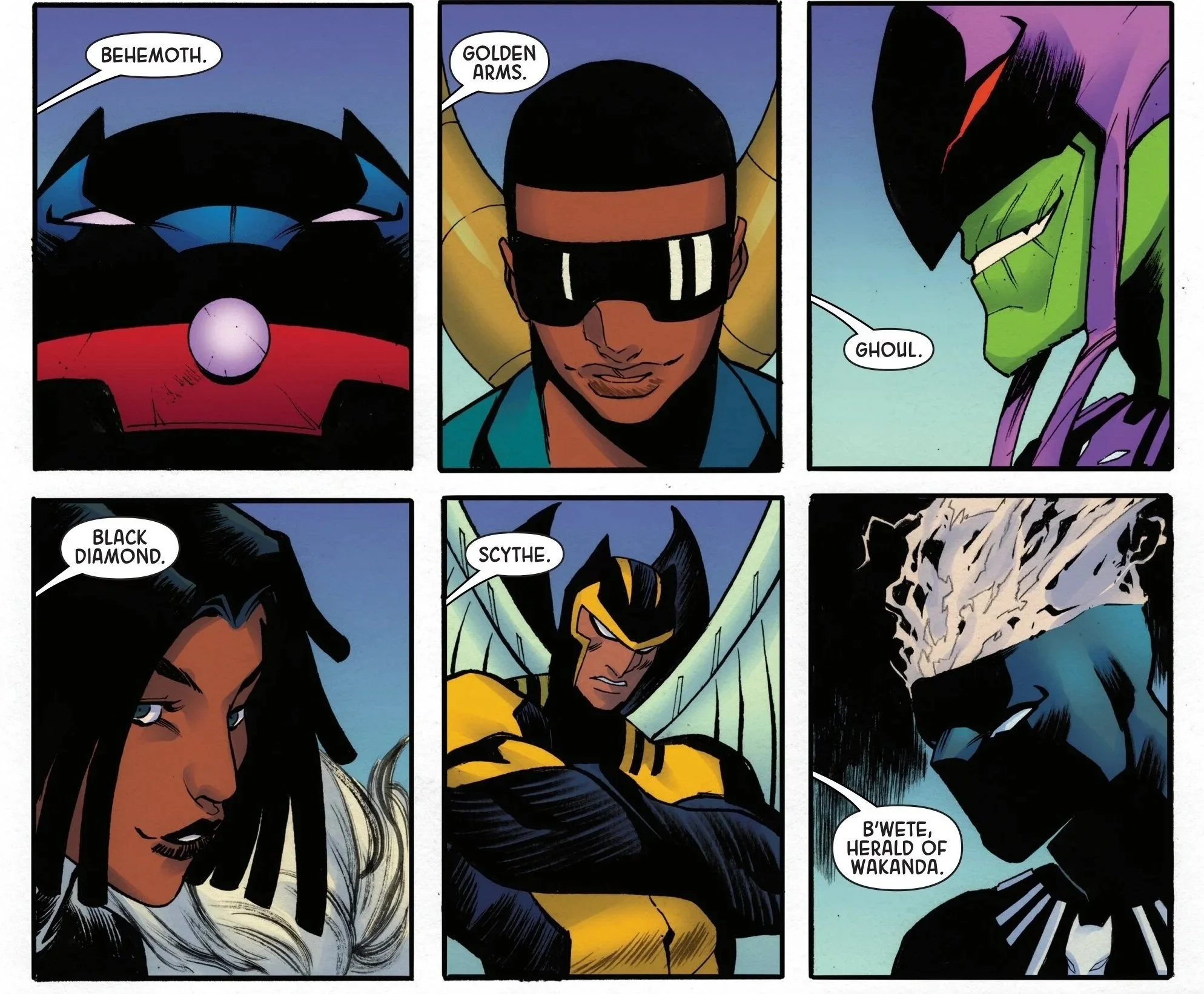
Every other character in this issue seems to have done a complete 180 since their appearance in the previous issue. Femi, who seemed all set to betray Shuri and T’Challa to exact revenge for his father’s death with his new robo-army literally just goes back to how he was in issue #2: supportive and understanding of the King and willing to let him make the right choices. We never did get any of Juggernaut-Panther’s threats of “making the King pay” because he’s simply a walking novelty, like all the other Pantherized-androids are. They’re literally only there for shock value by the end of this book and it shows when the six panther-bots are given new codenames and made honorary Wakandan Avengers or whatever. It looks and feels like that montage scene from the Suicide Squad movies, and all the more goofier because Transformers: The Last Knight already ripped this off too. It’s so glaringly weird, more so because I’m sure they’ll be integral to any future Black Panther stories. Shuri and M’Baku are also next to useless, doing the bare minimum and contributing even less than that to the narrative. But the worst of all is the imposter T’Challa, who was posturing and bragging to the Galactic Council about how he could be the best ruler for Wakanda. Heck, he even had his own literal satellite network to broadcast his big attempted murder of T’Challa. But the guy doesn’t even make it to the king. In fact, he gets destroyed in a heartbeat by M’Baku with barely any real effort. Yes there’s some lame MCU-levels of humor about whether M’Baku even know if that was the real T’Challa or not, and some lamer insinuations about how the other councils would react to seeing the “king” being killed, but these are handwaved away so quickly, you’ll get whiplash from the rush of it all.
Black Panther Intergalactic #4 is mercifully fast, but utterly a necessary end to this series which was honestly doomed from day one. As I’d mentioned in my review of the first issue, there was a lot that could’ve been said about how Wakanda was now in the position of a colonial power in the cosmos – an antithesis of what it represents on earth – and how that would affect T’Challa and the nation on a psychological and storytelling level. But LaVelle’s choice to make this a by-the-numbers, lazy, trope-filled pastiche of far better stories from both science fiction and Black Panther history was always working against the narrative, even without the abrupt cancellation.
The Final Saving Grace
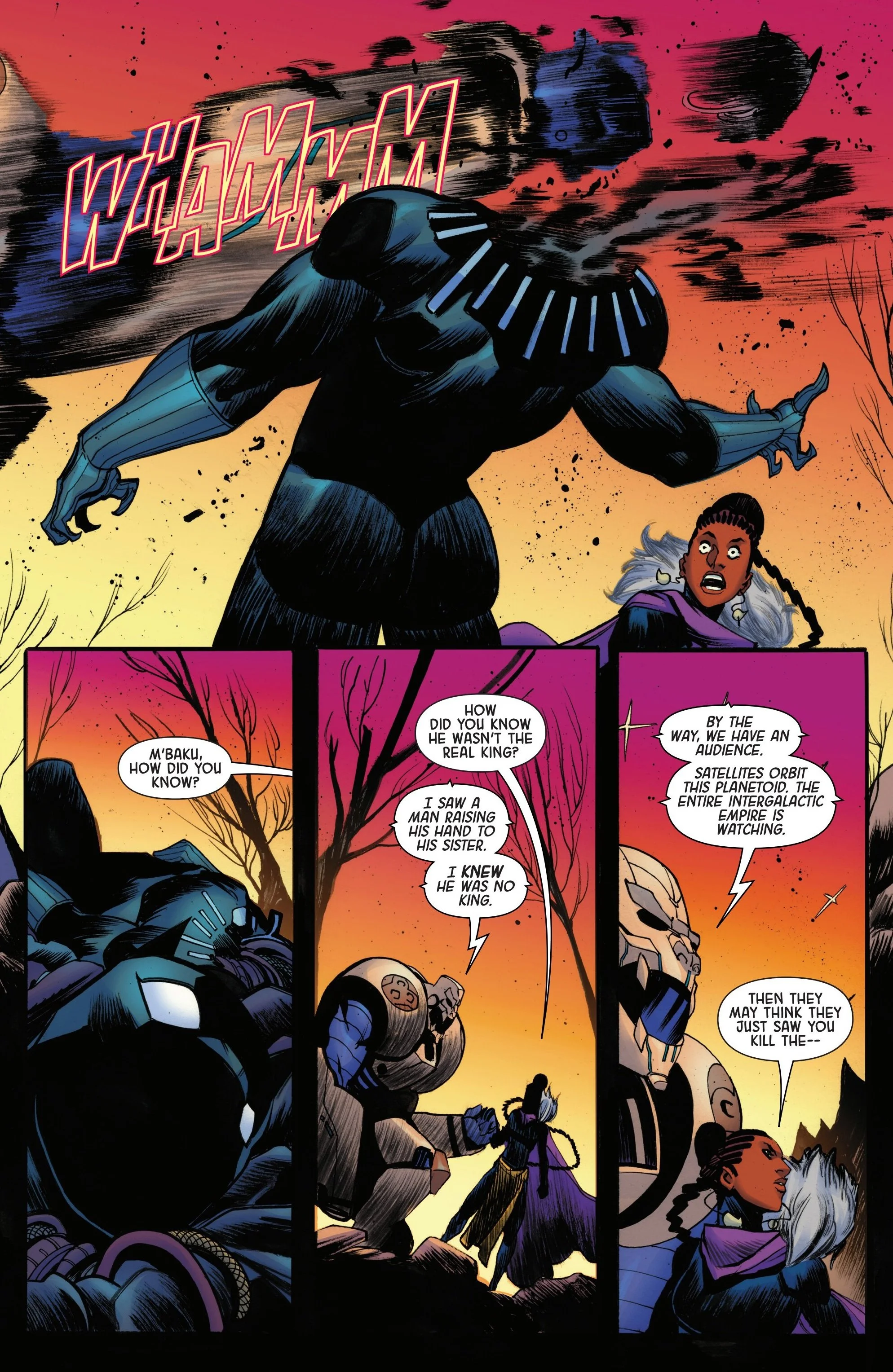
Fortunately, and also unfortunately, this is the last big hurrah for Stefano Nesi and Brian Valenza on lines and colors respectively. Over the course of this series, their distinct artstyle has been a consistently positive point for the most part, emphasizing the truly unique visual identity this book has. And that stylized fluidity continues to shine through even in this issue.
Nesi draws every action piece – and there are lot of them – with the kind of kinetic flow you’d appreciate from a Black Panther book. T’Challa’s look for this book is bound to become iconic, even if this adventure becomes a footnote. And that is solely due to how much heavy lifting Nesi’s designs do in capturing the King’s aura. There’s such a powerful sense of menace and authority that the art conveys for T’Challa which covers for the bland writing. Similarly, as goofy as the robot doppelgangers have been, they’re still interesting designs that combine T’Challa’s aesthetic with classic villains we all know. It’s…an interesting experiment to say the least, but one that I do admire to an extent. If I do have one criticism of the art, it’s that the facial expressions really aren’t up to par, with everyone looking too rigid and stoic and expressions blending together to the point where everyone just looks the same a little too often.
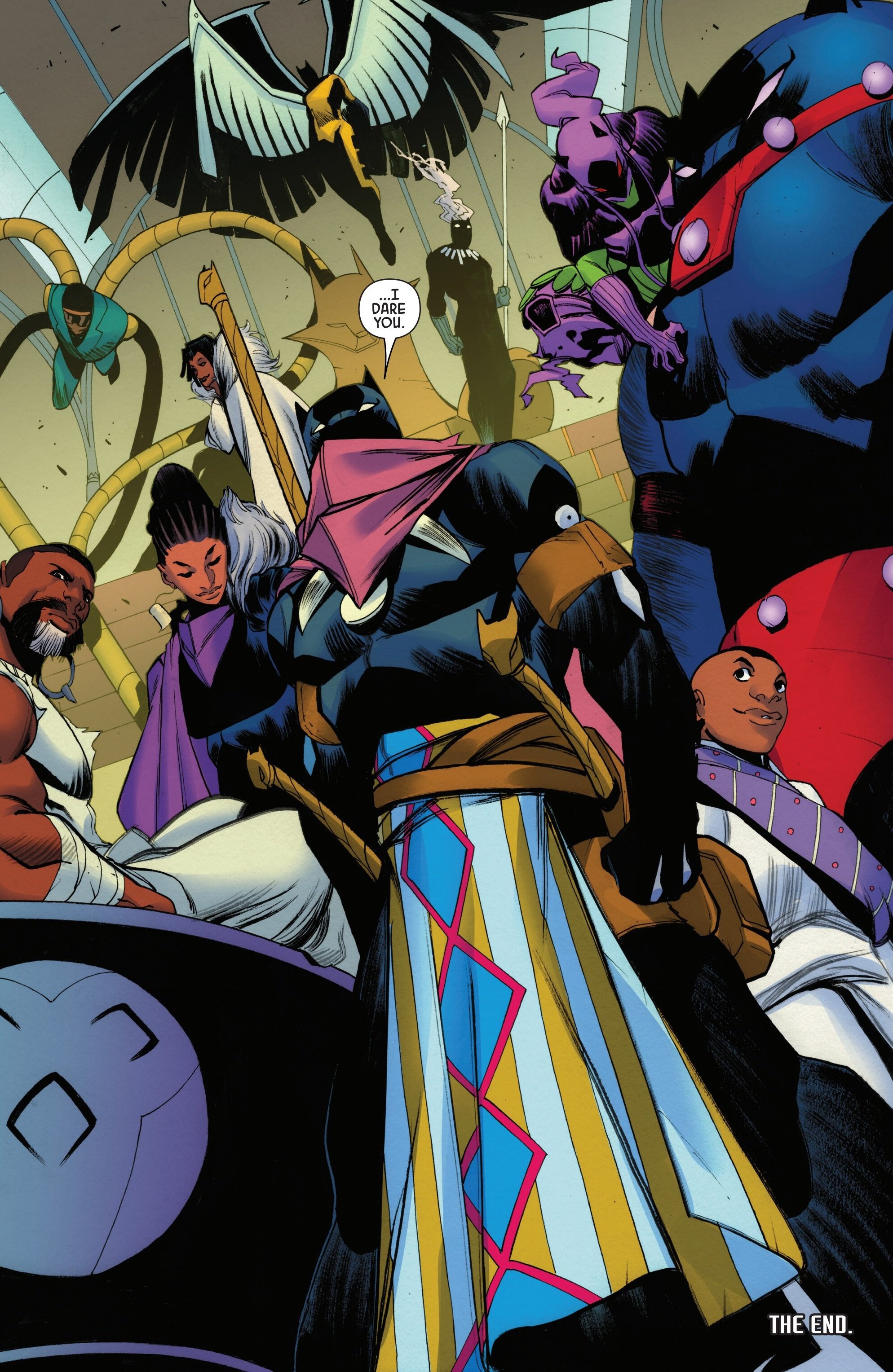
Valenza’s bold use of colors is also exceptional once again, providing the perfect mix of lights and darks that complement each sequence. There’s a lot of purples going on as usual, and its’ become such a visual treat seeing these weird, alien-esque color blends mixed with the more native tones of T’Challa’s clothing or Wakandan tech. The alien planet itself still feels ominous enough with Valenza’s lighting as does its inhabitants who have just the right shades to match the familiar and the uncanny nature of their existence. As far as final acts go, the art department really does hold this issue and this series up by the ears and at attention.
Lost Galaxy. Lost Oppurtunity
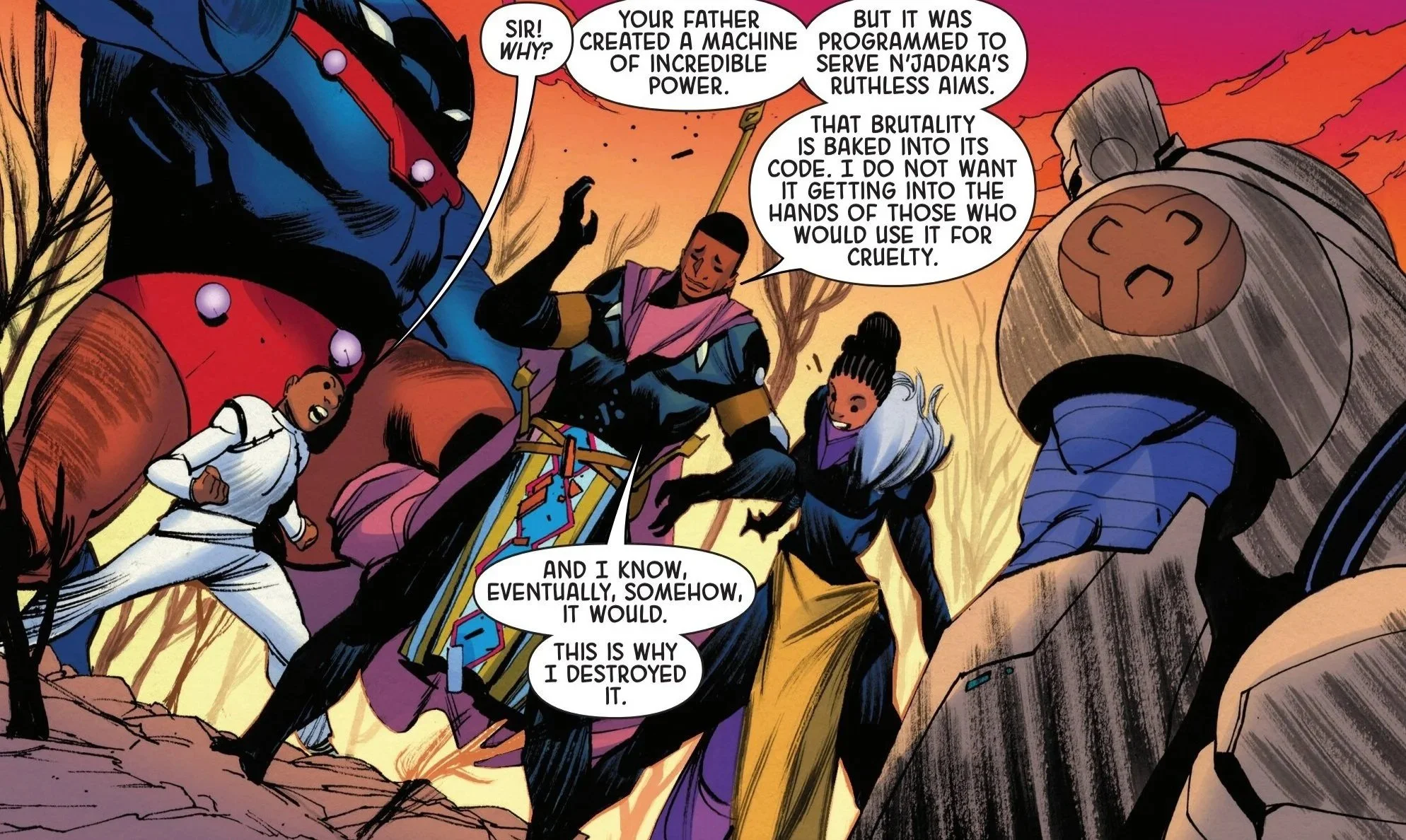
Black Panther Intergalactic #4 wraps things up about as best as it can under the circumstances it was given. There’s really, honestly, not much to say beyond that because we’ll truly never know what the bigger picture was for this or really any of the post-Imperial cosmic Marvel books that found themselves on the chopping block. It’s tragic. It’s infuriating even. But at the end of the day, I don’t’ personally think that this series was off to a great start to begin with.
T'Challa’s far too popular to be out of the spotlight for too long, so I doubt he won’t have his own book very soon again. But I can’t help but lament that even with the cosmic setting they had here, choosing to go with such a bland, derivative narrative was such a waste of one of Marvel’s most iconic characters and all the lore and even real-world messages he represents. Whatever comes next, I hope the team working on it has the reach to match their ambition, and that their ambitions stretch their creative legs just a tad bit more, so to speak.
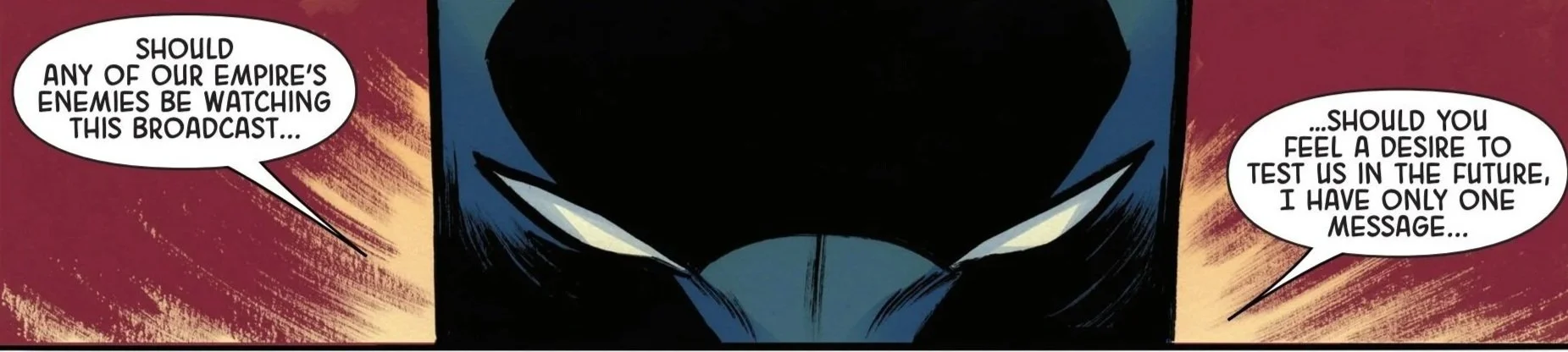
Final Verdict: Black Panther - Intergalactic #4 has the curtain brought down on this short-lived, exhaustingly mundane space-age adventure which feels so utterly uninspired and chaotic and offers precious little beyond some exceptional artwork.