
The Bat-Man The Second Knight : Book One
Author : Dan Jurgens
Artist : Mike Perkins
Colourist : Mike Spicer
Fear Wears A Mask : Book One Summary
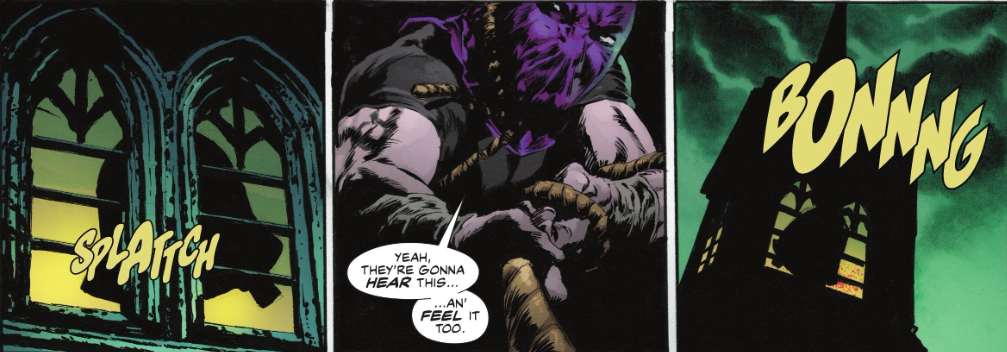
After reading through The First Knight to prepare for my review of Dan Jurgens’ second installment in this DC Black Label series, I was incredibly excited. The plot structuring, gritty atmosphere, and noir detective direction Jurgens established previously were top-tier, and he most definitely delivered in Book One of The Second Knight.
Jurgens sets the stage for a wild ride with a blistering beginning—introducing old foes with new threats and old allies with unknown motives. In contrast to the deliberate setup of The First Knight, Jurgens quickens the pace right from the start. This makes perfect structural sense; the world-building is finished, and we have already been introduced to his specific representation of a rookie Bruce Wayne.
In The Second Knight, the Bat-Man is faced with more gruesome murders, but this time they involve innocent Gothamites. This maintains continuity with the political murders of the first volume while focusing heavily on Bruce’s detective skills in another thrilling noir narrative. These murders are seemingly random, and we are introduced to a deviant serial killer whose monstrous acts left me eager for the inevitable encounter with the Bat.
This main plotline, alongside two great reintroductions of familiar characters, combines to create a gripping "Bat-gumbo" that I absolutely loved the taste of. This is a must-read for older audiences, as the Black Label scope allows for mature content that hits harder than a Batarang.
Dawn of The Knight : What Happened In The First Knight
Dan Jurgens’ The Bat-Man: The First Knight drops us into a 1930s Gotham that feels raw, frightened, and on the brink—a city still learning what it means to have a Bat-Man lurking in its shadows. This isn’t the polished myth yet; it’s the prototype.
The story unfolds as Gotham is rocked by a string of brutal murders tied to organized crime, corruption, and the quiet rot at the city’s core. Bat-Man operates more like a noir detective than a superhero here—interrogating crooks, stalking crime scenes, and piecing together clues—while trying to stay ahead of both the police and the killers. Jim Gordon stands as one of the few moral anchors, slowly realizing that this masked vigilante might be Gotham’s last line of defense rather than its greatest threat. The tension isn’t just about catching the killer; it’s about whether Gotham is ready to accept the Bat-Man at all.
What makes The First Knight so engaging is how Jurgens tells the story rather than just what the story tells us. This is classic Dan Jurgens: clean, deliberate plotting and a steady escalation of stakes with a Bat-Man who solves problems through grit, deduction, and moral resolve rather than spectacle. Jurgens leans into a Batman shaped by the era he lives in—the late 1930s, pre-WWII, in a wartime Gotham with a fearful public and criminals emboldened by chaos. There’s no rush for mythology or bombast; instead, Jurgens lets the Bat-Man earn his legend one brutal night at a time. Every confrontation feels grounded, and every victory is hard-won, reinforcing the core idea that Bat-Man isn’t a symbol yet—he’s becoming one.
The First Knight isn’t about Gotham believing in Batman; it’s about Batman believing in himself and proving to the city that fear can be aimed in the right direction. Gotham doesn’t need saving once—it needs watching over forever. The Bat-Man doesn’t “win” here; he commits. And in doing so, he accepts that this city will take pieces of him every time he answers its call.
Familiar Foes, Old Allies & Signature Storytelling : Book One Review
WARNING SPOILERS!
Hunted & Haunted
Taking place one year after the events of the first story arc, our boots are firmly planted back in the mud and shadows of a late 1930s Gotham. I very much like the Gotham that Jurgens has built for this era. While it has been explored before in DC Elseworlds stories, Dan Jurgens successfully transports the reader to this specific time period. It is an uncertain, anxious, and emotionally charged era, with the world on the brink of WWII—a setting that feels hauntingly relevant today.
As I mentioned in my summary, Book One of The Second Knight kicks off in fifth gear. Jurgens creates terrific tension by diving straight into a kidnapping and an elaborate murder. This hooked me immediately, and more importantly, it provides a strong entry point for a reader who may or may not have read The First Knight. Kudos to Dan Jurgens for that; after all, don't we want more people reading comics?
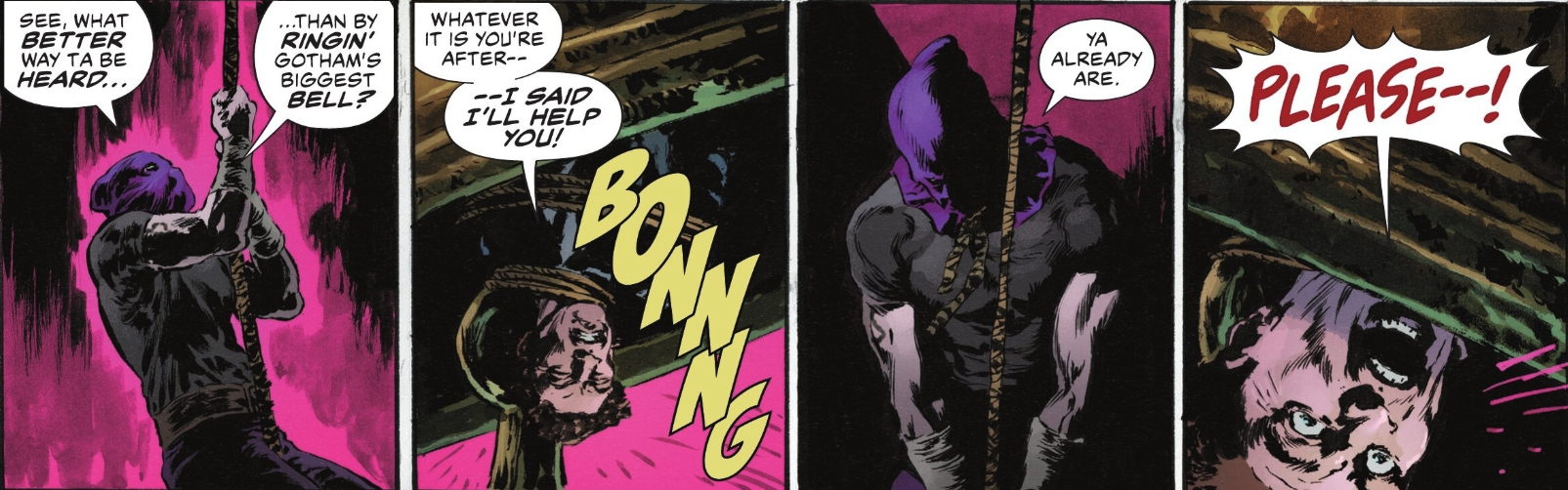
We are introduced to a murderous psychopath wearing nothing but a purple rag, tightened with a noose to hide his identity. For me, this "costume" was a masterful touch; the simple shell conceals a complex, vicious, and gruesome interior. The victim, Robert Fishman, was a good man who ran a soup shelter for kids; Jurgens makes you feel for the character by providing that short, effective context. This man was killed by being tied to a bell and literally being "rung" to death. The archaic approach to this serial killer is simple and effective—reminding us not to judge a book by its cover. His simple outfit stands in dark contrast to his twisted psychological motivations.
That simplicity is what makes Book One such a great read. Are there underlying messages a reader can take from the Dark Detective’s story? Yes—but as a reader, I was able to sit back and dive cowl-first into a gripping and thrilling noir detective story. I loved losing myself in a Bat-Man chronicle during one of his early cases: raw, uncharted, and unpredictable.
A Grounded Bat & Questioned Commissioner
Most readers know the lore behind Batman: his origin, his rogues' gallery, and how he operates. Many of those readers will be privy to Batman: Year One by Frank Miller (a must-read for new fans), one of the most influential stories ever written. It gave us a Bruce Wayne and Batman who are fallible, inexperienced, and still figuring out who they want to be.
Dan Jurgens builds upon this human depiction of our Caped Crusader, allowing me as a reader to become intrinsically invested in the character and storyline. By showing us that Bruce is more Man than Bat, you feel every fall, punch, and wound he receives. I found this to be a welcome change; it shows the reader that even the "great symbol to be" didn’t always have everything figured out.
This plays out in Book One, as Bat-Man doesn’t have all the answers. He’s not the perpetual planner we all know and admire, and he doesn’t have the fancy gadgets—because it’s 1939! For that reason, Bruce’s co-protagonist is just as important in building this story: Jim Gordon.
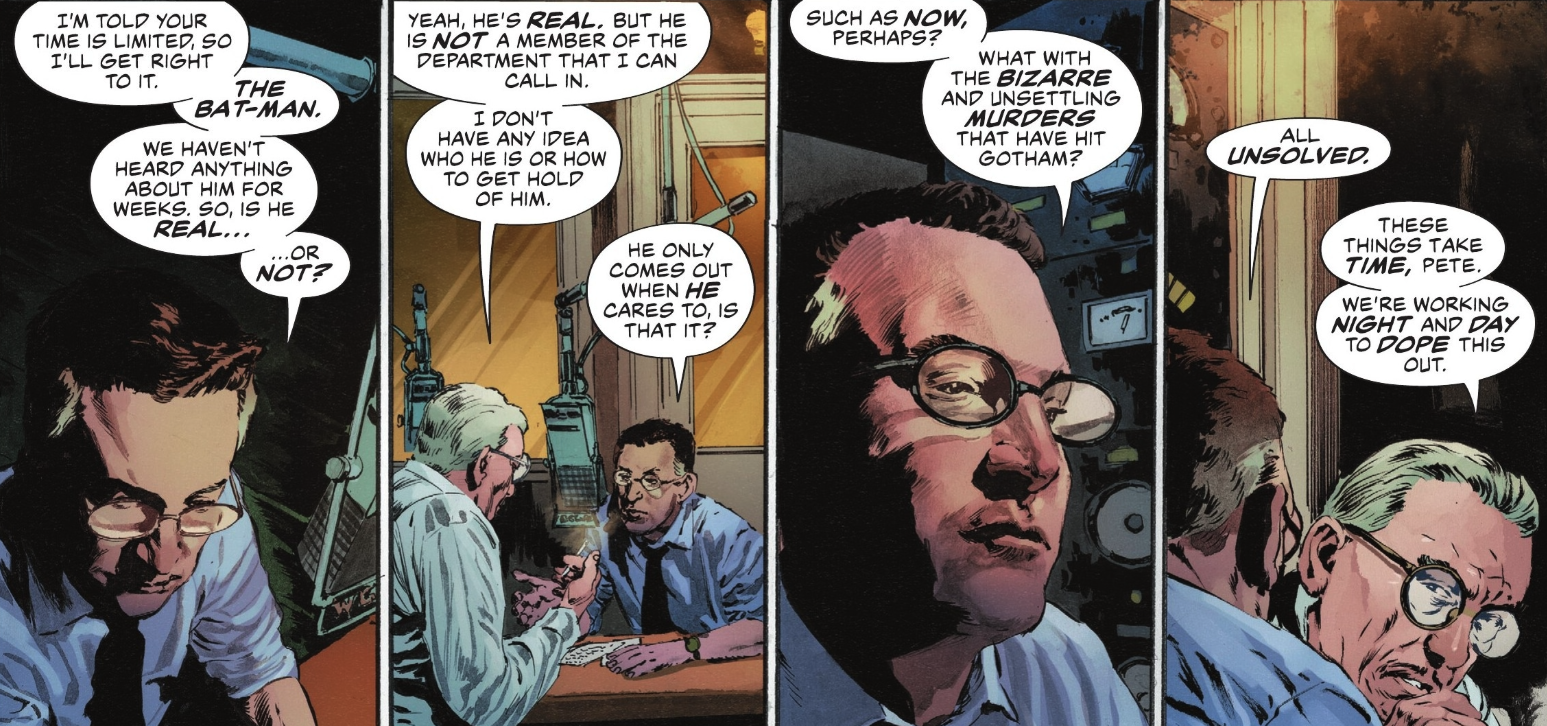
Jim’s involvement is fantastically written, as he is essentially the other half to Bat-Man. While Bruce works in the shadows, Jim has to face the public, answer questions from reporters, and steer himself through the political system. Early in Book One, we see Jim being grilled by a celebrity radio presenter: Who is Bat-Man? How is the force going to solve these murders? When will they catch the serial killer? Jurgens does a brilliant job of making Jim the yin to Bruce’s yang—Bruce needs to find the answers, and Jim needs to have them.
Words Over War
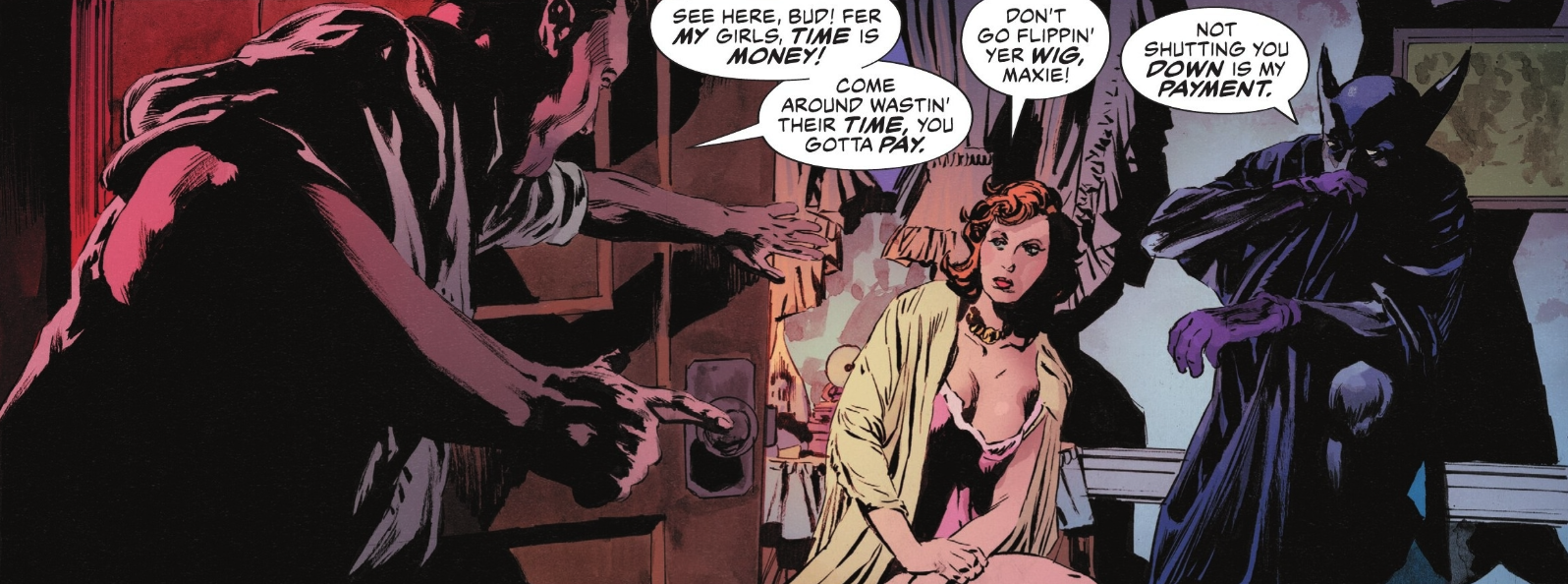
Book One feels more like the setup for the rest of the series. We follow Bat-Man doing more questioning than crime-fighting, which helps the reader feel closer to the story; it makes the experience more raw and real. Jurgens does a great job of highlighting how Bat-Man is still getting to grips with his code—his main source for the "beat on the street" is a man named Maxie Cross, the owner of a brothel. The tension Jurgens builds between these two unlikely allies is palpable, and for me, it spotlights the inner struggle Bruce has with himself by working alongside an illegal racketeer.
Nonetheless, Bat-Man uses Maxie and his worker, Tillie, for information to further his case and his understanding of the murders of these well-intentioned Gothamites. This leads him to discover that the victim, Robert Fishman, was a Jewish man who frequently visited the local synagogue.
Another integral side character in both The First Knight and this first book of The Second Knight is Rabbi Cohen. He provides solace to Bat-Man and represents a more faithful side of this dark and unforgiving Gotham. Bat-Man visits him at his synagogue to look for more details on Fishman, who was murdered with the use of a bell. Jurgens displays how Bat-Man’s fight for justice has no bias or judgment, as he visits two locations at opposite ends of the moral spectrum: from a brothel to a synagogue.
Fear Farmer
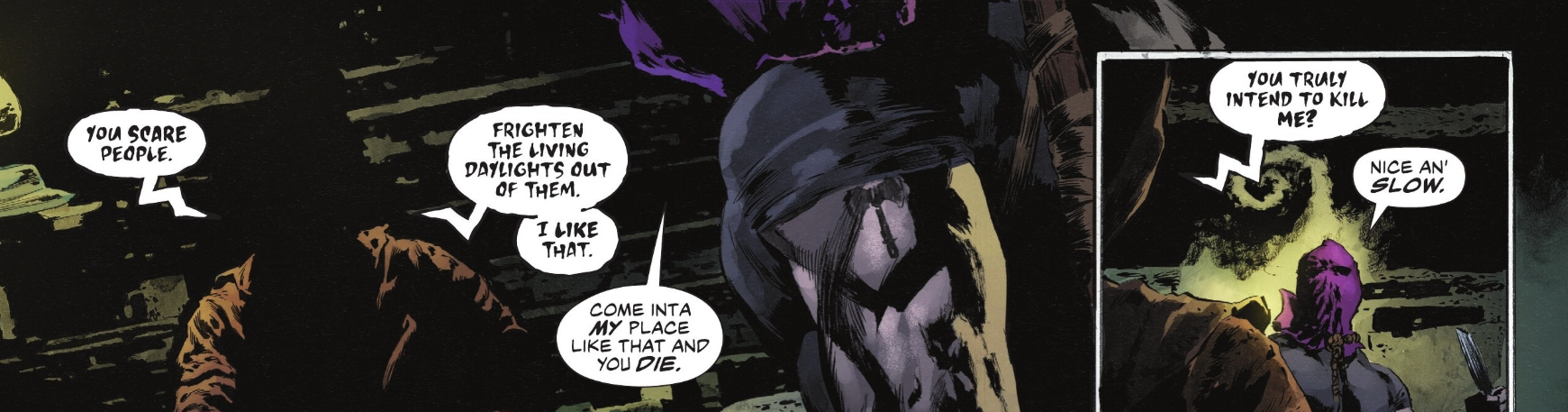
Dan Jurgens has done a fantastic job of setting the foundations for The Second Knight in Book One. Now that Bat-Man has finished his sleuthing, Jurgens pushes the story toward its peak. Remember that serial killer with the purple rag and the noose around his neck? Well, he isn’t the "baddest" man in Book One, as Jurgens allows one of Bat-Man’s most infamous enemies to reintroduce himself. In my opinion, this was expert storytelling; Jurgens had been carefully building an underlying emotional tone throughout both The First Knight and this volume—that emotion was Fear.
And who knows fear better than anyone in the DC universe? The "Fear Farmer" himself, Scarecrow! In a brilliantly crafted shift in the narrative, the "big bad" serial killer is shown frozen in fear, immediately illustrating the villainous pecking order. This serial killer is nowhere near the level of The Scarecrow.
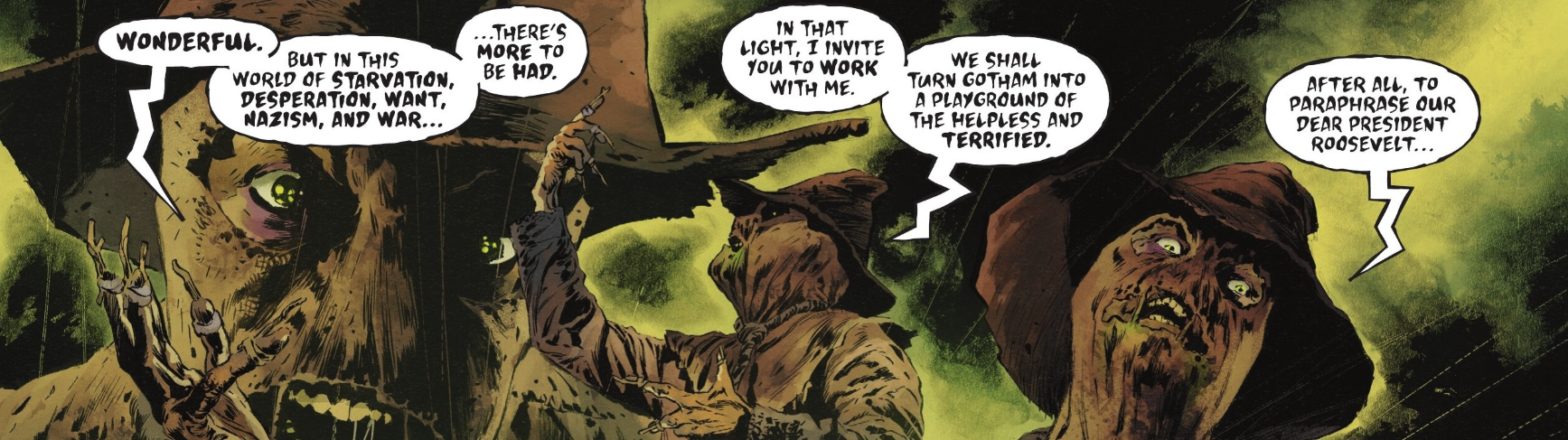
This was a nice and shocking surprise because Jurgens never once alluded to The Scarecrow, but once he is introduced, you have that great "Aha!" moment. However, I was left disappointed after reading Scarecrow’s monologue regarding his grand plan: “We shall turn Gotham into a playground of the helpless and terrified.” This feels like Scarecrow 101, and we’ve seen this plan a thousand times before. I’m hoping that, given how complex and deliberately misleading The First Knight was, Jurgens has a grander narrative to unveil with the inclusion of Crane.
An Unnerving Ending
If Scarecrow’s intriguing entrance felt flat due to his generic plan, the inclusion of a certain legendary reporter brings a new realm of possibilities. Lois Lane is unveiled as a journalist visiting from Metropolis working for The Daily Star. She has been sent to cover the grand opening of the motion picture Night of a Thousand Cuts, starring Bruce’s love interest, Julie Madison. This feels like a very vague reason for a character of Lois’s stature to be included, leaving me to pay close attention to how she will eventually influence the story’s dynamic.
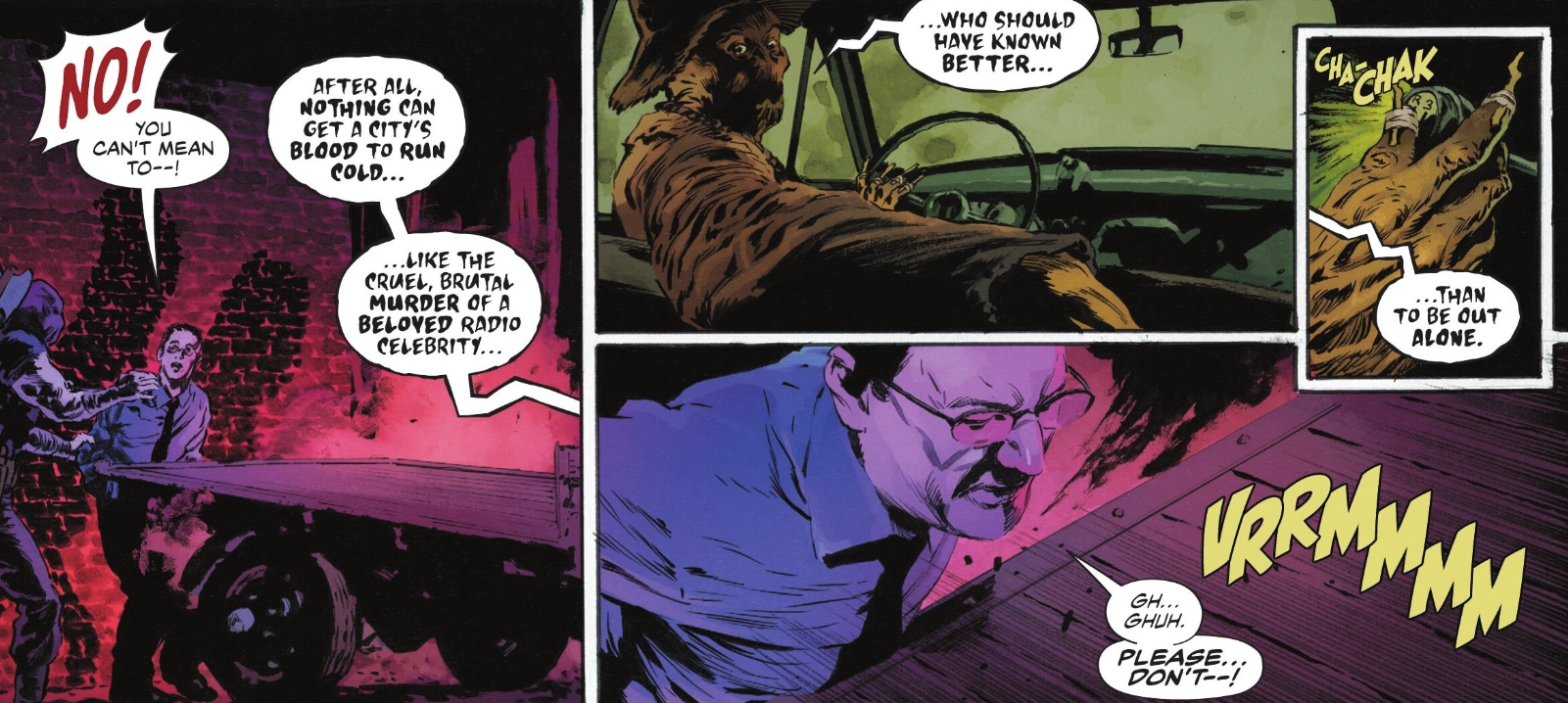
We started Book One in fifth gear, slowed down while we watched Bat-Man follow his clues, and now Jurgens hits "pedal to the metal" for the finish. In an upsurge of violence and a tornado of terror, Jurgens heightens the horror with the shocking murder of Gotham Radio’s celebrity presenter, Peter Cavanaugh. He began Book One by interviewing Jim Gordon and ends it by being literally split in half by a flatbed pickup truck driven by The Scarecrow. The murder is vulgar and visceral; it perfectly reinforces just how vicious this 1930s Gotham truly is.
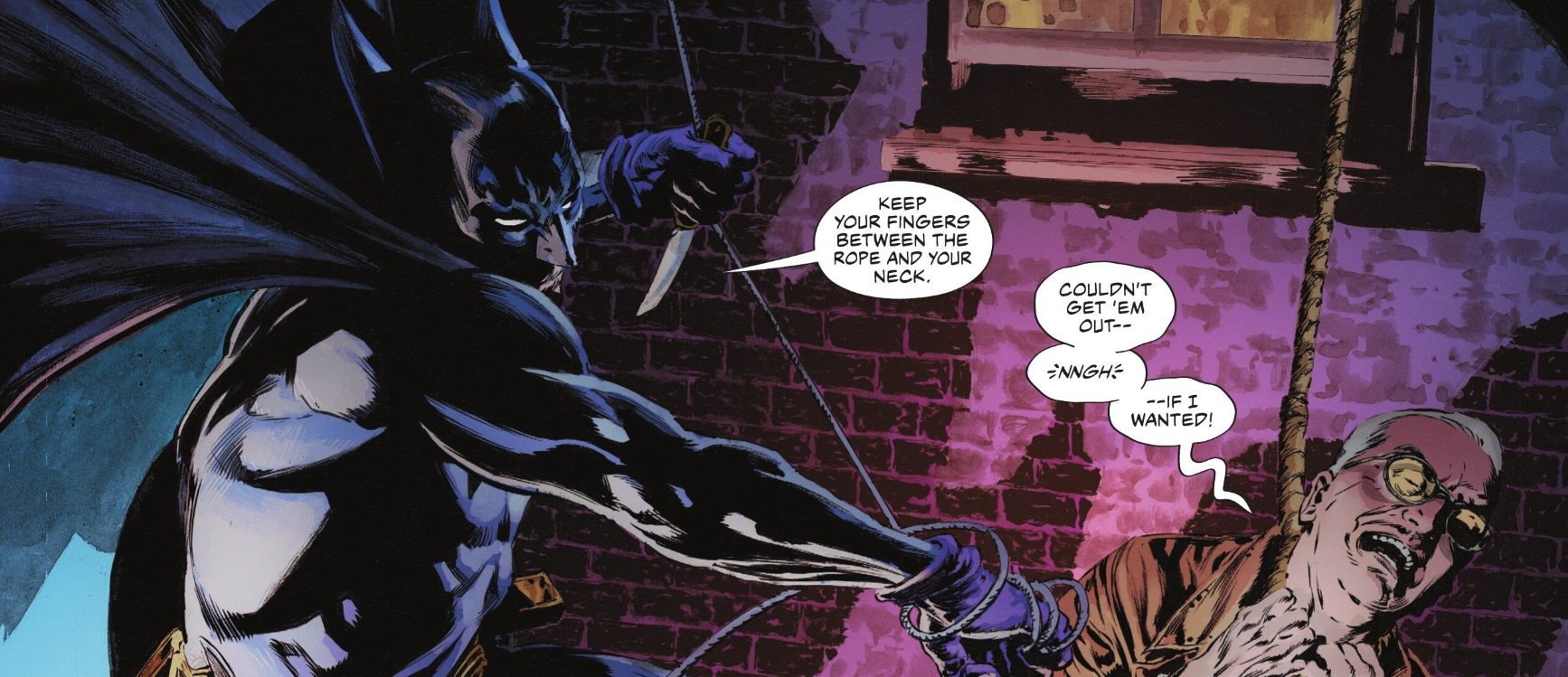
What better way for The Scarecrow to announce himself to Gotham City than to create a spectacle driven by fear and centered on Jim Gordon? Jurgens captures the era perfectly here: a spotlight focused high on a movie billboard as Gordon is thrown off it with a noose around his neck. The moment feels very Phantom of the Opera, befitting the operatic, gothic tone of the 1930s.
We are then thrust into a brutal fight between Bat-Man and the hulking murderer—seemingly Scarecrow’s new muscle. The stakes feel genuine; as I read through the sequence, it felt like Bat-Man was in true peril. He is wounded by a knife that narrowly misses his kidney—a small but vital moment. It reminds us that this is not a fully-fledged, modern Batman who has fought gods across time and space. This is just a man in a cowl and cape, doing his best to survive a night in Gotham.
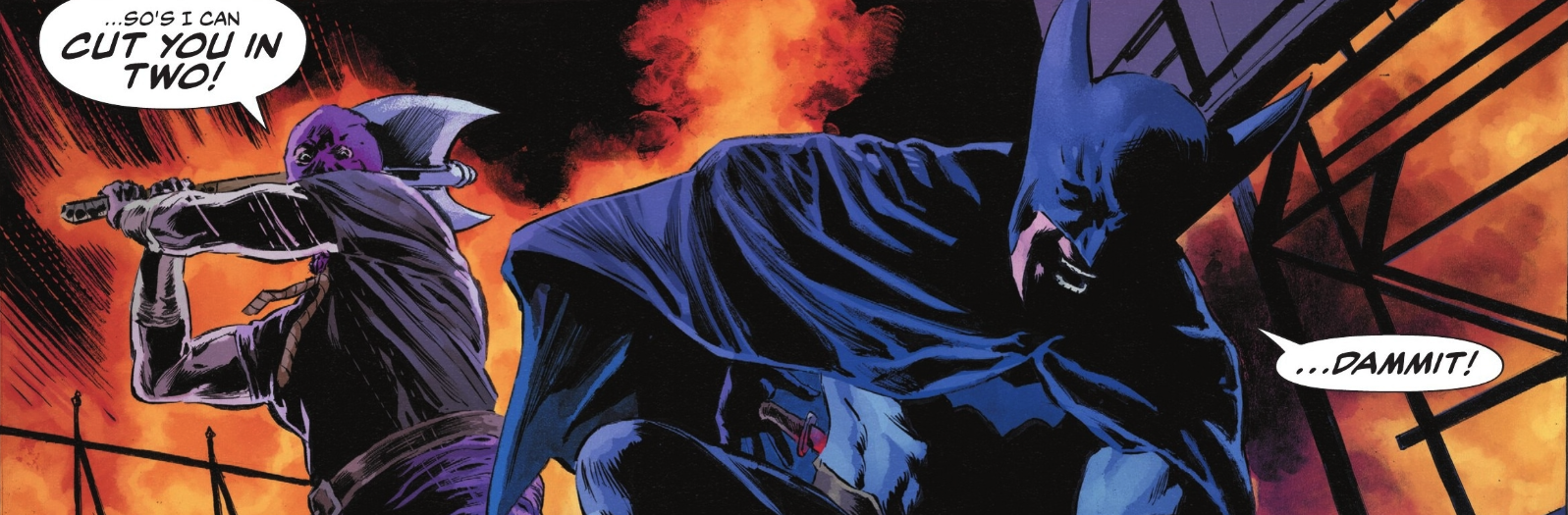
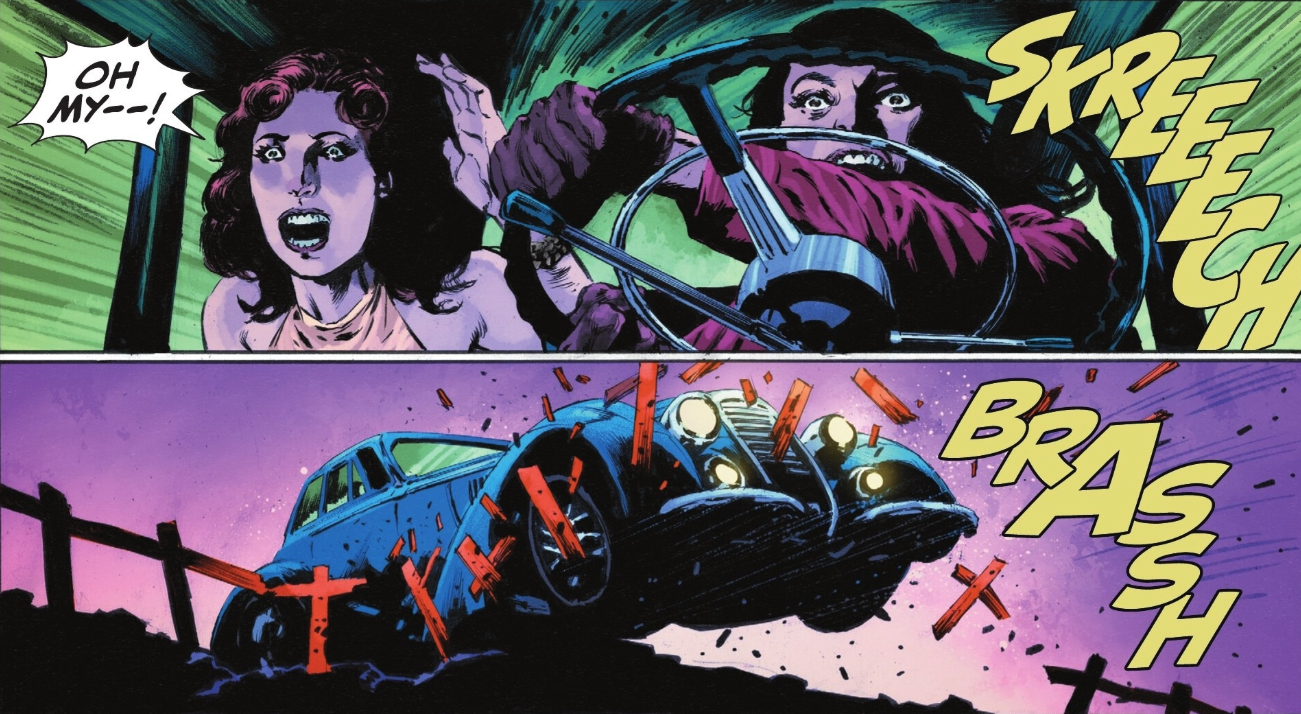
To add to the anxiety, the last image we see of Bat-Man is him being stabbed, with an axe poised to come down on him. We are then shown Lois Lane and Julie Madison, who have escaped via car and are on their way back to Wayne Manor. However, Scarecrow has slipped in one of his fear bombs; now, both women are crippled with panic and barreling down a winding road at the edge of a cliff.
Jurgens delivers exactly what you fear as a reader: Lois Lane, losing control because she is overcome with terror, drives off the edge. Dan Jurgens ends Book One with a literal cliffhanger. It leaves the reader desperate for Book Two to find out what happens next—and who, if anyone, might come to save Lois and Julie.
Ink Soaked in Alleyway Shadows
Mike Perkins and Mike Spicer work as a fantastic tag team to bring the 1930s to life. The linework of Perkins outlines the energy of the era—not just in terms of the story's setting, but within the aesthetic of the art itself. It feels as though you are holding a book actually released in the 1930s.
The coloring by Spicer captures the vibe of this noir detective tale: dark yet lucid, giving the reader the impression of being transported through time. This duo feels like the perfect personnel for this specific task.
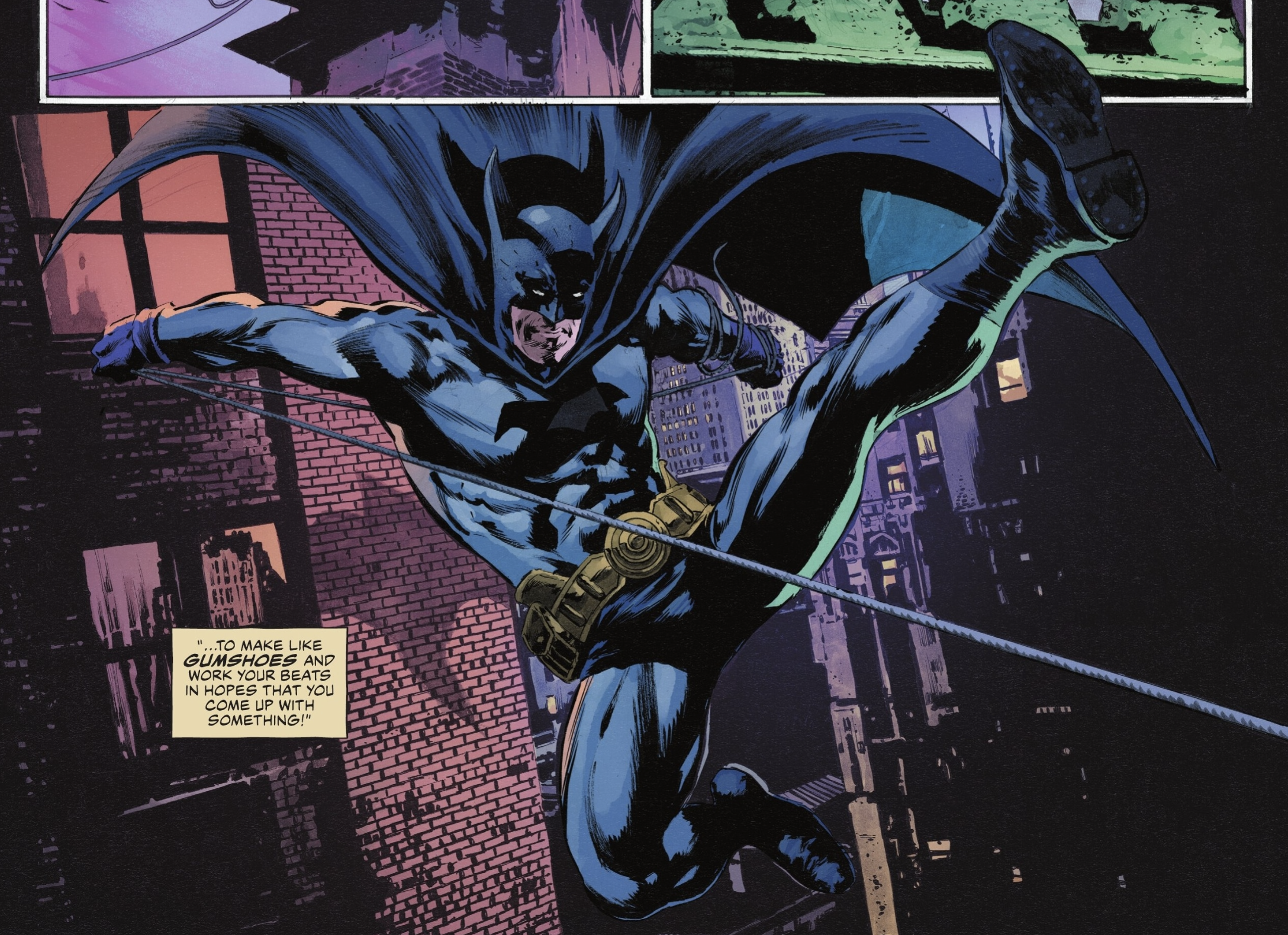
I have two favorite scenes from Book One. The first is a panel of Bat-Man that is simplistic in nature but perfectly captures the "greenhorn" feel of our hero-to-be. Perkins draws him in a way that directly contrasts with what we see nowadays from artists like Jorge Jiménez in the recent relaunch of Batman. There are no gadgets and no complex tactical suits; this costume feels incredibly basic—almost like simple lycra paired with a set of purple gloves.
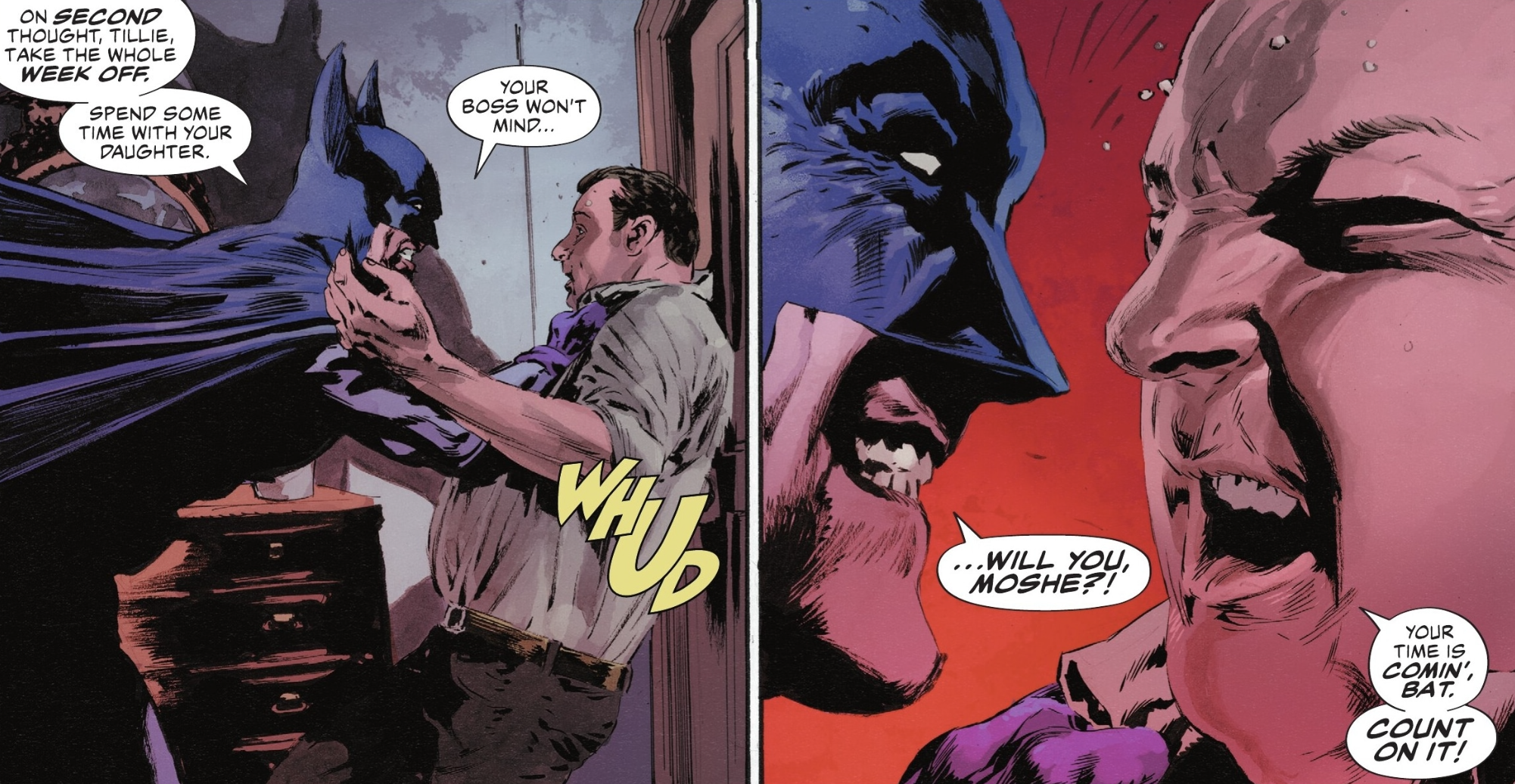
Then there’s this scene between Bat-Man and Maxie Cross (Moshe is his given Jewish name), the owner of the brothel. The dialogue from Jurgens is good, but it’s backed up by immense pencilling from Perkins that made me feel like a fly on the wall during this intense confrontation. It illustrates the inner struggle I spoke of—Bat-Man trying to get to grips with having to work with aspects of crime to rid of the grander aspects of corruption.
Conclusion & Rating
The Bat-Man: First Knight - Book One delivers exactly what it needed to: a strong foundation to set up the rest of the story. Set in the late 1930s, the narrative carries heavy undertones of that period—depression, impending war, shifting politics, and the rising shadow of Nazism. Dan Jurgens and his expert art team of Mike Perkins and Mike Spicer have done a fantastic job of pulling that energy from the page and into the reader's imagination.
The story picks up where The First Knight left off, substituting the previous arc's politically driven assassinations with the murders of random, well-meaning Gothamites. Although the central plot isn't necessarily revolutionary, I am intrigued to see where Jurgens takes us, given his previous major works and the high bar he set with the first volume.
The involvement of The Scarecrow was a genuine surprise, though his dialogue felt a bit wooden—we've seen the "spread fear in Gotham" plan many times before. I am hoping this is fleshed out with more complexity in Book Two. That, along with the surprise inclusion of Lois Lane, leaves me with plenty of questions. While it’s the 1930s and Superman likely exists somewhere in this universe, I’m hoping for something more nuanced than "Big Blue" simply flying in to save the day.