
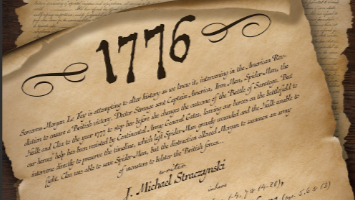
My Initial Thoughts on 1776 #5
1776 #5 is the final issue of the experimental mini-series, where Marvel tries to retell the story of the founding of the United States through the prism of the Avengers’ involvement. In the finale, the Avengers save the country, which in turn saves the very foundation of their creation. Unfortunately, the Avengers couldn’t save the issue from falling flat, as it falls victim to the usual tropes that can make so many time-travel stories convoluted and convenient. When you combine that with magic, the ending relies too much on both to create a quick and easy resolution.
Not all is lost, as the story’s impactful contemporary themes resonate in today’s political climate. Spider-Man and Captain America emerge as true heroes, with Steve Rogers playing a crucial role in the Marvel Universe’s birth of the United States.
The high expectations set by the first four issues of 1776 expose how the finale falters under its own ambitions. The disappointment is clear, as a few memorable moments barely salvage an ending that feels more forgettable than meaningful.
What Happened in 1776 #5
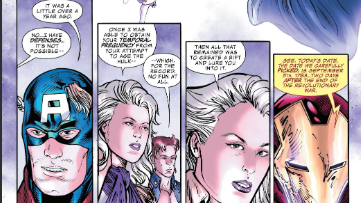
Morgan Le Fay and her army of monsters are about to overwhelm the Continental Army. Captain America and Spider-Man attempt to hold them back while Bruce Banner hands Clea the key to defeating Le Fay—the same time spell she used to de-Hulk Bruce. As Iron Man fights the monsters, Clea uses the spell, and Bruce regains his powers.
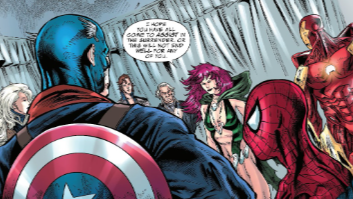
A trick is set by the Avengers—one Le Fay is well aware of—to get her to meet them as they fake the Continental Army’s surrender. Once Le Fay is in front of them, the Avengers are able to use the same time spell to trap her in a different timeline so she can’t damage the Revolutionary timeline again.
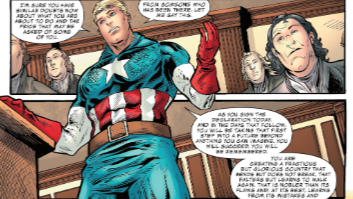
Before returning to their own time, Captain America speaks to the Continental Congress to remind them of the important work they are doing by founding this new country and attempting this new experiment we call the United States of America.
The Immediate Legacy of the 1766 Run
While the ending is far from perfect, the idea of Marvel heroes being integral to key historical moments does have some legs. What if the X-Men were important to the fall of the Berlin Wall? Or if the Fantastic Four saved the original Apollo 11 from alien pirates? I would read those series.
How this will affect Earth-616, if at all, is still to be determined. But don’t be surprised if, at some point, there is a throwaway mention of these events in a different book, especially if they continue this type of series. Selfishly, I want this to become part of the canon universe, as the Avengers’ tie to the birth of the United States tickles me.
What Worked Really Worked for 1776 #5
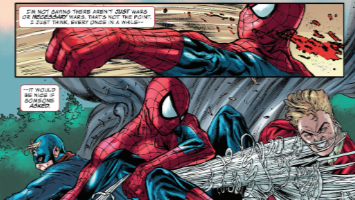
While the issue was inconsistent, the highs were extremely good. In a very Silver Age–era internal monologue, Spider-Man's thoughts on war were incredibly timely. More importantly, they were incredibly impactful. Spider-Man speaks the truth: no country has ever declared war on another. It is the people in charge who do that. How much more timely can that sentiment be? It's like J. Michael Straczynski received an early copy of the script for our current events. He timed the release of this comic to align perfectly with what is happening in our political and cultural climate.
Some might chalk this part of the book up to “virtue signaling.” However, there is nothing controversial about saying that war should be something we cautiously get involved in, with the approval of the countries involved. As much as the ending didn't resonate with me, I'll remember all five issues of 1776 fondly. It was a series that took a big swing at incorporating real-life, tough topics into a comic book. This series featured spandex-clad heroes who went back in time to save Benjamin Franklin and help create the country. Crazy that, for the most part, it worked.
The Ending Fell Flat
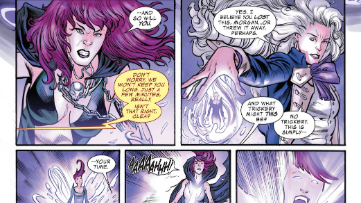
There was so much to look forward to after the initial four issues of 1776 set up an ending that would be memorable and unique, unlike anything else we had seen. 1776 #5 instead became a predictable, disappointing ending: a magic wand saved the day, and a contrived time spell took out Morgan LeFay in about 30 seconds. That felt underwhelming, and the Hulk trick, which was one of the highlights of 1776 #4, became forgettable and was wasted on a flat ending. Ultimately, this is what made LeFay come across as a weak villain, and she looked like she wasn't up to the fight against the Avengers.
The cliffhangers were much more effective than the actual payoff (Spider-Man being shot, Benedict Arnold possibly working with the Avengers, and Clea’s fight with LeFay), which was a common theme in this series. But the Hulk cliffhanger was much more aggressive because it was part of the end of the story. The time spell and the time-travel dilemma (that they can't affect time as much as someone who actually lives in it) were contrivances written into the story. 1776 had a lot of great parts, and some aspects might work well with other series, but its ending falling short of expectations might be its ultimate legacy.
The Art, While Not as Consistent, Was Still Good
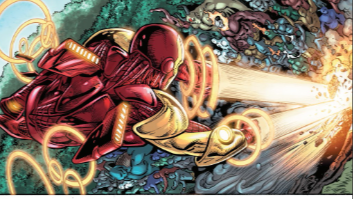
The art, while not as strong as it has been over the previous four issues, still had some very good highlights, specifically the Iron Man scene with his cannon blasters. That scene was masterfully drawn by Sean Damien Hill and colored by Alex Sinclair. Everything that makes Iron Man, IRON MAN, was highlighted in that scene. Stark’s cannon blasters looked great, and the coloring of Tony’s suit was so deep and rich. These could have been splash pages, but we were lucky enough to get them at all.
The monster work was also fantastic. Each monster had its own personality, color, and characteristics. Even when they were drawn and colored as a single blob, they still looked like individuals within a group. I thought they were masterfully done. However, on the other side of the coin, the Founding Fathers, toward the end of the book, all started to look the same. They began blending into the same person. That is how the art becomes inconsistent and less strong than the other issues of 1776.
That is especially evident in the final scene, where Captain America delivers his heroic speech to the Continental Congress. It shifts back and forth, and at different angles, Steve Rogers looks like two completely different characters.
Final Verdict
So while it wasn't all bad, 1776 #5 didn't quite hit the heights that some of the previous issues reached in this historical fiction series. The finale tripped up with the usual magic and time travel tropes that plague so many other stories. The villain, Morgan LeFay, lacked complexity and clear motivation, making her surprisingly easy to defeat and diminishing any real sense of threat, which only made the ending feel rushed. However, not all was lost, as the contemporary themes raised by Spider-Man and Captain America made a story set 250 years ago feel fresh and very topical today.
The immediate legacy of this book will be how writer J. Michael Straczynski simultaneously tied the country's origins to the essence of the Avengers and reminded us that some of the issues we face now have always been part of this country’s complex history. It will also be determined whether other artists run with this sort of idea in future titles — Marvel characters involved in historical moments.