
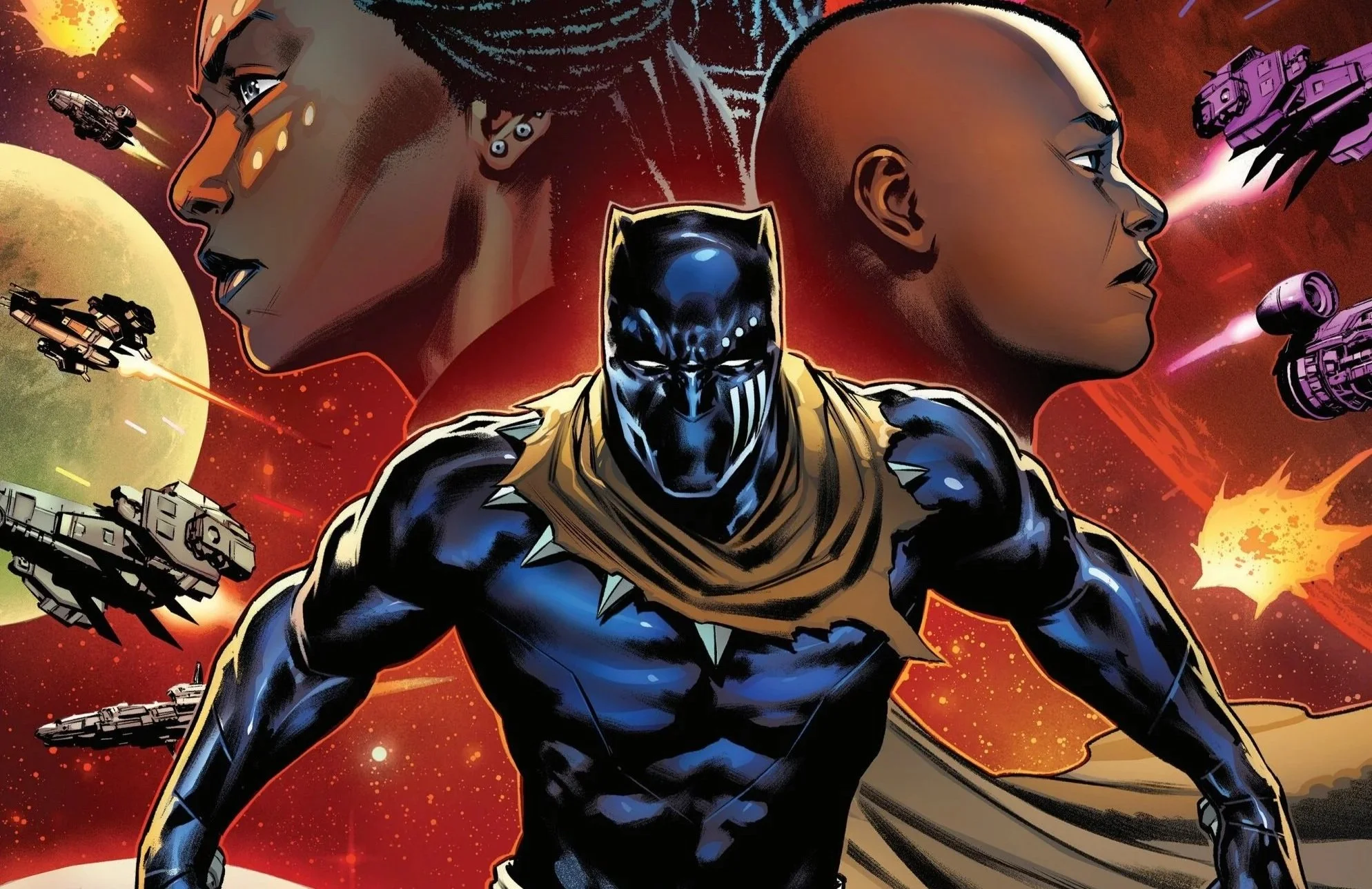
As I once again find myself humming the theme of Power Rangers: Lost Galaxy—just as I did when Coates first took the Wakandan empire into space back in 2018—I do so once more upon seeing the most recent interstellar feline foray: Black Panther – Intergalactic #1. However, while there was a certain novelty to the original series that birthed the now immensely oversaturated “Intergalactic Empire of Wakanda,” this latest series is just another reminder that there are only so many times you can keep this setting fresh. This is a fact that most recent Black Panther titles seem to be collectively suffering from, with their staunch refusal to truly push the envelope with the property. Once again, we have the same beats: T’Challa awakening on a hostile alien planet with no memory of how he got there, while in the backdrop, a space-age political power play continues with his extended cast.
This is particularly disappointing considering how Imperial left Wakanda’s space-faring empire in a new galactic status quo—one that positions them as a hostile, almost colonial element in space. There is so much rich fodder to mine here, but for whatever reason, Intergalactic #1’s debut issue plays it far too safe for my liking, utilizing "machine beats" from Black Panther stories that have become lazy writing tropes. Unlike more ambitious first chapters, this issue occasionally gets lost in its own setup; it raises questions, but none are compelling enough to alleviate concern. By plunging into familiar speculative tropes without fully justifying them yet, the book feels stagnant. It is occasionally intriguing and sometimes dazzling, but it is so focused on laying groundwork that it leaves the reader wanting sharper narrative claws after years of being served the same dish.
Something Something About a New Frontier…

The issue opens with T’Challa disoriented and alone on an alien planet, struggling against unfamiliar wildlife and a landscape that is both forbidding and strangely artificial. His usual support network is entirely absent, forcing him to rely on instinct, intelligence, and raw resourcefulness to survive.
Back on Wakanda Prime, T’Challa’s sister, Shuri, takes center stage as she attempts to track her missing brother’s last known signals. Her search leads her into growing political tensions with M’Baku, hinting at internal strain within Wakanda’s power structure during T’Challa’s absence. Shuri’s investigation eventually brings her to the home of a student named Femi, whose late father, B’Wete, was an engineering genius tied to Wakanda’s most secretive advanced technology. It becomes clear that an out-of-control AI developed by B’Wete may be the cause of T’Challa’s predicament, suggesting that the alien world he now traverses may actually be an artificial construct controlled by that rogue system.
On Earth or In Space…The Story’s Just the Same
Victor LaValle has the barest of bones for something potentially interesting here: a singular mystery on an alien planet. Why is the planet made of artificial constructs—some that look like dinosaurs and others like his old friends? What exactly is the rogue controller of this “planet”? Who is this “New Emperor” of Wakanda? These are all valid questions that should ideally serve as great setups for a debut issue to leapfrog from.
The problem lies with the surface-level fluff: the same old “T’Challa is a man and a nation unto himself” trope that has been done to death for nearly two decades. Similarly, the “Intergalactic Empire of Wakanda is in political turmoil” beat feels like just another Tuesday for the nation. At times, the story feels afraid to innovate or truly play with its core conceit, despite the immense scope available. This is the real issue: as a new #1 following a major event, you want to draw new readers in. Instead, this pilot issue throws newcomers into the deep end while leaving longtime fans frustrated by an over-reliance on tropes that border on parody.
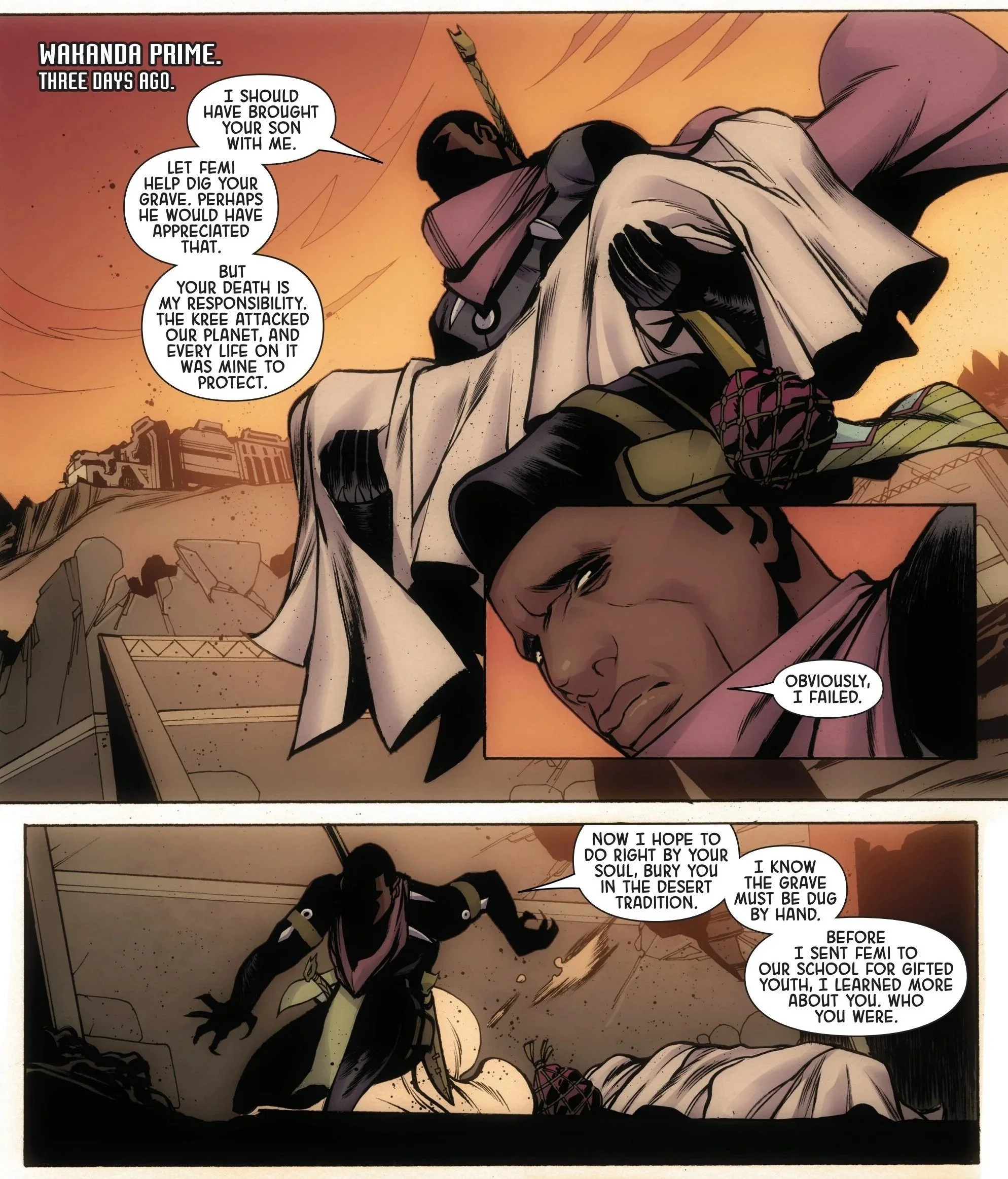
This is not to say there aren't strong personal elements. T’Challa is still presented as the world-weary monarch we know, even when stripped of his short-term memories and his empire. Grounding the mystery in his desire to do right by Femi—the son of the deceased engineer B’Wete—does much to humanize him. There is a poignant moment where T’Challa mourns B’Wete; as he digs a grave with his own hands, he recounts character exposition by way of a memorial. It’s an effective way to deliver backstory without being too heavy-handed (though the "funerary-exposition" does eventually overstay its welcome). Ultimately, it aligns with T’Challa’s warring philosophies: trying to be a good man and a good king in a universe that rarely affords him the luxury of being both.
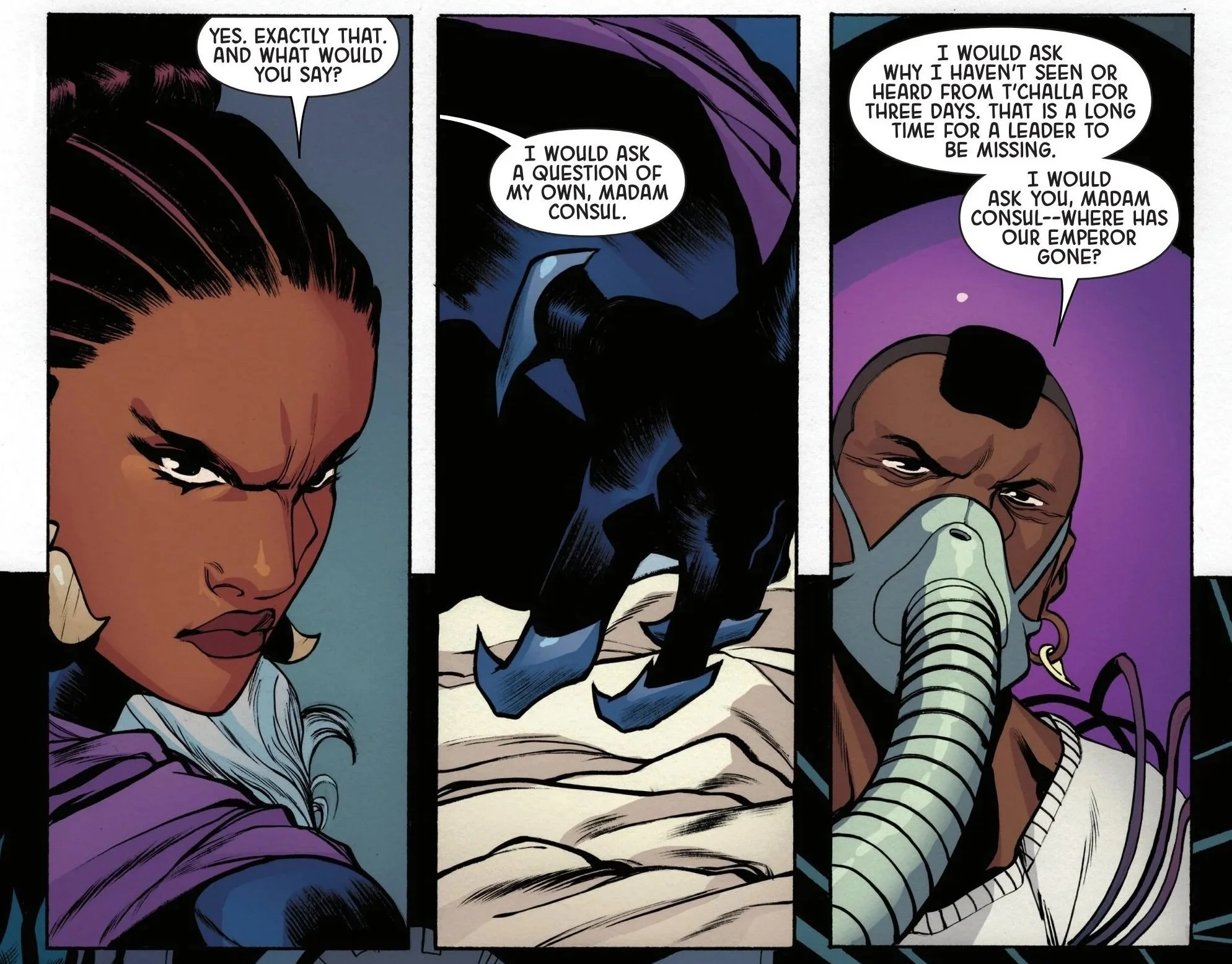
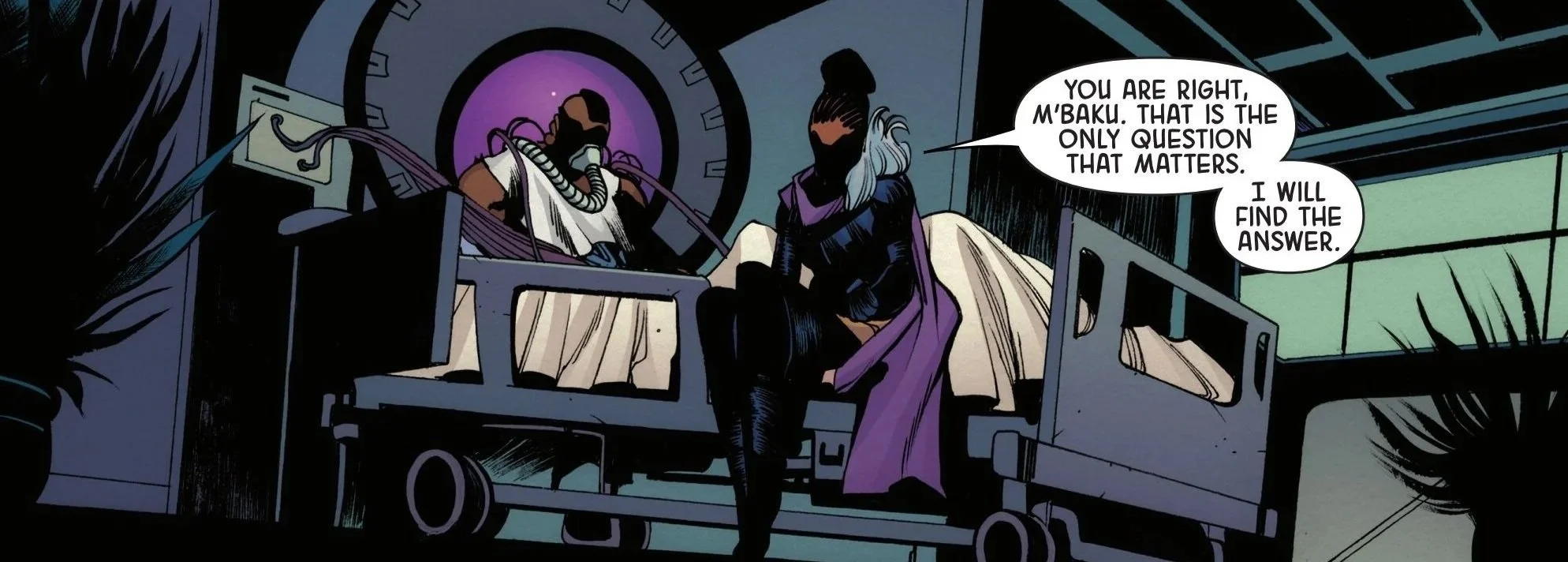
This one shining anomaly in the story is, unfortunately, marred by the ever-present boiling pot of Wakandan politics. For readers familiar with the first galactic Black Panther run in 2018, certain names might be familiar—though perhaps not in a positive way. Those who were previously confused by the existence of two entirely different M’Bakus (one in space and one on Earth), both involved in Wakandan affairs, will find those feelings returning with a vengeance. We see Shuri holding the fort in the face of mounting scrutiny and pushback against T’Challa’s absence, all while a new emperor has already claimed the throne. It is a hodgepodge of the "same old" Wakandan political fare and a complete waste of the status quo established by Imperial.
Rather than utilizing these tired story beats, LaValle could have set up this new series with Wakanda as an outcast—an utterly mistrusted and hated nation in a restructured galaxy. Following their duplicitous actions during the recent event, seeing them forced onto the back foot while fighting to regain their honor would have been a radical inverse of how the nation has historically represented itself. We could have explored an Intergalactic Empire of Wakanda that must reckon with its own status as a colonial power, and the effect that dichotomy would have on a culture that prides itself on being anti-colonial. This would have been incredibly topical in today’s climate. Instead, we are given the safest, most milquetoast storytelling imaginable to herald this new series—a move that feels like a betrayal of the property's potential.
The Mask Maketh the…Space Man…Panther…Whatever
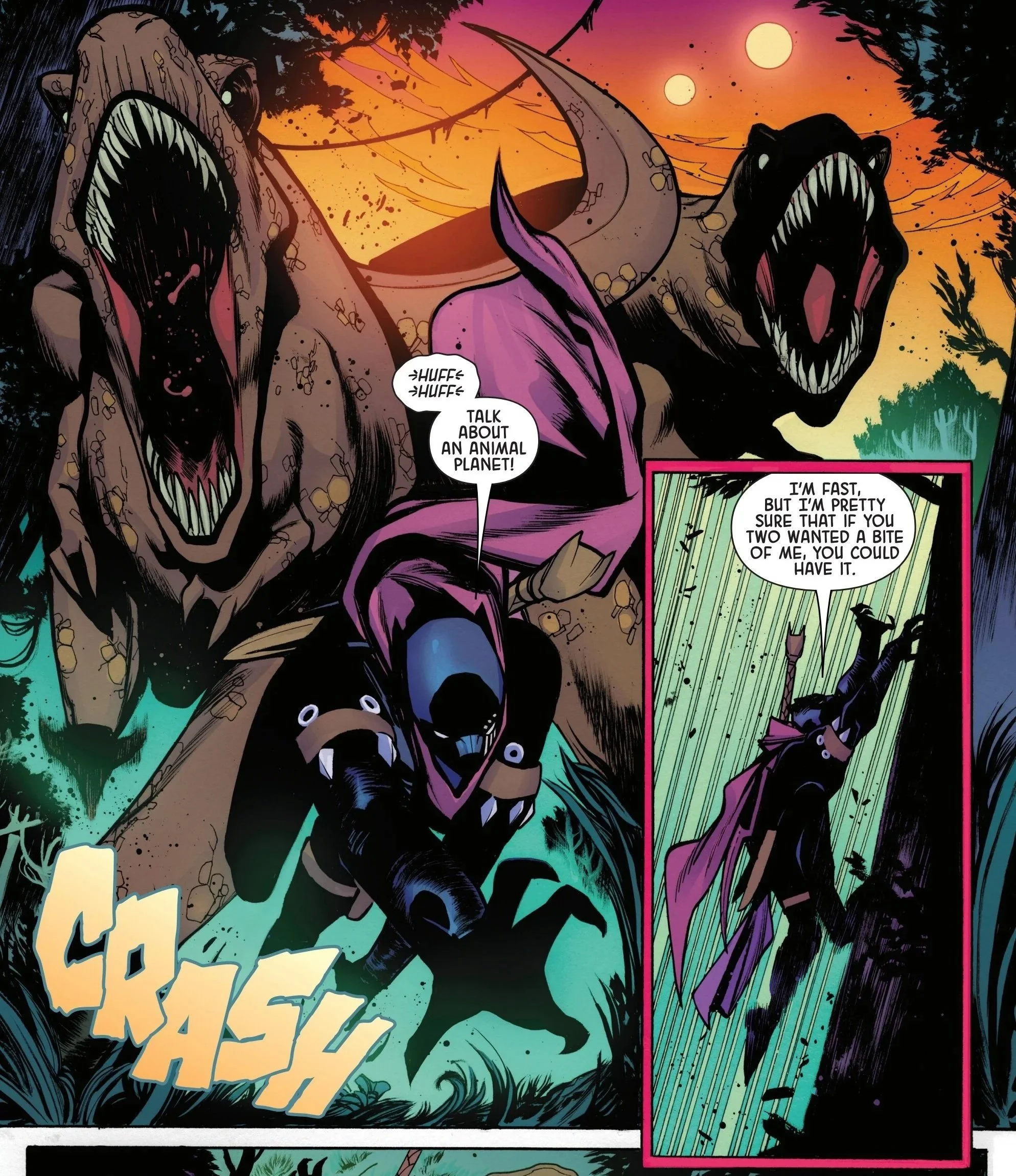
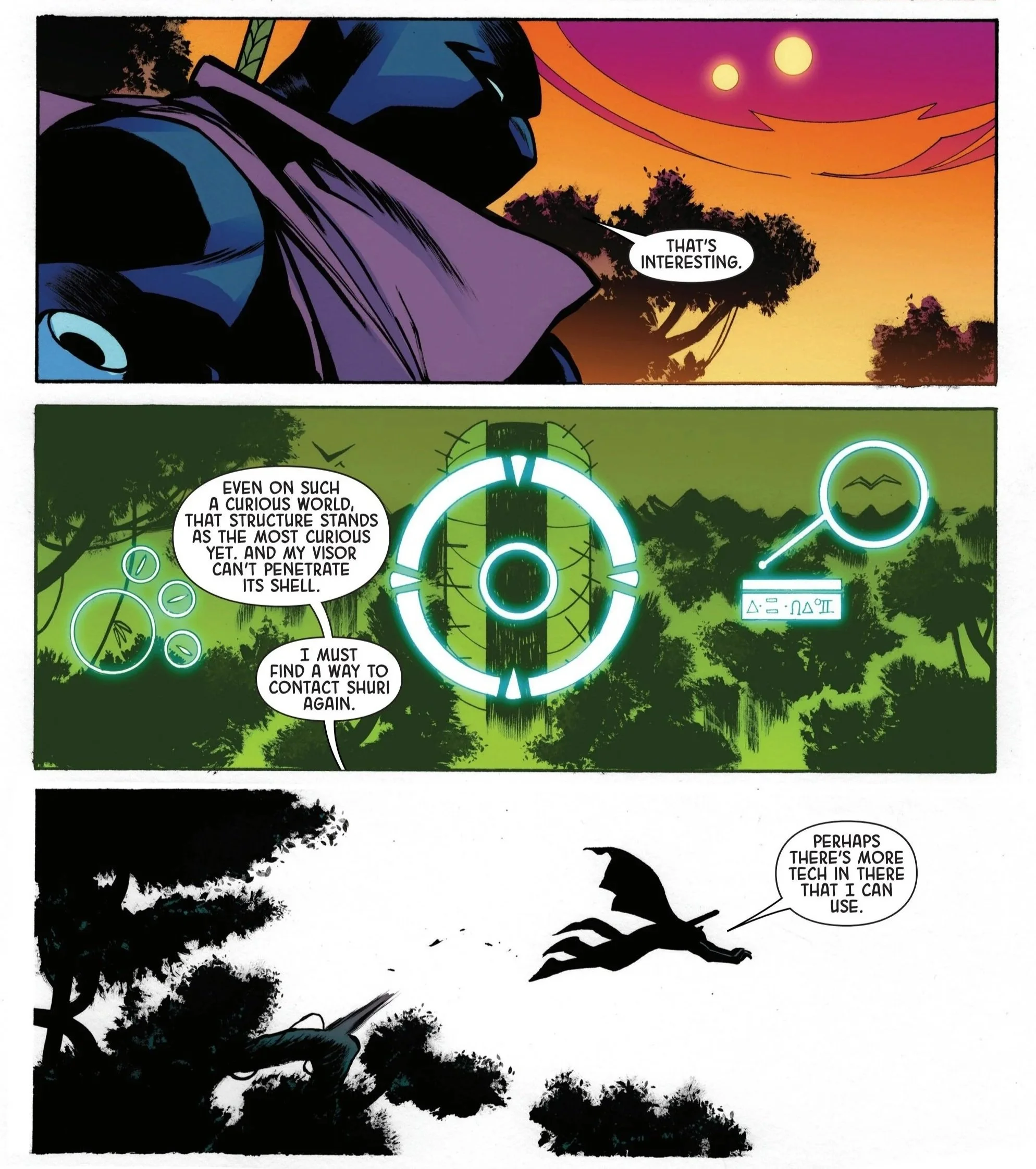
Stefano Nesi’s art is a mixed bag in this regard. When it comes to drawing the titular character, he nails it more often than not. The fluid, feline grace we associate with Black Panther is captured perfectly across the panels, especially when T’Challa is in motion within the suit. The new design is also quite sleek, keeping the core silhouette intact but incorporating more ragged cloth through a scarf-cape combo and a loincloth. Nesi also renders Panther’s mask in a more animalistic manner—sleek, deadly, and predatory, with the ears and muzzle pulled back in a shadowy grimace. It is a cool look through and through, and seeing it in action is always a sight to behold.
Less successful, however, are the human faces, which feel less stylized and simply messier. Features are far too often muddled when attempting to show emotional expressions; this is a significant problem when so much of the book hinges on maskless characters interacting on matters of great import.
Backing up Nesi’s line work is Bryan Valenza on colors, and I’ll admit, his work gives this book a unique visual identity. When Valenza’s alien hues mix with the fluid motions of Nesi’s art, the book achieves a genuine "space adventure" graphical feel. The color work effectively conveys the vibes of an interstellar odyssey, adopting somber tones when the script demands—such as during the funeral—and effortlessly shifting to the vibrant, natural hues of an alien planet filled with grotesque flora and fauna. Truly, the coloring is one of the few saving graces of this book.
A Debut That Dares to Be Dull
Black Panther – Intergalactic #1 takes some very shaky steps toward establishing its goals. The story plays it far too safe, falling back on old tropes rather than branching out to build genuine intrigue for the mysteries it attempts to set up. When inconsistent art is coupled with a script that refuses to push the envelope, it makes for a less-than-ideal kickoff for one of Marvel’s most acclaimed characters—a figure who is now a cultural and sociopolitical icon.
It is still early days, and there is time to turn this into a series willing to step outside its comfort zone and play hardball with its lofty ambitions. There is a striking visual identity to this book, one that simply needs a more fearless story to accompany it toward new horizons. However, as a debut issue, this is a disappointment. It follows an unfortunately consistent trend in recent Black Panther titles: a refusal to move beyond the safety of the MCU’s established paradigms to truly innovate with one of Marvel’s most unique characters. The only question that remains is if, or when, this book will break those patterns and live up to the ambition its creative team clearly desires to share.
Final Verdict: A debut with dulled claws that plays it far too safe for the astronomical potential it holds and is too unwilling to try anything beyond the same MCU-ized Black Panther tropes we’ve seen for nearly a decade now.