
Amazing Spider-Man #17
Writer: Joe Kelly
Art: Pepe Larraz
Once more, we find ourselves with some more cosmic Spider-Man adventuring after another stint in the narrative between the Big Apple and the great beyond. More than its previous meandering journeys through space, The Amazing Spider-Man #17 is truly the issue that signals, almost immediately, that you are not in familiar territory anymore. As Peter continues this cosmic, emotionally dense narrative, equal parts introspective character study and genre experiment, we start to reach a point where the story finally, and yet still somewhat clunkily, leans into the cosmic conceit. For the most part, this issue is bold, utterly visually striking in a way that harkens back to something like a Flash Gordon adventure, and quite unafraid to slow the pacing to a crawl in order to explore Peter’s internal landscape, with mixed results.
That being said, the issue also exposes fundamental structural cracks. There are moments where the story becomes too abstract, too disconnected from the ongoing arcs, or too heavily reliant on symbolism at the expense of narrative cohesion. It is an issue that aims high and often succeeds, but not without leaving some readers questioning whether the detour was worth the shift away from Spider-Man’s core identity. For readers who are still fond of this space-age action romp across the stars with the tenuous Guardians of the Galaxy, the ending of the issue somehow seemingly promises to abruptly end even that.
From Crash-Landing to Crash-Out
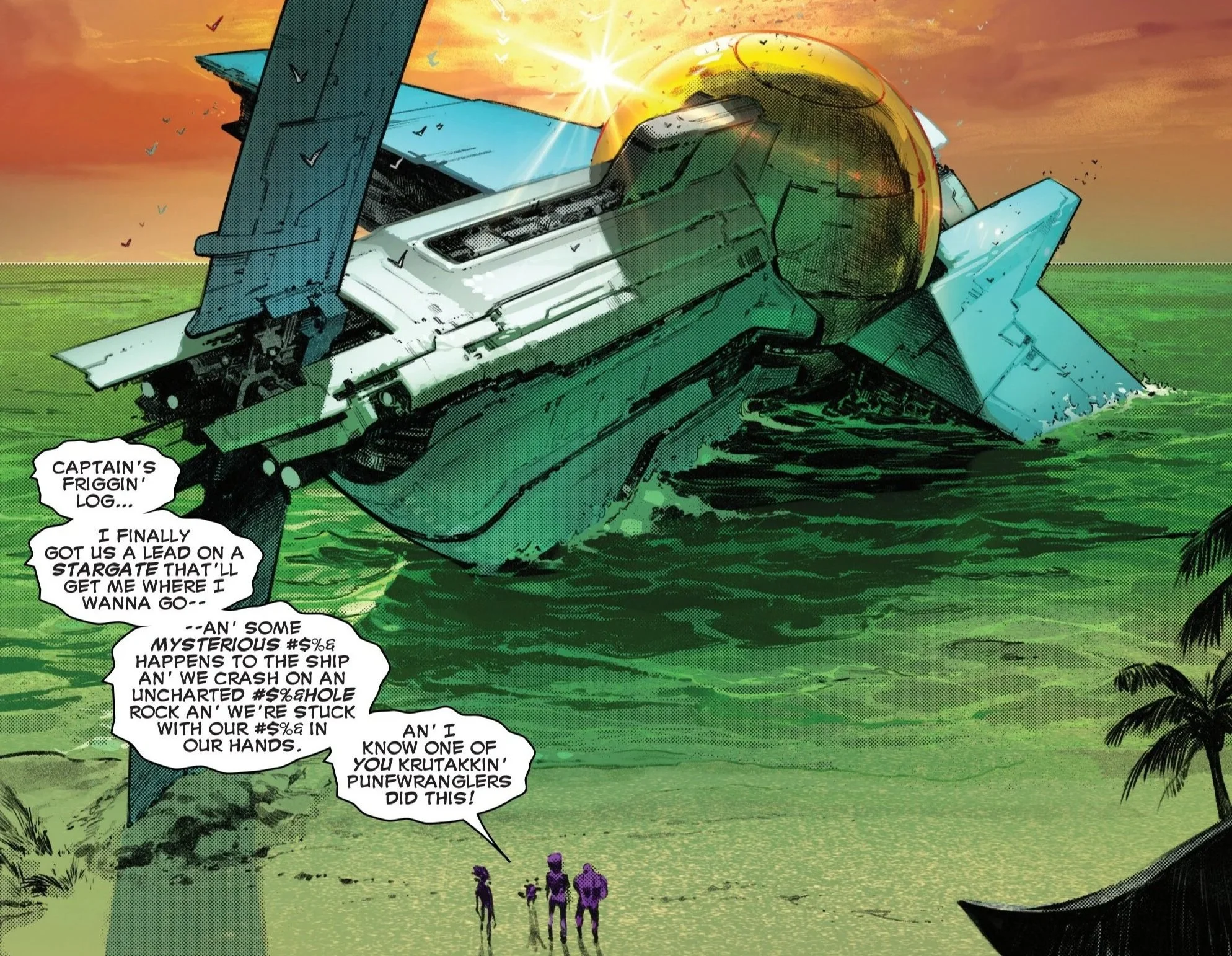
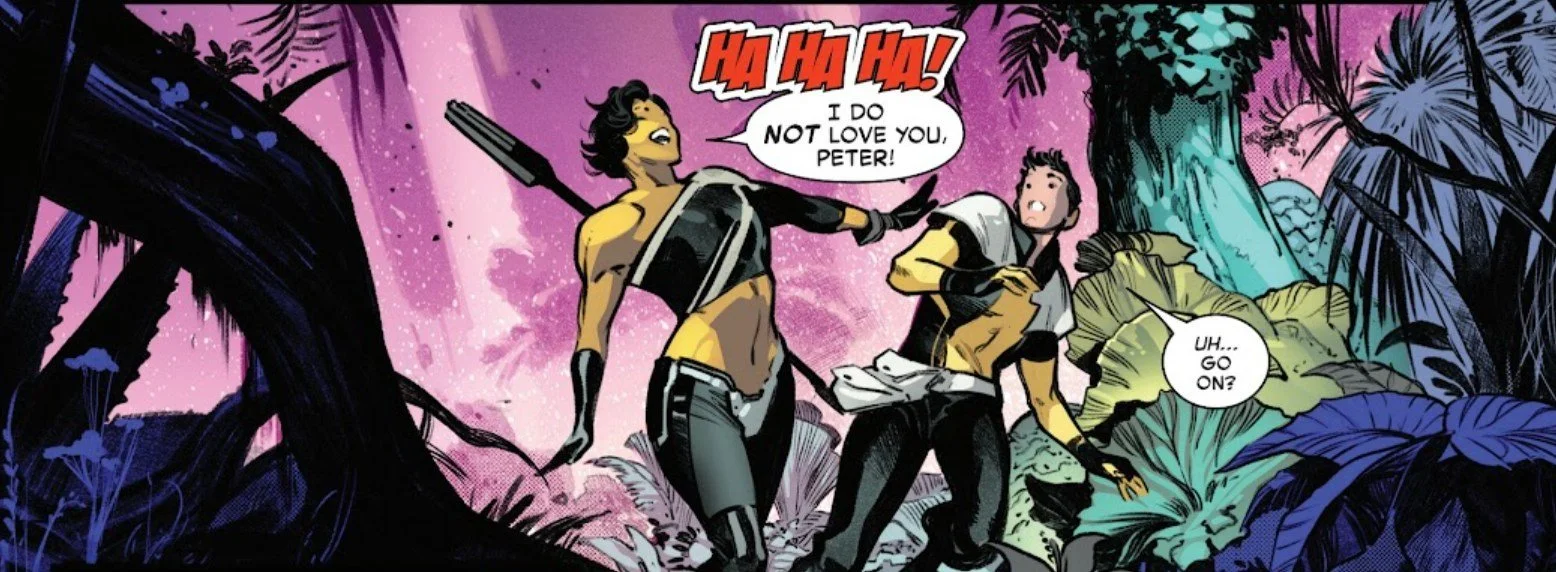
The story picks up with Peter Parker and his band of scallywag friends stranded after a catastrophic crash landing on an alien world. While Rocket and the rest of the team attempt to conduct repairs, Peter and Raelith go on to explore this new world. This environment is both beautiful and unsettling—a landscape filled with lush bioluminescent flora and unseen threats that put even his adventures in the Savage Land to shame. But fiercer than even these alien threats is the awkwardness of Peter and Raelith’s—everyone’s favorite new alien muscle mommy—blossoming situationship. More than any fight, it is the grounding of Peter and Raelith actually navigating their situation in a wholesome manner that allows both of them to open up to each other in unexpected ways, which is a real highlight of the issue. Far removed from quips, crime-fighting, and the crushing burden of his usual self-flagellating “great responsibility,” Peter allows Raelith to become a catalyst for honest reflection, even as she herself harbors fears and trauma from her own life experiences.
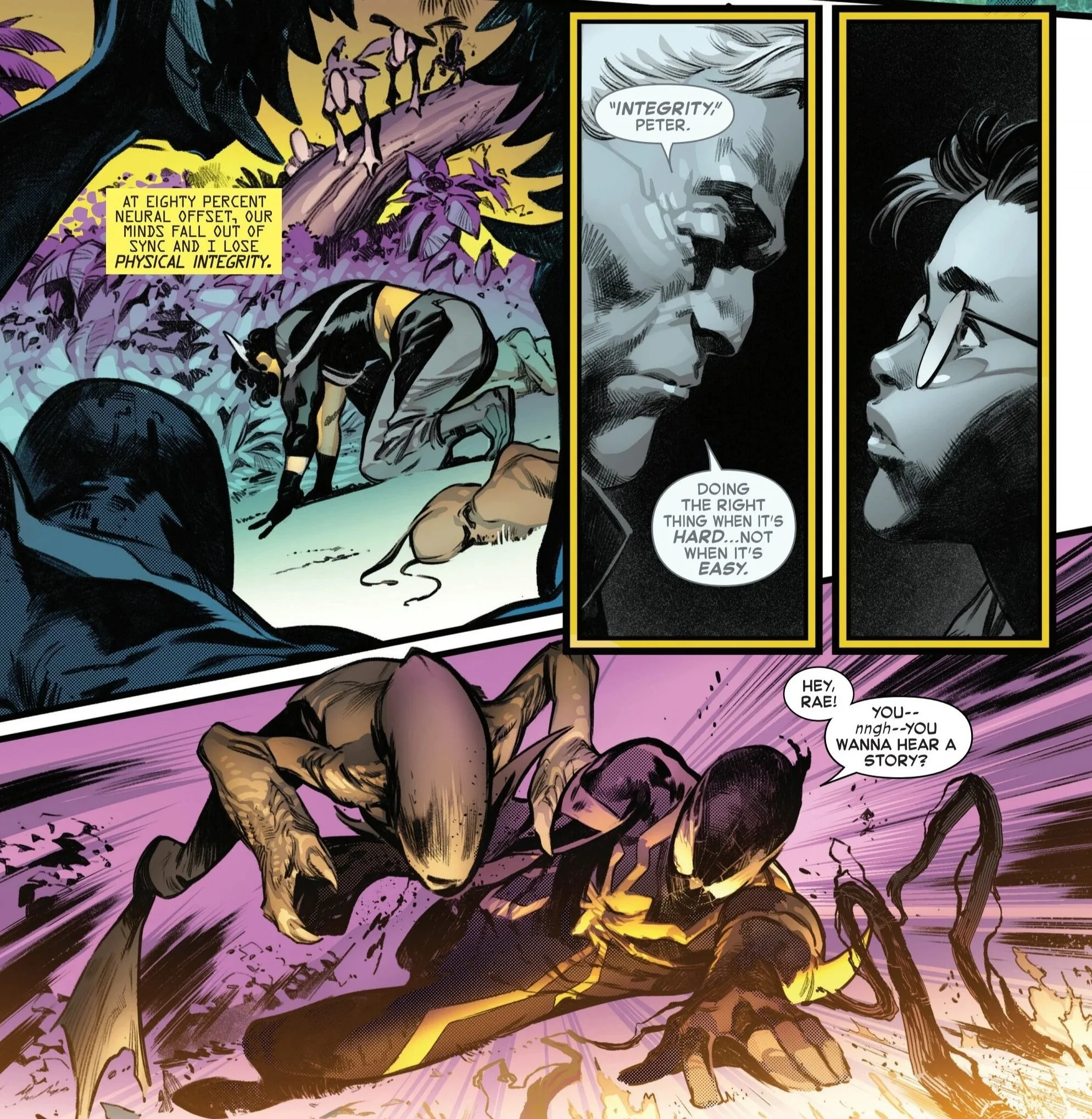
The narrative shifts dramatically with the arrival of Nikodimu of the Pinnacle, a psychic tyrant—and the one who Hellgate repeatedly invoked as he beat Peter to a pulp back on Earth—who seizes control of Raelith and unleashes an army of alien beasts. The conflict that follows is less a physical showdown and more a psychological battleground. Peter tries desperately to reach the version of Raelith he connected with, while she struggles against Nikodimu’s invasive influence, which amplifies her own doubts and fears. Punctuated throughout this conflict are flashbacks to Peter’s childhood, involving shame, secrecy, and emotional overwhelm, which echo the internal struggle Raelith faces, eventually allowing her to overcome them and fight back in spectacular fashion.
The issue ends both conclusively and ambiguously. The immediate threat is seemingly beaten back, and the survivors regroup, but Peter is left shaken. His fight against Nikodimu and Raelith’s actions to save him weigh heavier than any victory, with the final call being made by Peter that he must return home to New York. As the issue closes, readers are left pondering exactly what this latest encounter has stirred in our soon-to-be once again friendly neighborhood Spider-Man.
The narrative shifts dramatically, however, with the arrival of Nikodimu of the Pinnacle, a psychic tyrant – and the one who Hellgate repeatedly invoked as he beat Peter to a pulp back on Earth - who seizes control of Raelith and unleashes an army of alien beasts. The conflict that follows is less a physical showdown and more a psychological battleground. Peter tries desperately to reach the version of Raelith he connected with, while she struggles against Nikodimu’s invasive influence amplifying her own doubts and fears. Punctuated throughout this conflict, flashbacks to Peter’s childhood - involving shame, secrecy, and emotional overwhelm - echo the internal struggle Raelith faces: eventually overcoming them and fighting back in spectacular fashion.
The issue ends both conclusively ambiguously: the immediate threat is seemingly beaten back, the survivors regroup, but Peter is left shaken. His “fight” against Nikodimu and Raelith’s actions to save him linger heavier than any victory, with the final call being made by Peter that he must return home…to New York. As the issue closes, readers are left pondering exactly what this latest encounter has stirred in our (soon to be once again) friendly neighborhood Spider-Man.
A Story That Says the Best With Less - Yet Often Chooses Not To
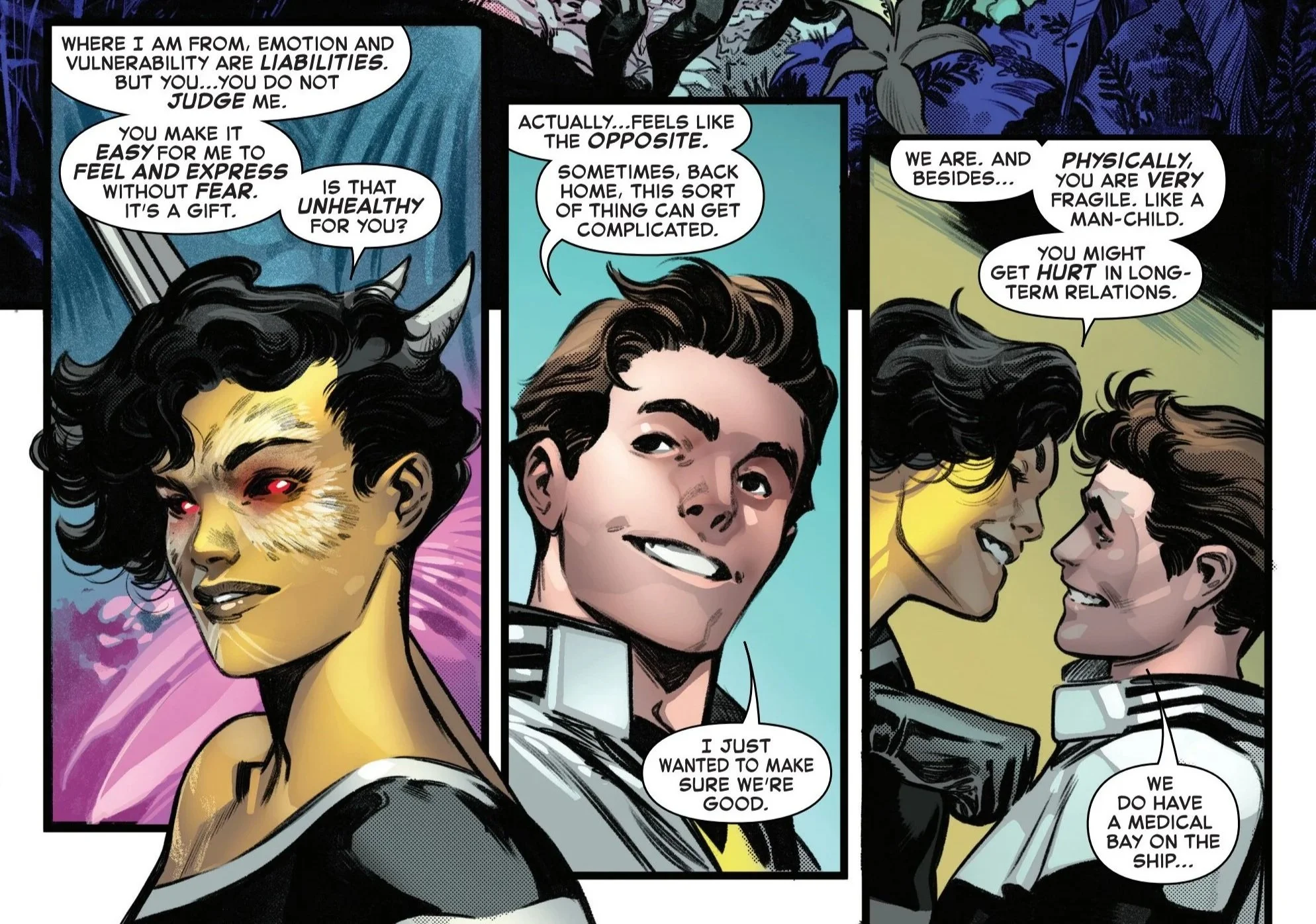
Amazing Spider-Man #17 is at its best when treating its space-age premise as a character lab: an opportunity to strip Peter down to his emotional essentials and see what remains when all his familiar scaffolding is removed. In that sense, the issue succeeds. His relationship with Raelith is layered, tender, and genuinely affectionate, offering a side of Peter rarely explored in mainstream canon with his usual harem of love interests. These thematic intentions are admirable, noble even. The story seeks to explore vulnerability, the nature of consent, emotional repression, and the weight of personal trauma, grounded in both metaphor and cosmic spectacle. Kelly’s use of Nikodimu’s psychic violation of Raelith’s inherent trauma perfectly mirrors the way buried shame and self-doubt can consume a person from within.
Furthermore, the alien setting allows readers to see Peter in ways that might feel forced or melodramatic in a New York backdrop with his usual cast and supporting crew—something that his new SwashBucklers of the Solar System (yeah, let’s go with that name) provide in their own unique ways. Rocket is written exceptionally well and funnily, while the rest of the crew also offers their two cents of humor. It is still baffling how, by the end of the issue, the crew are totally cool with their teammate Niall intentionally crashing their ship on this world to trap them so that…checks notes…they could all be a little family there. Kelly excels when writing with these targets specifically in mind, and he finds novel ways to link humor with humbler feelings over the course of the issue—something that has honestly been lacking on the space side of the ongoing Amazing Spider-Man saga.
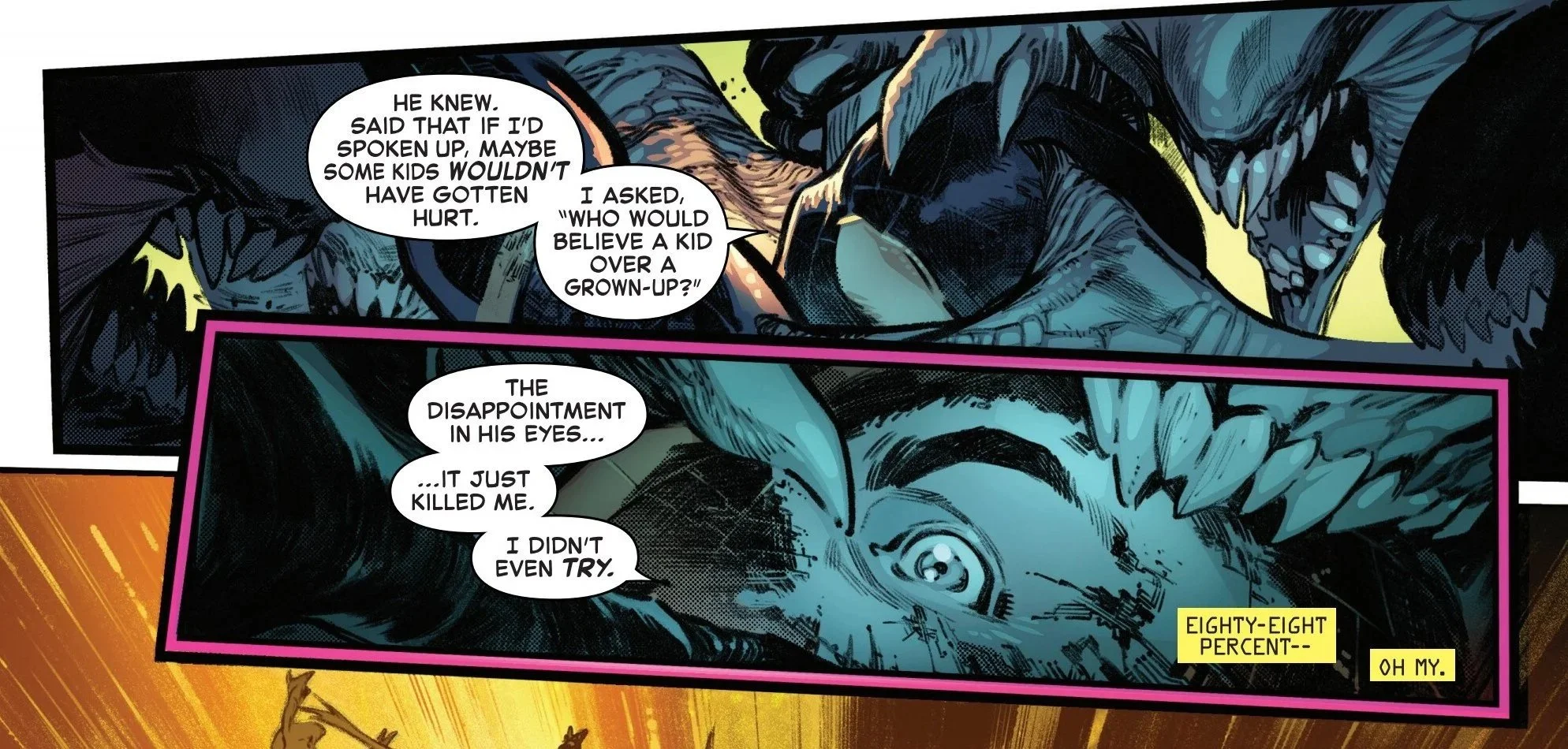
But these strengths come with notable weaknesses. Kelly’s penchant for long stretches of introspective dialogue makes the middle act feel sluggish and a bit too self-indulgent. While the emotional core of Peter and Raelith’s interaction this issue is strong, its delivery often feels repetitive, circling the same themes without advancing the plot. Readers expecting dynamic progression may find themselves waiting for something to actually “happen.” Instead of seamlessly deepening the present-day narrative, these moments sometimes feel grafted onto the issue for symbolic weight rather than narrative necessity. This is particularly true when Peter starts waxing eloquent about a candy shop and his own personal life a bit too much in the middle of a serious life-and-death situation. While the intent may have been to use the metaphor to help break Raelith out of Nikodimu’s psychic assault, it becomes a massive pacing killer in an otherwise tense scene. Although the flashbacks to Peter’s childhood have been percolating throughout Kelly’s run, here they feel the most shoehorned in, particularly when a memory of Uncle Ben chastising Peter about not speaking up as a child against a local predator is used to hammer home the consequences of Peter not living up to his responsibilities.
Now, to be very clear, Spider-Man stories can absolutely work in cosmic settings. Secret Wars proved that decades ago, the recent Spider-Man 2099: Spidercide arc also did this beautifully, and just about a decade ago, Peter’s best friend Flash Thompson had one of his best runs as Venom in his Space Knight series. But there’s a fine line between expanding the character and losing the very essence of what makes him compelling. In this issue, the lack of Peter’s typical earthly struggles—responsibility, moral conflict, and relationships back home—leaves him feeling emotionally adrift, and not always in a narratively intentional way. Though Kelly explores new avenues and parallels in this cosmic frontier, without those original grounding anchors, the story risks becoming a beautifully rendered but isolated vignette rather than a meaningful continuation of Peter’s story.
Most important of all, however, is the resurgence of the Hellgate storyline and all the dangling threads from earlier issues that entails. We’re dropped into the sudden bombshell appearance of Nikodimu themselves—the same whispered entity that Hellgate answered to—the whole reason this alien warrior literally beat Peter like he owed him lunch money before unceremoniously yeeting him off Earth and across the galaxy. The entire conceit of the space arc has been about Peter seeking to get strong enough to beat Hellgate so that he can return to Earth, defeat this nigh-unstoppable foe, and resume his life.
Yet even with Nikodimu popping up in all her resplendent glory, psychic infodumping a plethora of information onto the entire cast and readers, there still seems to be a gaping avenue left unexplored. Maybe Peter will uncover the final missing threads of this story, maybe they’ll be forgotten in the mire of Spider-Man editorial. You can’t really say with this book, but the sudden seeming urge for Peter to return home after his first encounter with the boss of the dude who sent him on this journey in the first place—without even achieving his goal of going super Spider-Saiyan times infinity—just feels unusual. It feels like even Kelly wanted to create an issue that breathes, that slows down, that dares to explore an unmined side of Peter’s humanity—one that has been trying (and failing) to outrun his own emotional gravity. And when it works, it hits hard. But when it falters, the issue slips into a meandering mess that’s hard to reconcile with its lofty ambitions.
A Space-Odyssey Brought to Vibrant Life
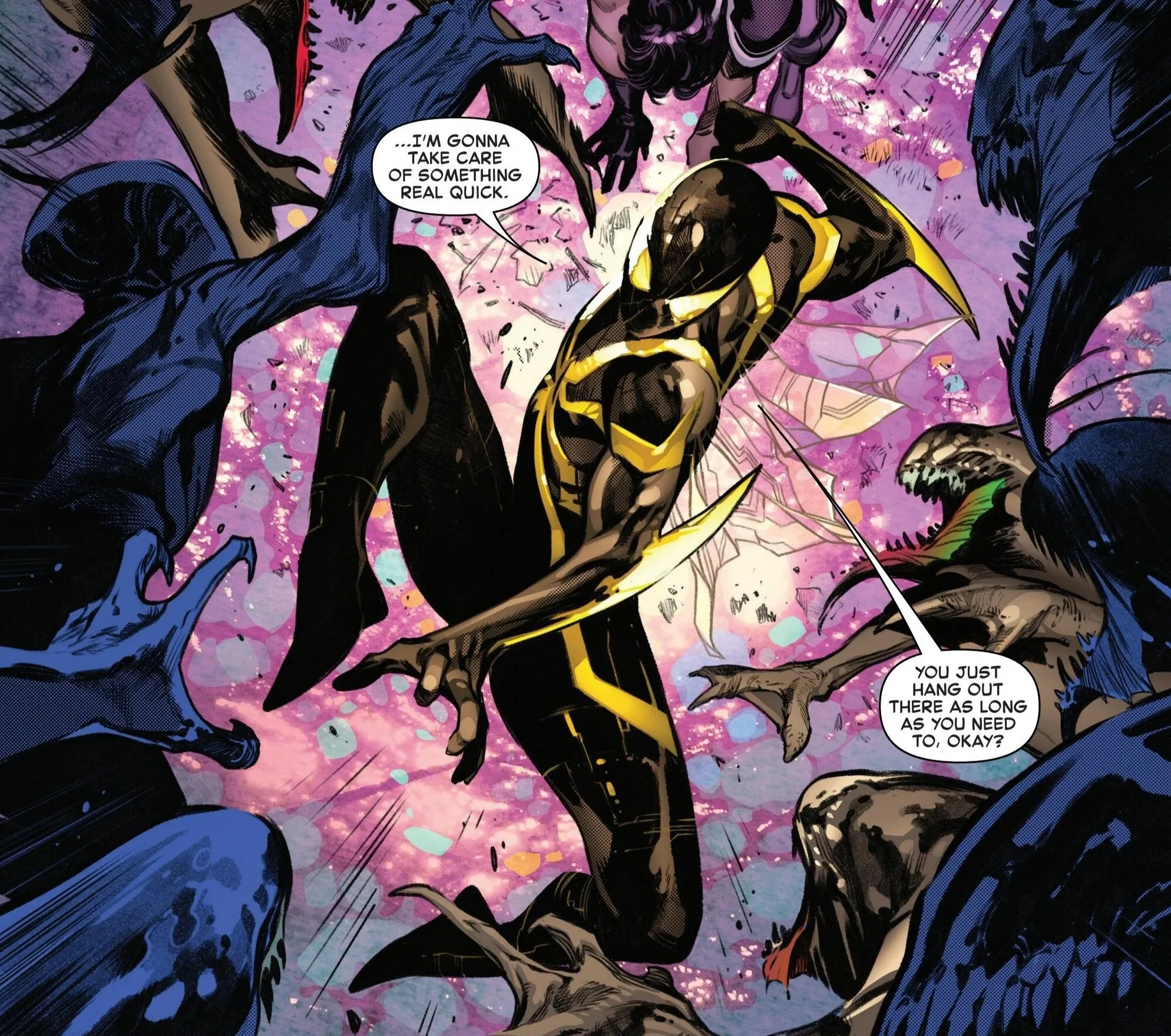
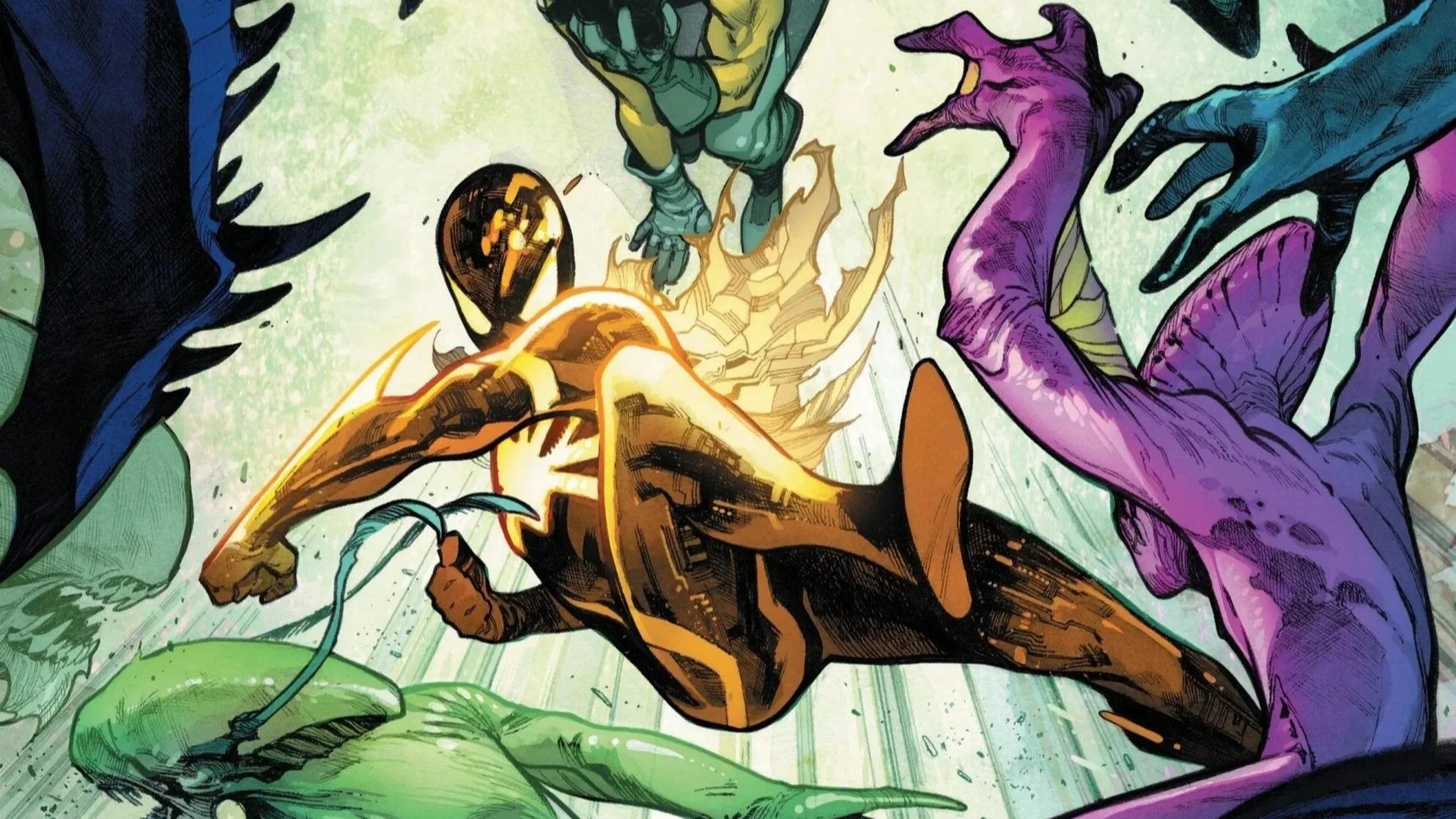
If, unlike Billy Joel Armstrong, you do not have the time to listen to me whine, I will admit that one area where I genuinely have no harsh words to say at all is the art department. Pepe Larraz is hands down the most incredible thing about this issue. His linework brings a spectacular space-age scale to every page. He makes the alien world feel simultaneously hostile and mesmerizing, filled with textures and details that make it feel lush, vibrant, and lethal in such an organic way rather than just being “weird for weird’s sake because SPACE.” Even the action reflects this glorious energy.
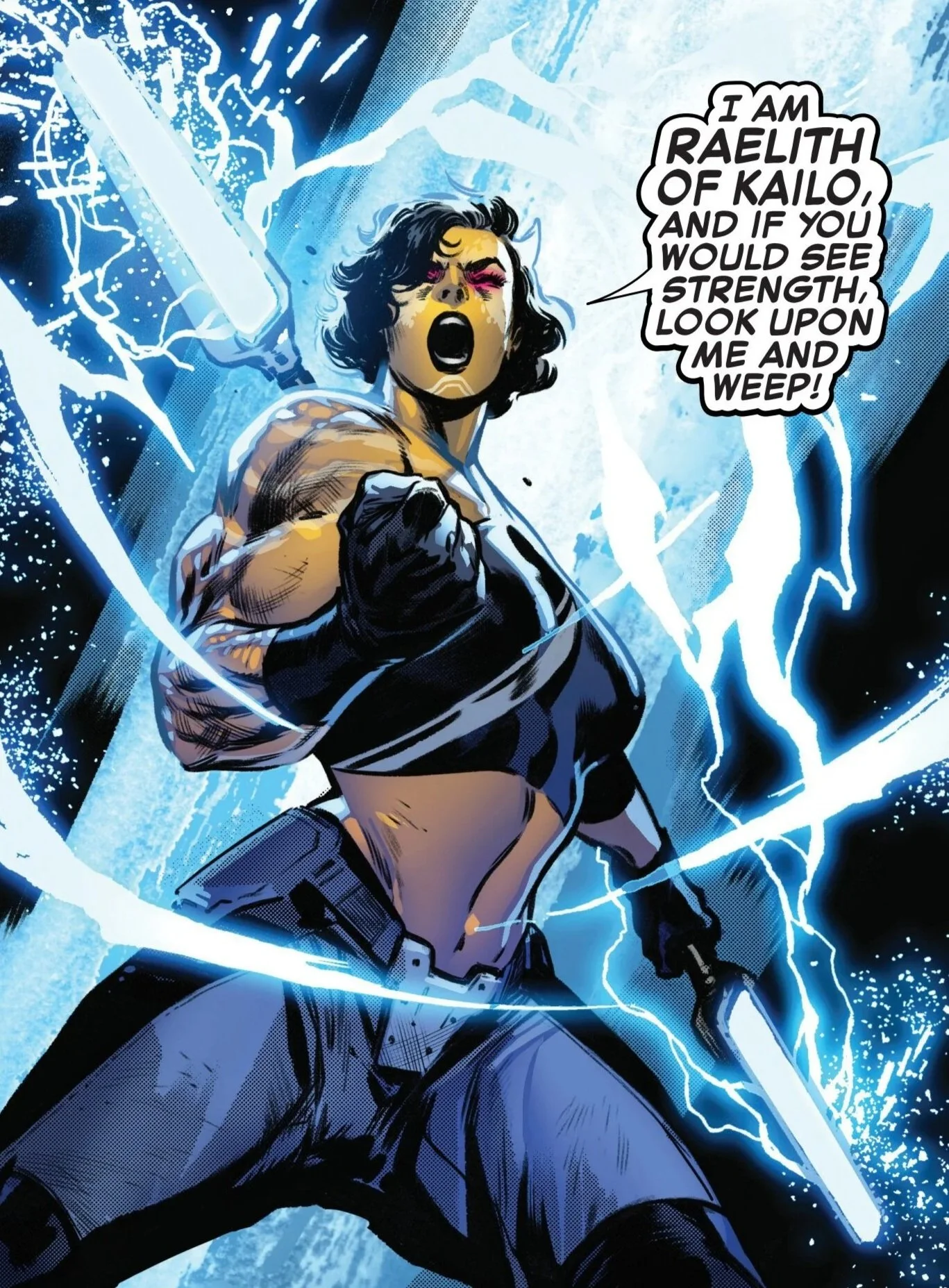
While there is little of it in this issue compared to previous ones, the sequences that are present are fast, feel impactful, and flow with gusto. Whether it’s Peter looking suave and spectacular as always in his Glitch-empowered new suit, or Raelith unleashing her bad-ass fury in one of the book’s best moments, Larraz captures the grandeur and fury of every line perfectly. Even Nikodimu, though still vague in her motives, is presented stunningly in visual aesthetic—this metallic angel of death and omen whose overwhelming psychic presence literally rends the panels and the heroes within them. It’s a cool-as-hell effect that really empowers a new malevolent character with this degree of aura farming.
Most important of all, however, is the amount of emotional clarity Larraz brings to the characters. This is his true ace in the hole for the issue. The micro-expressions between Peter and Raelith carry weight that the script sometimes overstates—and overexplains to its detriment. A quiver in the lip, a softening gaze, a shift in posture: these moments create more emotional resonance than entire pages of wandering dialogue, elevating the book beyond the shortcomings of the script to a significant degree.
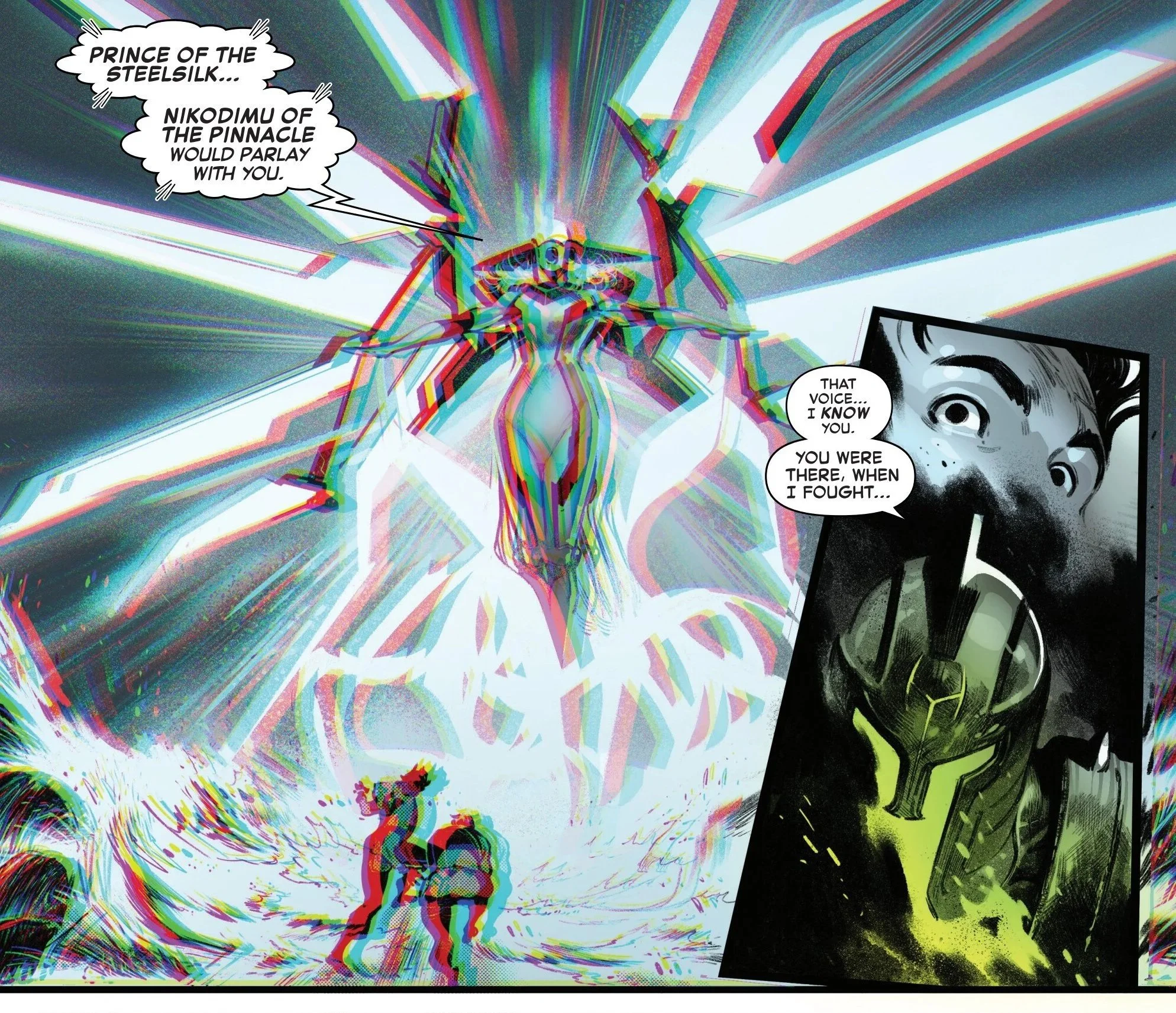
Finally, Marte Gracia’s color work elevates the visuals even further. The palette is rich and atmospheric, swinging between glowing teals, deep purples, and saturated greens that make the environment feel otherworldly without overwhelming the characters. Action sequences are clean and dynamic, but the quiet panels—the ones where Peter and Raelith simply exist together—are some of the most striking in the issue. Ultimately, it’s a gorgeous issue without a doubt, but the beauty more often than not masks a lack of narrative precision.
Just When They Hooked Me In…They Seemingly Cut the Line
Amazing Spider-Man #17 is one hell of an experiment, I’ll admit: one that reaches for emotional depth, narrative abstraction, and genre expansion. It succeeds on some of these fronts, admirably so, delivering beautiful visuals and revealing moments of character introspection that feel refreshingly honest and even novel in their approach. There is honestly no shortage of heart that Kelly and co. have put into the story they’re trying to tell, and it shows even in the most challenging moments.
But the issue also missteps—and does so to a large degree. The pacing drags, the symbolism overstays its welcome, and the story feels surprisingly disconnected from the larger run while still dropping overt threads to it at the same time, in a baffling juxtaposition. It’s compelling but uneven, ambitious but occasionally self-indulgent. For readers who aren’t fond of the space-age antics of the current run, this won’t do much to convince you, even though I’ll admit that even a nay-sayer like me was almost buying what Kelly was saying here, only to be told that it might be wrapping up sooner than expected. Meanwhile, other readers who enjoy slower, introspective storytelling will find much to appreciate, while those craving momentum or continuity may walk away frustrated. In the end, the latest issue is comfortable going down swinging—for better or worse—on whatever the future of this space-odyssey storyline of Peter’s entails.
Final Verdict: Peter Parker’s space odyssey almost hits its stride with some surprising emotional introspection that is anchored by glorious art, but still finds itself adrift far too often due to messily overstated writing and an ending that seems to herald a quick end to this romp across the stars.