
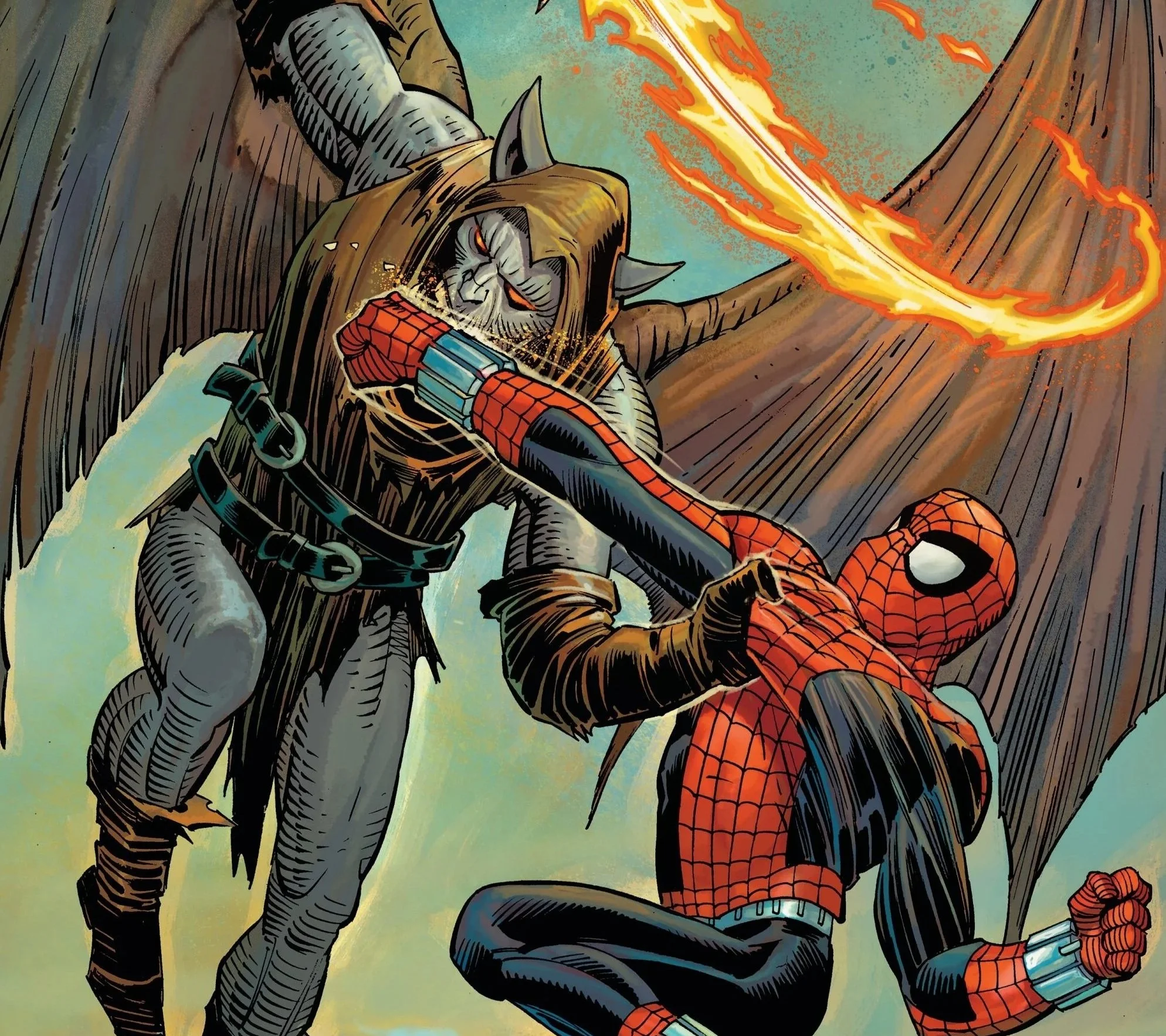
Joe Kelly has a truly thankless job, you know. He has to juggle two parallel Spider-Man stories with two almost totally divergent tones, featuring completely different sets of characters doing their own thing. Now, of course, when these two storylines finally converge, it is a different matter entirely. For the most part, the Norman Osborn section of the grand narrative of Kelly has had a far more character-driven arc for our titular "friendly" neighborhood Spider-Man.
However, Amazing Spider-Man #20 somehow feels like a misstep in that regard. It is an issue that somehow takes all the buildup Norman has been doing to salvage his character and kind of throws it into the freezer. This happens even when he is finally facing the army of Goblin slayers that have been tormenting his legacy.
For the most part, issue #20 is one protracted battle. It is one that focuses squarely on the sins, legacy, and accountability of Norman. The sum of his actions is finally coming home to roost even as he tries so desperately to be a better man (and Spider-Man). What should have been a thoughtful issue, however, somehow instead manages to be a hodgepodge mess of random fights, some genuinely shallow attempts at character depth from several characters, and some bizarre art shifts. These all make for a crashing low after the highs of the previous New York and Norman centric issues. As the series barrels towards its milestone 1000th issue, these problems become all the more glaring at this juncture.
Target: Osborn
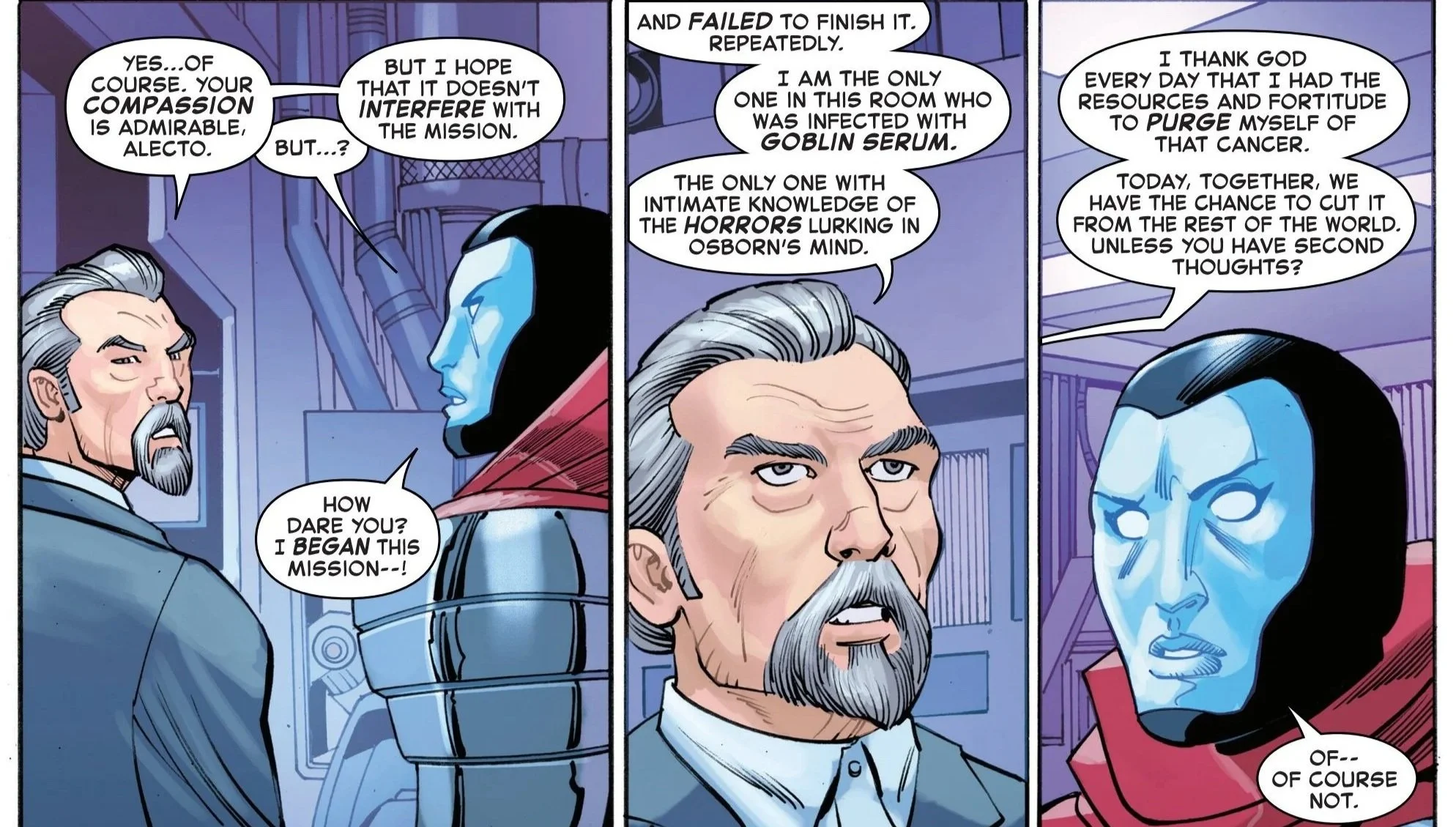
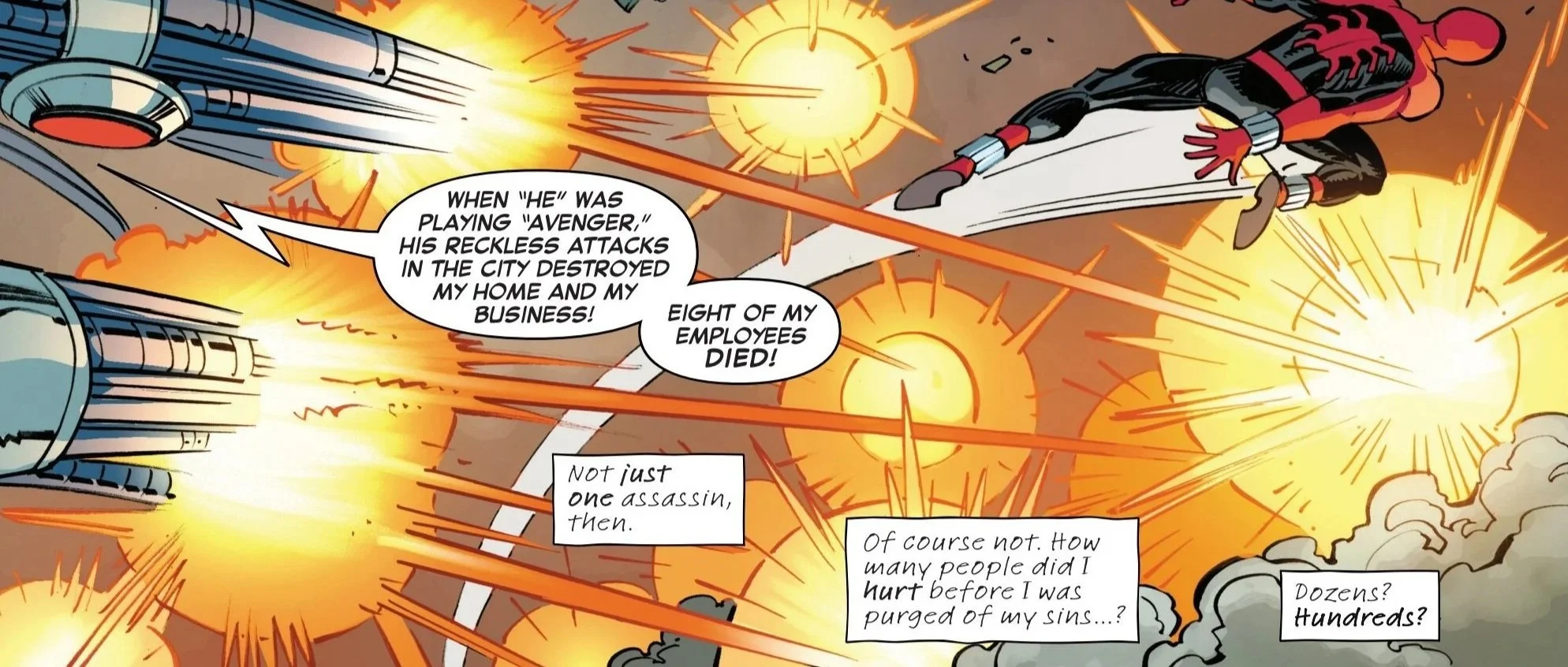
The issue picks up immediately where the previous Earth centric issue ended. Norman is fighting back an onslaught of Goblin slayers who are hell-bent on putting him six feet under. What really makes this a kicker is the fact that the slayers are seemingly piloted by former victims of Norman. These are tragic people who once lost loved ones to his evil escapades of the past and are now set on revenge. Leading this orchestra are Alecto and Roderick Kingsley. The latter has somehow convinced this gullible band of Norman haters to do his bidding in an effort to wipe the stain of the Goblin legacy from the face of the Earth. Conveniently, however, Roderick has left out his own Hobgoblin escapades, playing the charade of someone who has recovered from this Goblin addiction (insert eye roll here).
But even as the fighting ramps up, with Norman battling for his life and to protect innocents around him (including Aunt May, who happens to be in the wrong place at the wrong time again), Alecto tries to halt the battle to protect civilians. This is to no avail, as the hold of Kingsley over the Goblin Slayer crew is absolute to the point of having convinced them to murder the grandchildren of Norman as well. But even with backup from the other Spider-Heroes of the city, Norman is still fighting an uphill battle. It is one that teeters on the brink of life and death by the end of the issue. Oh, and Ben Reilly has also conveniently left another colossal mess behind for Peter to clean up,
How to Slay a Goblin
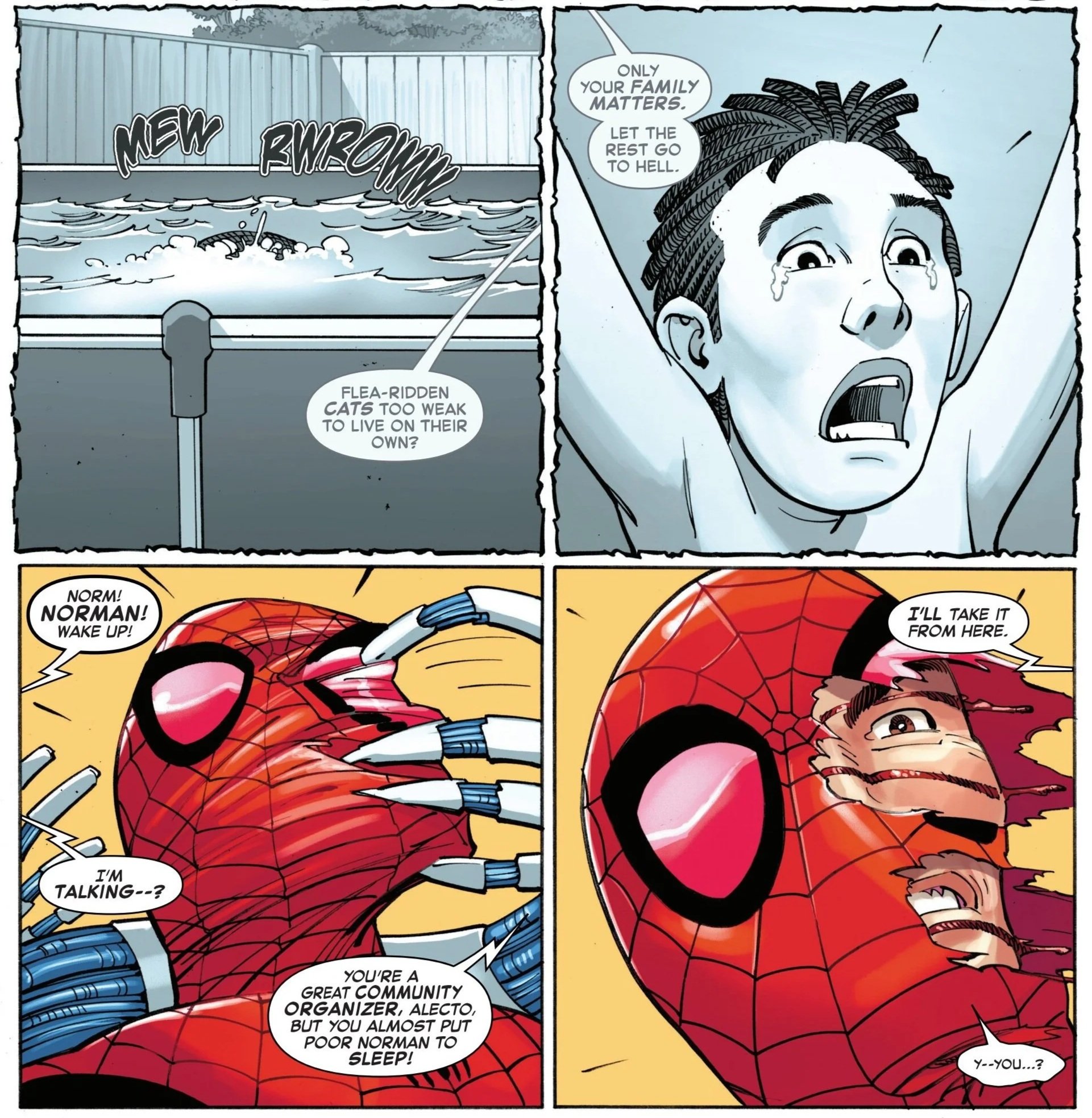
The most immediate problem with Amazing Spider-Man #20 is that it feels trapped by its own backstory. Nearly every major beat Joe Kelly uses here circles back to the past of Norman Osborn. His guilt, his victims, and his fractured psyche are themes that have been explored exhaustively and far better already in this run, but they are now starting to spin their wheels just to buy time. Rather than interrogating that history from a new angle, the issue largely reiterates familiar ground. The internal monologue of Norman is verbose and commanding, hammering home emotional beats the audience already understands, and yet we are still inundated with flashbacks of the childhood of Norman to somehow recontextualize his past cruelty once again. Instead of deepening the character, this approach risks flattening him into a perpetual loop of remorse and near-relapse. What makes this particularly frustrating is how much narrative real estate Norman occupies. Spider-Man, the titular character, often feels like a reactive presence rather than an emotional driver.
This problem is further exacerbated by how other supporting characters are operating around Norman. The Spider-Gang seems perfectly cool rushing to the aid of Norman and treating him like their de facto leader. There is even a scene where Spider-Gwen of all people, the living embodiment of one of the most evil acts of Norman imaginable, somehow has a short but heart-to-heart with him. Neither the two main people involved in the interaction nor anyone else really brings up just how utterly messed up things are. I get that it is the middle of a fight and there are bigger priorities; however, not once has such an obvious opportunity for actual character growth been ignored this blatantly. It is frustrating, to say the least.
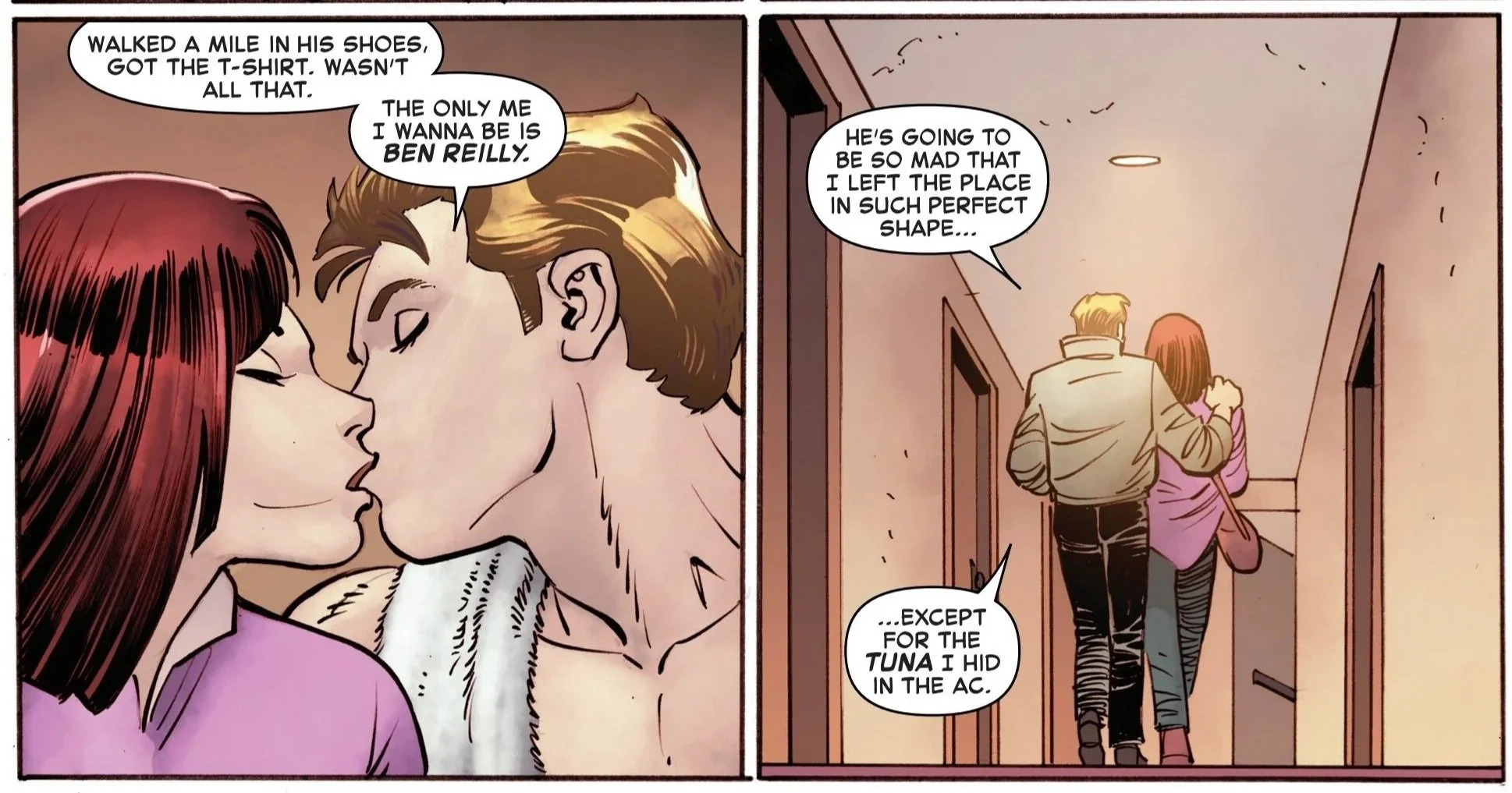
And speaking of frustrating, Kelly (as of this issue at least) seems to have completely thrown in the towel on some plot threads. Ben Reilly, especially, gets the shortest end of the stick. Having cosplayed through the life of Peter during his absence, he has now officially walked out after having done basically nothing at all. He just called it a day and took off. Now, of course, there is always the possibility he could come back in the next issue of this two-part arc. But the lack of Ben really doing anything while Norman pranced around as Spider-Man is once again such a magnificently wasted opportunity.
This matters for the same reason the Spider-Gwen situation matters so much. More than most, Ben Reilly has suffered at the hands of Norman. He was robbed of his very identity as a human and his life by the man. To see literally no attempt by Ben to even confront Norman with any of this is just mind-bogglingly wasteful. This is especially true when you consider both the more hostile attitude of Ben and the focus on Norman facing his sins. Instead, Ben chooses to prance around town, doing some science, living in the apartment of Peter, and ignoring calls from his boss following catastrophic accidents in the lab. I am certain Peter will have to clean all of this up when he gets back.
Finally, we come to the matter of the Goblin Slayers and their handlers, which is another great concept completely neutered by lazy writing. There is some great scope for storytelling by having these grief-stricken people being manipulated by the Hobgoblin to seemingly take their revenge against Norman, all while playing into the hands of Kingsley. But the execution is faulty. The Goblin Slayers themselves are a dime-a-dozen robotic threat. Norman should not be having so much trouble dealing with them, especially with help from the other Spider-heroes.
It is infuriating, and even the mild attempts at dissent from Alecto and those falling on deaf ears does not hold enough emotional weight to pull this story up. Once again, it is understandable that since this is the first issue in a two-part arc, several of these concerns might be swiftly addressed in the next issue. But for the time being, the meandering script of Joe Kelly offers few real stakes or character. The fake-out of Norman being horribly injured only further heightens how shallow so much of the narrative for this first part is. Also, I do not know what it is with the recent writing of Aunt May by Kelly, but her attempts to be sassy to everyone using Gen-Z lingo is really starting to become more gratingly noticeable. It is even more wildly out of character the more she does it.
A Baffling Midfight Art Shift
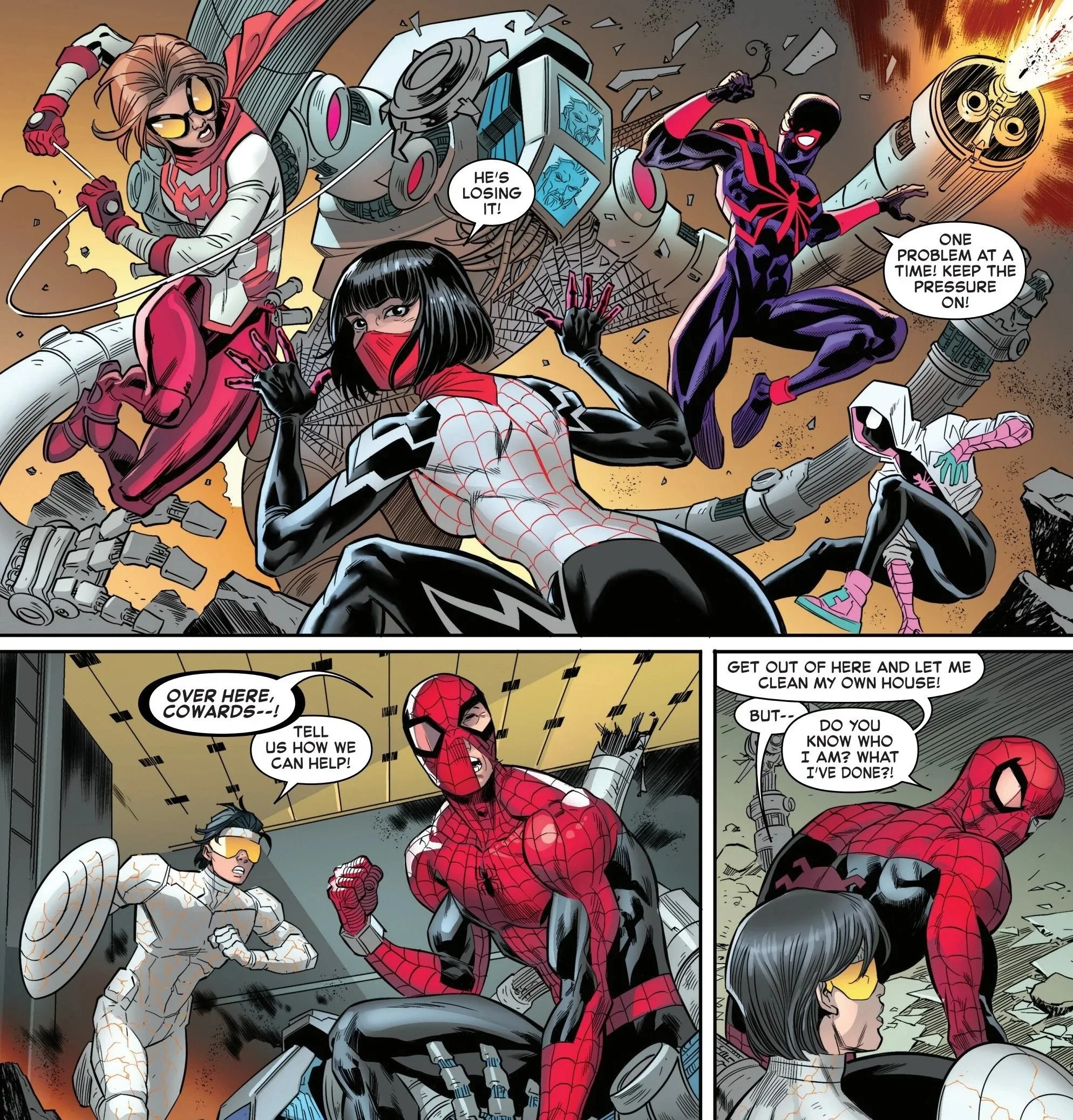
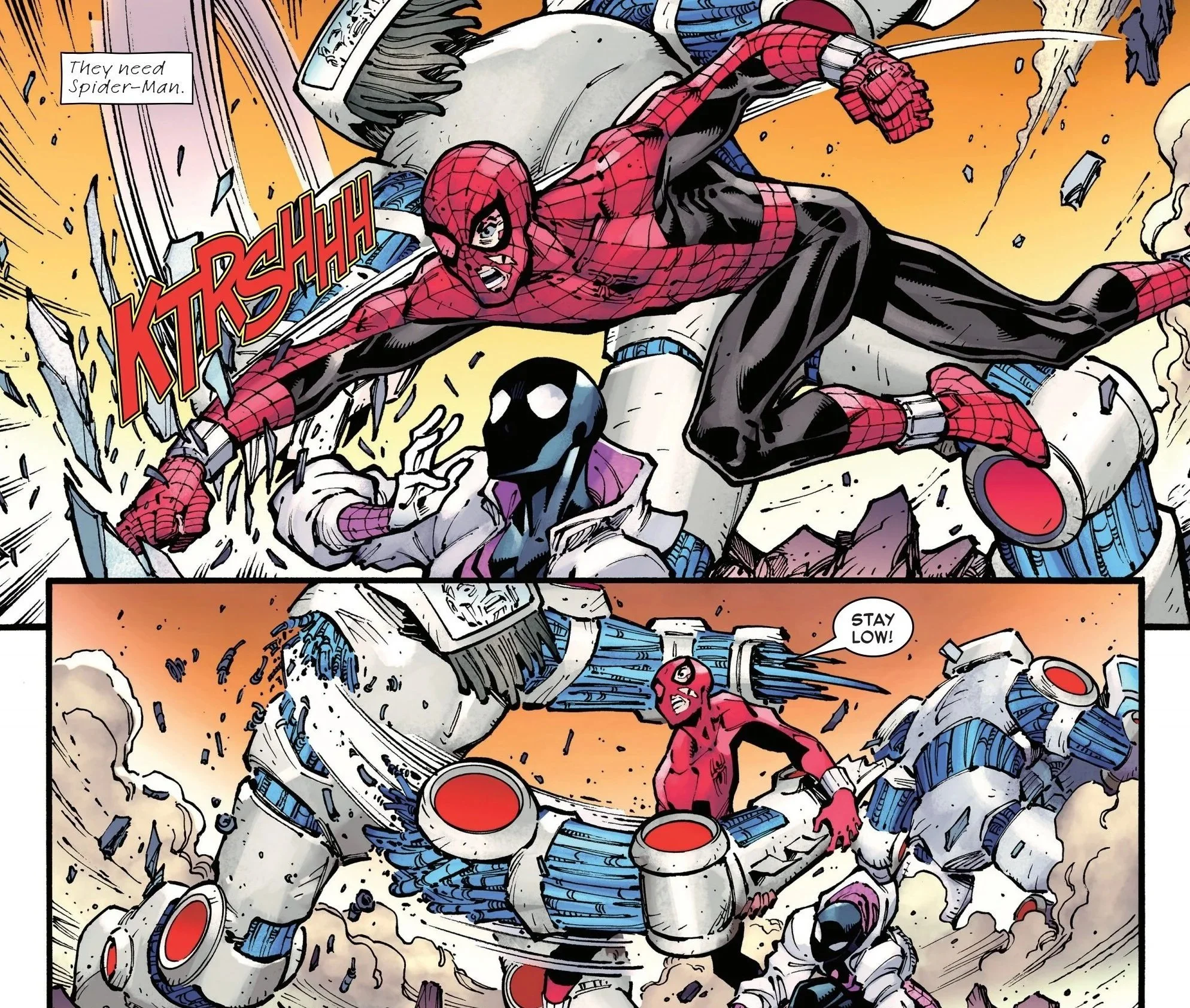
Up till this point, the New York-centric issues of Amazing Spider-Man have had John Romita Junior consistently holding down the fort with his distinct art style. Visually, Amazing Spider-Man #20 is competent in that regard. But the genuinely baffling inconsistency in art comes at the end, where the last six pages are split across three different art teams for no seeming rhyme or reason. On their own individual levels, each artist and colorist involved would be a great choice if they had worked on an issue from start to finish.
But for some wildly incoherent lapse in logic in the editorial, someone thought it was a good idea to have Romita Junior draw the majority of the book. This is followed by Todd Nauck suddenly drawing three pages in the middle of a climactic fight, and then Paco Diaz again drawing the last three pages of the same fight. It is frankly an insane choice. Since none of the styles really complement each other, they do not serve to show any smart or innovative transitions that line up with the frantic nature of the action. It is just a truly strange and utterly incomprehensible art shift.
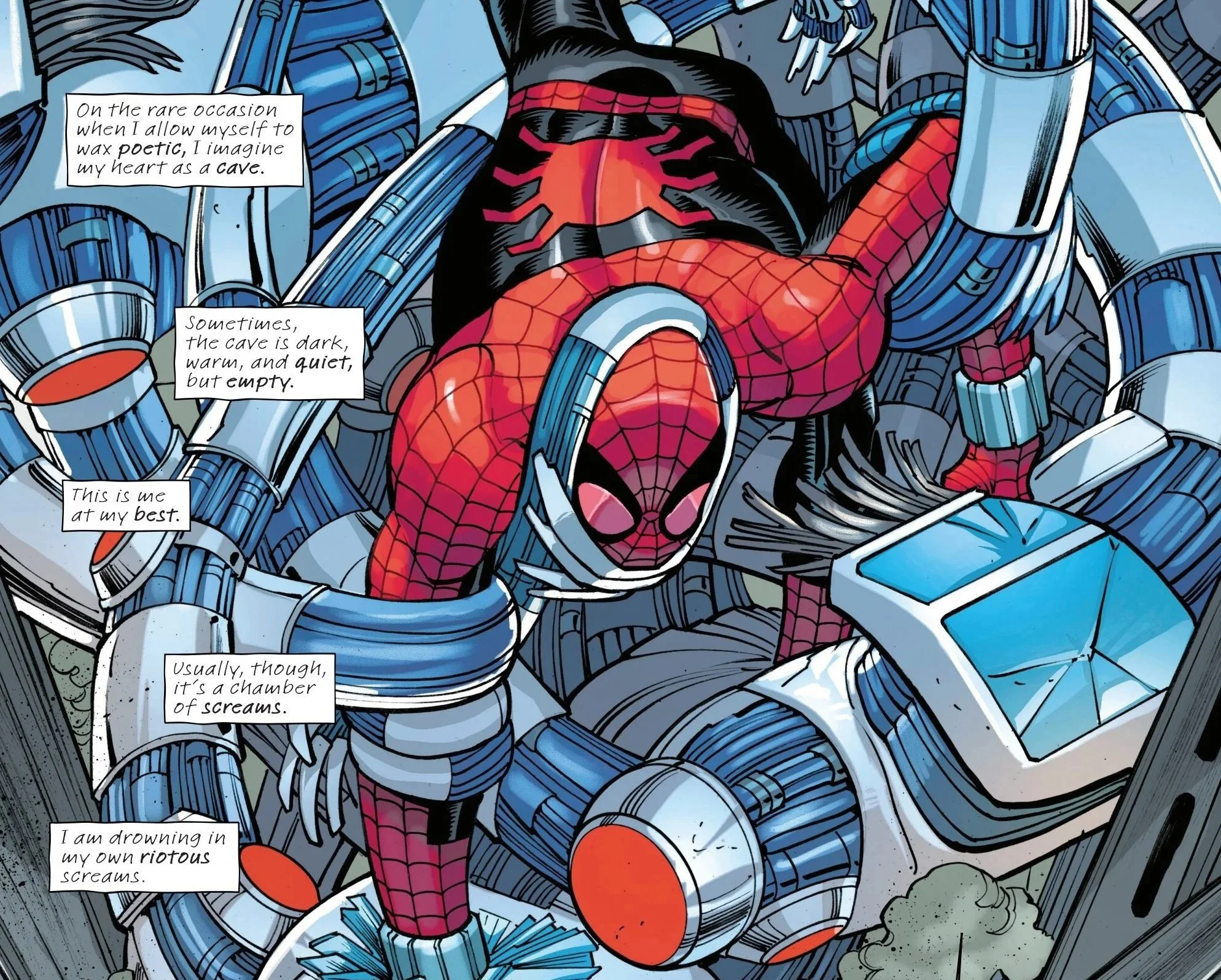
The work of Romita Junior still lends weight and gravitas to character moments, particularly the expressions of Norman. These effectively convey strain and instability when his mask is ripped right off his face. However, the action sequences of Romita are still stiff and hard-hitting, even though they might sometimes lack the dynamism needed to elevate the Slayers into truly menacing opponents. Todd Nauck and Paco Diaz inject more energy into the action scenes, but the jarring shifts in style in the final fight are just far too noticeable. This only further reinforces the sense that the issue is assembled from parts rather than flowing as a unified visual narrative. It feels like such a disservice to the work of three exceptional artists.
The color work by Marcio Menyz, Erick Arciniega, and Marte Garcia is solid, but once again, it further highlights the mismatch of art styles that have been slapped together. Bright reds of the suit of Norman accentuate the action. Dark palettes dominate, emphasizing mood over clarity, which occasionally muddies the readability of the action. The designs of the Goblin Slayers benefit from stark contrasts and eerie lighting, but the environments often blur together, diminishing spatial awareness. Overall, the art does its job, but it is once again completely hampered by the jump between artists. This only further fails to elevate the book beyond its script.
Neither Payback Nor Payoff
Amazing Spider-Man #20 feels like such a disappointment because it is emblematic of a run that feels increasingly overextended and uncertain of its priorities. Its earlier strengths (the psychological depth of Norman Osborn, thematic ambition, and visual callbacks to the legacy of Spider-Man) are undermined by repetitive storytelling, uneven pacing, and a disconnected art style shift at a pivotal moment. The issue wants so badly to say something, anything about redemption, responsibility, and consequence, but it often settles for restating those themes rather than interrogating them meaningfully.
For longtime readers deeply invested in the saga of Norman Osborn so far, this issue may still resonate, but barely. For others, it risks reinforcing fatigue with a run that seems more interested in circling familiar trauma and making downpayments on future books rather than providing any actual payoff. Ultimately, issue #20 feels less like a dawn and more like a never-ending twilight. It is a story caught between escalation and exhaustion, waiting for a decisive step forward that, for now, remains just out of reach.
Final Verdict: Amazing Spider-Man #20 is far too obsessed with setup than telling an actual story and with a jarringly unnecessary artistic shift at the end of the issue, this book takes several unfortunate steps back from Norman’s carefully developed character work to instead set up new books farther down the line.