
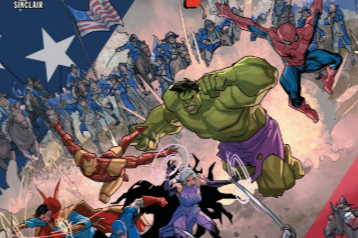
Initial Thoughts of 1776 #4
1776 #4 is the penultimate issue of this reimagined time travel story that sees the Avengers trying to save the past and the future of the United States. Spider-Man has been shot, and the Red Coats, with the help of the sorceress Morgan Le Fay, are at the doorstep of crushing the Continental Army. The big cliffhanger where we left off in 1776 #3 of Spider-Man being shot was a bit anticlimactic, but it ultimately works as a plot device to get Clea, who is the only one of the Avengers who can match up against Le Fay, off her. Speaking of Le Fay, she, or I should say writer J. Michael Straczynski, uses a time spell to age the Hulk to try and defeat him rapidly. Magic, when used correctly, can be a viable story plot rather than a deus ex machina.
Everything works well in 1776 #4. From the drawing to the coloring to the plot, all of it seems like it is finally working together just in time for the ending, as this is a five-issue miniseries. The ridiculousness of the concept makes the stabs that might not regularly work not only work but also serve as essential plot points. The groundwork of 1776 #4 has paid off, delivering a very good comic book.
What Happened in 1776 #4
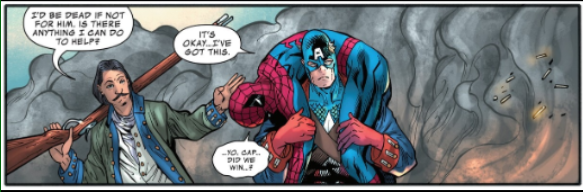
We pick up right where we left off in the last issue, as Steve Rogers is trying to get a shot at Peter Parker off the battlefield to get healed back to normal. That requires some extra help, which requires Clea to retreat from her battle against Morgan Le Fay. Tony Stark finally succeeded in getting Benjamin Franklin to convince the rest of the Continental Congress to evacuate Philadelphia away from the upcoming battle.
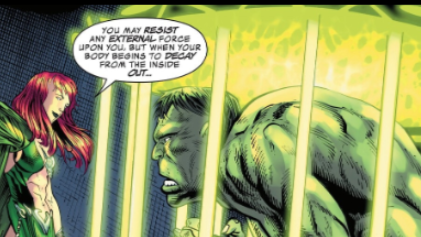
While Clea fixes up Peter, Hulk comes face to face with Le Fay, who uses some time magic to quicken his aging, leaving him trapped. However, unbeknownst to Le Fay, this was used to turn the tide against her. We also find out that the man Peter saved on the battlefield is part of his family tree. While all this is going on, Le Fay and her monsters have officially made their way to the front of the battle.
What Is Set to Happen in the Final?
The war is finally at the doorstep of the Continental Army, and the fate of the United States is on the line. Will the Hulk be able to escape in time to reveal what he got from Morgan Le Fay? He put himself in harm's way, so his plan better work for him and for the birth of the United States. Now that Peter Parker is fully healed and Iron Man is done with Benjamin Franklin, all the Avengers are heading to the front lines to hopefully save the country and the Avengers as a concept. But more importantly than the fate of the country, will we meet any more of Peter’s relatives?
The Character Work, Among Other Things, Work Well in 1776 #4
The story of 1776 continues to hum along and gets everything set up for the finale in the next issue. After getting over some of the awkwardness of trying to make American historical figures and Marvel superheroes work together, the fourth issue in this miniseries is finally hitting its stride. What works best in 1776 #4 is the fact that everything the creative team has tried in the previous three issues, including anything that might have seemed weird, is set up to pay off in the final issue.
Something else that is sticking with me after putting down 1776 #4 is Steve Rogers risking everything for his friend. Is it dumb? Yes. Does it jeopardize the entire mission? Sure. However, he does not leave a soldier behind, and while that is a grandiose idea, those are the types of ideals that can win a war. Just like in the review of 1776 #3, where Spider-Man’s true character shone through the chaos, Steve Rogers does the same here. No matter how hard or impossible things seem, you do not leave a soldier or a friend behind. That theme has shone through the entirety of 1776. The Avengers are always who they say they are, and they remain true to their character. This humanizes the heroes and makes them relatable, which is what makes comics so good at their core.
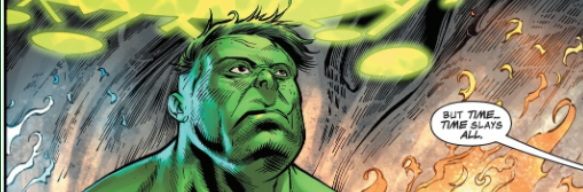
With all that being said, 1776 #4 would not have worked without its own unique ideas. When Morgan Le Fay and the Hulk faced off against each other, the usual magic spell was not used to make it a fair fight. Instead, Le Fay used the same time she steals to keep herself young to age the Hulk toward his death. I thought that was genius, and I do not think that has ever been done to the Hulk before. That was incredibly creative and a new way to subdue him. This was done to gain the upper hand on Le Fay in the next issue, so it was clearly done with a purpose. I really enjoyed that story beat, and it looks like it is going to pay off in a major way in the final issue.
The Pacing Slows Down
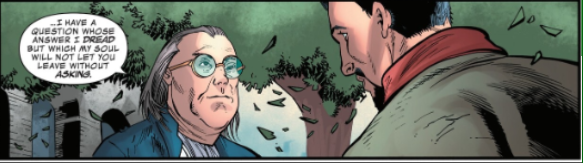
This also felt shorter than the previous three issues. Besides the first issue, the three following chapters were all twenty-three pages long. 1776 #4 simply had slower pacing than the rest of the issues. It is not a bad thing, but it did feel like the pacing they had built over the last three issues came to a screeching halt. So, while we got everything tied together entering the final issue, where I am sure the pacing is going to pick right back up, it was slower.
The next complaint is not necessarily a criticism of the creative direction of 1776 #4, but more of the use of tropes, specifically in comic books. Everything is coincidentally connected to the same people, and everyone is related. Everything seems to be aligned in a cosmic way, and everything is predetermined fate. There is a lineage that cannot be broken because it is the fates that bind all. Star Wars is like this, too. In this instance, Peter Parker saved his great-great-great-grandfather, Elias Parker, thereby preserving his family lineage. While it works as an emotional beat for the story, it is played out. When the issue is good and you have to find something wrong, it sticks out.
This is just a "me" thing, since I was a history major, but I find it hard to take Benjamin Franklin as a sympathetic character. Franklin was a slave owner, a womanizer, and a bad father. In comic books, we are supposed to suspend our disbelief, but in a world of time travelers, flying men, and monsters, Franklin as a caring person might be the most far-fetched idea of all.
The Art Finally Hits Its Potential
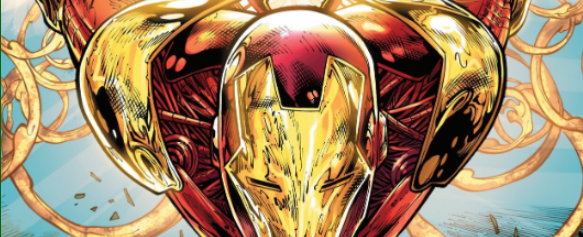
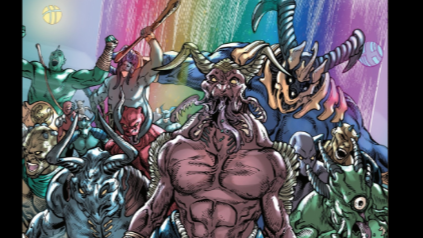
The art has grown on me. It all clicked for me at the end of the issue when all those monsters summoned by Morgan Le Fay appeared. The art has mostly been moderate by comic book standards. What I mean by that is, there really has not been anything over-the-top. Interdimensional monsters transported to the stiffness of the Revolutionary Era are superb. This is where Sean Damiel Hill excels. His work with monsters is some of the best. That single panel, at least for me, finally brought the art to life and has me excited for the conclusion. While the characters' designs, specifically their faces, still are not my favorite, all the art, put together, works, and 1776 #4 is the culmination of that.
Colorist Alex Sinclair brought it again. The most consistent aspect of this miniseries has been the fantastic coloring. What stood out in 1776 #4 were the Hulk's color and the Iron Man suit's shading. The line work feels “of-the-time,” which is a weird thing to say, since the Avengers are in the Revolutionary Era, but if you try to understand what I am saying, you will know what I am talking about.
Overall, this has been the best issue of art in 1776, so I am expecting big things for 1776 #5.
My Final Verdict for 1776 #4
1776 #4 is an enjoyable issue that finally brings the art and story elements together, setting us up for what is set to be an over-the-top, fun ending. However, for all of its grandiose ideas, what makes this issue stand out are the small pieces of character work that humanize the Avengers. In this issue, that weight falls to Steve Rogers. A mixture of big ideas and small character work is what makes 1776 #4 the best issue in the miniseries.
The pacing is a bit off, and some of the age-old tropes do not fully work, but nothing detracts from the story as a whole. The art is as good as it has ever been, and it finally comes together in sync with the rest of the story. Ultimately, the job of 1776 #4 is to get us ready and set everything up for the final issue. Job accomplished.