
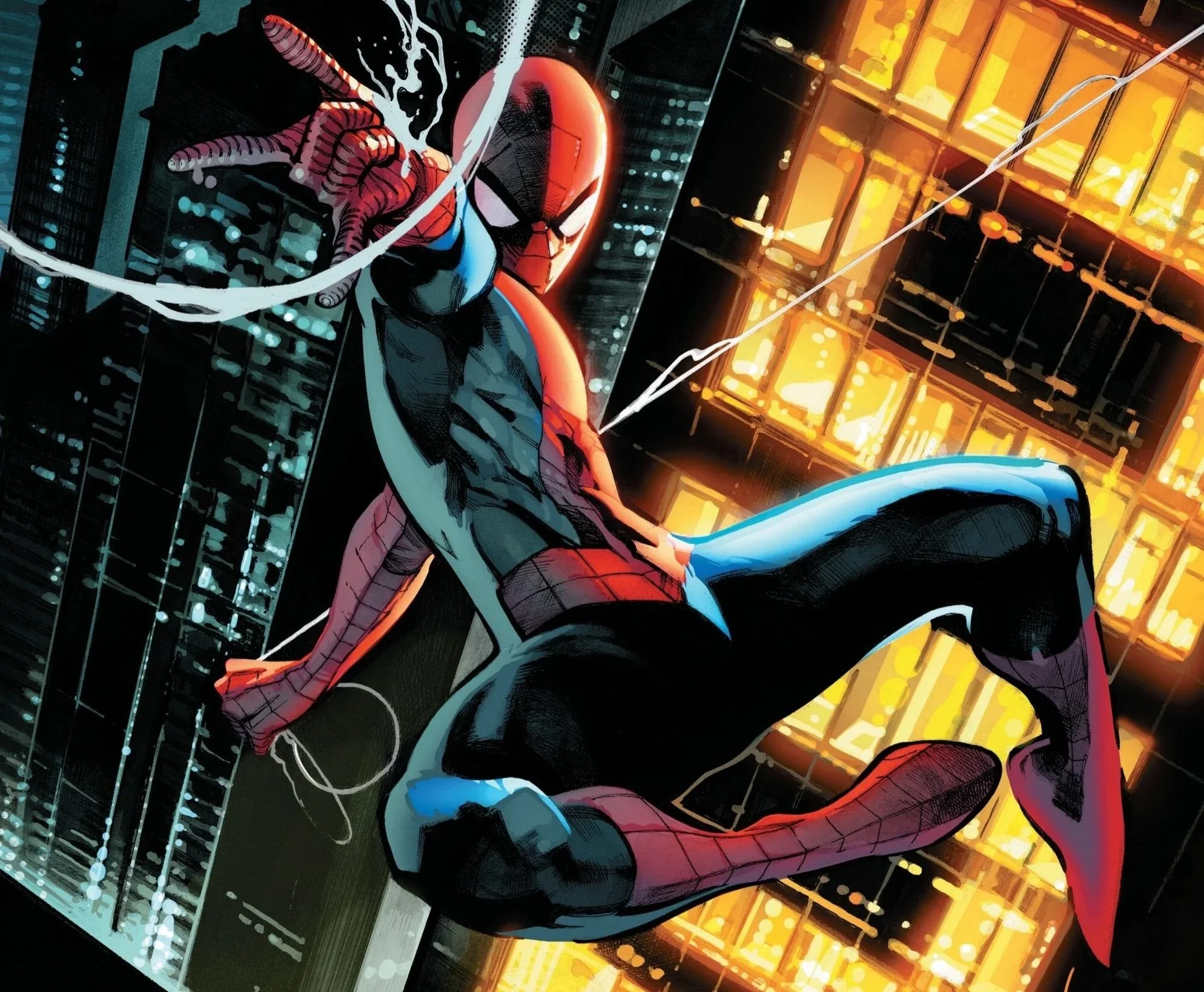
After nearly 65 years and at a 1000 issues, we’ve finally arrived at this milestone event. Amazing Spider-Man. One of the longest running superhero comic series ever – a mosaic of the trials and tribulations of one the most beloved superheroes that has ever graced our printed pages. And for what it’s worth, there’s a lot of positive and negative adjectives you can put to that history. But this issue in particular? This big one? Amazing Spider-Man #1000 is nothing less than a celebration of the good, the bad and spidery that came with it.
With nearly a hundred pages packed into this issue, and a whole host of some of the best and brightest creatives to have ever worked on this series nearly 65 year history, along with a couple of unexpected guest writers on the job as well – this issue does its best to present the next chapter of its ongoing story alongside a few celebratory adventures that all perfectly showcase just how much readers love and loathe this remarkable series.
An Arachnid Anthology
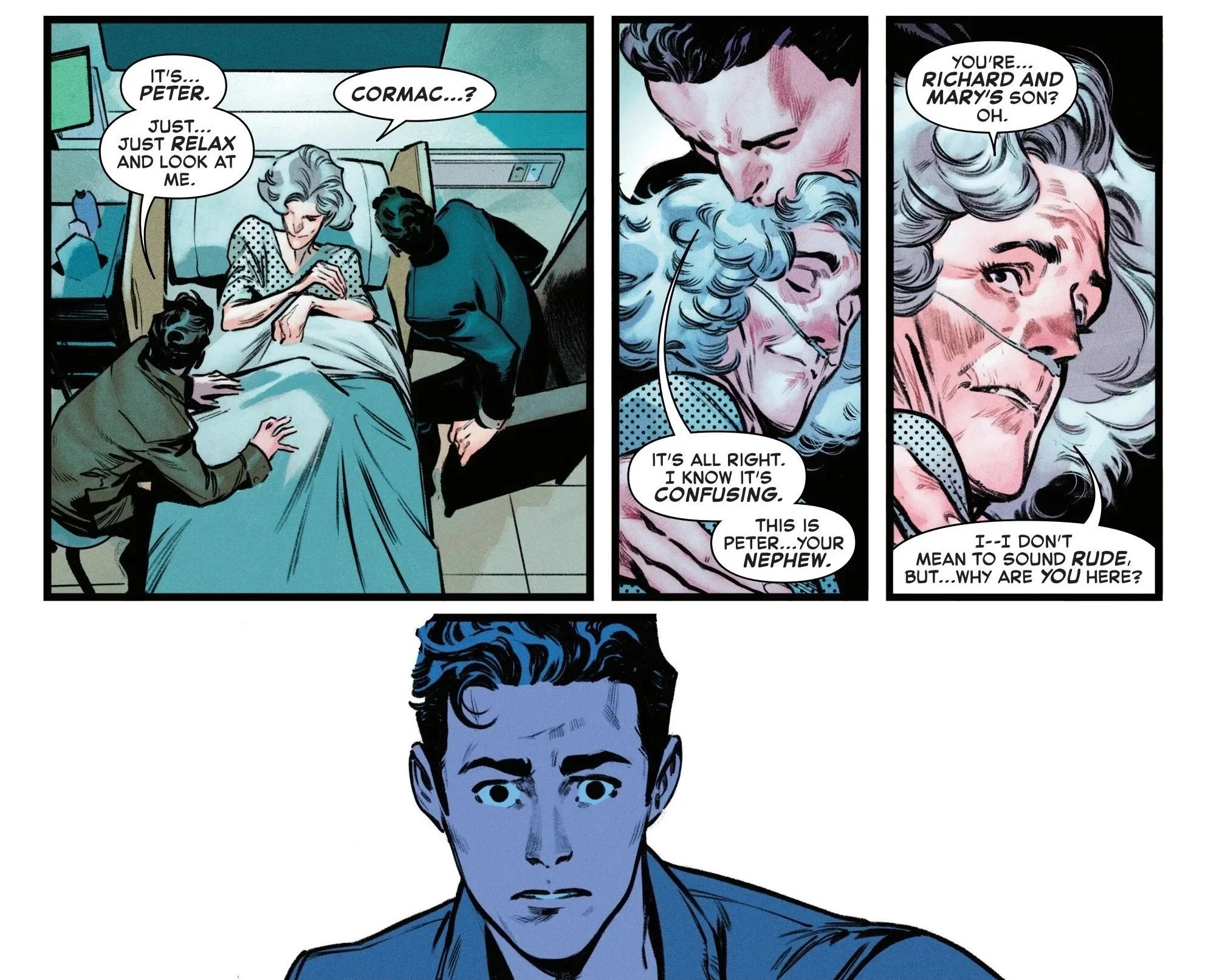
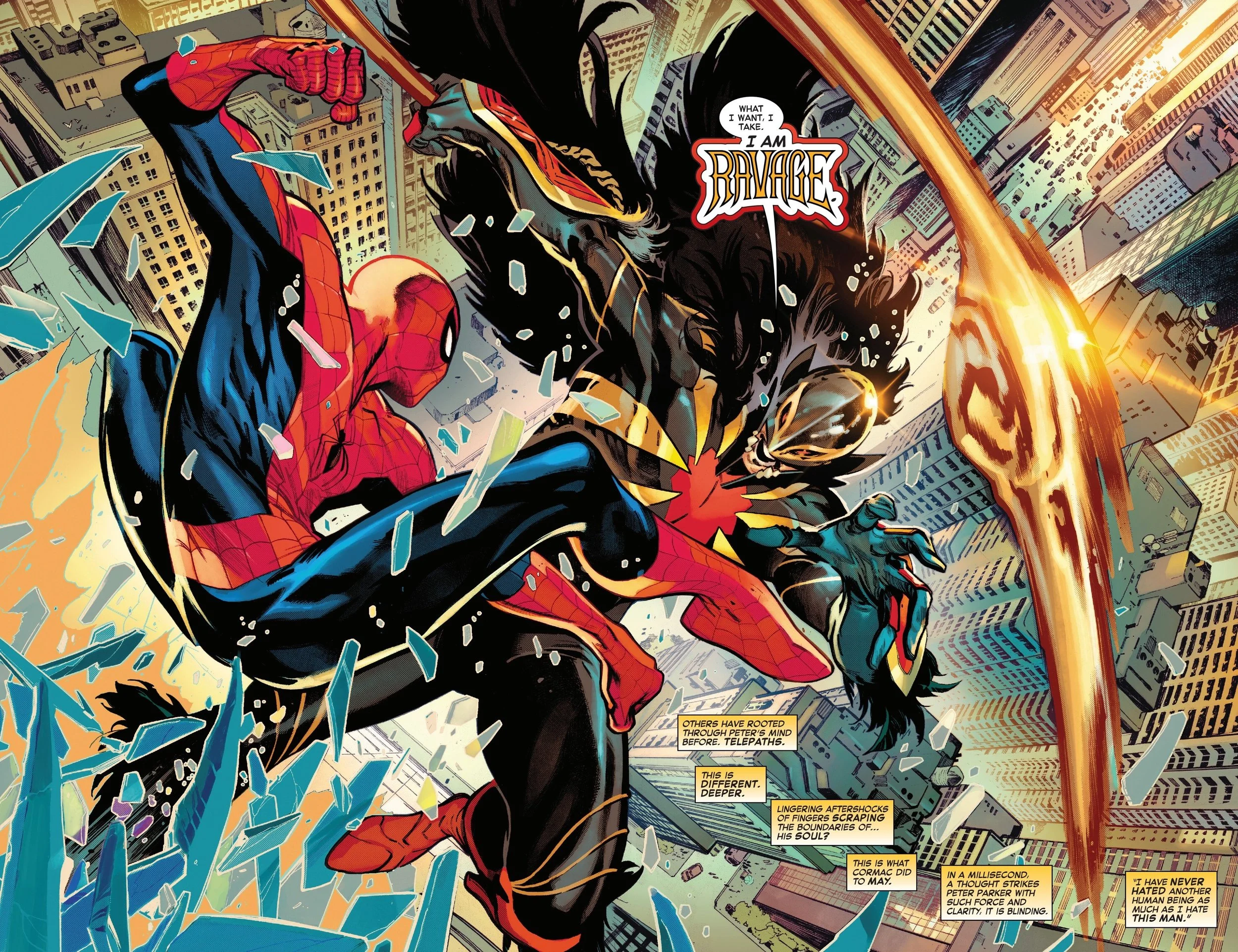
This milestone issue features eight amazing stories over the course of its 100 or so pages. The first major storyline continues the events of the ongoing Amazing Spider-Man run – picking up where Amazing Spider-Man #35 left off. As Peter rushes to the hospital after getting news of his Aunt’s stroke, he quickly comes to see the horrifying situation in front of him: his Aunt is well, but she can’t remember who he is or their history together. At her side is her son – Peter’s cousin – Cormac, who she seems to know and dote on. This nearly breaks Peter, but not as much as the final groan-inducing reveal that Cormac was eeeeevilllll all along. How unexpected; the audience gasps in shock. And he’s got a super scary villain suit and a totally terrifying name. Ravage, they call him, with his big villain motivation being that he wants the love that Peter got his entire life from Aunt May. Oh, and revenge for letting Uncle Ben’s death happen in the first place, once he finds out how that happened after going through Peter’s mind. So, Peter’s marquee story in issue #1000 is him fighting his evil cousin whose biggest problem is mommy/daddy issues that he literally weaponizes to beat the snot out of his cousin because he wasn’t loved enough as a child. Make of that soap operatic majestic show what you will.
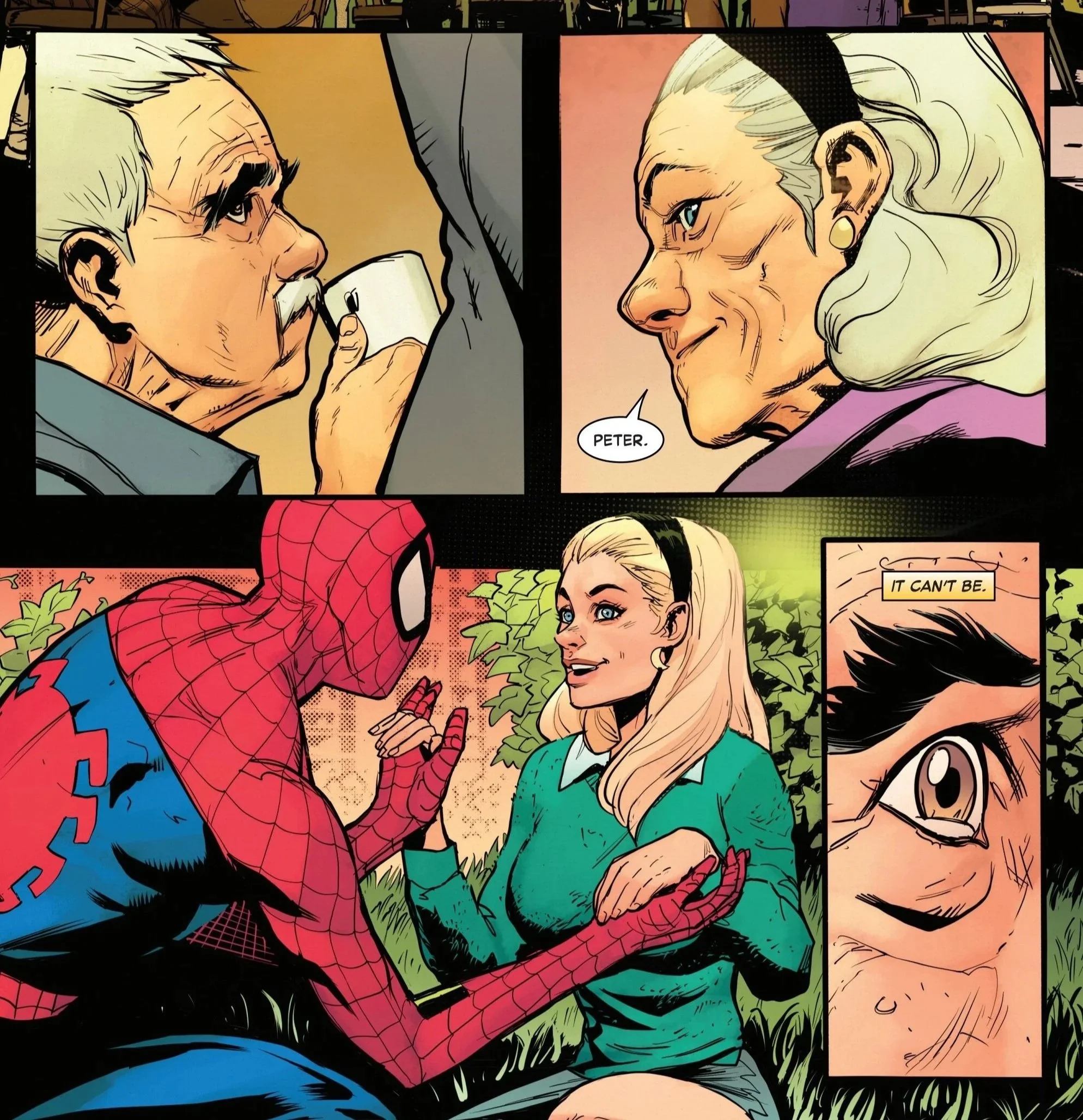
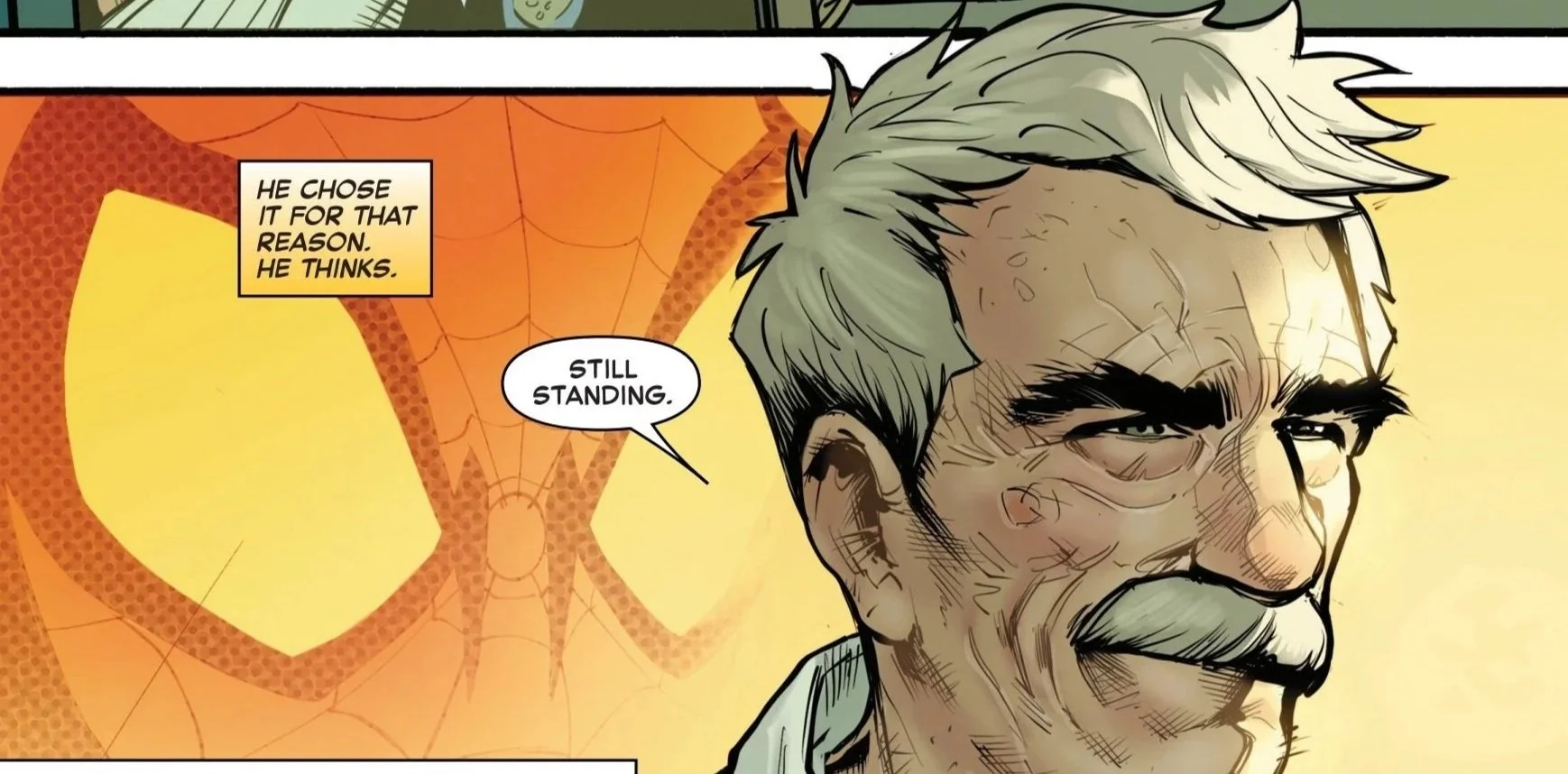
The next major story, “I’m Still Standing” is by guest writer and showrunner of Fargo, Legion, and Alien: Earth fame: Noah Hawley. In his somewhat of a take on Spider-Man: Reign, we get a Peter Parker who is now fully retired and living his days in a nursing home. His family – son, daughter-in-law, and grandson – come to visit and check up on him. His grandson is even the current Spider-Man, so the legacy is still being carried on. However, things start to take a weird turn when an aged Gwen Stacy shows up in Peter’s life once more, which Peter refuses to believe but is eventually convinced is real. Things aren’t what they appear to be, though, and knowing Hawley’s penchant for mind-warping story beats (that often get a little too pretentious for their own good), there’s more going on here as Peter’s own sense of reality is played with by a sinister force from his past that is determined to erode his sanity.
The next six stories that follow are short ones written and drawn by some of the best and brightest creatives across the long pantheon of ASM’s history. “Requiem for a Goblin” is J.M. DeMatteis’ and Humberto Ramos’ short yet introspective look at Peter’s wrestling with his feelings about the death of his best friend, Harry Osborn (the first time he died, mind you). “Tears of the Spider-Queen” is a kinetic and almost psychedelic tale by the legendary Frank Miller and Peach Momoko about Spidey facing off against a Spider-Demon and her creepy cult as he tries to save one of their victims. Former WWE wrestler and current CCO, Triple H (and his buddy Robert Fee) teams up with Ed McGuinness and Mark Farmer for “The Big Night”, a sweet little story that harkens back to the impact of Professional Wrestling in Spidey’s life.
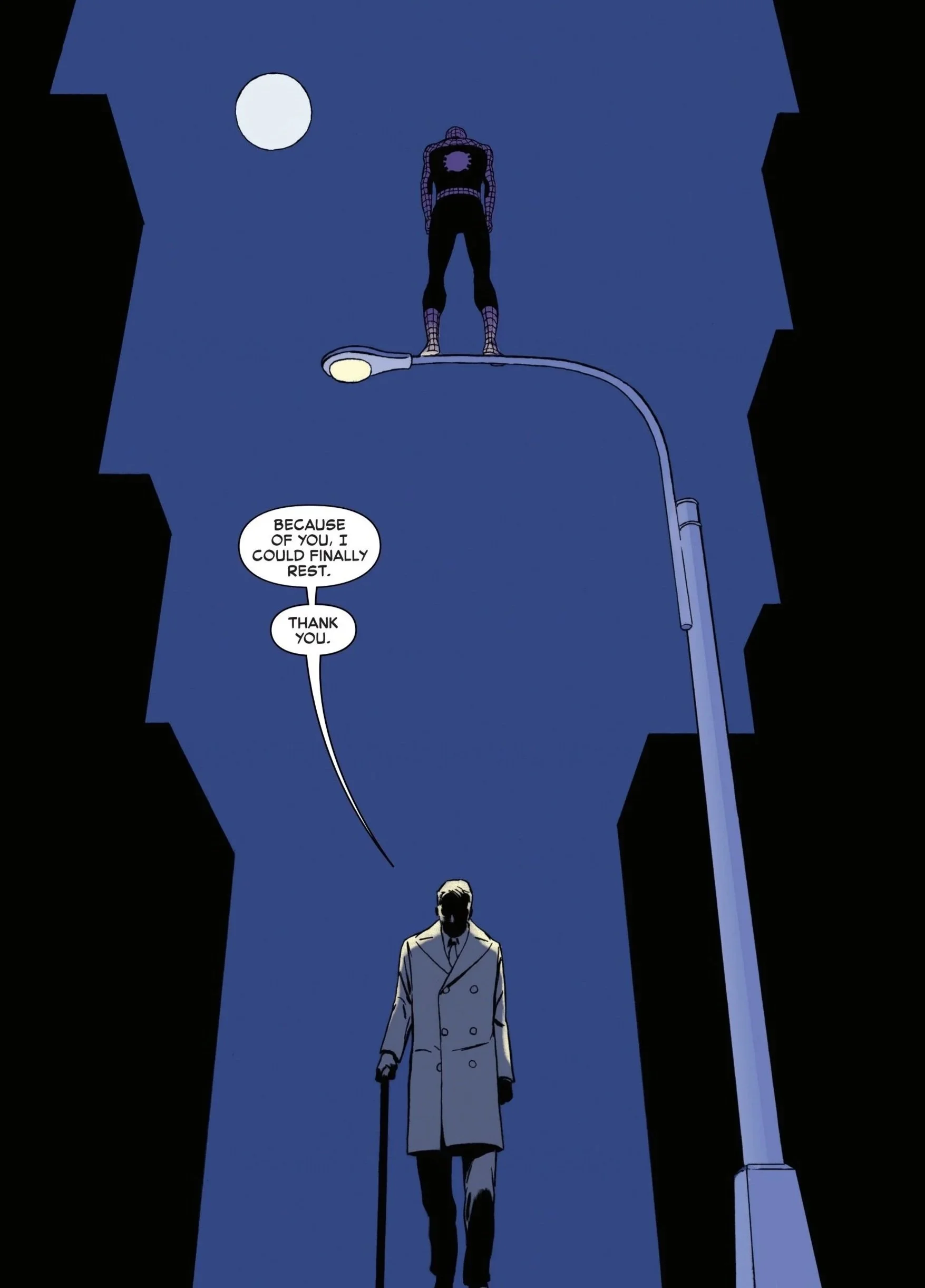
Then we have Spidey stalwart creatives Brian Michael Bendis and Stuart Immonen go through a bit of a meta romp about Spidey’s costumed debut anniversary in “The Gesture”. Next, Stan Lee’s brother – Larry Leiber – and artist Giuseppe Camuncoli tell their own weird little western story (emphasis on weird) in “Of Webs and Six Guns”. To finally cap off this issue, long-time Spider-Man writer – Dan Slott – and artist Marcos Martin’s “I Can Never Rest” is a somber yet beautiful retelling from the perspective of a police officer of the night Peter let a random thug get away, and the consequences that shaped his life forever because of it.
You Never Know What You’re Gonna Get
There’s a whole plethora of creative talent on this amazing 1000th issue, so obviously a lot of ground to cover. With stories ranging up and down on the quality scale across the board, I will say one thing off the bat: for a hundred-page book, there were some interesting choices made on which stories got the lion’s share of the page count. Like, I understand the main Joe Kelly story getting 20+ pages since it’s still part of the ongoing ASM run and carries that story forward, but then we have guest writer Noah Hawley’s alternate reality story also getting a whopping 20+ pages as well. This wouldn’t be so jarring if we didn’t consider how every other writer, especially series stalwarts like Dan Slott and Brian Michael Bendis or even Frank Miller, were given less than 10 pages each for their shorts. I’m confused on that front and what the editorial idea was in this decision, but for the most part it doesn’t seem to have affected the intended quality of each story, in my honest opinion.
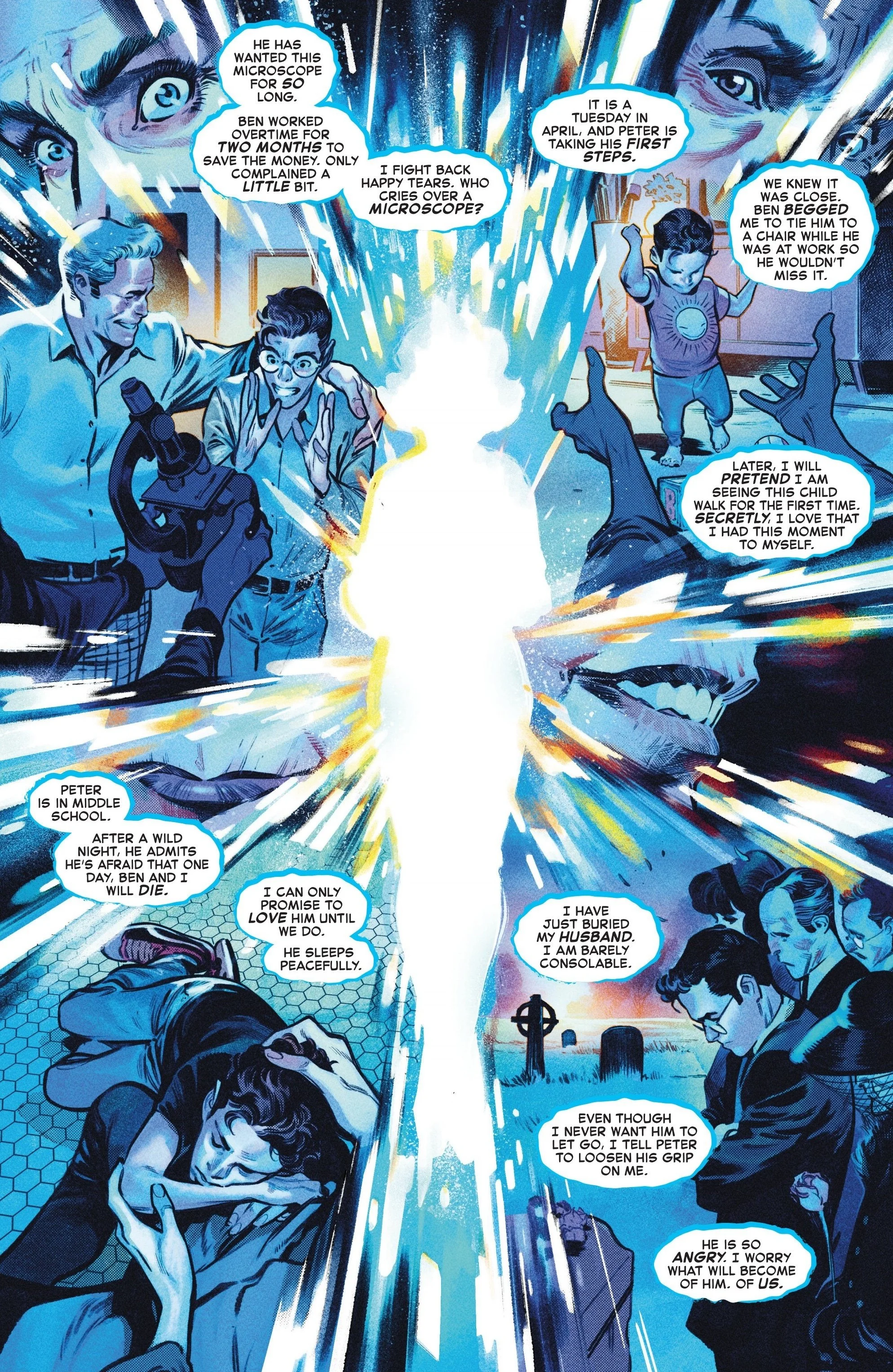
Let’s start with Joe Kelly’s latest chapter in his ongoing Peter Parker saga. We already got a glimpse of things to come in the previous issue, to very groan-inducing results, and there’s no real difference here in this issue either. As stated before, Aunt May gets ill for the billionth time, although this time we’ve reached new levels of soap opera angst with the age-old “she has amnesia” trick being pulled. Peter is forgotten, and only Cormac is registered as the true son. Oh, and of course, we finally drop the charade as Cormac finally reveals he’s a masked supervillain who wants to destroy Peter and suck up all his memories of Aunt May and Uncle Ben. Yes, Joe Kelly finally gets to play his master card of Peter’s evil cousin being actually evil! And why does he hate Peter? Because DADDY ISSUES! DUN DUN DUN. It’s so unbelievably absurd that it almost veers into black comedy, though I’m fairly certain that wasn’t the intended effect. Although there is something quite mirthful about Peter’s evil cousin beating him to death with a club made out of the physical manifestation of Aunt May’s love. And things take an ever more laughable turn when Cormac finally learns about how Uncle Ben died, adding more fuel to the fire of this absolute mess of a motivation chart. That being said, there are some tender moments where some of Kelly’s better writing talents shine through when he’s delving into Aunt May’s memories of Peter, and it’s genuinely heartwarming seeing that perspective done with genuine sincerity and investment. However, for the most part, this chapter in particular was just another day at the office that is Amazing Spider-Man and is, in its own way, a glorious showcase of some of the worst, status-quo, shock-jock writing that has plagued the series for almost 15 years now.
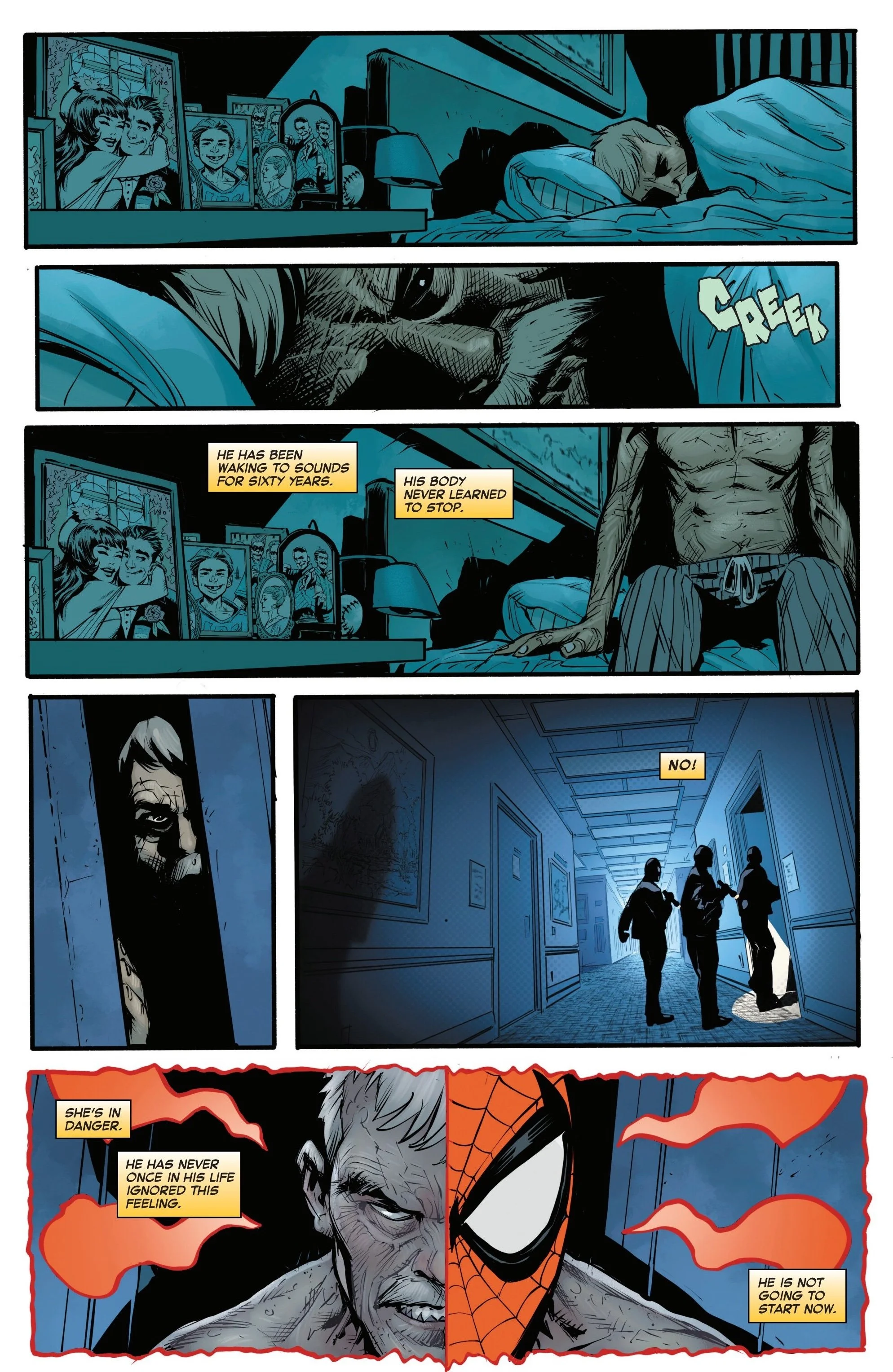
Noah Hawley then proceeds to write his own take on Spider-Man: Reign, albeit with his own TV spin on it in “I’m Still Standing”. Old Man Peter Parker stories have been done to death, as have stories about Peter’s descendants carrying on his legacy, and this story by Hawley isn’t reinventing the wheel. While it attempts to present the illusion of heartfelt storytelling and does somewhat capture Peter’s memories of holding on to the past, I honestly don’t think it needed 20 pages to tell this story, especially with the reveals being what they are. Hawley’s writing weaknesses for TV rear their ugly heads pretty fast here, as there are attempts to make this overdone storyline something more than it actually is. And that hype costs it in the end by making it kind of generic. Your mileage for this will depend entirely on how you feel about Old-Man Spider stories in general, and while I did enjoy Peter’s relationship with his grandson and how he was the only one willing to believe in Peter’s judgement and uncover the big mystery at the heart of everything, this story could really have benefitted from being at least 10 pages shorter.
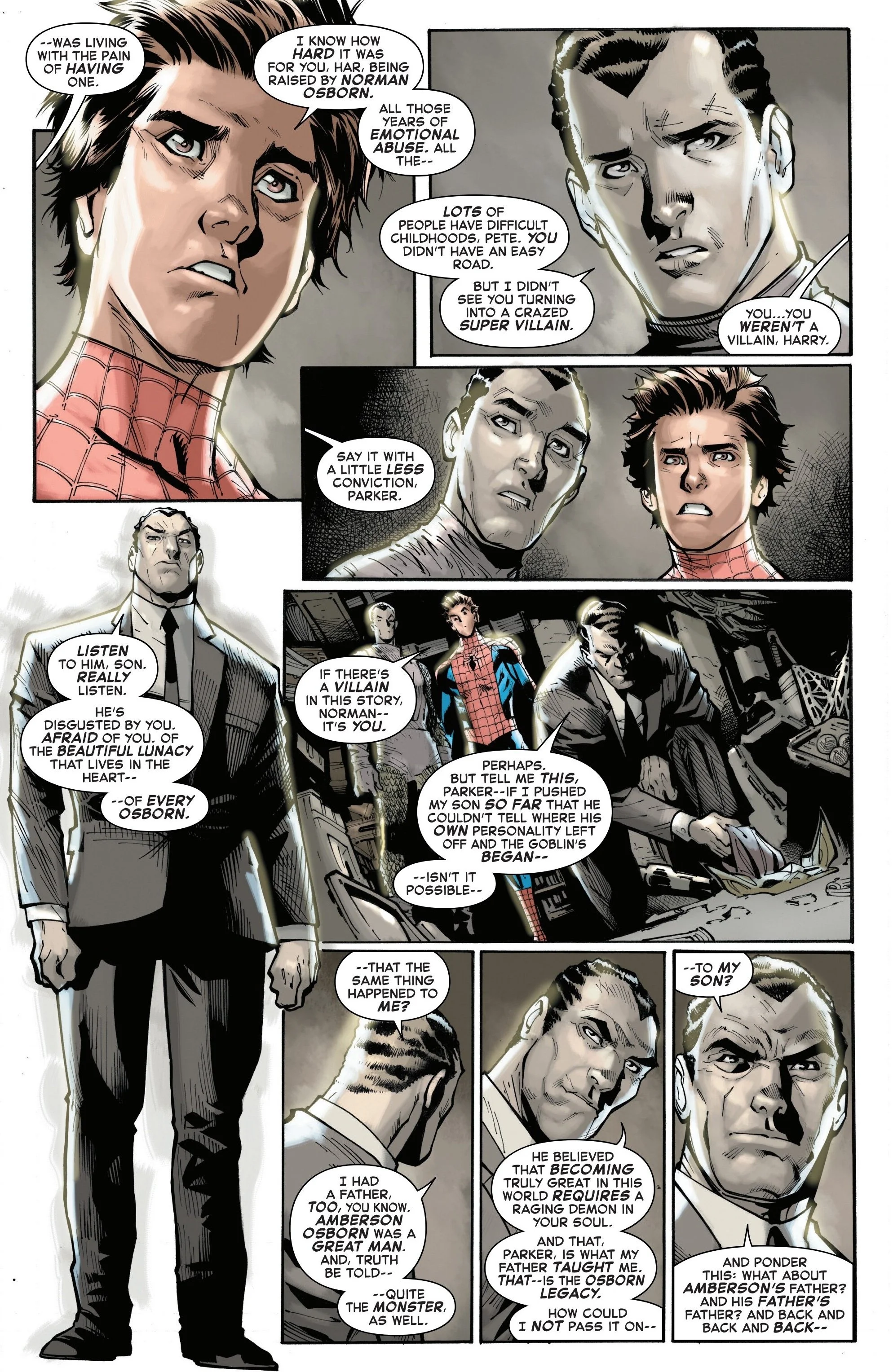
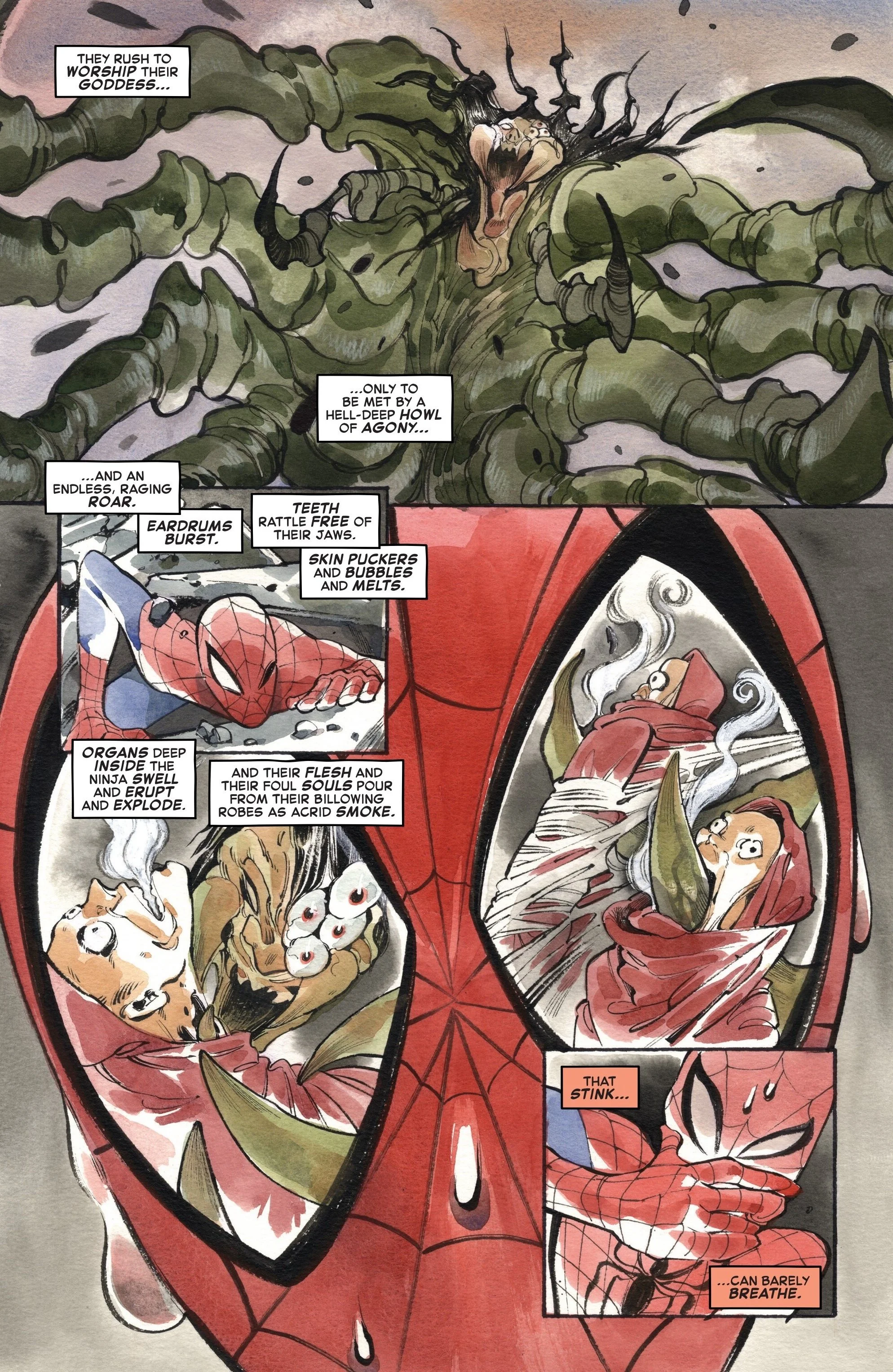
The next few shorts, however, provide a real menagerie of writing qualities to them, so make of that what you will. J.M. DeMatteis does a great job in capturing Peter’s trauma alongside his fear and guilt about Harry Osborn’s death from back in the day. It’s a fairly straightforward tale that’s more cerebral in the sense that we get a good indicator of Spidey’s defining guilt: watching his loved ones die while they’re also the source of his pain, since Harry was also the Green Goblin, and DeMatteis captures that feeling quite well. Frank Miller’s story is more of a high-octane action adventure with a dash of body and spiritual horror thrown into the mix. Miller’s usual approach to the narrative also shines through here amidst all the energy, telling a story that uses supernatural undertones that highlight both the eerie nature of Spidey’s more formidable offensive abilities while still being couched in his humanity.
And then, of course, the heavily publicized short story by Triple H (with liberal help from WWE writer Robert Fee) is a fairly quick, yet inoffensive tale that does a good job of nodding to how Pro-Wrestling has such deep roots in Spider-Man’s lore. Framing it as a memory of Uncle Ben and a child Peter going to watch a wrestling match – complete with mandatory WWE branding on the turnbuckles and mat – is a charming approach to take, and it’s lighthearted enough for a guest writer of Triple H’s creative pedigree (a tag team of sarcasm and punning is doing the real carry job there). But hey, seeing Crusher Creel using a Burning Hammer on D-Man of all people wasn’t on my bingo card, so I can roll with it.
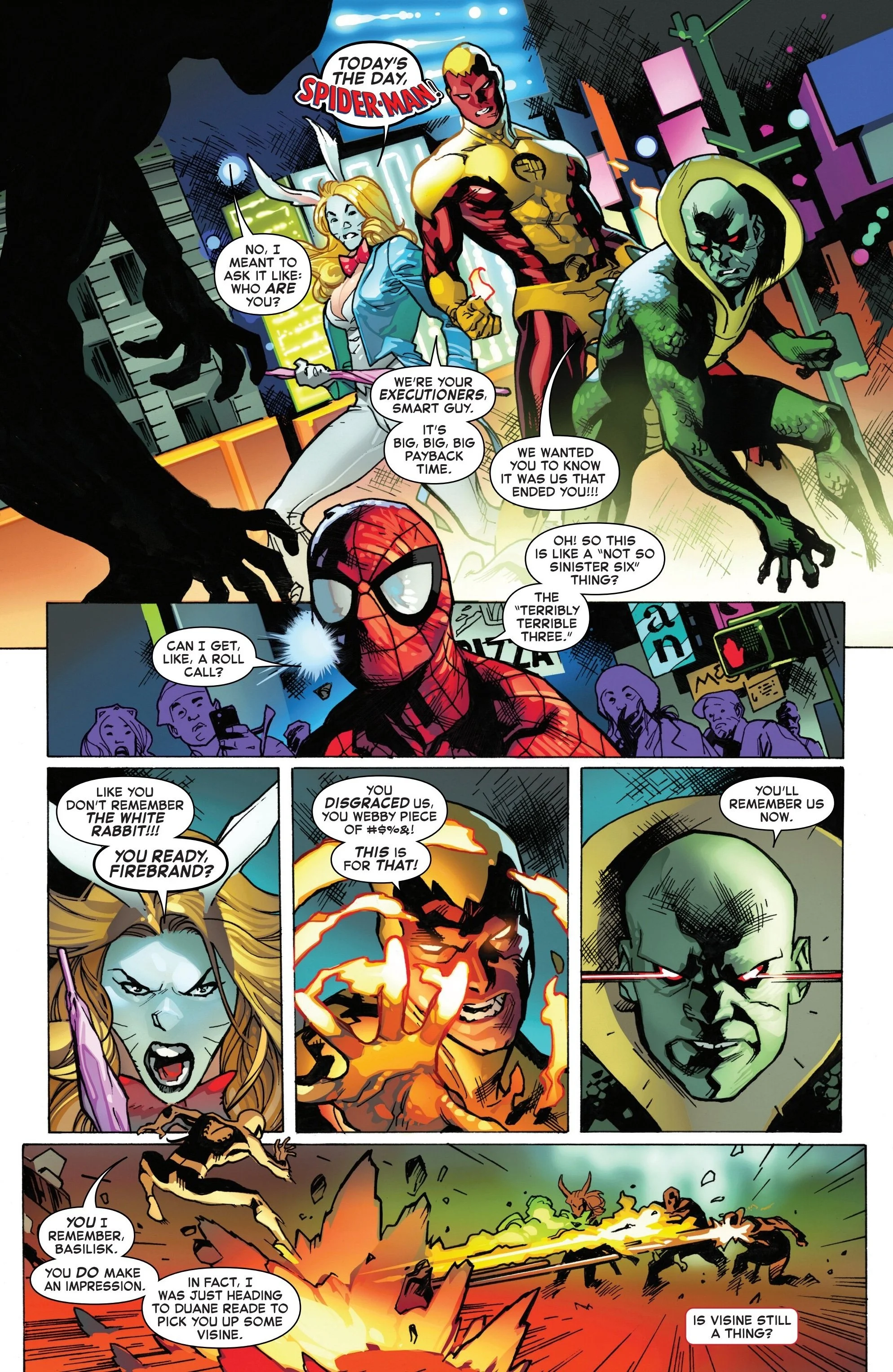
Brian Michael Bendis, probably one of the greatest Spider-Man writers to ever work on the character, plays his best hits by telling a fun little action romp of his own, filled with quips, dips, and flips. Also, it’s fun seeing some true Z-list Spidey villains like Basilisk, Firebrand, and White Rabbit mix it up, and Bendis does a good job keeping them formidable yet still reminding everyone why Spidey still clowns on them so regularly. Ultimately (Bendis pun intended), the real heart of this story lies in the meta-textual celebration of Spidey’s first costumed debut: a celebration that takes place in the story, hosted at Avengers Mansion, which of course Spidey misses. But at least Captain America – notably Peter’s idol as a superhero – is there at the end to give him the morale boost he needs, emphasizing that age-old line from the old theme song: Action is his reward.
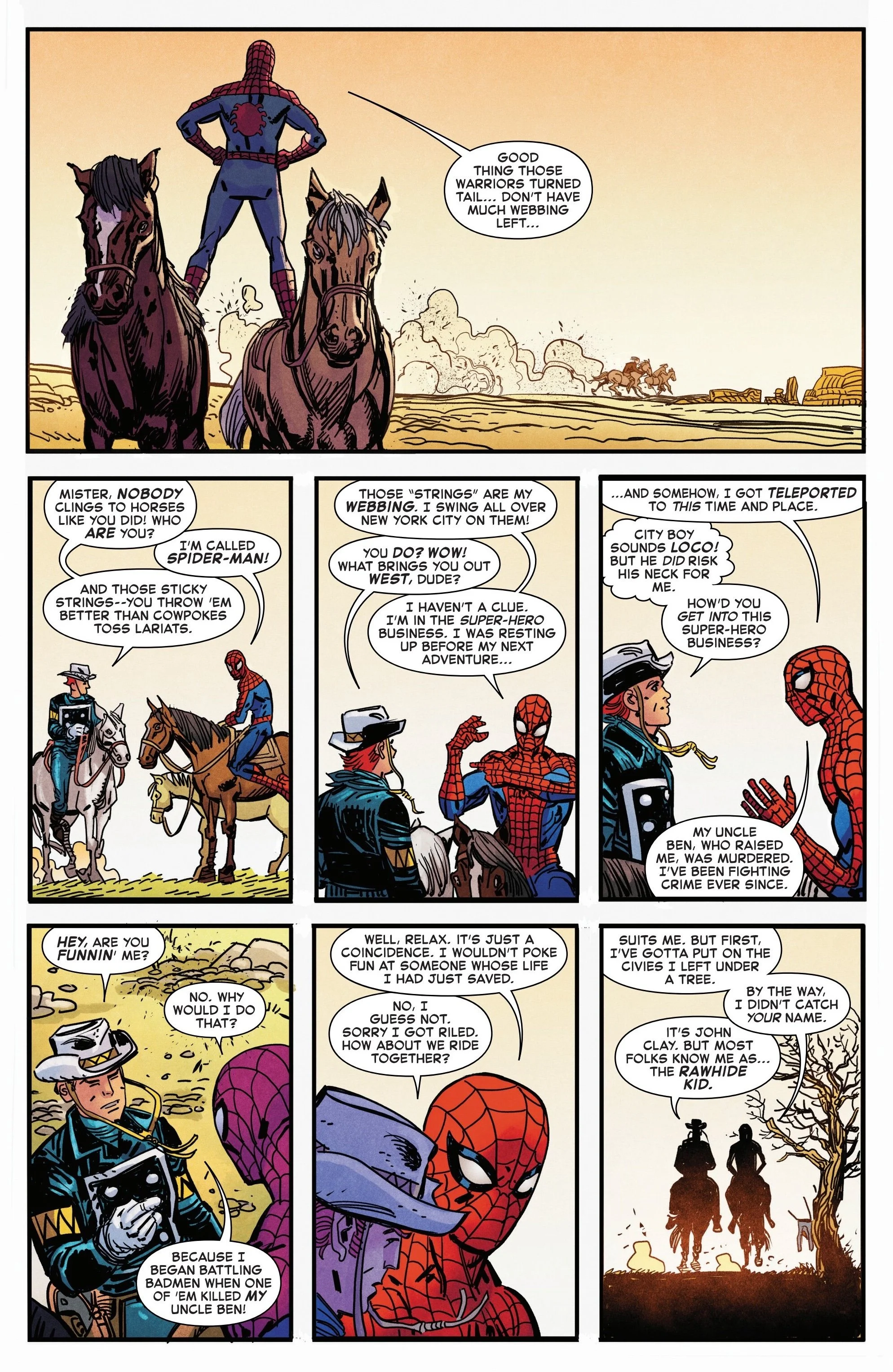
Stanley Leiber also gets to pen a short of his own here, with Peter starting off enjoying a nice, quiet day with Mary Jane at the park, which somehow turns into Peter being pulled into a literal Old West and even a team-up with the Rawhide Kid (another old Stan Lee co-creation). This story honestly feels incredibly random, and gets more random as the story goes forward. We’ve got Spidey beating up random Native American “thugs”, getting propositioned by salon-based sex workers, and even engaging in a Dirty Dozen-style gunfight alongside the Rawhide Kid before he’s returned to the present and left wondering whether this adventure even happened at all. Honestly, I don’t think even Leiber himself was sure of that fact, but this just goes to show that even the wild, wacky, and random have their place in Spidey’s web of stories too.
Finally, Dan Slott ends up penning probably the best short story in this entire issue (and maybe the best story overall in this issue, period). While Slott’s writing in the recent past on ASM did run a bit on fumes, there’s an amazing showcase of Slott at his best with the way he framed this tale. Arthur is an old police officer who is, in fact, the same police officer Spidey refused to help when a robber ran past him. We all know how this story goes, but Slott provides a truly somber new twist to this story by having the entire series of events play from Arthur’s perspective: his obsession with catching the robber who is also a killer, arriving at the scene of Uncle Ben’s death, hearing Peter’s anguish, and chasing down the killer, only to see him get apprehended by Spider-Man. It all culminates in Slott having Arthur and Spidey meet again years later, and all the memories of that past coming back to haunt both of them. There’s solid, measured humor and some incredible narrative framing with Spidey/Peter never being fully shown in frame until the very last page, where the story’s emotional core reaches its climax. I honestly can’t praise this story enough or do it justice beyond saying that you need to read this even if you read nothing else in this issue at all.
Amazing Spider-Man #1000 is certainly a hell of a mixed bag when it comes to the kinds of stories you’ll find here. I do lament that other Spidey mainstays like, say, J. Michael Straczynski, David Michelinie, or Ann Nocenti, weren’t a part of this celebratory volume, and I figured cutting a few pages from a couple of the larger stories could’ve maybe helped facilitate a few more creators. But alas, there’s never an ideal scenario where you can get everyone all in one place, no matter how much you want. And the selection of creatives we did get was enough to truly showcase the entirety of what Amazing Spider-Man as a series has represented over the years, warts and all.
Action is His Reward
Just like it’s all-star writing team, the artist lineup for this issue is also full of heavy hitters across the board, making for a real visual treat even in the stories where the script falters. That being said, I was more than a little shocked that John Romita Jr. of all people wasn’t penciled in to illustrate on this issue in any capacity. It’s a very strange omission, to be sure, and that absence is one that feels very noticeable considering the nature of this project.
For the mainline ASM story, Pepe Laraz and Federico Blee don’t miss a beat with the kind of line and color work they’ve been belting out in the series so far. There’s a great mix of bedlam and emotional mayhem in the art overall, especially when this is the story that introduces Ravage for the first time – Cormac’s evil costumed identity. For a new villain design, it’s honestly incredibly generic, but maybe that was by choice considering Cormac’s own hang-ups. But Laraz and Federico do their best to make the suit pop as much as possible. The action in this story is great and feels hard-hitting and fast as hell, with nice visual throwbacks to previous Spidey media as well, namely 2002’s Raimi-verse Spider-Man film. But despite the generic script, the art really elevates things, especially with some truly gorgeous panelling as Ravage tears through Peter’s mind and we get glimpses of both his and Aunt May’s memories in the mix of it all.
Patrick Gleason’s linework for Noah Hawley’s story is also very dreamlike and suburbia-centred. This is compounded by the almost idyllic shading and color work by Marcio Menyz and Erick Arciniega. Considering this is a play on the Old Man Spidey trope, the art conveys that feeling of ‘days gone past’ quite effectively and does make you feel for Peter’s current plight and the state of his mind. I also really dig the legacy Spider-Man costume design that Pete’s grandson wears, which is a simple yet cool play on the original design that really drives the nostalgia home. There’s a lot of doom and gloom in the offing, but also a lot of hope too, and I think the mystery, the angst, and the good emotions are shown quite beautifully by the art team in this one.
Seeing some Humberto Ramos art – especially on the Green Goblin- is always a treat too. And with support from Victor Olazara and colorist Edgar Delgado, he turns in some really nostalgic work in his signature style for the Harry Osborn story. Then we have Peach Momoko pitching in on Frank Miller’s story, and I honestly never thought in a million years what a combination of these two would look like, so it was really fun to see that experiment play out in such stunning fashion over the pages of that particular story as well. Triple H’s little rasslin’ tale gets some really fun art from recent ASM mainstay Ed McGuinness, alongside help from Mark Farmer and colorist Matthew Wilson. This artful tag team knows how to pop the eyes with their unique style, especially with this story that relies so heavily on visuals more than script to really drum up the feels (and that sweet corporate synergy with WWE for eagle-eyed viewers). And then we have Stuart Immomen and Marte Garcia on lines and colors respectively for Bendis’ story, which is a real fun, no-nonsense Spidey art fair that’s filled with some nostalgic villains and some fun visual gags here and there. Of course there’s the strange art for Lieber’s Western story as well, courtesy of Giuseppe Camuncoli, Klaus Janson and Rachelle Rosenberg. Your mileage on this will depend heavily on how you feel about Camuncoli’s art in general, and this story is far from his best showcase, feeling quite discordant in a story that already felt out of place despite its somewhat fun and wacky nature.
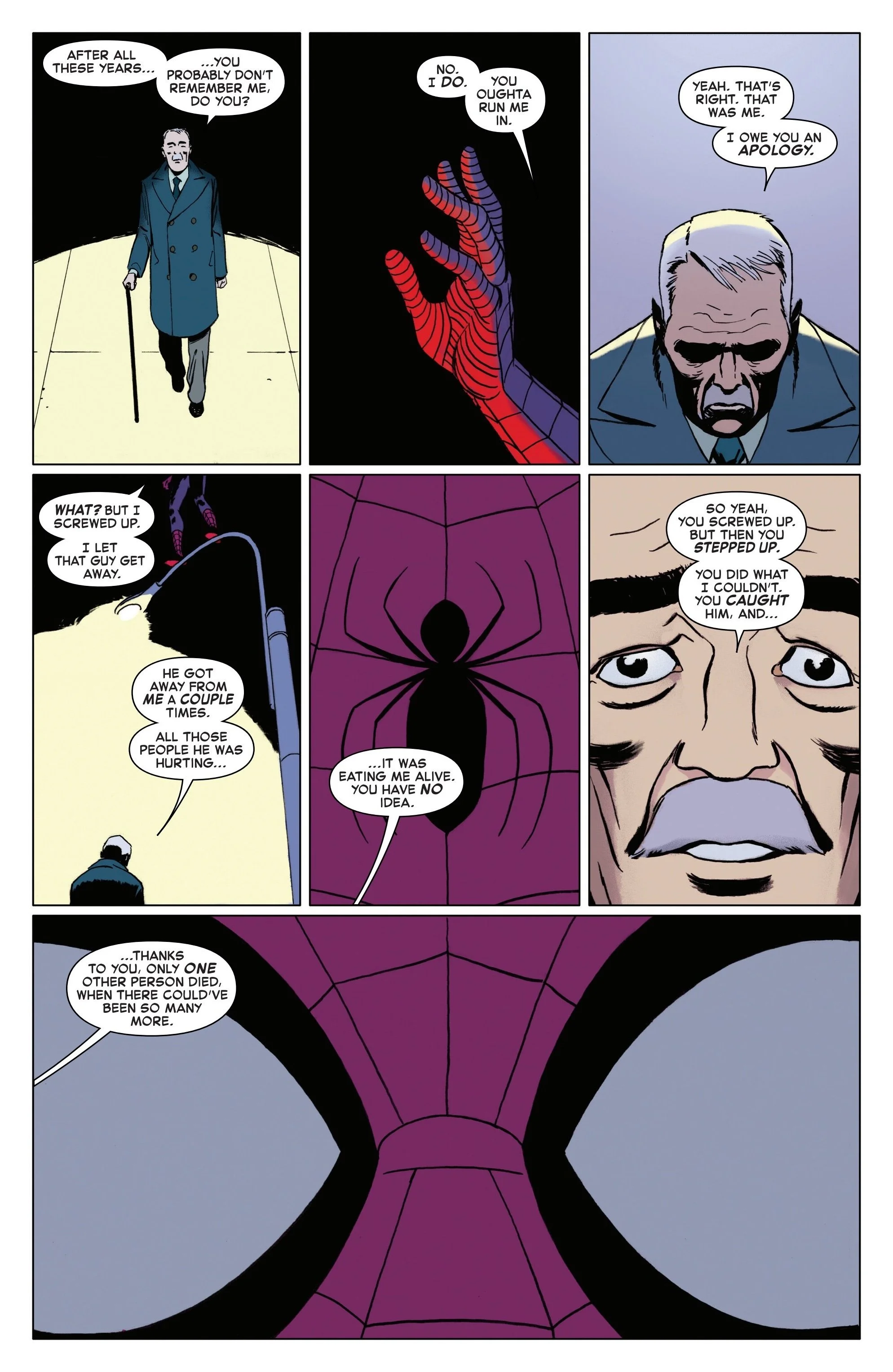
But of course, I must once again gush about Dan Slott’s introspective Spidey tale, with my praise now going to the amazing line work of Marcos Martin and coloring by Muntsa Vincent. Visually evocative of the late Tim Sale’s seminal Spider-Man: Blue in many ways, Martin’s story really captures Slott’s vision to a tee: telling a story we know all too well from a new perspective. I love how Spidey is always off frame, a hand there or a foot here or hidden in the shadows throughout the entire story. Instead, we get the frantic POV of career cop Arthur, from chase to investigation to the aftermath of tragedy and how she perceives Spidey. It’s exceptional framing and, paired with Vincent’s excellent shading, really showcases the kind of stories comics can tell and the deeper roots of Spidey himself, especially with that finale.
The Swing of Things
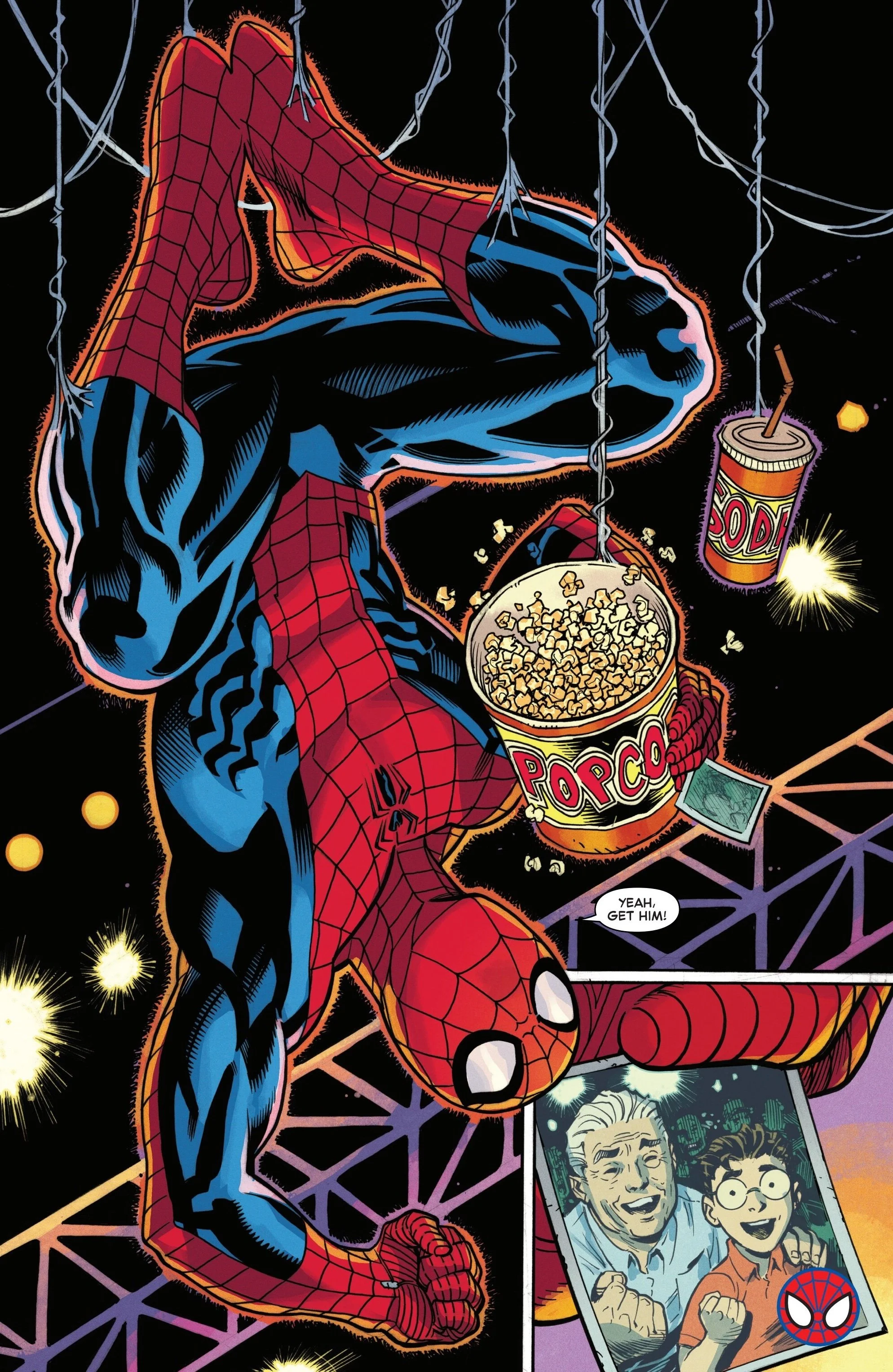
So, what more can I say about Amazing Spider-Man #1000 that I haven’t said already? It’s fun, it’s infuriating, it’s messy, it’s loving, and it’s everything in between all those words as well. There are so many reasons that this longstanding series and this incredible character have awed and annoyed readers for more than six decades now, and a lot of that will be very clear in the pages of this milestone 1000th issue.
I’m a little sad that so many other creators who contributed so much to the character were missed from this celebratory adventure, but that’s the nature of the beast, say what you will. And even though I’m still frustrated with where the series is currently, Amazing Spider-Man will continue to be a daily read for me and so many other fans even then. Call it the definition of insanity. Call it whatever. But this series - Stan and Steve’s wall-crawling, webby boy all grown up (or as much as editorial will let him grow up hehe) - with all its soapy, cheesy, maddening goodness, means something to so many. And that investment is something you can’t just swing away from.
Final Verdict: Amazing Spider-Man #1000 is a celebration of everything that readers have ever loved, loathed and yet still lingered on for in our friendly neighborhood wall crawler’s spectacular and frustrating life.