
Initial Thoughts
Spider-Man/Hulk: Fire and Brimstone #2 delves deeper into Bruce Banner's psyche and explains why a man of science is suddenly a man of faith. Bruce and the Cardinal have also managed to get Peter Parker to buy into this crazy notion of exorcism. Banner has been at his wits' end with the Hulk, and is willing to do ANYTHING to get rid of him. While Bruce deals with this, Spider-Man and Daredevil remain the Angel and Demon on Bruce’s shoulder. I love that dynamic that these three characters have developed. Not only that, but Peter has become Bruce’s Guardian Angel.
Overall, issue #2 of this unique series had much more to like than dislike, mainly because its religious overtones are far more interesting than anything else in the book. The dialogue still teeters on cringey at times, as Smith tries to relieve, and I do think adding a fight against the White Rabbit as filler would help. And while you can justify the fight with “the life of an everyday superhero,” I would be okay with this series ending after a couple more issues of us trying to see the Cardinal try to remove a Gamma demon from Bruce Banner—which sounds crazy.
A Guardian Angel is Born
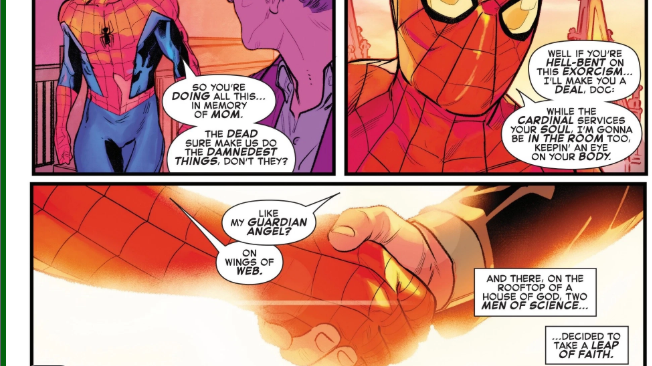
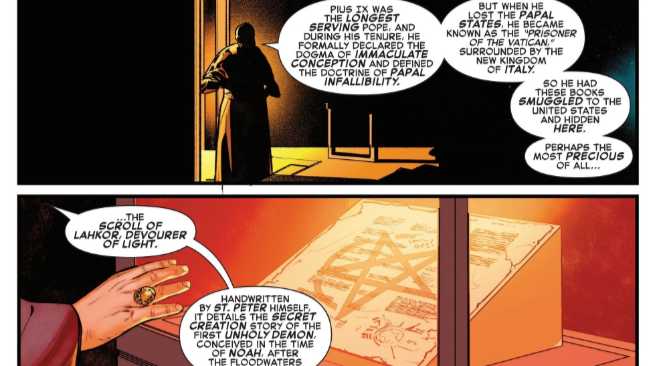
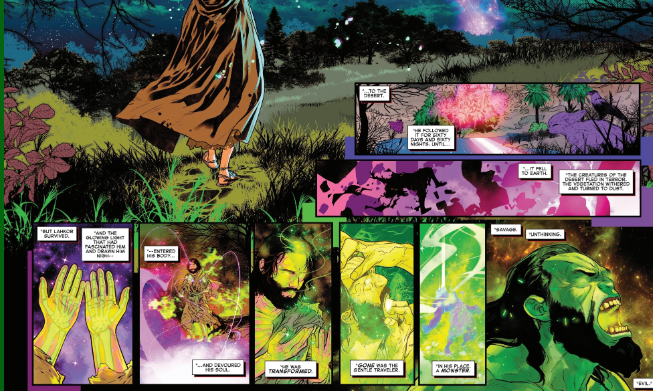
The most important takeaway from this issue is that Bruce and Cardinal Thornhill finally get Spider-Man to buy into this crazy exorcism idea. It also gives the reader more background and context for Thornhill’s reasoning. The Cardinal reveals that an exorcism has, in fact, been done on a Hulk before, one that caused havoc on Earth for thousands of years. That precedent is the hope Bruce is looking for to get rid of his demon, possibly, and the reason he is putting himself through all of the remembering of childhood trauma. Spending more time on that history, and actually showing what happened, would have been a more efficient use of time and panels than a random Spider-Man vs. White Rabbit fight.
Depending on how Spider-Man/Hulk: Fire and Brimstone finishes up, I would love to see a prequel series about how that happened. For now, with each passing issue, this exorcism seems more and more likely. I will give this series a lot of leverage, especially because some of the dialogue is NOT hitting with me, as long as they keep walking me through the story. For now, I think the main story is one of the more interesting ones in comics right now.
A Methaphor for Mental Health
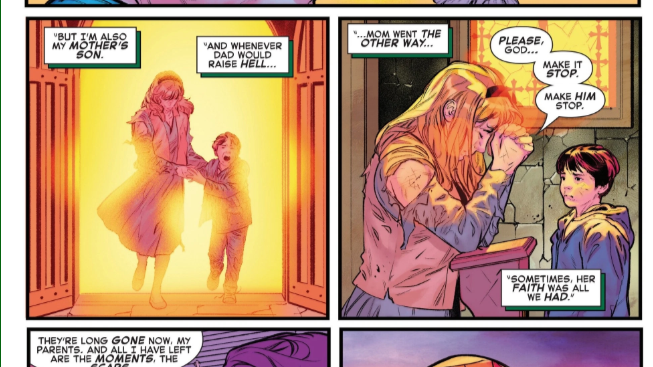
For me, the most impactful part of the story is revisiting Bruce Banner’s childhood. This part of Banner’s life isn't often discussed, even though it is a well-known part of his upbringing, but Smith and McElfresh use it in one of the most unique ways I've seen a hero’s childhood used in a long time. I think, if I counted right, there were only five panels that flashed back to Banner’s childhood, but Smith and McElfresh used them to make the issue carry much more weight than if the entire book were covered in Banner’s childhood memories.
Something that came to mind while reading this issue is that the Hulk, who lives inside Bruce Banner, can be used as a metaphor for mental illness or a mental disorder. The Hulk represents the voices and thoughts some of us struggle with, and how many of us wouldn't want a quick fix to get rid of our demons? Bruce is trying to find an answer to his ultimate problem, so I do not blame him for trying the most extreme method to date.
So I think if you aren't a fan of the book's religious overtones — which I totally get — you can still relate to this series from a mental health perspective. I think that is an aspect of life we can all relate to. From anxiety, OCD, and depression, I think we have all dealt with something that makes what Bruce Banner is trying to do universally relatable.
The Art Makes the B Plot Worthwhile
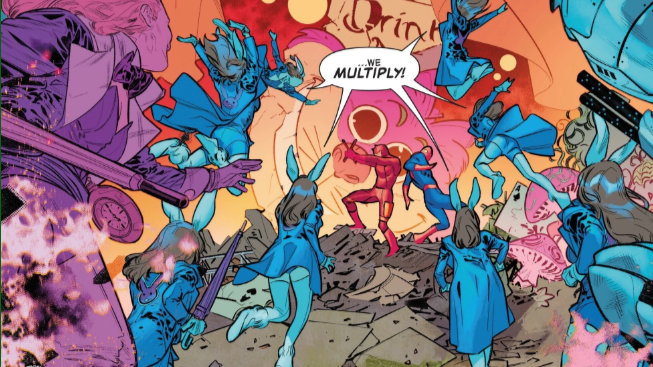
Even though I don't find the battles the most interesting part of this story—they feel like filler—R.B. Silva still drew a dynamic, bombastic set piece, and he did it well. Every panel is packed with action and destruction, so even a fight against White Rabbit feels massive in scale. I loved the claustrophobic feeling of fighting inside the building, with the design and color shadowing. Also, as someone who spent quite a bit of time at Mass as a kid, I LOVE the architecture Silva brings to his Catholic Church designs. I think that helps build the atmosphere McElfresh and Smith have been writing.
Silva also excels with his fractal design and expressions. Cardinal Thornhill’s shock at Spider-Man crashing the confession between him and Bruce was great art. With Catholicism as such a strong Muse for Smith, Silva knows exactly how to match it in his art.
Along with the great art, Federico Blee's coloring is on point. It's not exactly neon, but the hues he picks almost remind me of nightclub neon, which really stands out on White Rabbit and her crew. It's just not his action coloring. Blee’s costume coloring — including Hulk’s green — is so vibrant, yet so close to the original colors we remember and recognize.
Final Verdict
Writers Kevin Smith and Andy McElfresh keep delivering on a unique and extraordinary concept, even if the dialogue misses the mark and the fist fights against C-tier villains feel shoehorned in. What really held my interest, though, was learning that this wasn't the Catholic Church’s first time exorcising a “Demon/Hulk,” and that Spider-Man, even if begrudgingly, has bought in to look after Banner. Even if you aren't into the religious themes of Spider-Man/Hulk: Fire Brimstone #2, I feel strongly that the underlying mental health themes are something we can all relate to. For that reason, this title remains infinitely intriguing, even with its flaws.