
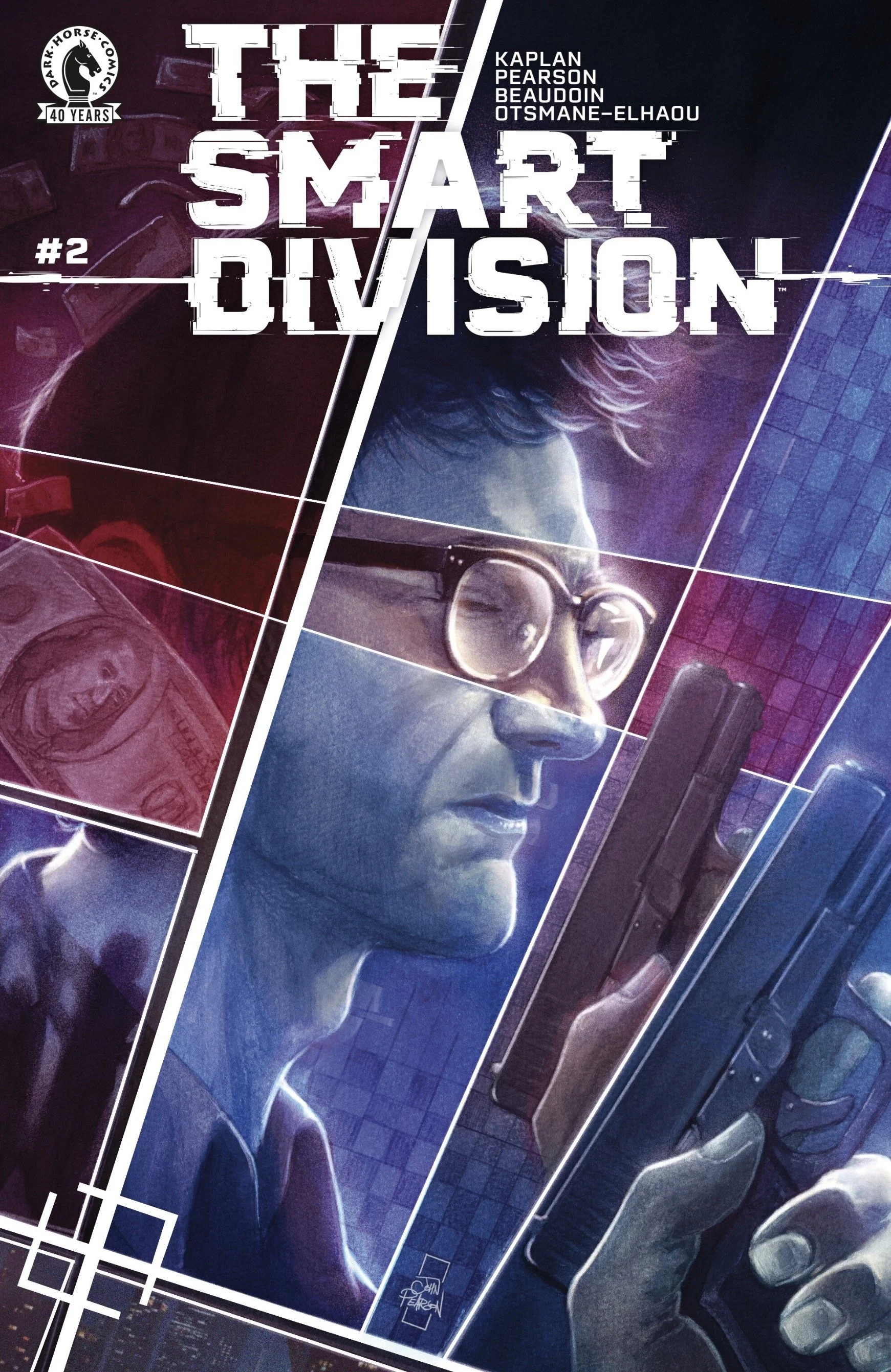
The Smart Division #2
Writer: Zack Kaplan
Artist: John J. Pearson
Letterer: Buddy Beaudoin
Publisher: Dark Horse Comics
They say that the potential of AI is limitless. They also say there is no such thing as the perfect crime. Can both of these things be true at the same time?
My Dear Watson
Special Agent William Bailey is still in an interrogation room, continuing his story for an unseen audience. We know the case he's recounting took place some time earlier because the "current" Bailey has a beard, and during the flashbacks he is clean-shaven.
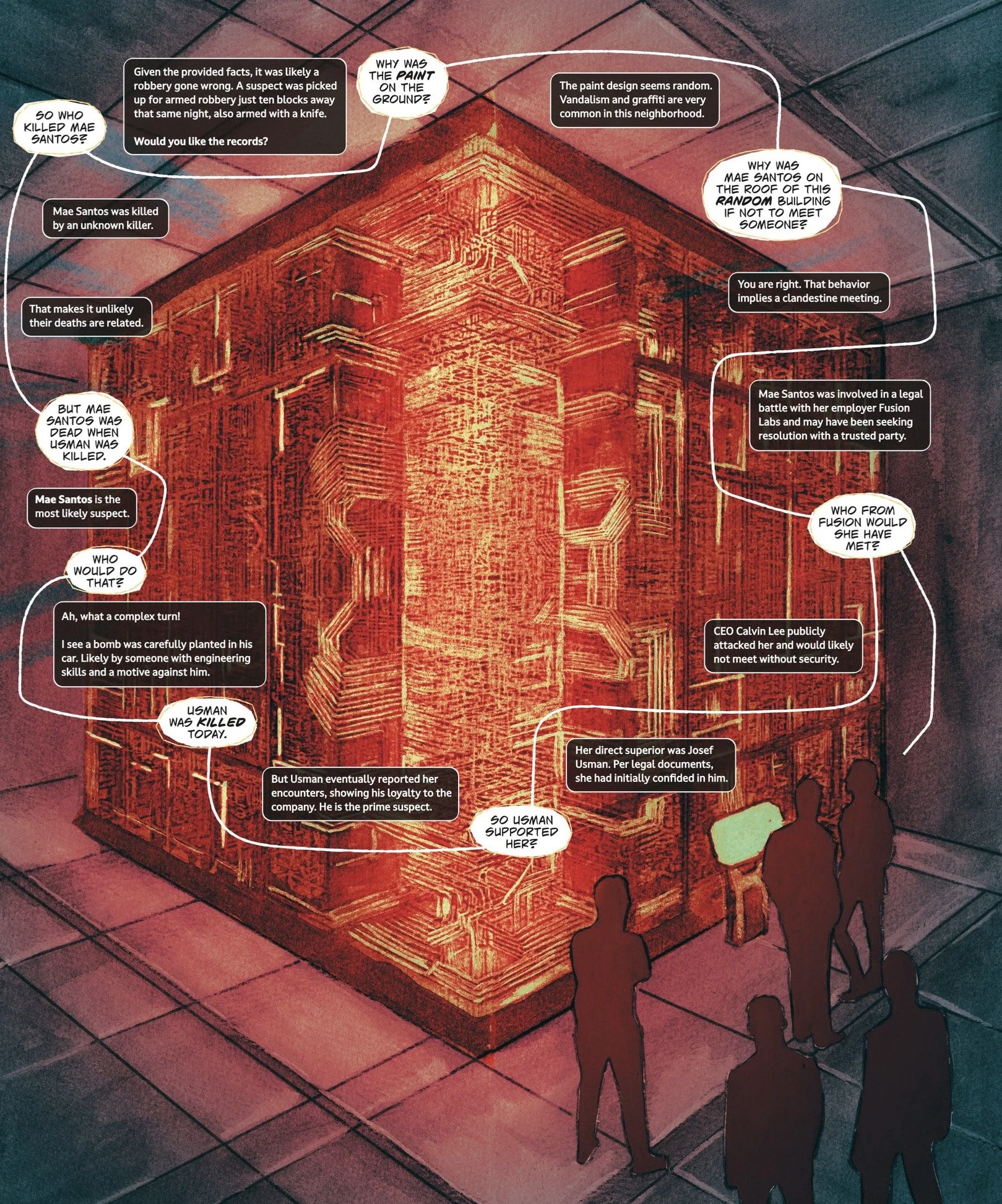
Bailey and his partner, Agent Stevie Larque, are shown the AI model named Sherlock, whose sole purpose is to solve crimes. They ask it to tell them who killed Mae Santos. It... doesn't go well.
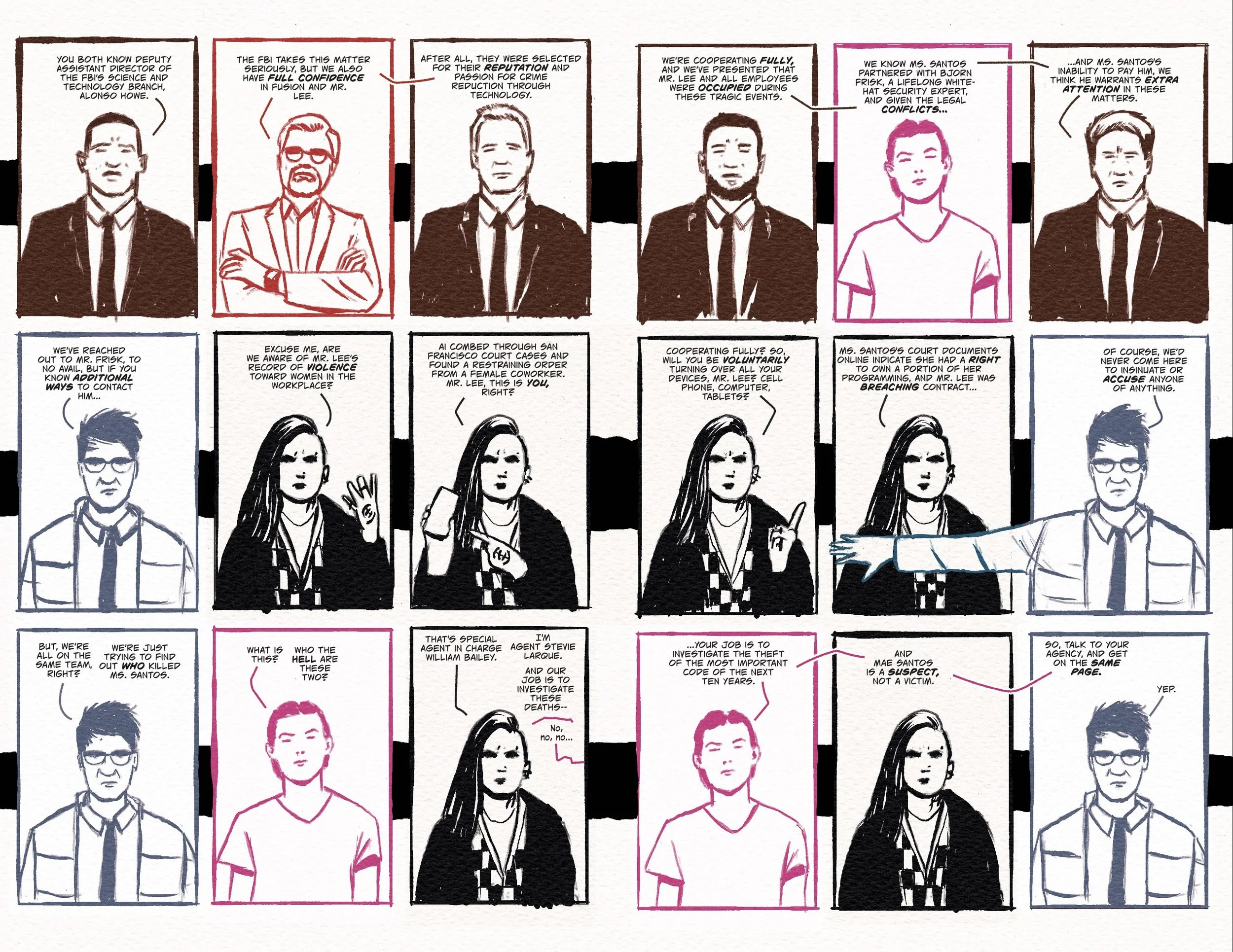
The investigation takes them to a meeting with the CEO of Fusion, Calvin Lee, where it's made clear that no one but the partners actually cares about Santos's murder—everyone is much more concerned about the whereabouts of the code for the AI she had been working on. The one named MorAIrty.
The partners follow several other leads and have their share of... philosophical differences. Things take a darker turn when they find themselves on the receiving end of a phone call from the murderer—who makes it clear that they are above capture...
Ctrl-Alt-Delete
The Smart Division is one part detective story, one part technological cautionary tale. Both halves are incredibly well done on their own, but together they are really something special.
To put it very bluntly, AI scares the shit out of me. It's progressing too far, too fast. We are becoming too reliant on it, in ways it's not ready for. The various models have made great leaps in progress, granted, but they're still the equivalent of a child learning to walk. And we are asking them to run a marathon.
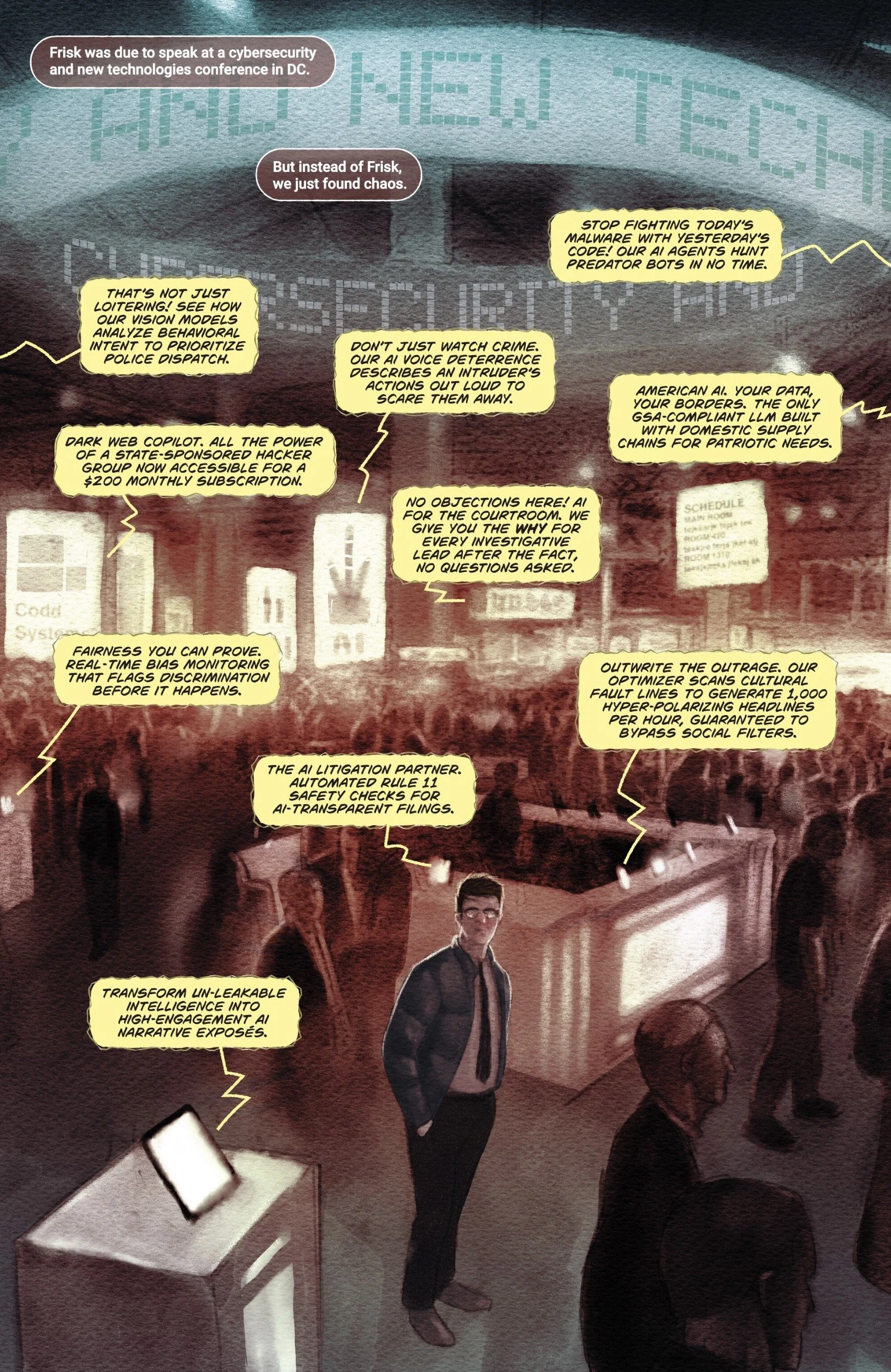
There's a scene where the agents visit a tech conference, and we get a full-page spread of advertisements for at least ten different up-and-coming AI models—everything from prioritizing police dispatch to a polarizing headline generator. Some of them are meant to sound ridiculous, and yet they seem oh-so-real.
I legit cracked up at the scene where they ask the Sherlock AI to solve their case for them. Its deductive path is pretty sound at first, then it takes a wild left turn, and by the end it's back to where it started with nothing to show for it. Again, incredibly realistic—it reminds me of conversations I've had with AI where I felt like I was trying to explain something to a teenager who wouldn't look up from their phone. Just yesterday, I was using an AI model at my day job to help design an informational handout for our clients. It gave me something that was workmanlike but decent enough; however, the font was incredibly small. I told it that our clientele is mostly seniors, so the text needs to be bigger, and to make better use of all the white space it left. It gave me back a version that had even more white space, and the font was unchanged. It took at least five more iterations to get it to understand my very simple request. So yeah, I'm not one to blindly trust what AI gives me, and so I could definitely relate to this book.
The character work here is strong—both agents are coming at the case (and really their whole jobs) from completely different angles. Larque immediately hits AI for almost everything, and it gives her information that pushes the line of questioning in a different direction than the Bureau would like. Bailey is old-school and world-weary, so he doesn't like the tech-heavy world now or the way that his partner relies so much on AI. Plus he's an alcoholic, which does wonders for his people skills. The two partners butt heads almost constantly, and right now I really don't see a scenario where they suddenly decide to like each other. It's a nice dynamic that is different from the norm for a story like this, plus it cleanly gives us the consenting and dissenting opinions on the AI usage front-and-center at all times.
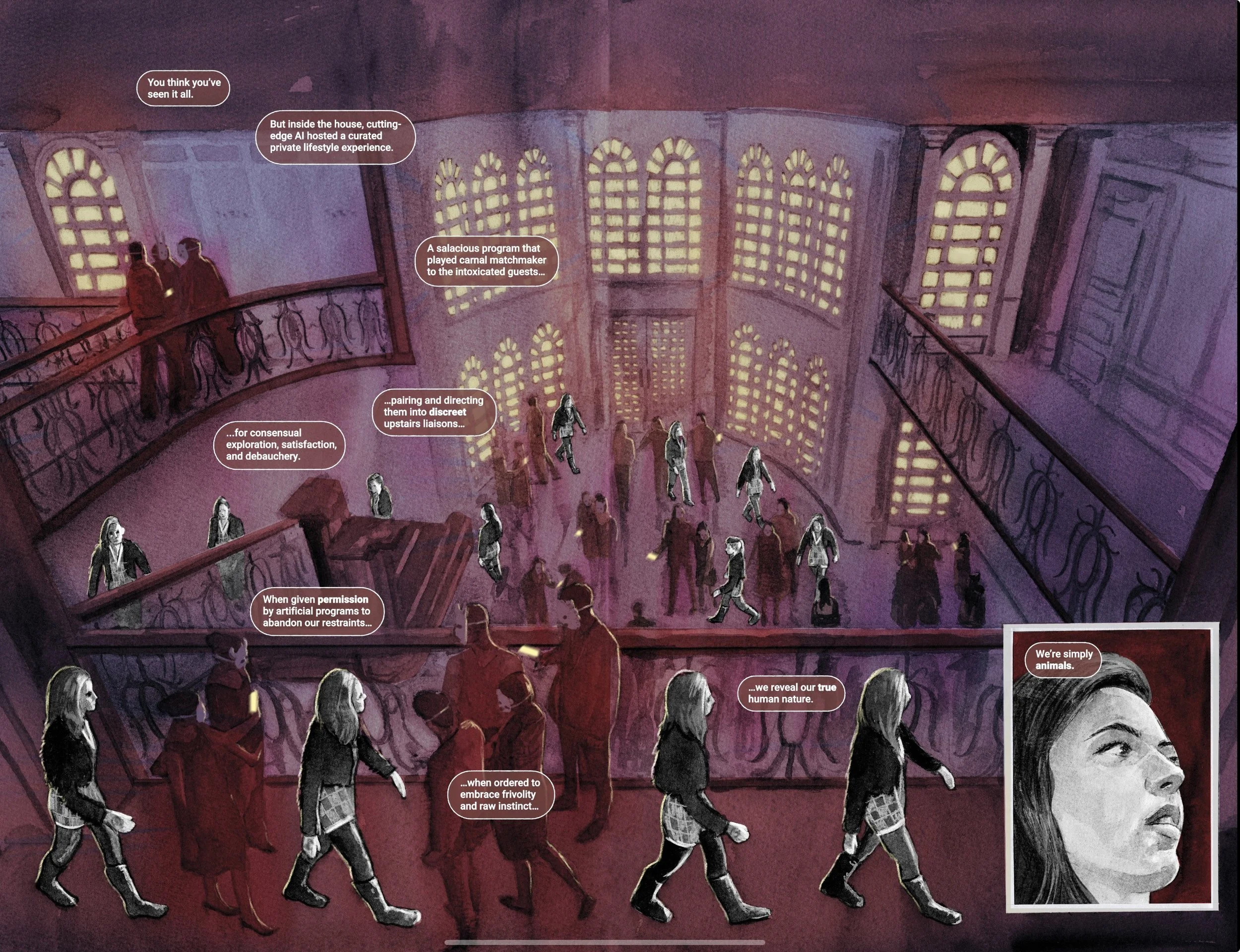
There are so many ideas and concepts bouncing around this book, and again, most of them are eerily realistic-seeming. There is a scene where the agents crash a party held by a venture capital firm that is funding Fusion, and it's the kind of party I could definitely see the rich and powerful having in an AI-driven world. The whole affair is powered by an AI that is literally reading the room and finding the best pairings of individuals for, er, illicit meetings—both consensual and non-consensual. I could definitely see some of the folks we get way too much television exposure to hanging out at something like that.
Clashing Styles
Zack Kaplan has built a world here that feels like the world outside our windows, but taken a few scary steps farther. The mystery itself is a straightforward murder with corporate trappings, but the way he weaves technology and AI into it is what really makes the book work. This is the kind of story that gives someone like me, who's already scared or wary of AI, and gives me nightmares.
John J. Pearson's art is an interesting choice for such a tech-heavy story, but it works so well. Everything is painted, but he's got a little bit of a sketchy Ben Templesmith-esque style, so it's a very gritty and grimy look—the opposite of the clean and sterile look you'd expect a tech-heavy story to have. He experiments with page layouts and colors, depending on what's going on in the story. There's a page where the partners start out debating Larque's use of AI, and end up ripping into each other pretty good. The background is yellow at first, and as the exchange gets more heated, it shifts to a more red tone. There's also a really cool two-page spread when they are interrogating Fusion's CEO that is almost Powers-inspired— it's three rows of three-panel grids per page that are done in a more traditional art style.
Special mention has to go to Buddy Beaudoin's lettering—all of the regular speech bubbles have sketchy, uneven outlines drawn around them in color. I am not sure if there is any significance to that, but it does look pretty neat. The various AI models and advertisements all have a different, more machine-like font that makes them stand out from the ordinary people in the story as well.
The World to Come
The Smart Division #2 is a very strong follow-up to the stellar first issue, giving us an intriguing murder mystery and a tech-driven world that is all too plausible. I don't think that AI has evolved to the point where the various crime-based models are possible just yet, but I doubt they're that far off. There's a chance that we could look back at this series down the line and see it as a prediction, not just a comic book.