
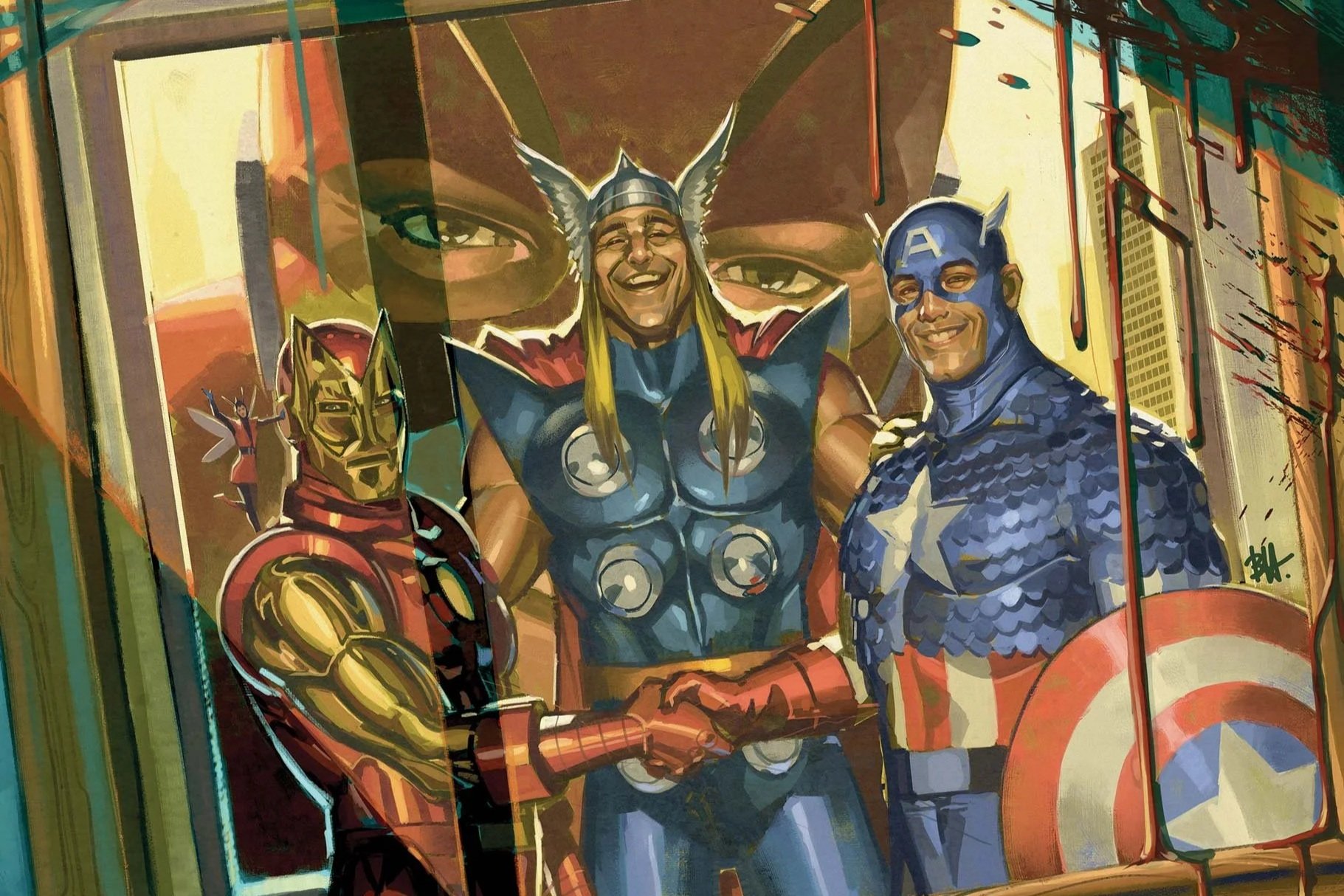
Captain America #5 (2025) Published November 19th, 2025. Written by Chip Zdarksy, Art by Valerio Schiti, Colors by Frank Martin. Cover Art by Ben Harvey.
(Writer’s Note: This review will contain spoilers for Captain America #1 - 5)
The fifth and final chapter of “Our Secret Wars” reaches its conclusion in the latest issue of Chip Zdarksy’s Captain America run. Because it’s my first review of the series - which just so happens to be the finale of the current arc - I’ll be doing a general summary of the whole story to this point and this article will contain some spoilers, so please be advised going forward!
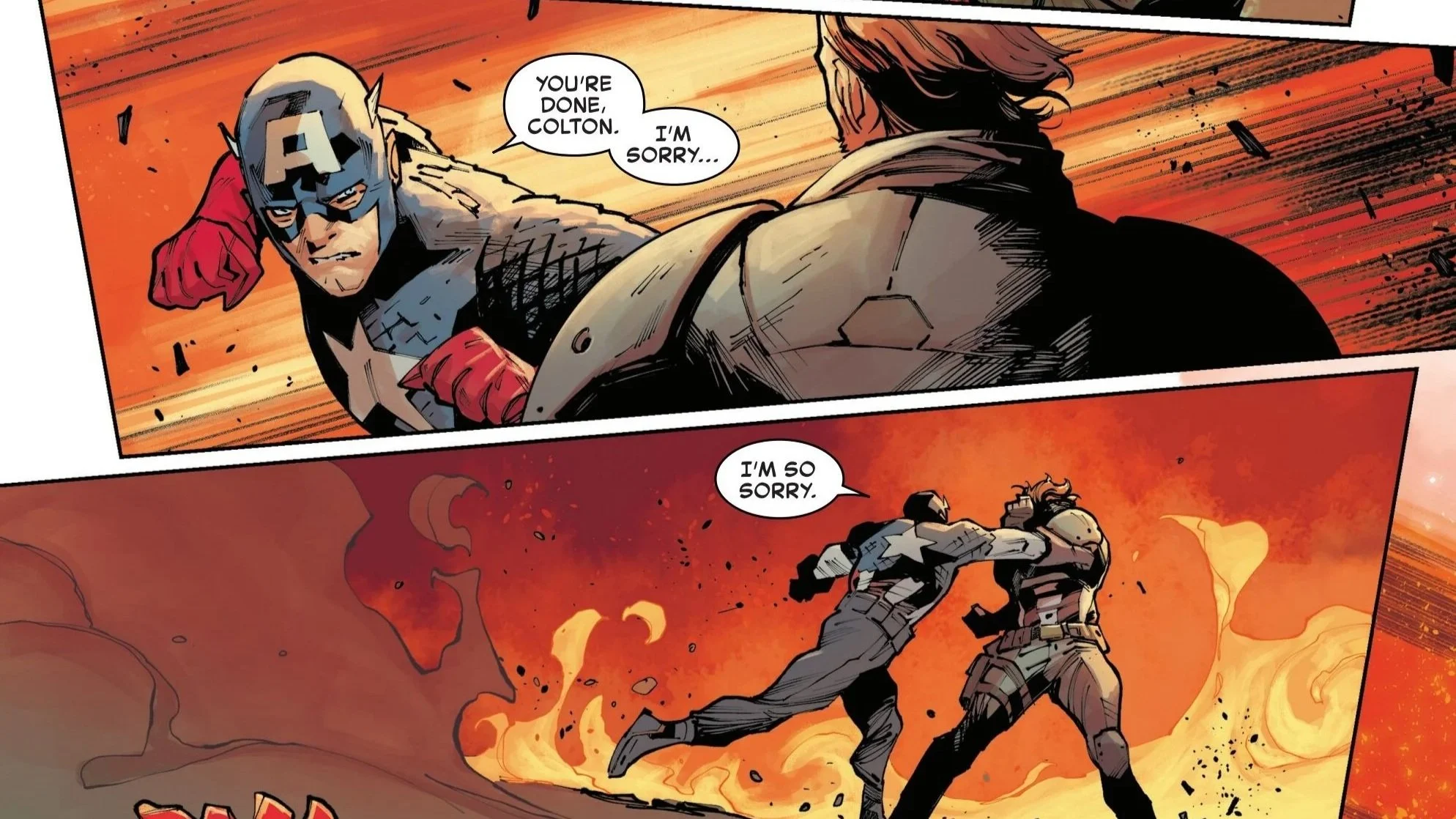
It’s Captain versus Captain as Steve Rogers confronts David Colton in Captain America #5 (2025)
I’d imagine it’s always a challenge tackling an iconic character with decades worth of lore and canon and telling a story worth telling that doesn’t retread old ground while also staying true to the character. I’d also imagine that challenge only intensifies when you’re dealing with such a character that has very real world history baked into their narrative DNA and has been thrust into countless stories and tales that has that same character dealing with very real world issues ranging from international conflicts to the ills that plague society here in the United States of America. But in this case, the challenge is not just met but triumphed over. Writer Chip Zdarksy, penciler Valerio Schtti, and colorer Frank Martin come together as a well oiled machine of a team to give us the current volume of Captain America which has just released issue #5 (legacy numbering #776 for those of you keeping track).
Before we get into the nitty gritty of issue #5, I’m going to rewind the clock just a bit to cover the story so far. If you’re already caught up, feel free to scroll past to the actual review section of the article for Captain America #5. If you need a refresher or you’re curious as to what happened thus far, stick around, True Believers!
Our Secret War: The Story so Far…
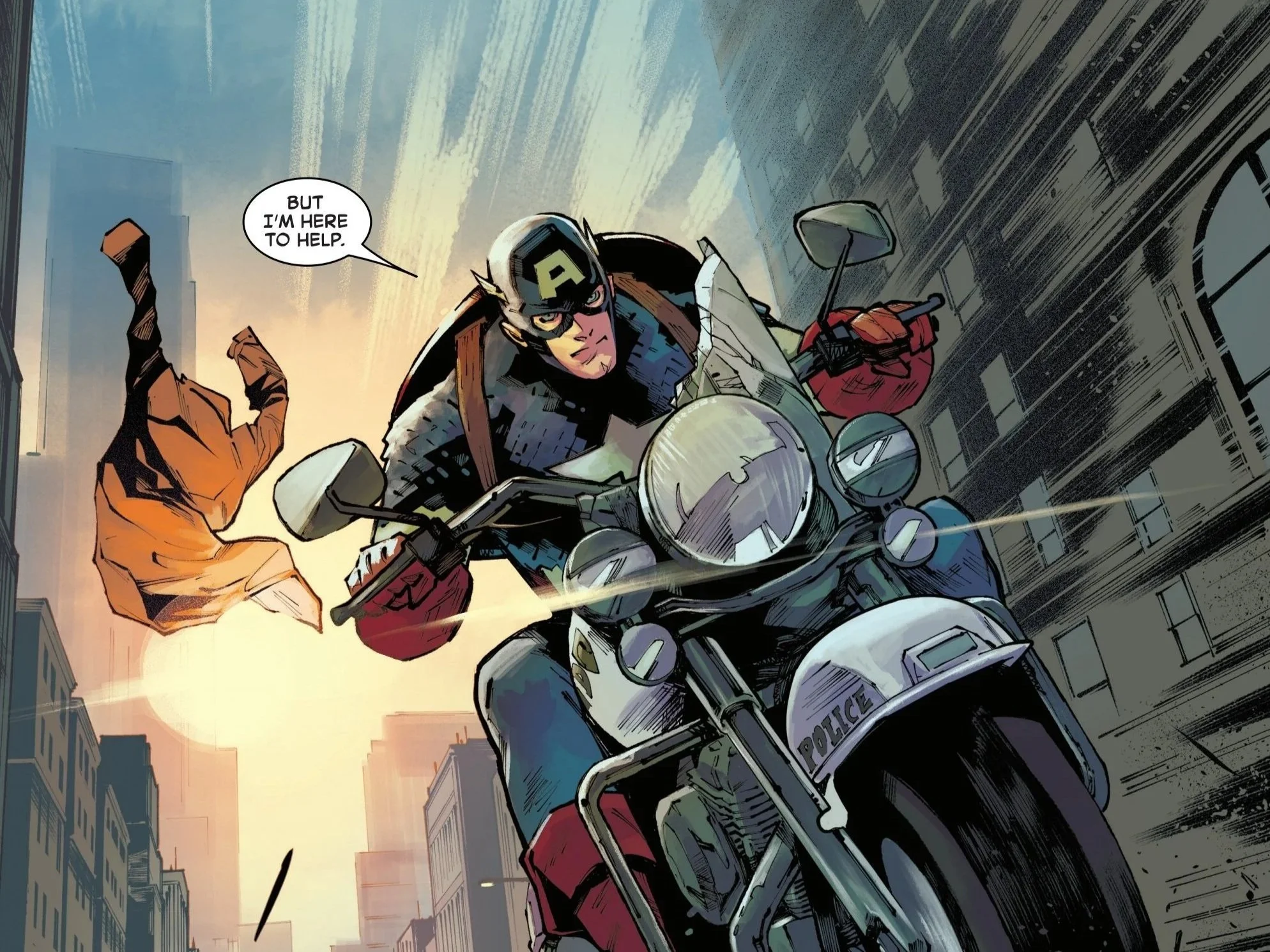
Captain America rides to the rescue in Captain America #1 (2025)
Our story begins in the earlier days of the Marvel Universe, specifically, merely a week after Steve Rogers has been thawed out of the ice and found by the Avengers. As such, this is a Cap who is still acclimating to the changes of the country he so proudly served during World War II and the changes to the world at large. It allows Zdarksy to play with the character in the era that largely defined Marvel as we know it but due to the sliding timescale nature of comic books, set to contemporary lens. After stopping a disturbed former military man from committing an act of terrorism at the UN building, Rogers is met by the Armored Avenger himself, Iron Man, who insists that Captain America officially take his place among Earth’s Mightiest Heroes. Cap politely declines, explaining that he already belongs to an organization, namely the U.S Army and that it is time he returns to base.
Enter David Colton
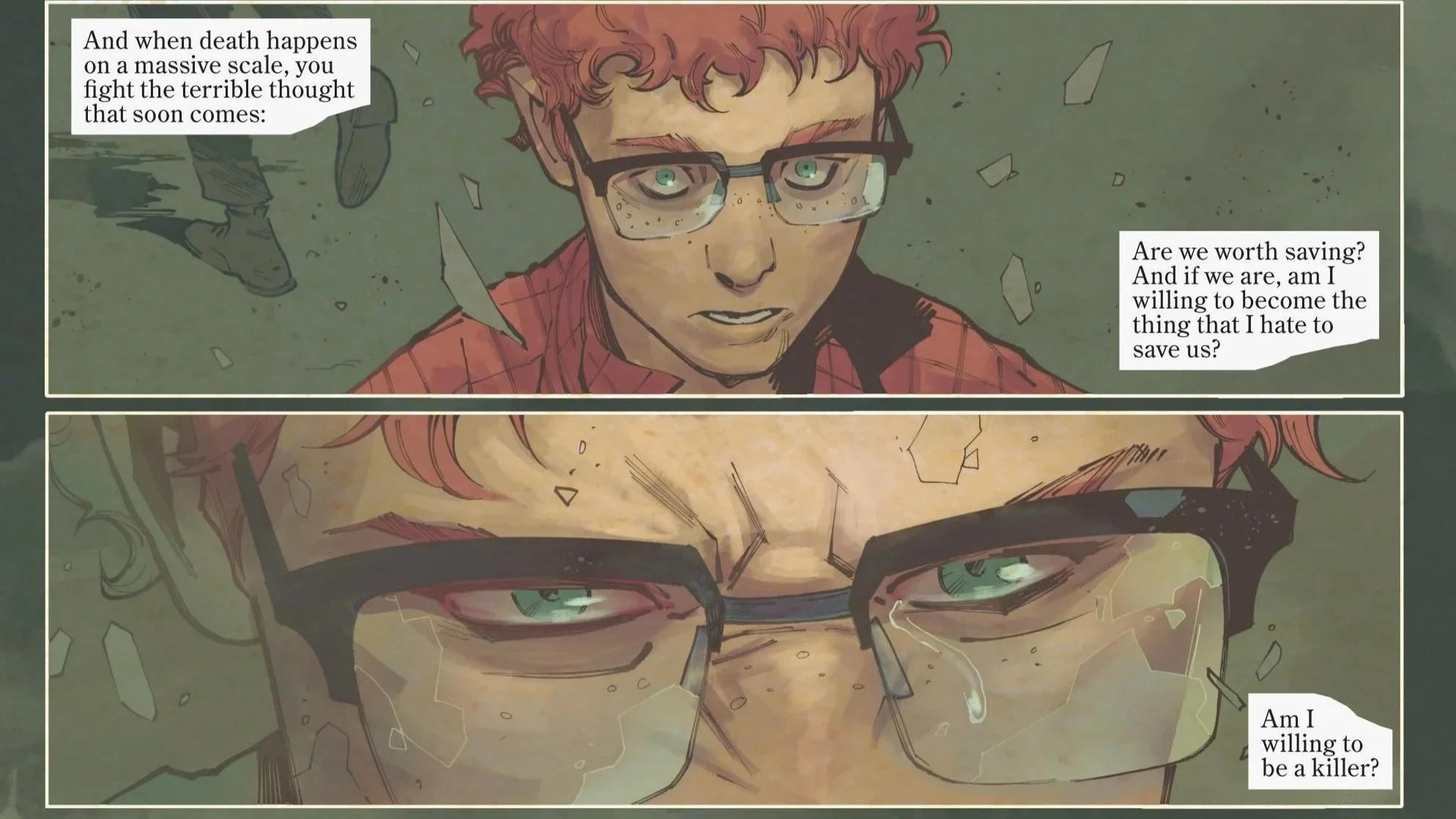
A young David Colton witnesses the fall of the Twin Towers during 9/11.
As this is playing out, we’re also seeing poignant flashbacks beginning with taking us to ground zero of the tragic events of September 11th, 2001. We see a young man who is witnessing the fall of the World Trade Center right before his eyes, setting him along a path that informs many of the future events of this entire arc. This young man, David Colton, horrified and angered by the senseless act of terrorism that altered the course of not just American history but that of the world, opts to enlist in the armed forces. His journey parallels that of Steve Rogers in more ways than one: he desperately wants to serve his country and do good, but his body is too frail to match his spirit. And like Steve, David doesn’t want to go seek revenge and join the war for the sake of bloodshed or to appease his own machismo; he wants to help the innocents caught in the crossfire. And again, also like Steve, Dave is bullied and tormented during his training regiment but never gives up. It is this very inability to give up when the rest of the world demands the opposite that catches the eye of his superiors who in turn give him the opportunity to serve his country not just as a soldier, but as Captain America.
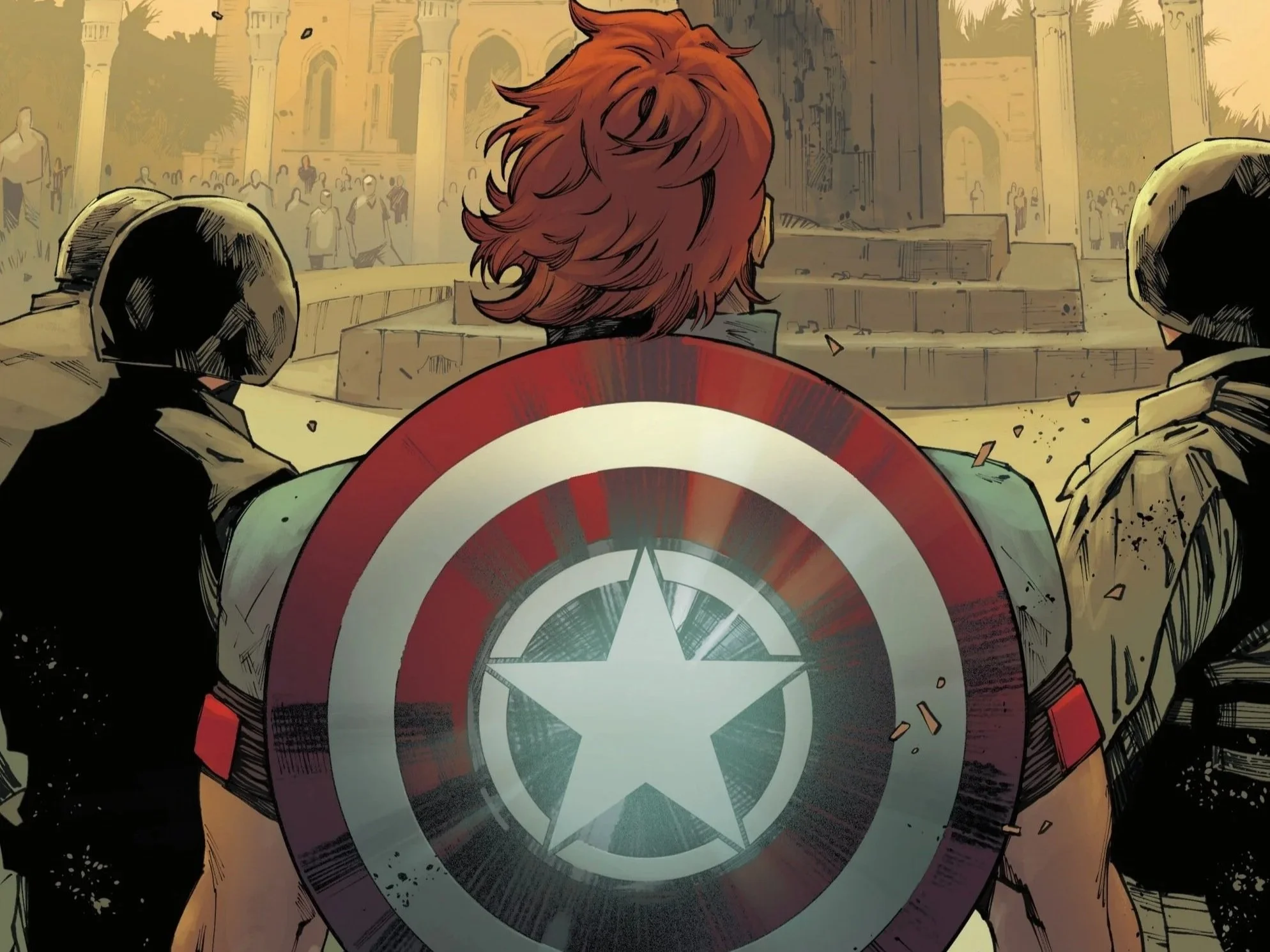
The legacy of Captain America endures.
The mirroring of Steve’s origin and what drives him when compared to David’s is the driving force behind the whole saga which wastes little time introducing the characters by the end of the first issue of the run. After Steve declines officially becoming an Avenger, he’s recruited by General Thaddeus “Thunderbolt” Ross to undertake a mission under the Army: infiltrating the Eastern European nation of Latveria and rescuing embassy hostages captured by the dictator who has seized the country with his armored fist: Victor Von Doom. After a brief meeting with Reed Richards of the Fantastic Four, Steve is given the run down on what makes Doom tick and just how dangerous he is. But beyond Reed simply giving Steve a detailed rundown on his greatest foe, we see a reverent side of Mr. Fantastic as he tells Steve just how much of a hero he is and how much he was sorely missed. Following this, Steve is officially briefed by General Ross and introduced to the new Howling Commandos, Slate and Chill, before meeting his commanding officer for the mission, David, who is at this point, officially Captain America.
DOOM awaits in Latveria

Victor Von Doom welcomes Steve Rogers to Latveria in their first ever meeting in Captain America #2 (2025)
The narrative continues with both Steve and David being forced to face some harsh realities about their country and the rest of the world as they invade Latveria under the premise of it being strictly an extraction mission for hostages. While there is mutual respect between Captain Americas, David feels that Steve is too much of an idealist and a potential liability when it comes to the mission. Conversely, Steve is unsure what to make of the American war machine or their definition of “freedom” as it’s defined nowadays, and the idea of simply rescuing hostages and leaving while Doom has broken numerous international laws does not sit well with the man who fought fascists in WWII. They meet their contact point in the form of Marius Wolf (no relation to the German football player…at least, I think so), head of the Latverian resistance: a group of rebels determined to free their country from the rule of Doom. Marius believes that, should the Captains and Howling Commandos offer their aid to the resistance efforts, it would make their true objective easier as a result.
David isn’t having it and wants to stay on course for the mission and nothing else, recalling his time serving in the Middle East and how being a would-be savior and liberator isn’t so simple in times of war. Conversely, Steve wants to help the citizens of Latveria, recalling his own wartime experiences, and he believes that by helping them, it will inevitably assist the team in getting to the hostages by drawing Doom’s attention. Begrudgingly, David agrees as he and the Commandos split ways with Steve and Marius and his reprogrammed Doombot. Steve and Marius manage to infiltrate Doom’s castle and spot the despot himself, unmasked. Marius immediately goes to assassinate Doom, but Steve stops him, insisting that they bring him in to face justice and pay for his myriad of crimes both here and abroad. It’s at this point the reprogrammed Doombot suddenly doesn’t seem to be all that reprogrammed and springs to life, handing them both over to Doom himself. Interestingly enough, though, Doom regards the original Captain America in the highest regard.
Battle of Idealogies
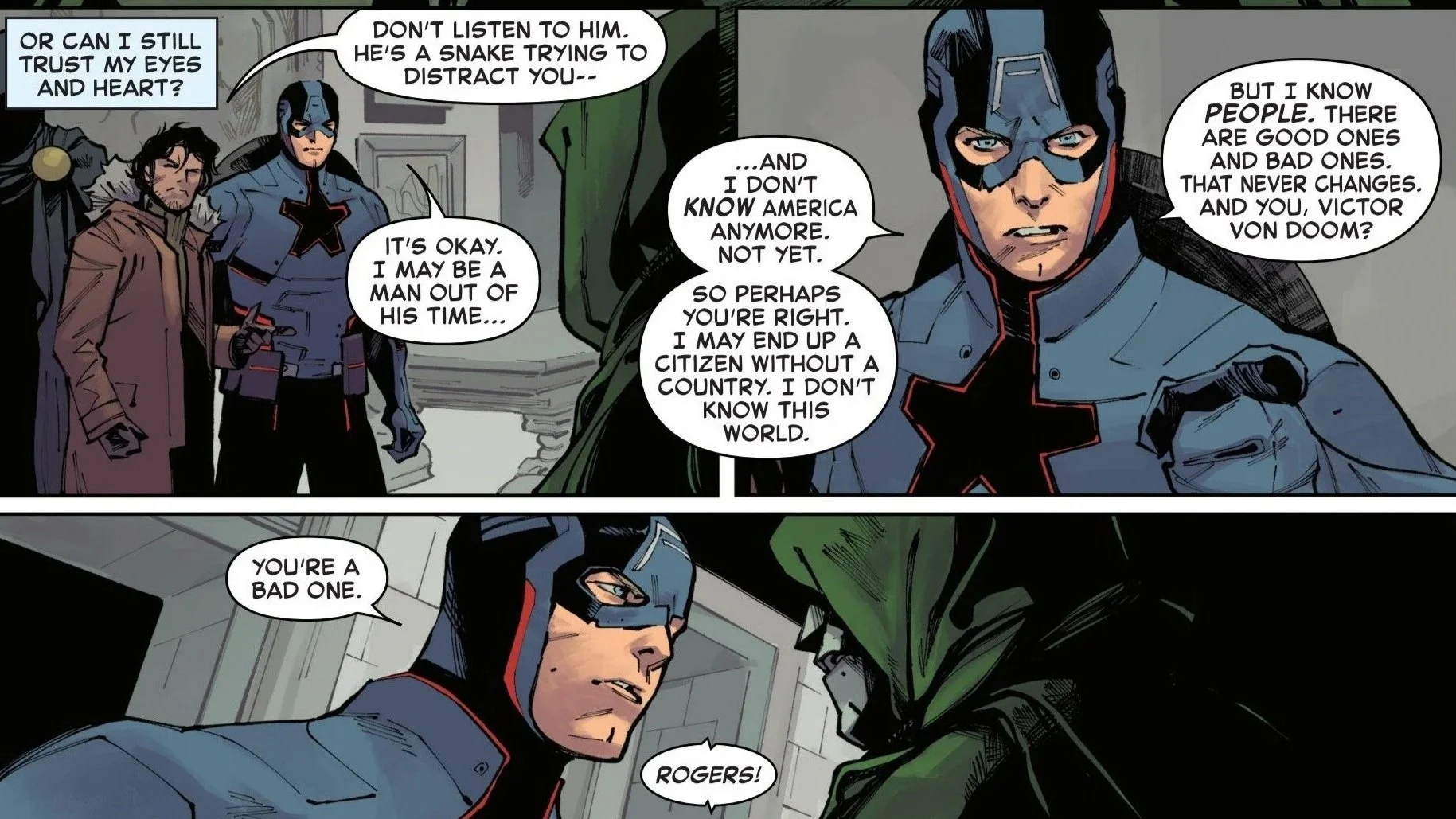
Steve Rogers confronts Doom in Captain America #3 (2025)
Doom’s presence in the story is certainly a highlight as he explains just how much he looked up to Steve Rogers as a young man, inspired by his fight against the Nazis and Adolf Hitler. And like Captain America himself, Doom sees himself as a symbol for his people. Zdarksy makes the canonical first meeting between these two iconic characters memorable and just as much a conflict between ideals and wills as it is a battle between arguably Marvel’s greatest superhero and its greatest super villain (which I’ll be getting to!). We also see more of David’s backstory as he grows increasingly disillusioned during his service in a post 9/11 world. The weight of the horrors of war combined with the weight of the mantle of Captain America should have broken another man, but somehow David endures...or so it seems. It would have bene far too easy to make him an outright villain or even closer to a classic US Agent-esque character in the form of being a jingoistic nationalist, but David is portrayed as truly wanting to help people and not just solely American citizens. Meanwhile, Steve and Doom trade pointed words with one another, the former comparing the latter to Hitler and even asking him what makes him different to which Doom simply replies, “Hitler was elected.”
Probably my favorite exchange of dialogue between the two in the whole series to date. We return to David and the Howling Commandos as they embark on their mission to extract the American hostages as we start to see the cracks in David’s psyche finally splinter. The team encounters the grisly sight of executed hostages as David get psychologically triggered as a result. His memory of a young boy being gunned down by a fellow soldier in the wake of an explosion is haunting as David narrates how his only concern in the moment is to move and help, counting the dead at a later time as a luxury. Doom and Steve continued to argue point and counterpoint for both Doom’s rise to power and dictatorship of Latveria as well as America and its potential for great good and in Doom’s eyes, greater evil. But even as Steve acknowledges how much the country has changed and how he may not have a place in it anymore after waking up from the ice, he nevertheless knows people, good and bad, and that Victor Von Doom is certainly a bad one.
Unrattled, Doom reveals he’s well aware of the divide and conquer stratagem being used against him and knows about David and the Howling Commandos extraction mission, revealing that the Doombot that Marius had seemingly reprogrammed had been feeding him information all along. We return to another flashback of David as he lashes out at the soldier who sniped the young boy from his earlier memory, callously saying “it’s us or them” right before David swings his shield into the soldier’s jaw, breaking down for the first time and tragically not the last.
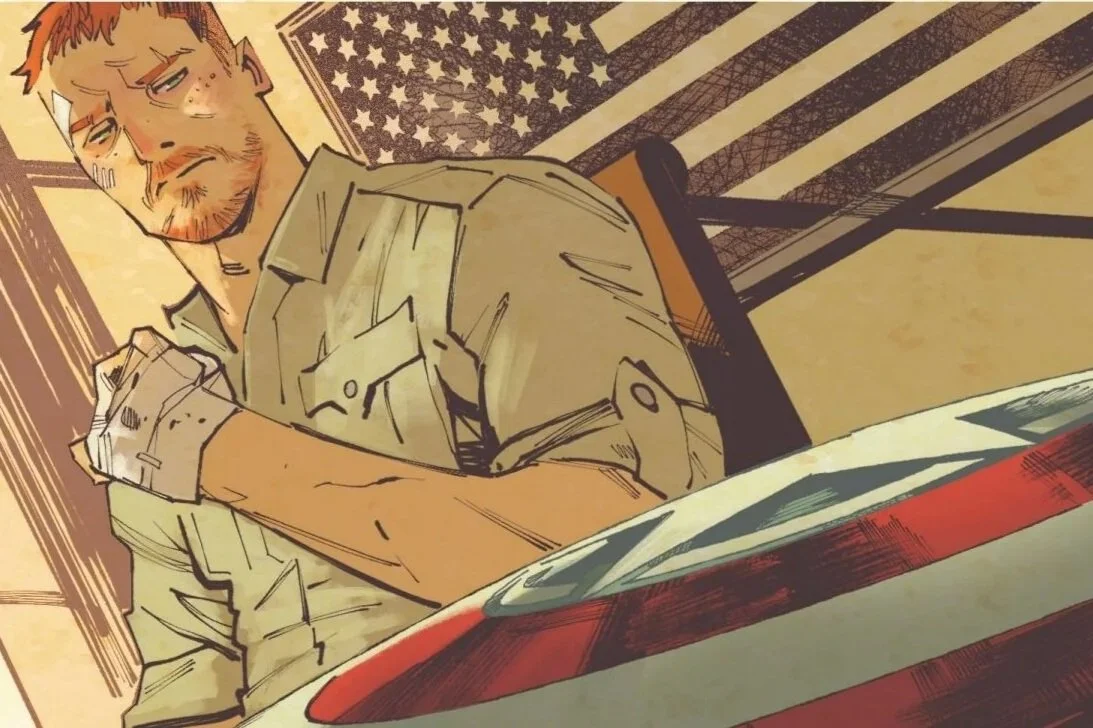
The burden of the shield weighs heavily on David in Captain America #4 (2025)
We find out that David’s outburst in the past resulted in the military scrubbing all civilian footage of him attacking his fellow soldier after he shot an unarmed civilian child and that he was to be discharged following the events. But as his CO put it, “Uncle Sam put a lot of money into you” and offered him the chance to continue to serve his country, albeit for covert missions out of the public eye. In the present, Doom moves to publicly execute Marius to make an example out of him, and in true heroic fashion, Steve arrives just in time with a heroic save. As the stage is set for the inevitable battle between Doctor Doom and Captain America, David and the Howling Commandos frantically race to save what’s left of the hostages as they mow through the Latverian military, leading them to the location of one of the ambassadors’ husbands, Terry, and their daughter, Ainsley.
Just as David reassures them that they are safe, Chill shockingly turns his dagger and literally stabs Terry in the back to the horror of both this poor child watching her father die and David himself. It’s then that Slate reveals the *true* parameters of their mission: they were never intended to rescue the hostages at all; they were there to prevent them from ever talking. We shockingly discover that the United States backed Doom’s rise to power in the first place, only for Doom to betray them. The members of the embassy and its ambassadors knew this to be true and were similarly silenced so that the truth would never get out. Unwilling to go along with this monstrous mission, David turns on Chill and Slate in an attempt to make sure the only remaining witness, the girl Ainsley, survives.
Captain America vs. Doctor Doom!
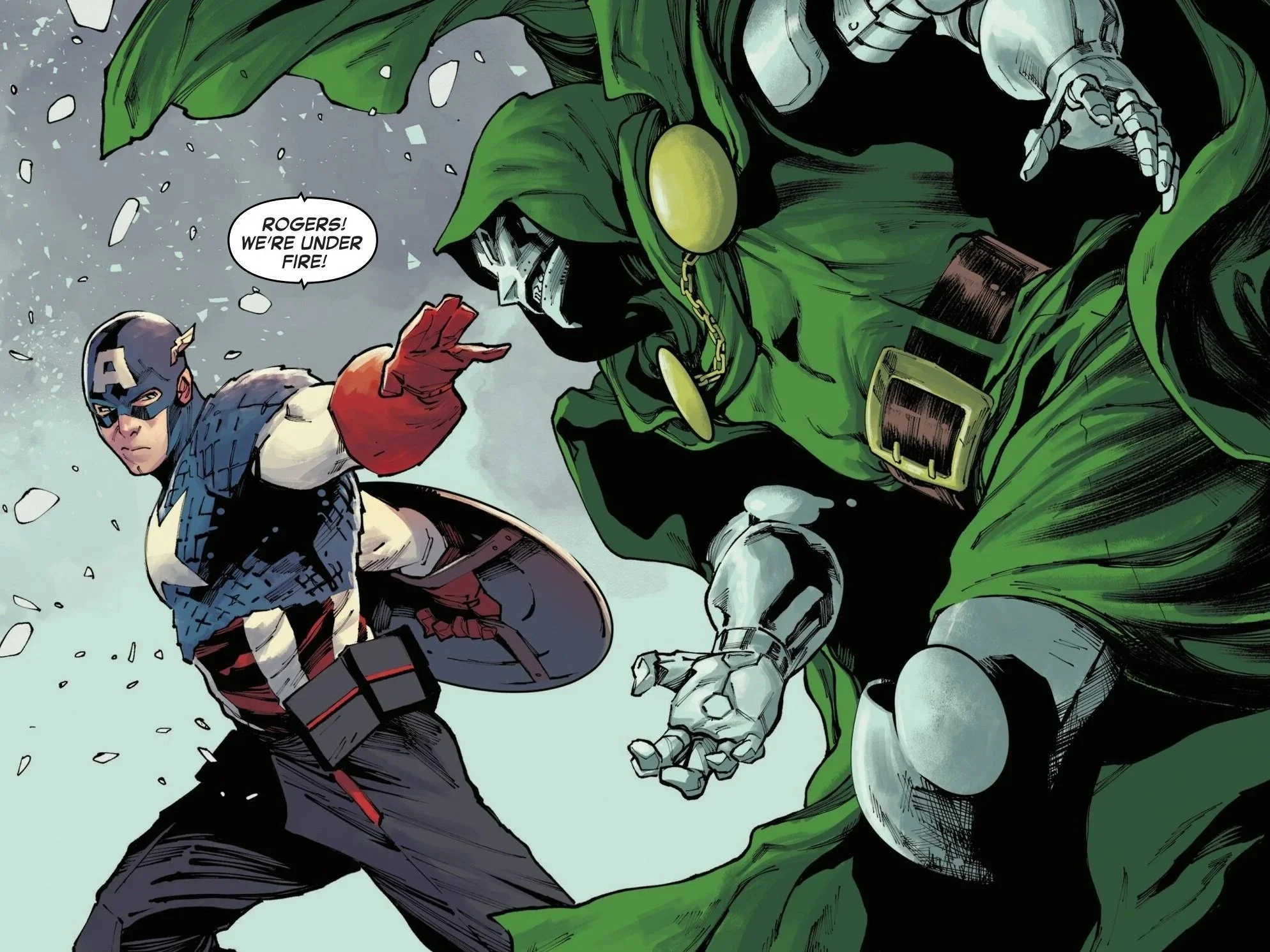
The long awaited showdown between Cap and Doom finally begins!
Meanwhile, we’re treated to an exceptional battle between Cap and Doom and his Doombots. Despite being outnumbered and outgunned, Steve holds his ground and challenges Doom to face him alone without his automatons, playing to his ego. Amusingly, Doom recognizes this ploy and accepts regardless, declaring this is as much a battle between America and Latveria as it is between two men. Doom easily takes control of the battle and in his zeal to defeat Captain America for all his citizens to see, winds up killing his own people during the clash, going as far as to mock Steve’s horror for the senseless death as mere theatrics as they’re “not even American”. It’s this simple exchange that paints Doom for what he really is: an evil tyrant who uses Latveria and its citizens as a means to an end despite his alleged love for them. He sees them as pawns and willing sacrifices for the greater good, that greater good simply being whatever Doom believes in that given moment. It also paints Steve as who he really is: a good man who values *all* life regardless of their country of origin. Just as Doom is about to finish Steve and gloats over the possibility of “liberating” America, he’s quickly thrown for a loop thanks in part to an experimental device given to Steve by Reed Richards, which results in disabling Doom’s armor, if only momentarily. The battle between these two larger than life symbols concludes with the Sentinel of Liberty removing Doom’s mask, exposing him to his people as just a man, a man they could someday overthrow themselves. Doom can scarcely comprehend his own people hurling rocks at him, seeing him as the despot he is…just in time for Captain America to deliver a fascist smashing punch to his face while saying “Reed Richards says hello.” As far as superhero and villain fights go, it’s perfect.
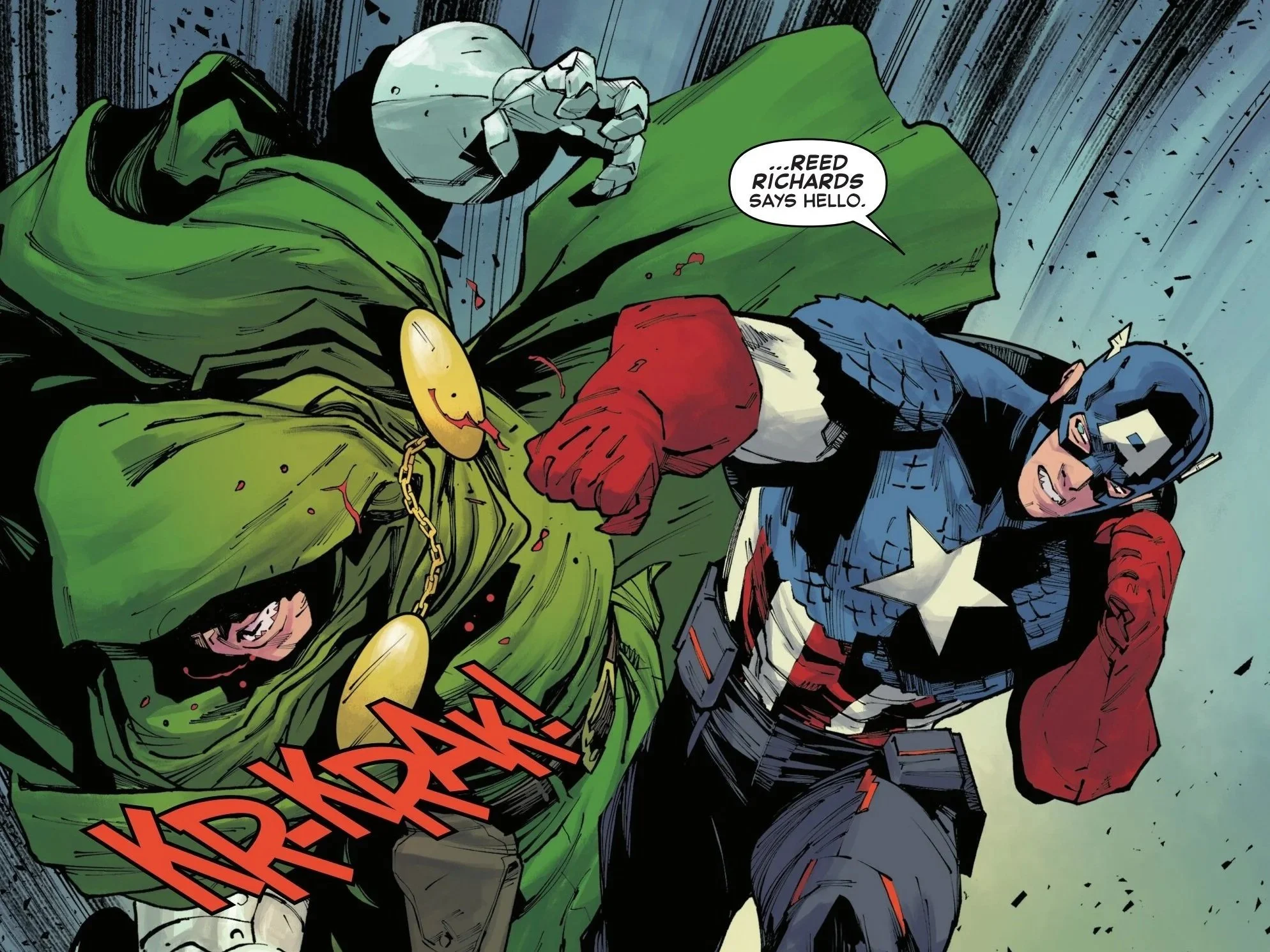
CURSE YOU, RICHAAAAAARDS!
As Cap triumphs over Doom, we see David racing after his own former comrades as they seek to eliminate Ainsley and complete their grisly mission of leaving behind no witnesses. Unable to accept once again being responsible for the loss of innocent civilians' lives for the sake of “the mission”, David finally snaps once more, lethally dispatching Chill as he informs Cap that they have been, in fact, the bad guys all along. And that the only way to fix the situation in Latveria is to kill them all.
The Boiling Point
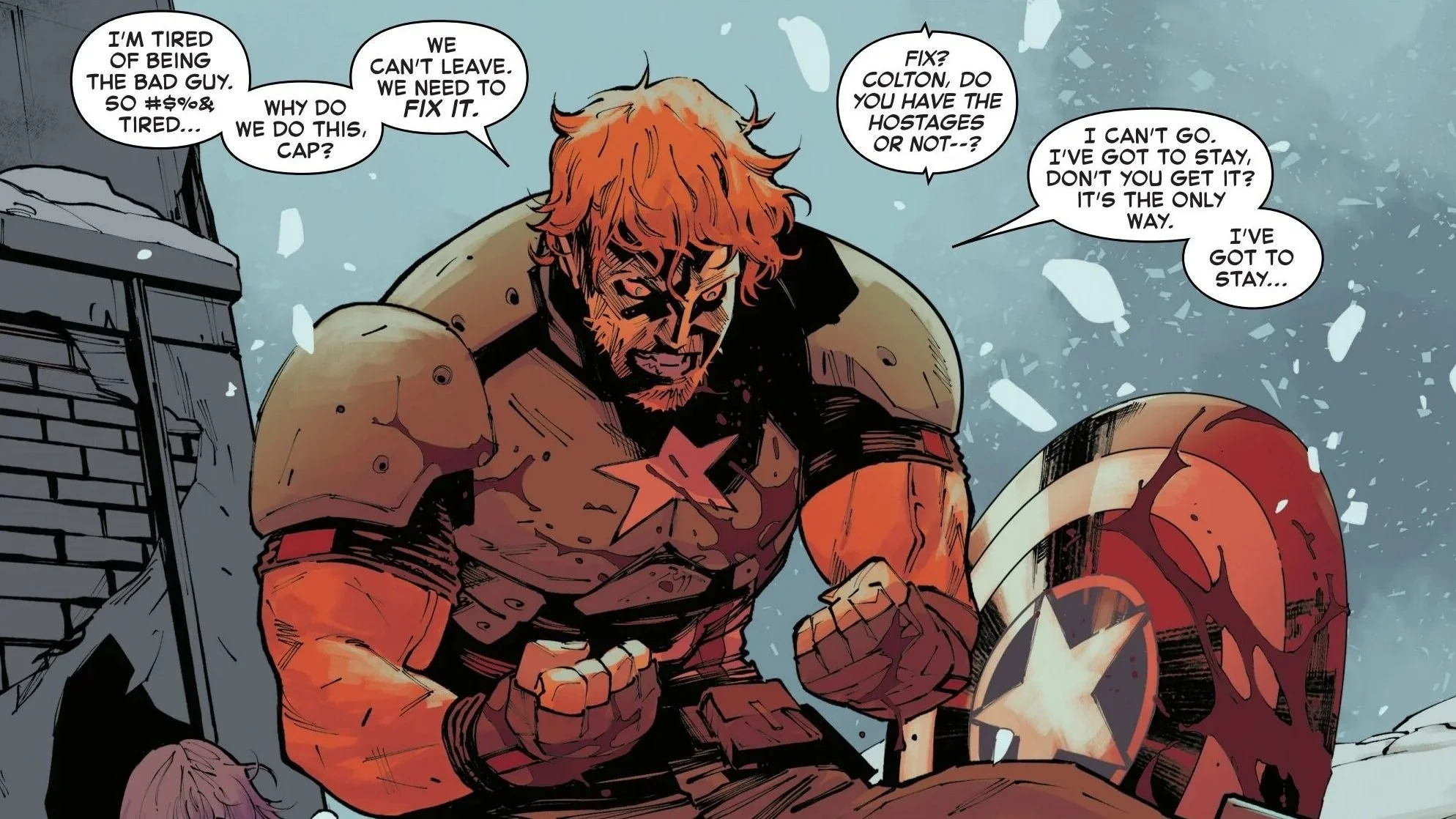
An incensed David Colton resolves to do what only he can.
All of this builds up wonderfully and thrillingly so in the pages of Captain America #5, wrapping up the “Our Secret War” arc. We hit the ground running with another flashback of David, this time of him returning home to his mother, who has been vocally opposed to David joining the military in the first place following witnessing 9/11. In the present, Steve, realizing that David means to wipe out Latverian soldiers as well as Doom himself in a fit of rage, races to stop his fellow Captain from crossing a line he can never return from. Marius, the Latverian resistance leader, has no such qualms, but concedes that there is rising conflict from Latverian soldiers given how Doom haphazardly killed his own people during his battle with Cap in the last issue. Steve appeals to him, asking him to build support instead of death. While he won’t join Steve in his attempt to pull David back from the brink, he does offer him aid in the form of a motorbike, asking Steve if he knows how to ride one, which prompts a knowing smile from our hero. Slate, battered but still alive following David’s rebellion, encounters some Latverian soldiers, demanding to know the location of the bunker where David is presumably heading.
We again see the anguish from David during a flashback as he returns home to his mother, who is relieved he is alive but barely able to comprehend the horrors he witnessed in Baghdad and Ramadi and all over the Middle-East. He acknowledges her feelings over him enlisting in the first place but insists that he served for the right reasons, to help people and free them. But as he reveals that he’s dealing with a dull pain, one that may be the only thing he has, we see yet another heartbreaking scene showcasing to us not just the horrors of war and how it affects soldiers, but that of a mother grieving for her still living son. It is both beautiful and haunting, which is fitting given the themes of this book and heavy subjects it tackles.

David reaches the point of no return.
Back in the present, Steve reaches the barracks, but not before coming across the daughter of the murdered diplomat. She’s luckily safe and sound, but clearly traumatized given the events she’s undergone. Steve reassures she’ll be okay and attempts to radio for an emergency evac despite being nowhere close to the extraction site. As Cap approaches the barracks, we’re greeted with the grisly sight of a resolute David standing in the center of a massacre of Latverian soldiers. He explains how this was necessary, that the Latverian soldiers had to be killed given their allegiance to Doom and how they deny the citizens freedom, the very same freedom David believes in with all of his heart. Steve tells him that they are not at war, but supposed to be on a rescue mission. Some of the men whom David brutally murdered were scared and lost soldiers who wanted to defend their country before it turned into something it wasn’t and Steve reiterates that they cannot do this, not in cold blood and not to a sovereign nation. He offers David help only for David to tragically turn him down, stating that the blood on his hands have to mean something, that he’ll swim in it if it means that Latveria can finally be truly free. He goes to murder one of the Latverian soldiers who survived his rampage only for Steve to stop him, resulting in a battle between the two Captains.
Whereas Doom versus Steve was a thrilling, classic clash between hero and villain done in the mighty Marvel manner, David versus Steve is somber and made all the more tragic given that David Colton at his core desperately tries to be a good man and soldier. The exchange is fast and brutal between them, but it’s Steve who ultimately comes out on top. Slate, who had been trailing David, arrives at the scene with murder on her mind, all too eager to eliminate both Captains. She fires a spray of bullets towards Steve, but it’s David who springs to action in the nick of time, blocking them with the shield before taking her down. We also, perhaps unsurprisingly, realize that whatever procedure the army had David undergo to turn him into Captain America is less stable than the one Steve underwent as he doubles over. He asks Steve if he knows CPR, to which Steve does not as those techniques didn’t exist until well after WWII. As David weakens with his body giving out, he tells Steve the truth behind their mission once more, that the United States government backed Doom and helped him overthrow King Vladimir. He pleads for Steve to tell his mother that losing him is worth it. Steve watches on helplessly as the evac finally arrives, a haunted expression on his face as he processes everything.
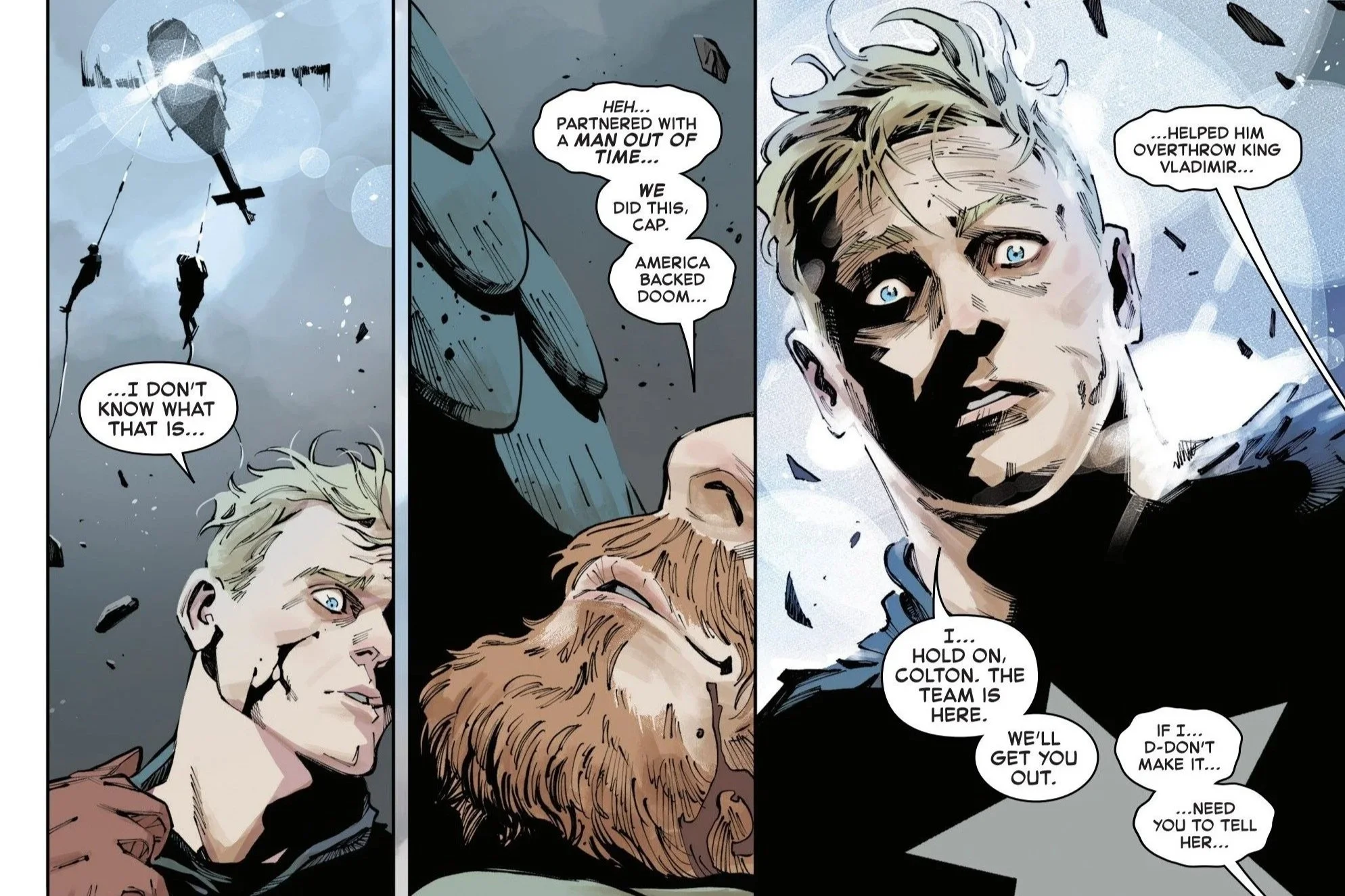
The ugly truth is revealed.
An End, a Beginning
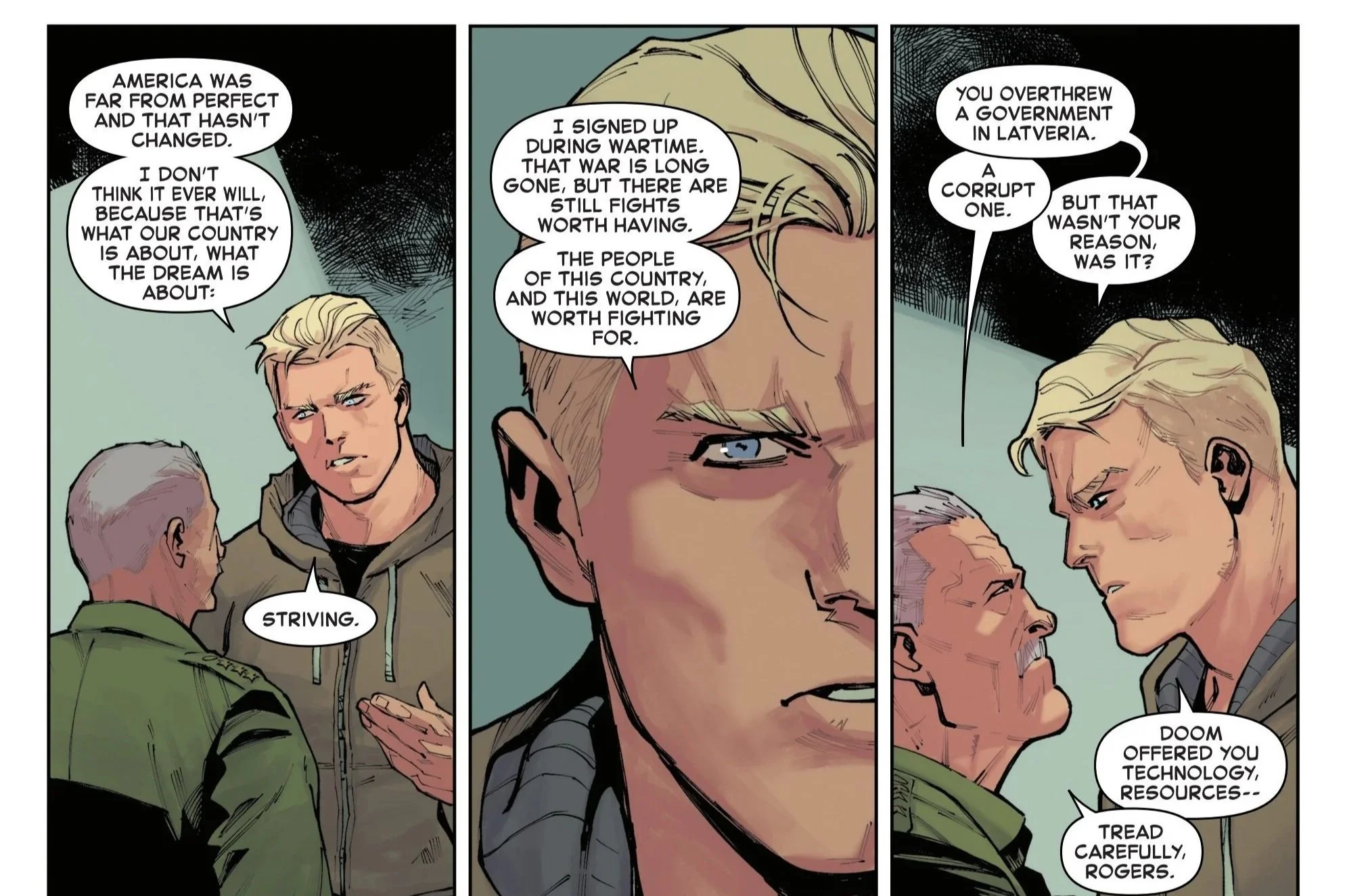
Even a Thunderbolt can’t deter Captain America.
We reach the conclusion of not just this issue but the whole arc as David confesses through writing to his mother that he’s been gone some time, that he’s a killer. It’s another emotional gut punch after a series of gut punches in this gripping tale. We flash forward a month later, as David is in the middle of a surgical procedure of some kind, while General Ross watches on. Steve Rogers is brought before him, in cuffs, having deserted shortly after the evacuation team arrived on site in Latveria. As Ross reprimands him, Steve defiantly declares he needed to clear his head and talk to the people, to find out if America is still worth fighting for. He tells Ross that the country is an imperfect place, but that doesn’t mean the dream shouldn’t be striven for. Cap also confronts Ross over the fact that America overthrew King Vladimir and propped up Doom, not because it was the right thing to do, but rather because Doom offered technology and resources in exchange.
Ross pointedly does not confirm nor deny this as Steve requests an official discharge, one which Ross denies, claiming that, as far as he’s concerned, Captain America is the property of the United States military. Before the heated exchange can get even more heated, we’re treated to the appearance of Tony Stark. Tony introduces himself to Steve, cheekily explaining that Iron Man has told him all about the living legend. He reveals that he’s responsible for the technology that saved David. In classic Tony fashion, he tells Ross he overheard him denying Steve’s retirement, which prompts him to float the idea of retiring himself, taking his technology he’s supplying the military with him. The two leave the clearly pissed off general behind as they go grab a drink together. Finally, our issue neatly wraps up with Steve moving into the classic Avengers Mansion. Greeted by Iron Man, who is just Tony Stark’s bodyguard, and it would be silly to think otherwise, Captain America reveals why he finally took the Avengers up on their offer to join their ranks: to help people.
The simple clarity of that mission statement is more than enough for Steve to get on board with the team as he seeks to figure out the new world he’s now a part of. Our story ends with a nice little touch as Steve is informed of a package waiting for him in his room. It’s an action figure of Bucky along with a handwritten note from Reed Richards simply saying, “The world never forgets heroes. I’m glad you’re here.” This neatly wraps up all five issues with the throwback to issue #1, following up on a wonderful moment between Mr. Fantastic and Cap.
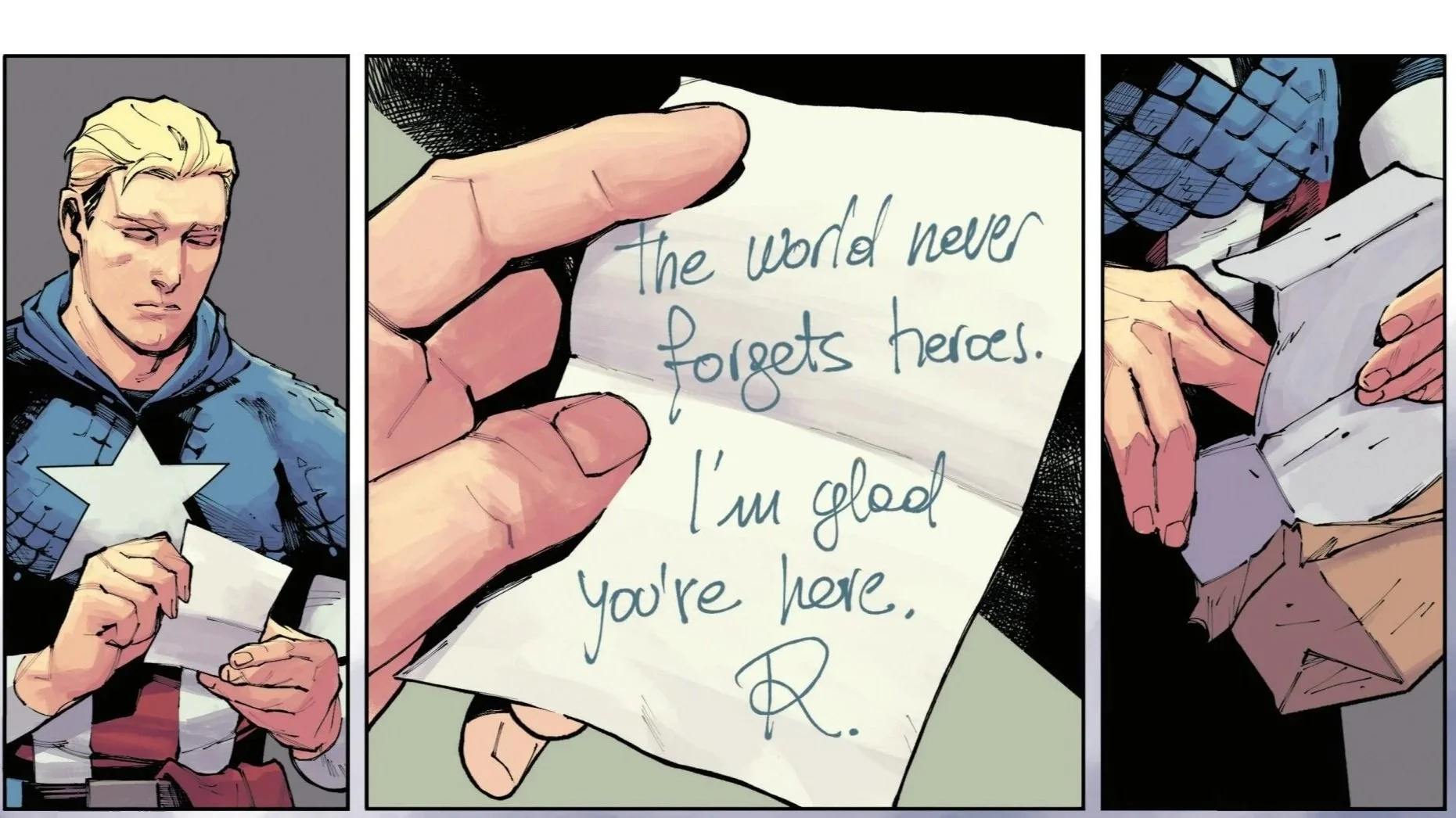
We’re all glad you’re here, Cap.
Thoughts On This Modern Chapter of Cap (#1-5)

Normally, I’m wary of “forgotten stories” or never-before-seen events that take place in the past just because of the pitfalls that can occur upon doing so. Even the slightest alteration or change of previously established canon can wind up having a domino effect. It’s something that longtime readers are often concerned about and not entirely without merit. And while the idea of the US government having its own Captain America while Steve Rogers is presumed dead is something that has certainly happened before, more than once, this take is a unique one. Due to the nature of both comics’ sliding timescale and real-world history, Captain America, who is intrinsically tied to real-world history, is a character in which soft or even hard retcons simply have to happen from time to time. It’s the nature of the beast, given the medium. Luckily, we’re fortunate that the story is worth telling. Not only do the real world events make sense to reference and acknowledge, especially given how they inform the entire character arc of David Colton, but this period of time in the Marvel Universe, literally only a week since the iconic and revolutionary events of Avengers #4 - the return of Captain America - is treated with due reverence and treats the younger versions of these beloved characters with respect and care.
More than that, this issue and the whole Our Secret War arc as a whole explore not just the horrors of war in a visceral and real sense but also touch upon the lengths the governments of the world will go to in the name of lofty ideas such as “peace” or “freedom”. While the showdown between Captain America and Doctor Doom was certainly a big selling point for me personally, it was the character of David and his turmoil that truly drove the book. But make no mistake: even with David’s inclusion and the critical lens held up to American foreign policy, this book is very much a Captain America book led by Steve Rogers. Chip Zdarksy manages to write Steve in a way that’s earnest and heartfelt, a good man first and a good soldier second. The “man out of time” schtick can only go so far with writers, even when the story itself takes place well before Steve has more or less caught up with society. Zdarksy acknowledges that, but doesn’t make that the core of Steve’s personality. It’s his desire to help people and stand up for what’s right that does that.
The art here, from beginning to end, is perfect. Valerio Schitti has this weird and eerie ability to make some of the most brutal scenes in this book still beautiful to behold. As strange as this seems to read (and believe me, it’s stranger typing), I don’t think I’ve seen an arrangement of corpses look better on the page. The fluidity of Captain America’s blows is also drawn with a physical brutality that evokes the type of kinetic energy one would expect from a super soldier. Perhaps most importantly, though, are the emotions Schitti captures from the cast. When we see David and his Mom sobbing, we feel it. When we see the terror of Latverian citizens and soldiers alike fleeing for their lives, we feel it. When we see the horrified realization on Steve’s face as he looks on, we *feel* it. All this is vividly colored by Frank Martin. The action taking place during the present is sleek and sharp, often with Cap’s patriotic colors cutting through. But it's the artistry behind the flashback scenes that Martin truly shines. They’re softer, muted, letting us know it’s a memory without needing an explicit reminder of the fact. They say it’s best to show, not tell and the colors do just that. There’s so much detail here. Everything from blood splatters to swollen eyes to debris is laid out masterfully. I sincerely hope the art team is here for the long haul. It’s a definitive modern style worthy of Captain America.
Conclusion and Verdict
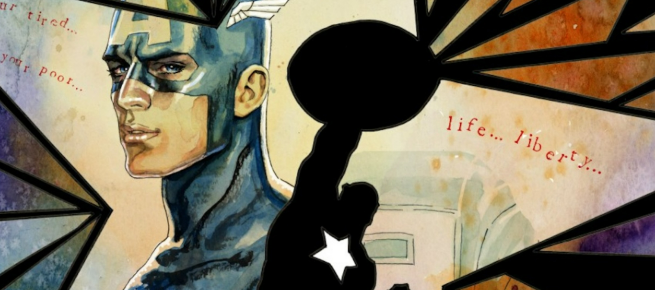
Ultimately, as if you couldn’t tell, I am a big, big fan of this issue and this overall arc. I’m sure some folks will balk at this story given its implications that Steve awakens in a post 9/11 world, which would, in theory, retcon stories in which other historical events that took place before that tragic day are referenced by or even directly involve Captain America, including arcs featuring him dealing with the War on Terror. And I get that, truly, but ultimately a good story is more important than canonical state in of itself. To that end, this is a story that can and does stand on its own, even without looking to the future. But if we were to look towards the future, it is a safe bet to assume that issue #6 of the series, stated to take place after the events of “One World Under Doom”, will see us joining Captain America as he returns to Latveria.
It will be extremely interesting to see how Latveria has changed (and perhaps how it hasn’t) since Steve’s first foray there and I’m hoping we’ll see more of David Colton down the road, even if he doesn’t make an appearance anytime soon. Call me crazy, but I think if Chip Zdarksy can keep the momentum going, we may have a modern Captain America run that can rival Ed Brubaker’s transformative work with the character. To close things out, I’ll leave you my final review, both for Captain America #5 on its own and for the “Our Secret War” arc as a whole.
Captain America #5 Review: 8.5/10
Captain America: “Our Secret War” Arc: 9/10
Ultimately, this arc manages to juggle superhero action, heart pounding espionage, and real world trauma in a way that’s exciting, tragic, poignant, and at the end of the day, gives you hope that while our institutions may fail us, that the ideals they’re founded upon are very much worth fighting for. I can’t recommend it enough.