
Initial Thoughts
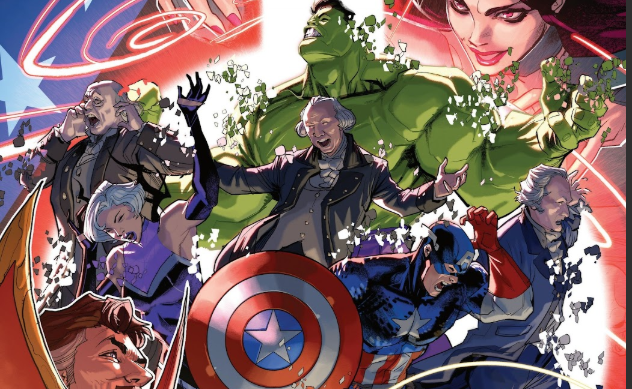
The Battle of Saratoga, with a Marvel twist, has officially started in 1776 #3, and the Avengers are not only fighting for their existence, but for the fate of the United States. 1776 #3 is the strongest issue in the mini-series thus far, bringing together modern-day themes and issues with a pinch of historical fiction and sci-fi. The third issue in the series raises a time-travel morality crisis, as Spider-Man debates which lives are worth saving, even if saving them would endanger history. This paradox might even cost Peter Parker his life.
This issue does a fantastic job of raising thought-provoking ideas about a young country and democracy, created by imperfect people in a turbulent time. How can we justify enslavers, deadbeats, and drunkards creating the modern democracy? 1776 #3 hits you in the face with two compelling dilemmas that are mixed in with all of the other Marvel fun and nonsense. It's a balancing act, but the creative team of J. Michael Straczynski, Sean Damien Hill, and Jay Leisten pulls it off.
It took a while to get there, but 1776 #3 really brings home its main themes and hones in on its message. Issues #4 and #5 have to stick the landing because this one did all of the heavy lifting.
What Happened in 1776 #3?
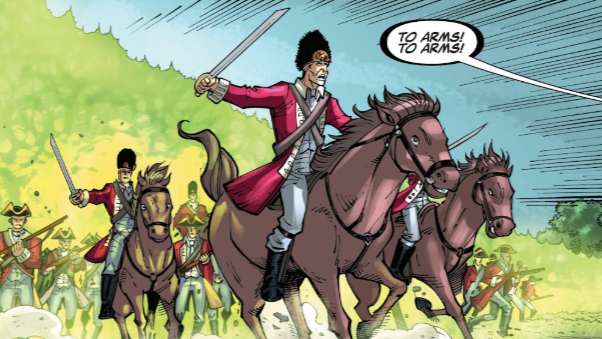
Every Avenger is in the middle of their mission to stop Morgan Le Fay from changing history by having the British army defeat the Continental Army, negating the start of the United States and, by proxy, the Avengers. Clea is in the middle of a hand-to-hand battle with Le Fay, Tony Stark is with Ben Franklin to get the Continental Congress to move away, and the Hulk is now behind enemy lines, as he successfully infiltrated the British army. Lastly, Captain America and Peter Parker are at the front lines as Benedict Arnould provides them with ammunition and a horse.
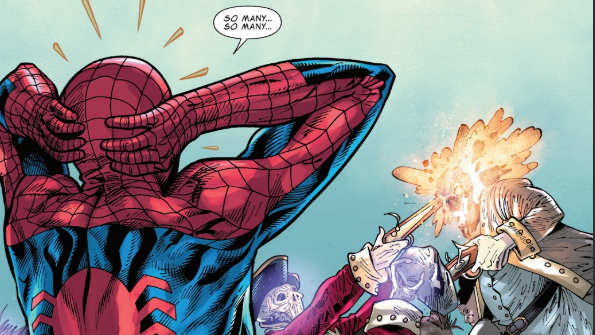
The Battle is brought to Steve and Peter sooner than they expected, and they are now on the front lines of one of the most famous battles of the Revolutionary War. Spider-Man is reminded that he must not, and can't, save everyone. In a split second, Spider-Man goes from saving soldiers to bleeding out in the middle of the Battle of Saratoga.
Will the Avengers win the Revolutionary War?
Spider-Man is shot. The Hulk is deep behind enemy lines, and Clea is going head-to-head with the mastermind behind it all, Morgan Le Fay. Will the Avengers be able to pull it off and save the country and the Avengers themselves? Will there be any fundamental changes to the creation of the United States of America? Benjamin Franklin and Tony Stark, who had short appearances in this issue, will no doubt still play a massive part in this story. Even if Clea can handle Le Fay, we know we won't go down without a fight.
A New Twist to an Old Trope
I REALLY enjoyed the predicament Peter Parker was put in. As a hero, he instinctively tries to save as many people as possible. However, as we've been told a million times in every time travel story, you must maintain a healthy distance between yourself and the people of that particular time. This isn't Back to the Future; you can't kiss your mom. You have to make sure you watch what you are doing at all times so you don't mess with the timeline. Peter is put in a rare predicament: Mess with time by saving as many lives as possible, or keep the timeline the same and watch innocent lives be killed right in front of him.
By being given the power to see who must live and who must die, his moral dilemma is made that much more difficult. Can you imagine having that vision as a regular person, let alone a superhero? Absolutely brutal. He then, of course, gets shot trying to save the one person who is not supposed to die. This isn't a new trope. However, physically seeing who is supposed to live and die in a war—as a hero — is new to me.
Another aspect I enjoyed was making Benedict Arnold, a historically famous coward and traitor, a sympathetic character in this story. We don't know how it will end up. However, if the story is really pushing to keep everything as is, Arnold will more than likely still be a cowardly traitor. With context, he does seem a bit more sympathetic, but he is still not a hero.
There is always a corner a writer can paint himself in with time traveler and/or historical fiction, but when done right, they can still build suspense even though you know how it's going to end.
The Founding Father Paradox
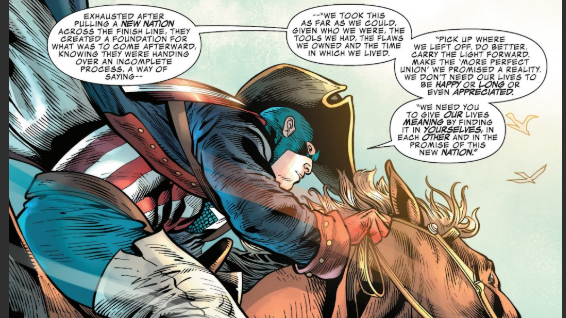
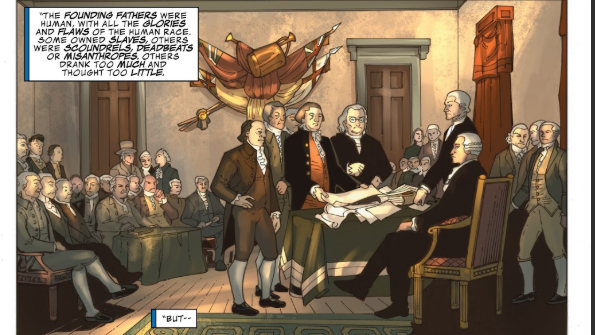
I am a bit conflicted in some of the themes presented in 1776 #3. Captain America’s character has always been one that champions the country, regardless of what is going on. In 1776 #3, he expounds on the virtues of the founding fathers and lectures us on how they were imperfect humans in an imperfect time. However, in today’s climate, it just seems hard to buy into what Steve Rodgers is trying to sell. I know the nuance is there, which is why he told their stories, but at a time when it seems things are bleak in this country, we don't want to be lectured about how great the founding of the country was.
However, one could also argue that this is the perfect time to discuss the founding in that context. As I was writing that first part of this section, the more I thought about it, the more I realized how this might actually be the perfect time to talk about how, while imperfect, the reason we smany of us are critical of what is going on now, is because we know what this country CAN BE, and how short we have fallen of the original idea. Maybe that's why it hits such a spot with me. This isn't to get on my soapbox about society or politics, but reading this evoked that emotion, and that is why comic books are so great.
Solid Art
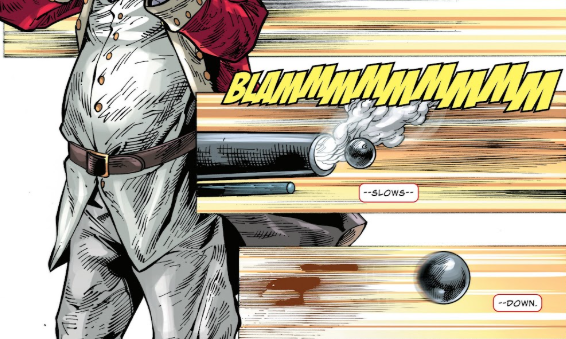
There isn't much to add that I didnt already mention in my 1776 #2 review. The art is a throwback to the stylings of the late 1980’s and early 1990’s, giving the entire series a “classic” look that fits the story. The time-period pieces still look fantastic, and Jay Leisten’s coloring adds an element of modernism with classic drawing.
Although it is not for me, it gives it a sense of originality and authenticity that a modern drawing would not have. However, there are more action pieces, specifically the page where Spider-Man gets shot; there are moments where you start to wonder if they are actually going to do it. And when they do, it's a genuine eyebrow-raising moment. Thanks to how it was drawn.
Final Verdict
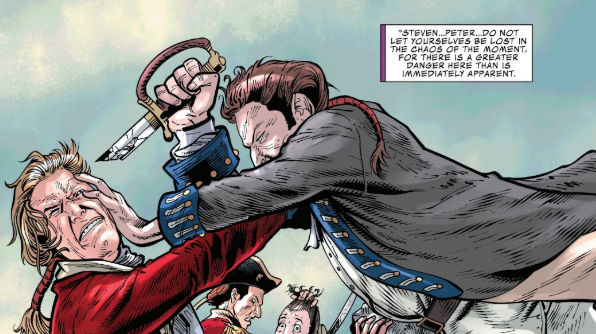
1776 #3 is a well-rounded comic book issue that continues the Avengers' story during the Revolutionary War while functioning as a single issue within a larger story. The creative team did a good job of tiptoeing between relevance and serious questions and themes, while still incorporating comic-book and Marvel hijinks. J. Michael Straczynski’s twist on an old-time travel trope gave the story so much more depth; it leaves you wanting more and excited for the last issue.
Questions and issues about our founding fathers are never easy to answer, and this issue adds context and complexity. It's not here to sway you one way or another, but it does raise the question, especially given the Avengers' entrenched place in American culture. It took two issues to get there, but 1776 #3 masterfully gave this series gravity.