
Strife and Discord Find the Amazons on Themyscira
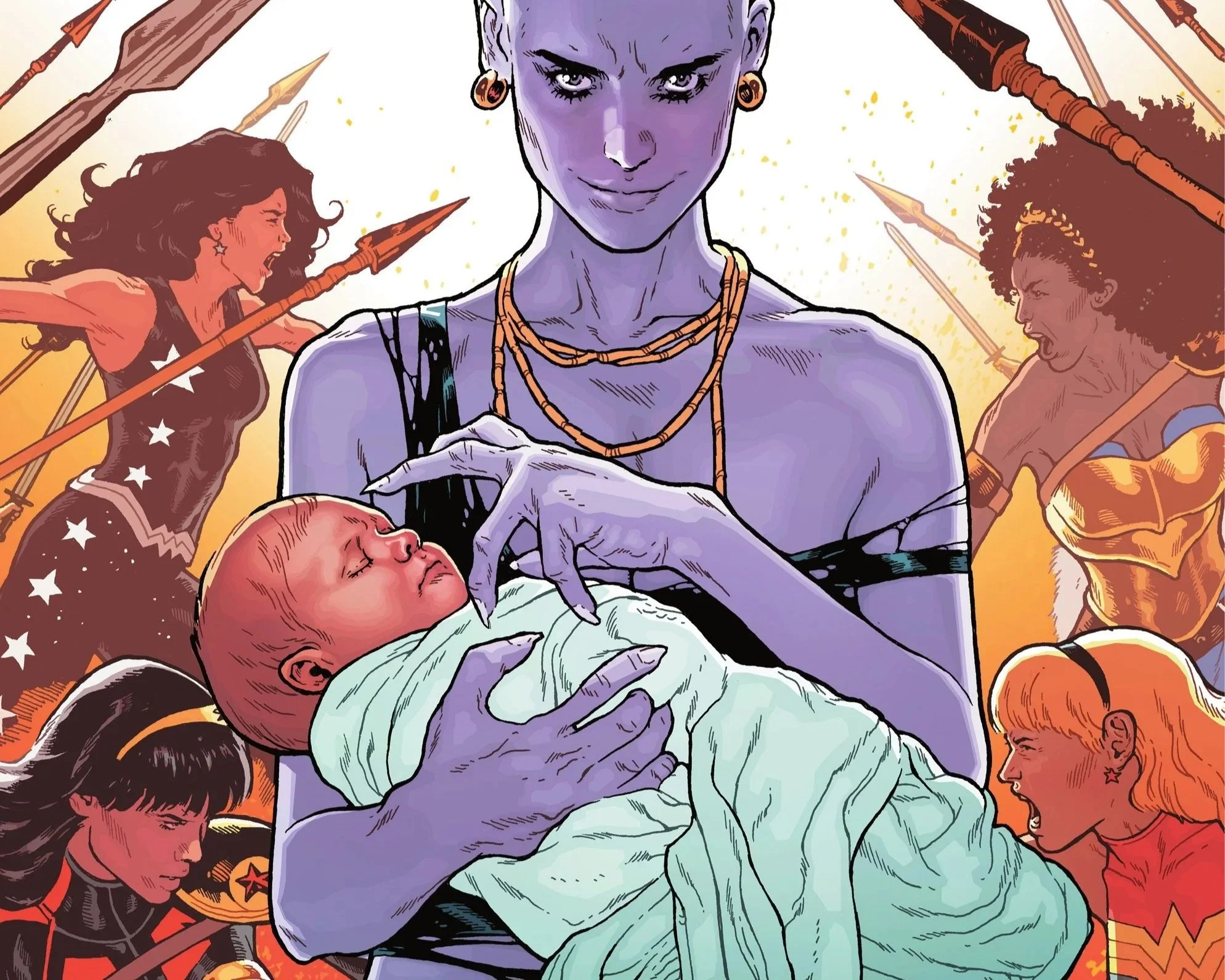
Cover to “Wonder Woman #30” (published February 18th 2026) , written by Stephanie Williams with art by Jeff Spokes
Cover art by Jeff Spokes
The second and concluding part of “The Village” takes place in the latest issue of Wonder Woman. Series regular Tom King and Daniel Sempere enjoy their deserved break as Stephanie Williams and Jeff Spokes return to wrap up their story in issue #30. In the previous issue, we saw that the Amazons were being manipulated from the shadows by the Goddess of Strife, Eris, who is somehow working through the infant daughter of Wonder Woman herself. With Diana taking a momentary leave of absence so she can recenter herself, it will be up to the Wonder Girls, Queen Nubia, Philippus, Clio, and Bia to safeguard baby Lizzie from the designs of Eris. Can they keep Lizzie - and themselves - safe? Let’s break down the issue and find out!
Warning: This article will contain spoilers from “Wonder Woman #30”.
The Village, Part 2
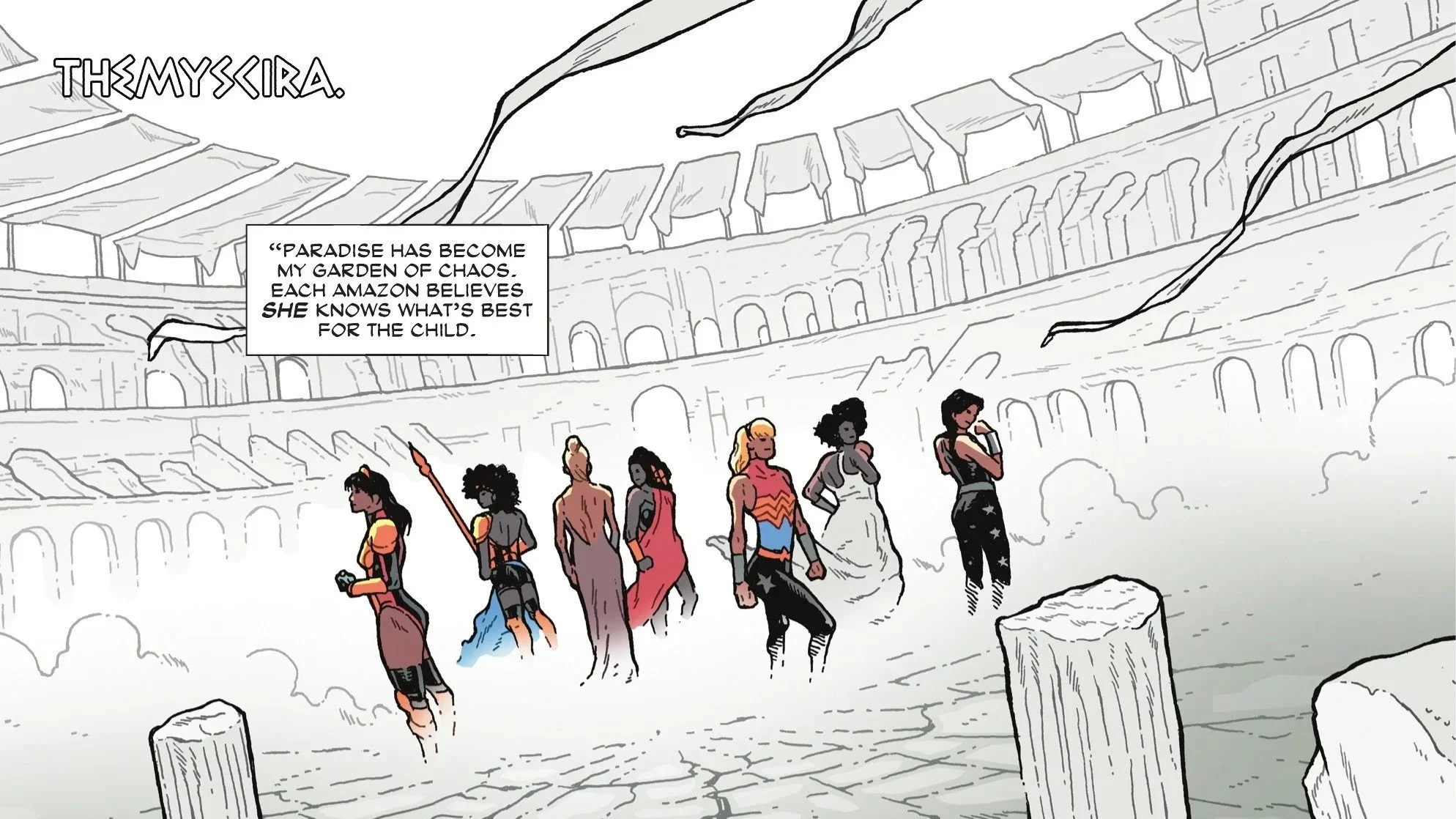
The Amazons stand united as they prepare to defend themselves from the machinations of magic of Eris.
We begin right where we left off in the previous issue of Wonder Woman. The assembled group of the sisters of Diana, in the form of Donna Troy, Cassie Sandsmark, and Yara Flor, stand in the coliseum of Themyscira. They are joined by Queen Nubia, Phillipus, Clio, and Bia as they realize that the fevered pitch sparring session that escalated too far moments ago was the result of Eris, the Goddess of Strife.
Eris monologues through the narration. She informs us, the readers, that Paradise Island has become her garden of chaos. Each of the Amazons standing assembled before her believes they know what is best for young Lizzie, the infant daughter of Wonder Woman. It becomes clear that she is feeding off the fear that the Amazons hold within their hearts, specifically the doubts that they are not good enough.
Queen Nubia rallies the Amazons to her as little Lizzie lets out an inhuman cry that turns into a laugh, which is the result of the influence of Eris over the babe. Eris acts accordingly by targeting Nubia with her magic. This prompts Nubia to ask Bia to give the infant to her. As Queen of the Amazons, she believes she is clearly the one best suited to care for the child in the absence of Diana.
Cassie is the next to have the attention of Eris. This prompts the second Wonder Girl to argue she is best suited to protect Lizzie due to her divine blood. Yara is next, believing that as the newest member of the extended Wonder Woman family save Lizzie herself, her innovative way of thinking is best. Donna is the next to fall under the spell of Eris. She believes that as the most experienced of the Wonder Girls, and having a special bond with Diana herself, she would know what the mother would want. Philippus is told that she should take charge now instead of failing Diana once more. Finally, Clio, the historian, is told that she understands destinies better than most and is well read enough to know the best path forward.
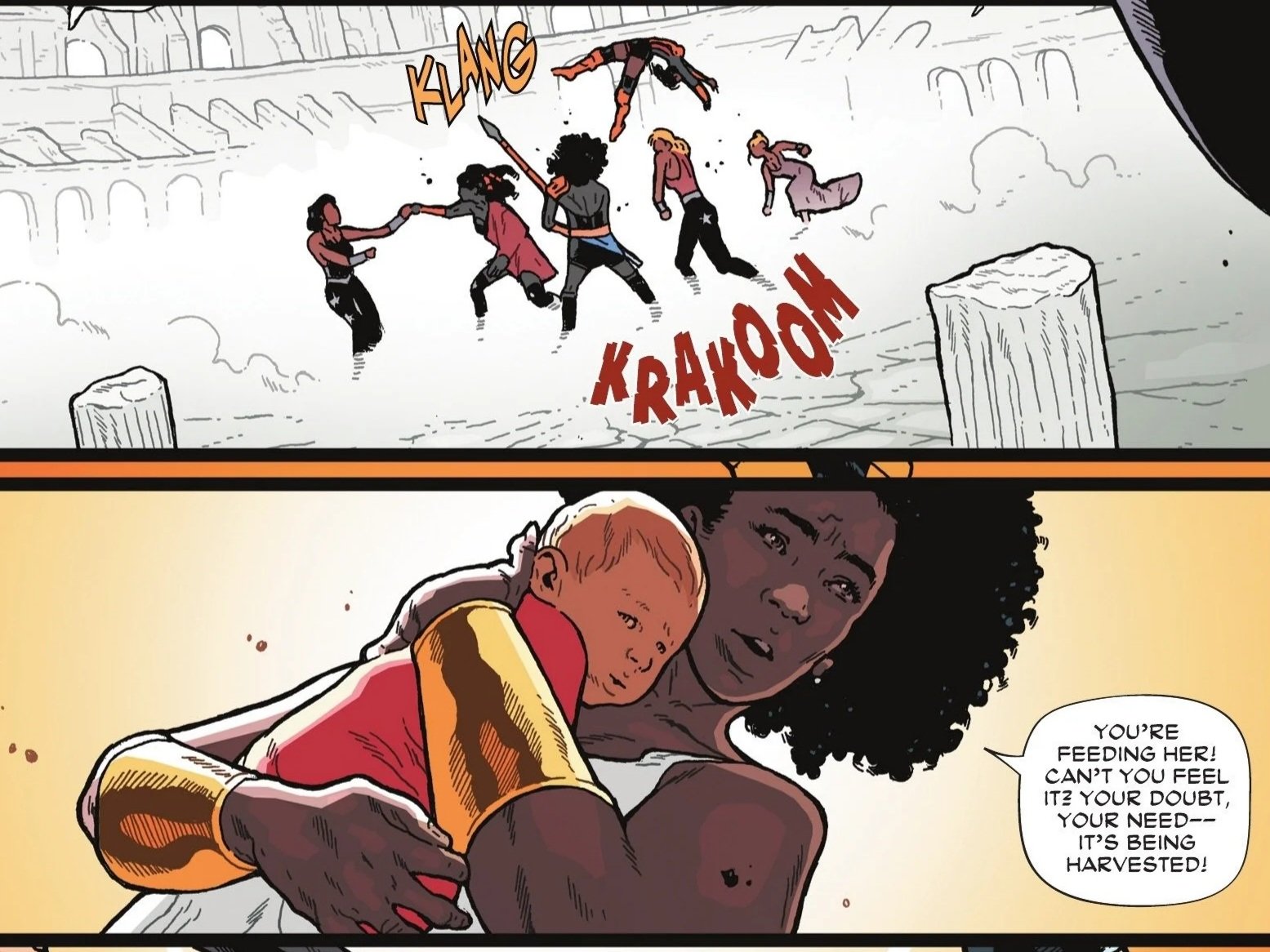
Bia tries to get her fellow Amazons to stop fighting but to little effect.
Bia is the only one seemingly unaffected as the Amazons all begin fighting amongst themselves. As she holds Lizzie close, she shouts for the others to snap out of it. She realizes that their internal doubts and fears are only being harvested by Eris, who is feeding off of their energy. That same energy coalesces above them in their frenzied melee, and it manifests as a golden apple.
Eventually, the Amazons pause their battle just in time to see Eris floating above them. The Goddess is all too pleased to harvest their strife. She tells the Amazons not to stop on her account. She mocks them for using a child to validate themselves, specifically pointing out their collective fears and self-doubt before taking a bite of the golden apple.
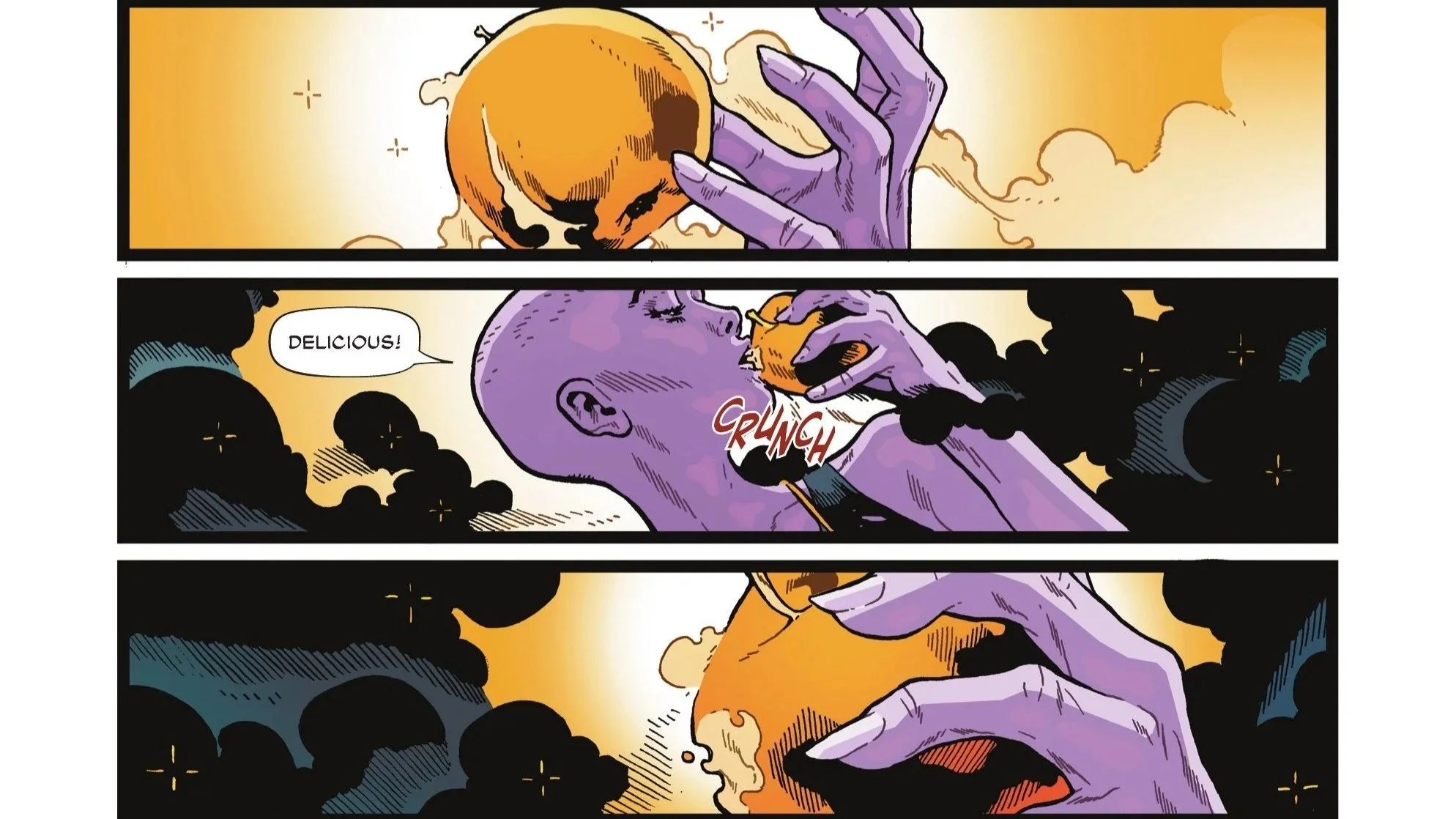
Eris enjoying the fruits of her labors.
Dark shadowy figures appear, manifesting from a black smoke as doppelgangers of the Amazons step forward and rush to face their opposites. Each Amazon is paired against her own dark reflection, which is a literal representation of her doubts made tangible and dangerous alike. However, we soon see an all too familiar golden lasso entwine the wrists of Nubia as Wonder Woman herself arrives in the nick of time.
She informs her sisters that the shadows are their own doubts weaponized against them. She uses the power of the lasso to compel Nubia to see the truth. She is worthy, and she was chosen by the former Queen, Hippolyta herself, to lead the Amazons forward. Nubia resists but only for a moment. She realizes that Eris is using their love against them, and this realization only strengthens her resolve as Diana encourages her.
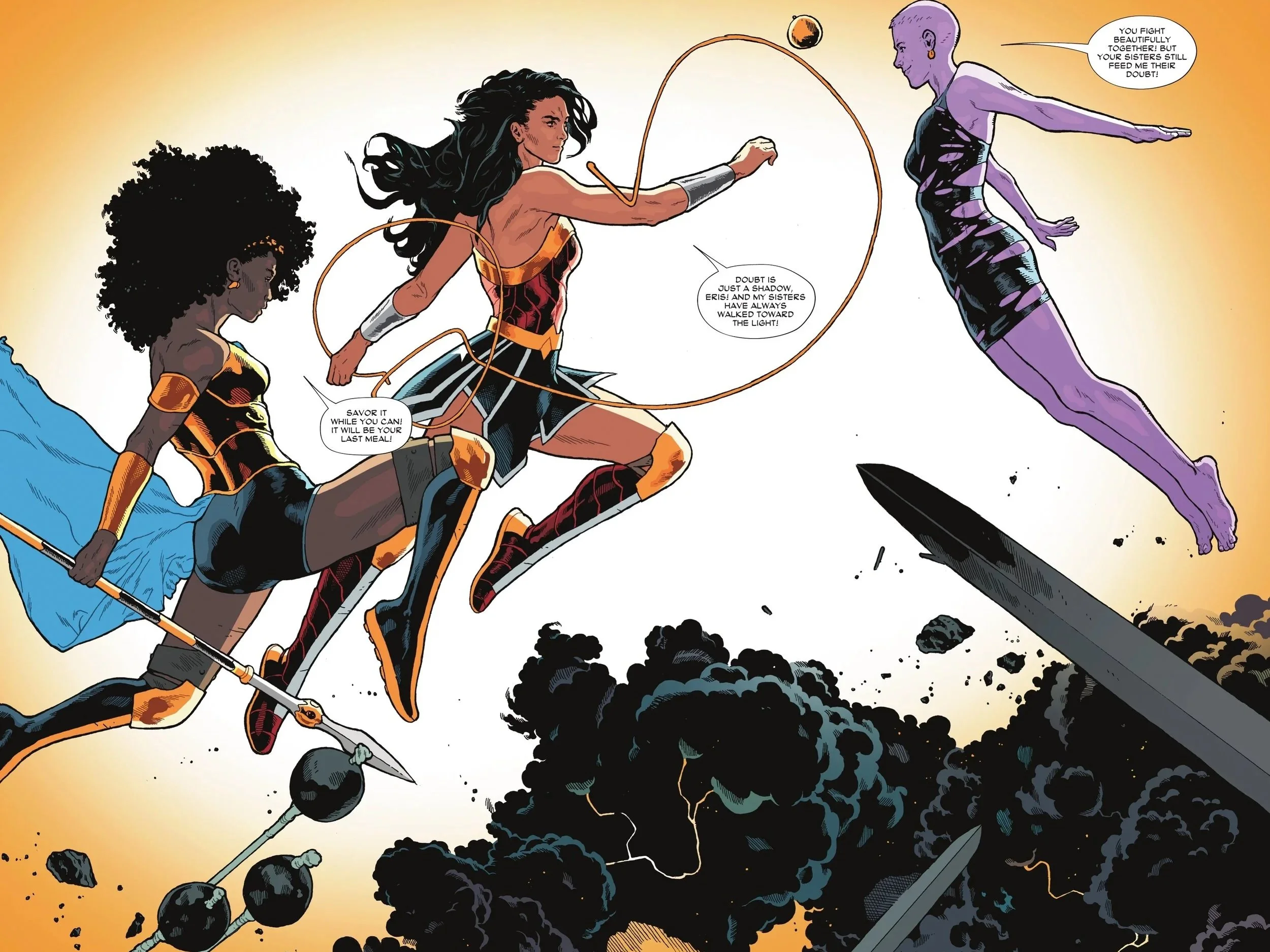
Queen Nubia and Wonder Woman clash against Eris, Goddess of Strife.
Diana and Nubia leap toward Eris and her golden fruit as the other Amazons square off against their shadow doubles with the outcome in doubt. But Wonder Woman and the Queen of the Amazons together are more than a match for the Goddess of Strife. Eris is laid out, and she defiantly shouts that she cannot be destroyed, for she is discord itself.
Realizing that the doubts of the others are real, the two realize that they can only be saved by realizing that doubt in of itself does not mean weakness. They join hands as Diana wraps her lasso around the spear of Nubia. They call out to their sisters and tell each of them in turn why their doubts come from caring and loving one another. One by one, each Amazon reaffirms that her doubts only come from a place of good as they stand united against Eris. They are more committed to each other than before as their insecurities slowly fade away thanks to their combined power.
Eris starts to shrink away from the blinding radiance coming from Wonder Woman and Nubia. As she retreats, she claims that their unity is only temporary and will come apart as Lizzie grows up.
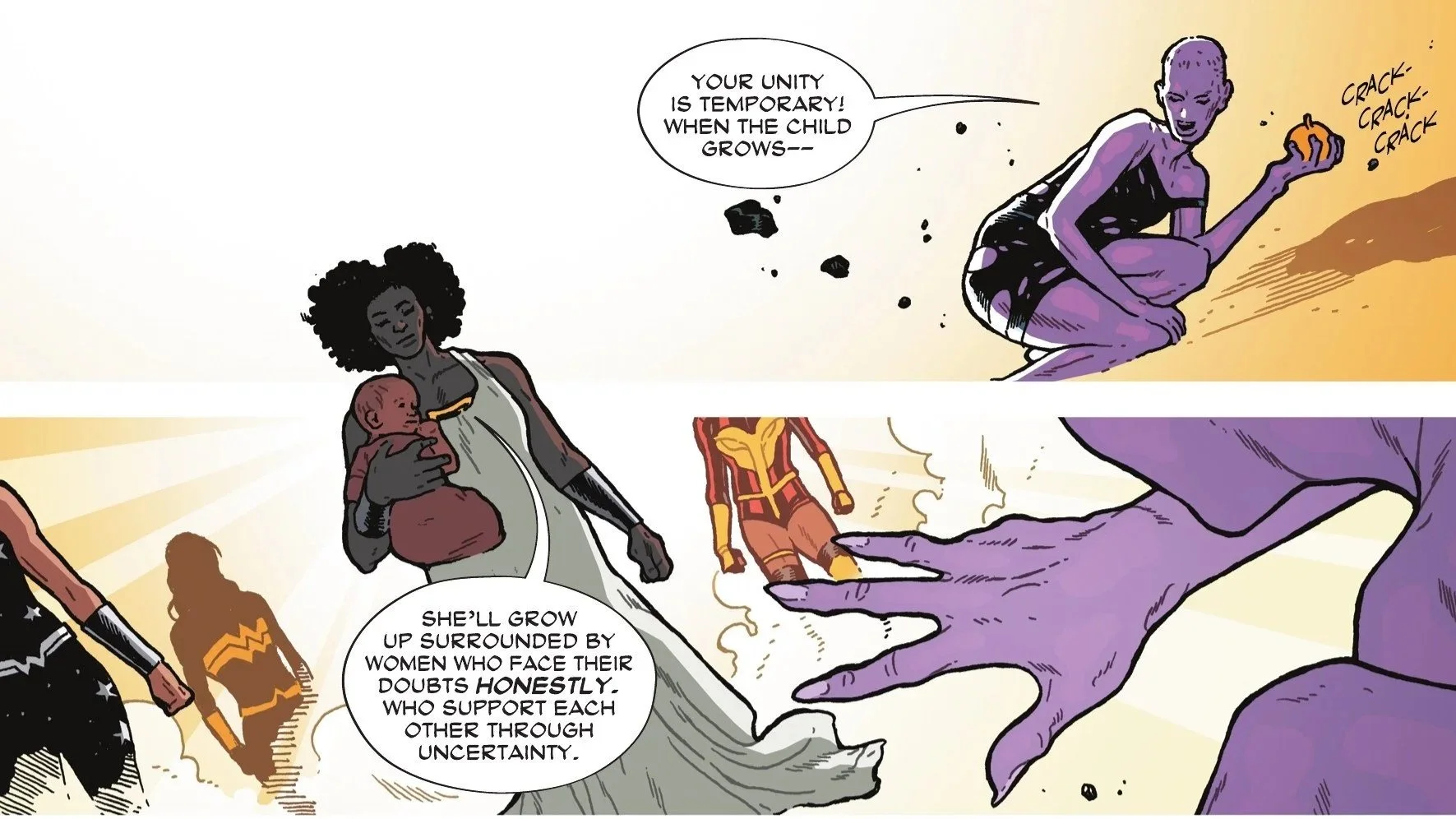
Lizzie is probably in the best hands imaginable for being an infant child to a superhero.
Bia steps forward with Lizzie in tow. She says that the daughter of Diana will grow up surrounded by women who will show her that they face their doubts together and honestly. The innocence wafting from Lizzie literally burns Eris as she crawls away. Eris screams that the child does not know discord or conflict. Wonder Woman agrees and takes her daughter back from Bia. She explains that the infant knows only love, joy, and acceptance.
The golden apple in the hand of Eris starts to crack before ultimately shattering in her grasp. The Goddess of Strife refuses to accept defeat so readily, however. She taunts Diana that Lizzie will not stay innocent forever. She claims that once the girl doubts, questions, and rebels, they will be waiting and she will be the key to everything. Eris departs, but not before warning the Amazons that the Wonder War is coming and their precious unity will wither.
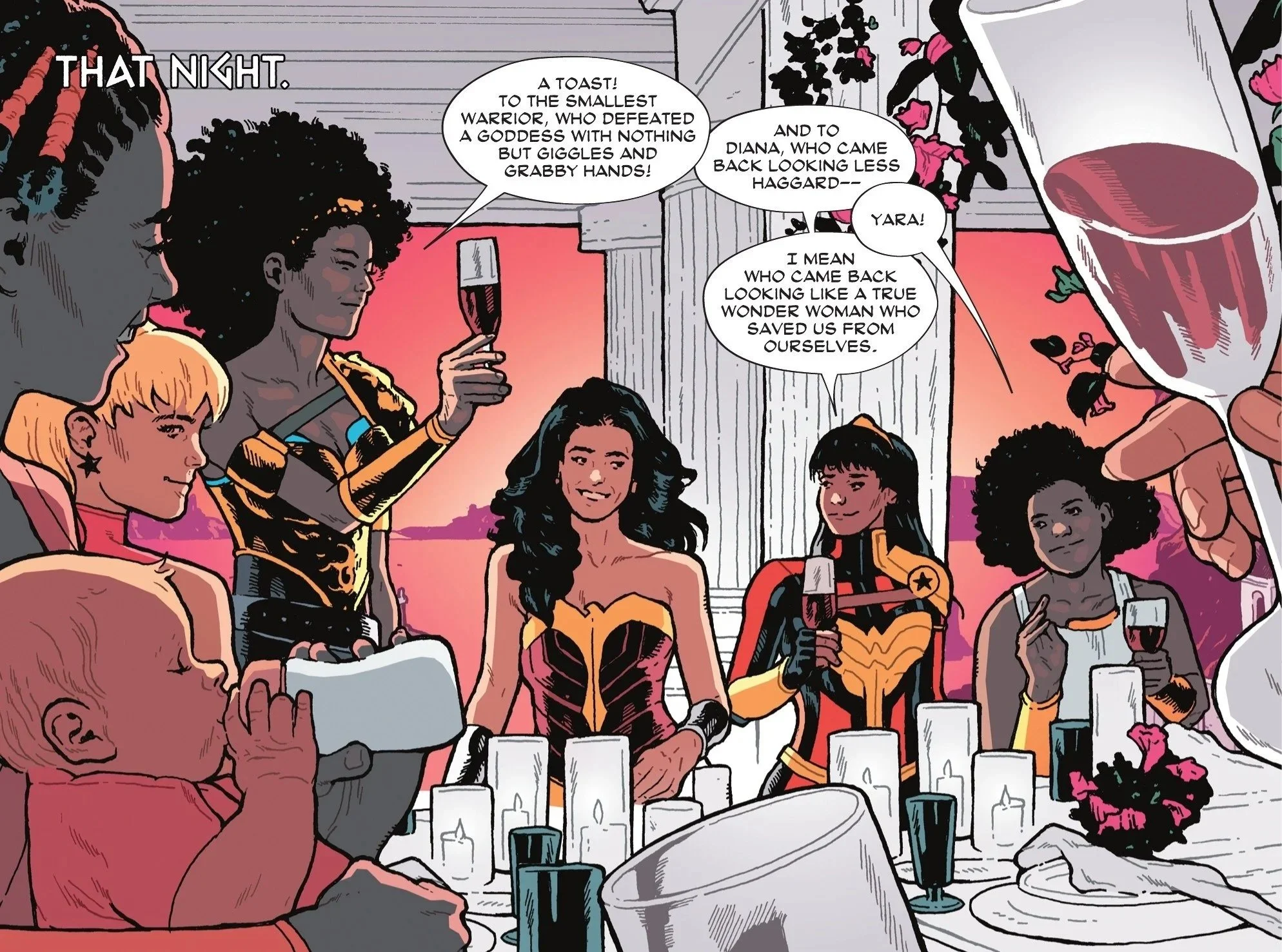
A much deserved toast!
Sometime later, the Wonder Girls relax with Lizzie. They contemplate how they almost destroyed themselves, but they note that they stopped Eris together thanks to their bond and love for one another. They note that Lizzie will make a great Wonder Girl someday. We then turn our attention to Wonder Woman and Philippus.
Philippus apologizes to Diana for cutting the meditation of the princess short and forcing her to come to their rescue. She says that they should have protected Lizzie. Diana gently cuts her off and says she did protect Lizzie. She tells her that all of them did, and they did so while fighting their own demons. The two embrace as Wonder Woman reveals that her daughter reminds her that even immortals are allowed to be human. Philippus, in turn, reminds her that she is never alone and will always have her sisters and Themyscira.
We jump ahead to later that night as the Amazons enjoy a toast dedicated to Lizzie herself for defeating a goddess. Lizzie babbles and eventually lets out a burp. This is as good a sign as any that she will fit right in with a group of the strongest warrior women in the entirety of the DC Universe.
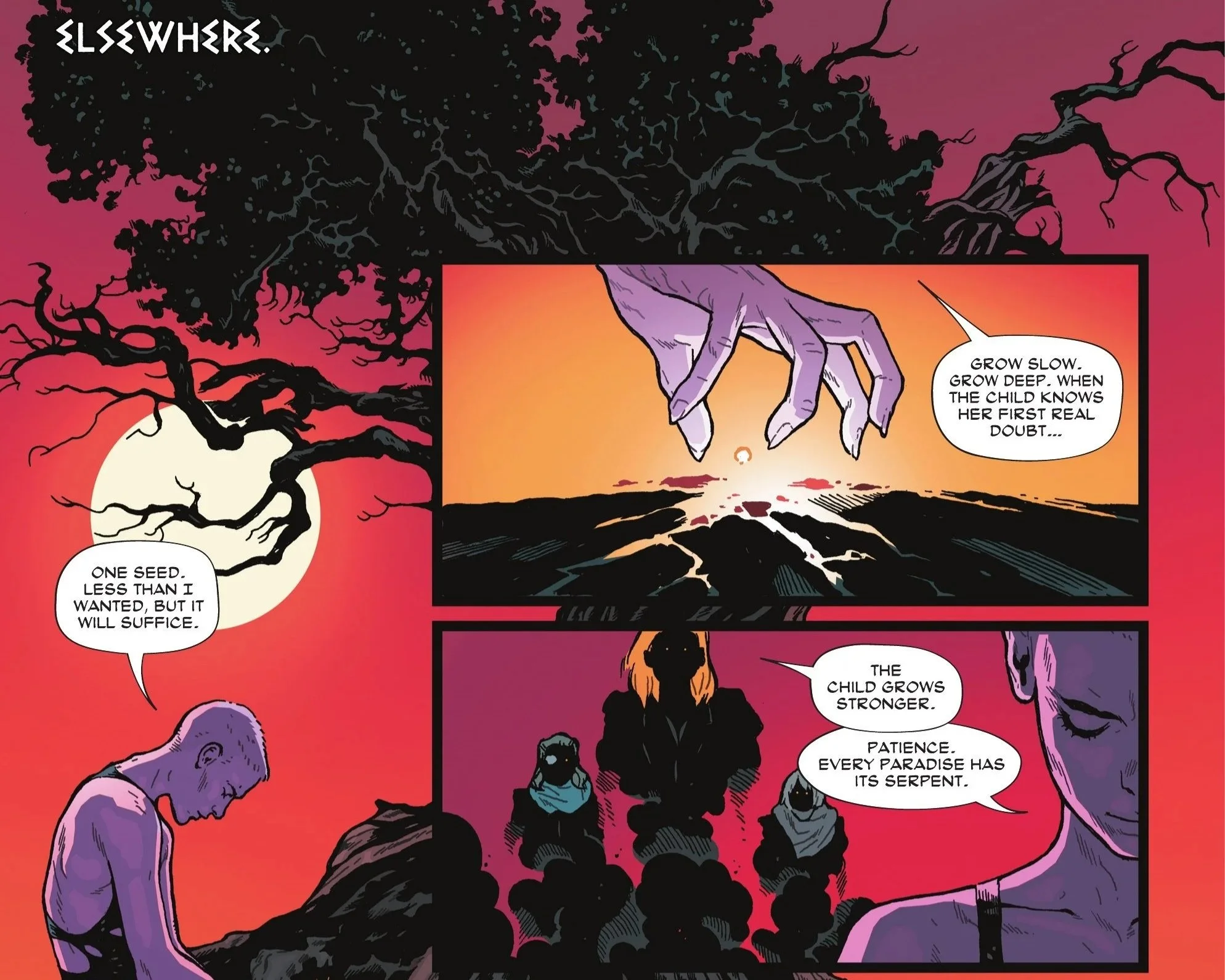
Eris plants the single seed born from the golden apple created from the Amazon’s doubts.
Our issue concludes as we go elsewhere on the island. We see Eris with a single seed, planting it in the soil as she laments that it is less than what she had originally wanted, but still enough to suffice. As she plants the seed, she remarks that it will grow slowly and deep, waiting on young Lizzie to know her first real doubt.
Eris is joined by smoky shadows who state that the child is growing ever stronger. Eris remarks that despite the Amazons being forewarned and united, a unity forged in crisis is brittle. The threads converge, and trials have only begun, but Eris is more than content to let the Amazons prepare for the battles they can see, for the true war blooms unseen. The issue concludes with an ominous warning that the Wonder War is finally upon us.
It Really *Does* Take a Village
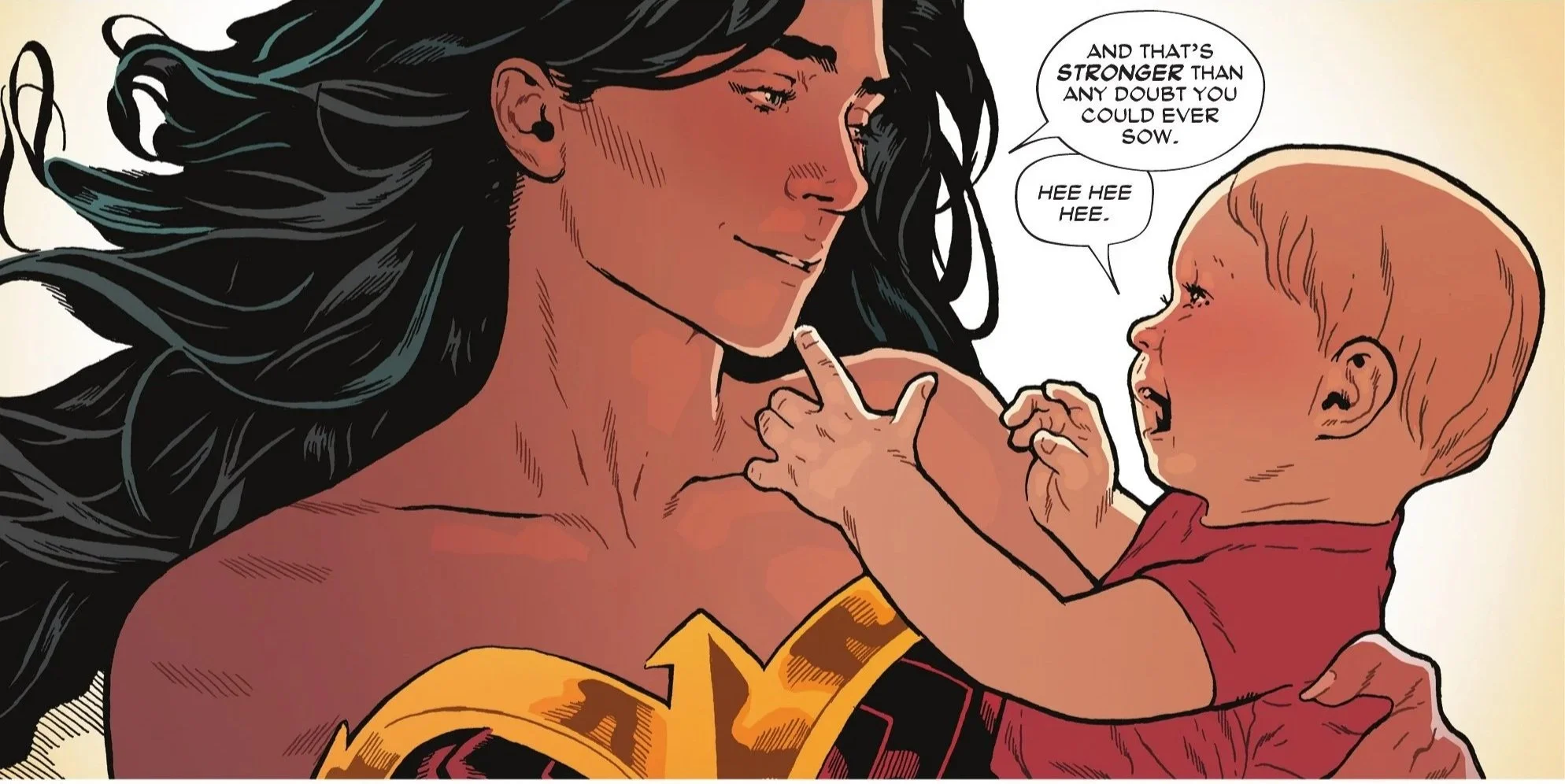
A little time away to recenter herself did…wonders for Wonder Woman.
The second part of "The Village" two-parter story wraps up a short but sweet tale. It serves as a nice diversion and breather from the regular Wonder Woman writing duties of Tom King, but it also manages to build upon the oft-referenced Wonder War. I presume that war will start in earnest starting next issue. Wonder Woman #30 builds off of what issue #29 set up. While it does certainly have connective tissue to previous issues in the run of King, plus Amazon Attacks, and what lies ahead, it still is a pretty strong issue on its own, all in all.
Stephanie Williams returns to wrap up her brief two-issue story and does so by giving each of the showcased characters a moment to shine. As I have said in numerous reviews for multiple titles, a great sign of a good writer is how they are able to tell a compelling story with the titular character of the series either not present for most of it or not being the star. Wonder Woman shows up to help save the day for sure, but she still is not the central figure here. The spotlight is shared between Queen Nubia and the Wonder Girls, with the other Amazons, Philippus, Clio, and Bia, also having their own moments.
To me, that displays a strong understanding of the title character and the supporting cast of characters. It shows how they fit in the world and larger narrative. The themes here are universal and obviously quite important to the mythos of Wonder Woman. The importance of family and self-care is nevertheless made evident here without the story coming off as preaching on top of a soapbox. The name of the two-part story arc, "The Village," is also appropriately named, given the old saying of how it takes a village to raise a child. If nothing else, we walk away from this book knowing Lizzie will not be wanting for loved ones to take care of her.
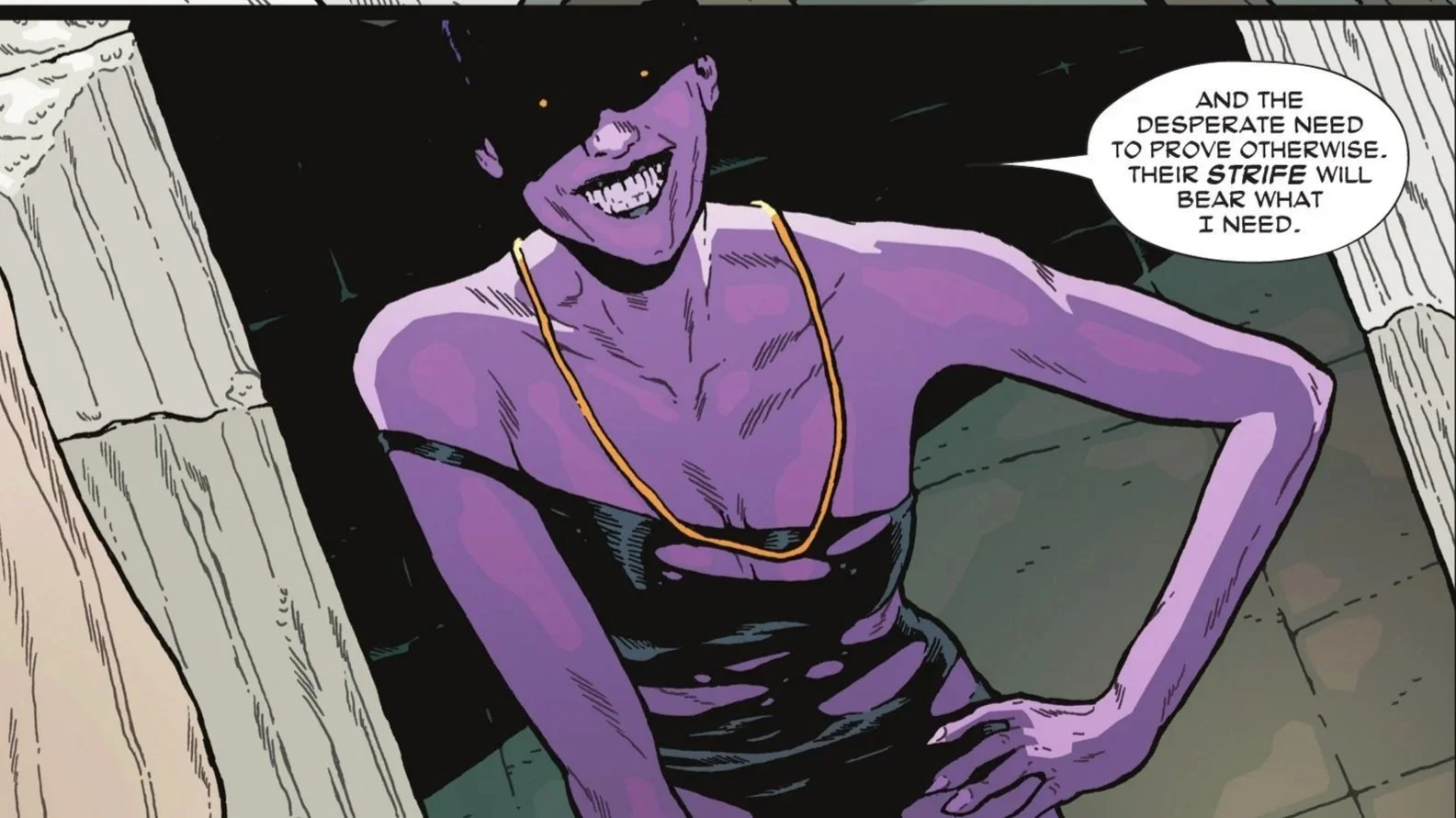
Eris is a slept on villain and despite being a “lesser” goddess, is very dangerous to Wonder Woman and her family.
There is a lot to like here, mainly the interaction between the Wonder Girls. Donna, Cassie, and Yara all have unique history and dynamics with Diana herself and among one another. Seeing them work out their messy inner doubts and fears was good, meaty, character-driven stuff you like to see. Nubia was also particularly compelling here. She provided a commanding presence as the Queen of the Amazons, while also displaying some doubt in the sense of whether or not she is even worthy of the crown in the first place.
Philippus, Clio, and Bia do not get quite as much development, but the moments they do have serve the story itself and do each of them justice. Eris was done particularly well here as the antagonist, picking up from Amazon Attacks and not missing a beat. I feel that the rogues’ gallery of Wonder Woman is, unfortunately, a distant third place behind those of Batman and Superman. Honestly, it is behind that of the Flash, too. It is always a treat to see one of her more underappreciated foes getting the spotlight in a good way.
The ending of the comic directly leads into the whole Wonder War arc. This is something Tom King has been hinting at for quite some time, and I am almost exhausted with the foreshadowing and hints. I really like the idea of the Matriarch, who has a visually striking anti-Wonder Woman design, but I feel like the title has been meandering around to getting to the point where this story can actually begin in earnest.
Of course, my gripes about the build-up of the Wonder War are no fault of Stephanie Williams. She did a great job making sure she set the table for the return of King after a two-month break without compromising on quality for the story she was telling. If there is any fault with the issue, it would be the relatively minor one of the reader potentially needing greater context or familiarity with the prior work of Williams regarding Wonder Woman stories. However, this is not so much to the point where you cannot just jump in and appreciate the story.
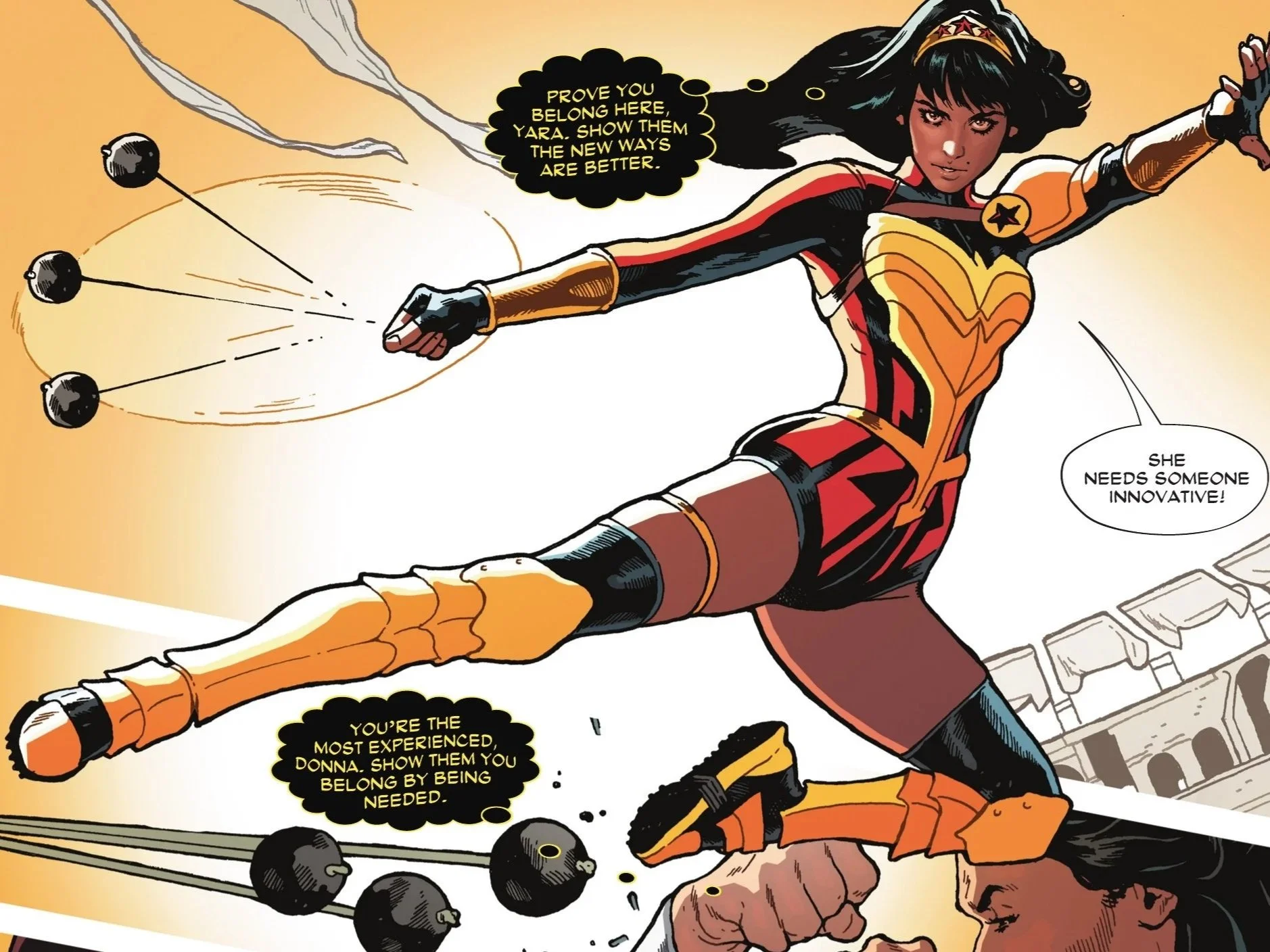
Yara was a stand out character here from an art standpoint due to her dynamic posing and action scenes through the book.
Jeff Spokes returns as the artist, bringing incredible choreography and a sense of fluid movement and motion to the book that really captures the grace of these immortal warrior women. While each character is drawn well and given dynamic poses or expressive emotions, Yara Flor walks out of here as the real winner when it comes to the action. She is almost always in mid-motion, as graceful as she is deadly, and spread across the panels like a tour de force.
Each of the women here, though, is brought to life in a masterful way that embraces their strength and femininity without veering into fan service or exploitative art, which is always appreciated. Themyscira as a whole looks, well, wonderful, if you will forgive the pun. It is depicted in a way that goes beyond being an island paradise. It is literally called Paradise Island, mind you, but it is shown as almost otherworldly and truly blessed by the gods.
The skyline here is breathtaking, with the shades of oranges and reds as the sun sets, painting an almost picturesque scene. The palettes in general are just really neat, and they make the issue just as gorgeous to look at as the dialogue and narration is enjoyable to read.
Final Thoughts and Review
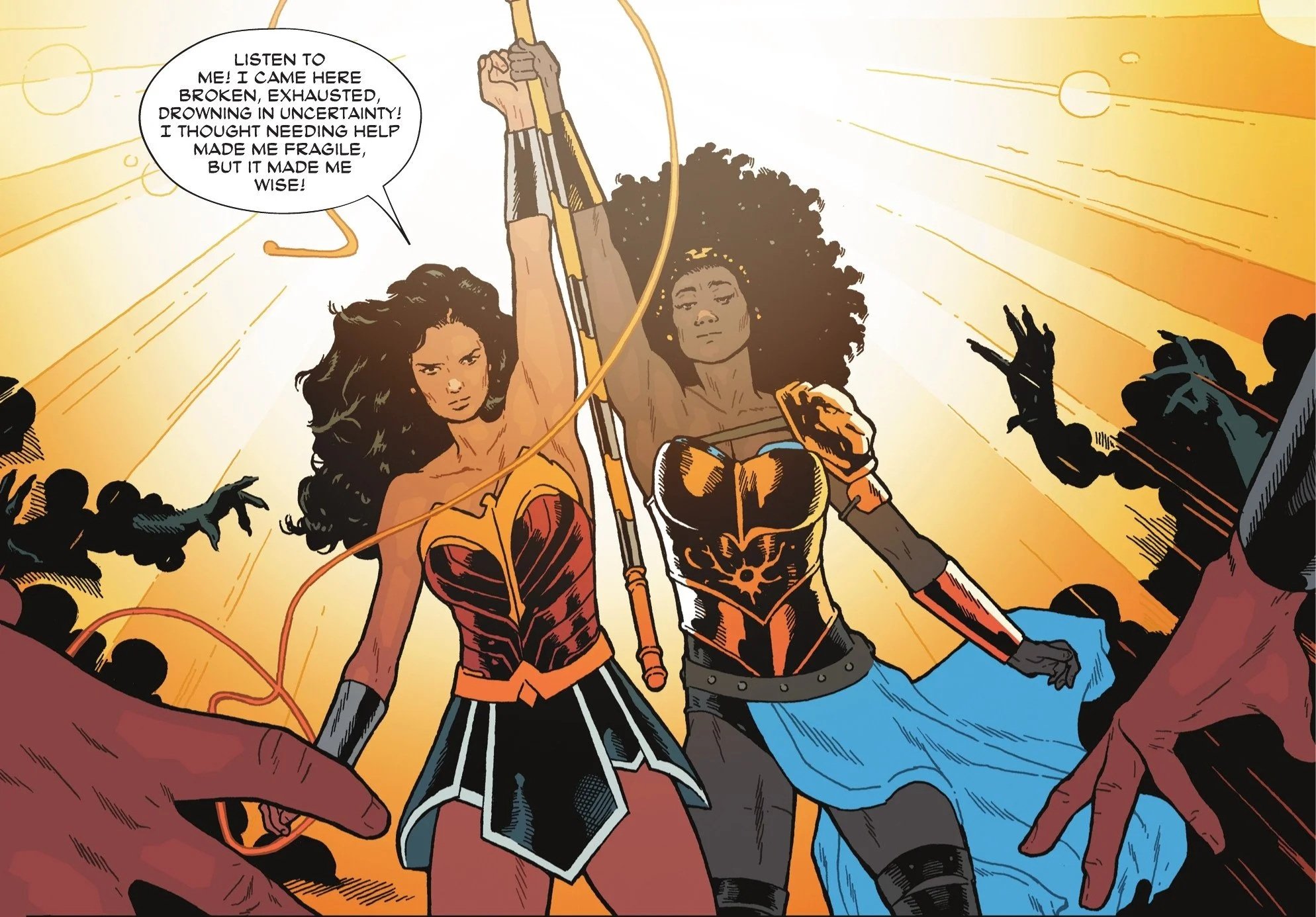
The Princess and Queen of Themyscira rally their Amazonian sisters together.
I think that issue #30 of Wonder Woman is a particularly strong issue in of itself and also a good conclusion to a short two-issue arc. It can be enjoyed on its own, but it also has larger implications for the rest of the ongoing series going forward. Truth be told, I would not be surprised if readers campaign for Williams to return to the book in the future or at least be given more Wonder Woman adjacent stories to pen in the meantime. The art by Spokes works hand in hand with the prose, crafting an emotional story that hits all of its required beats and offers a satisfying conclusion.
Final Review: 8.5/10
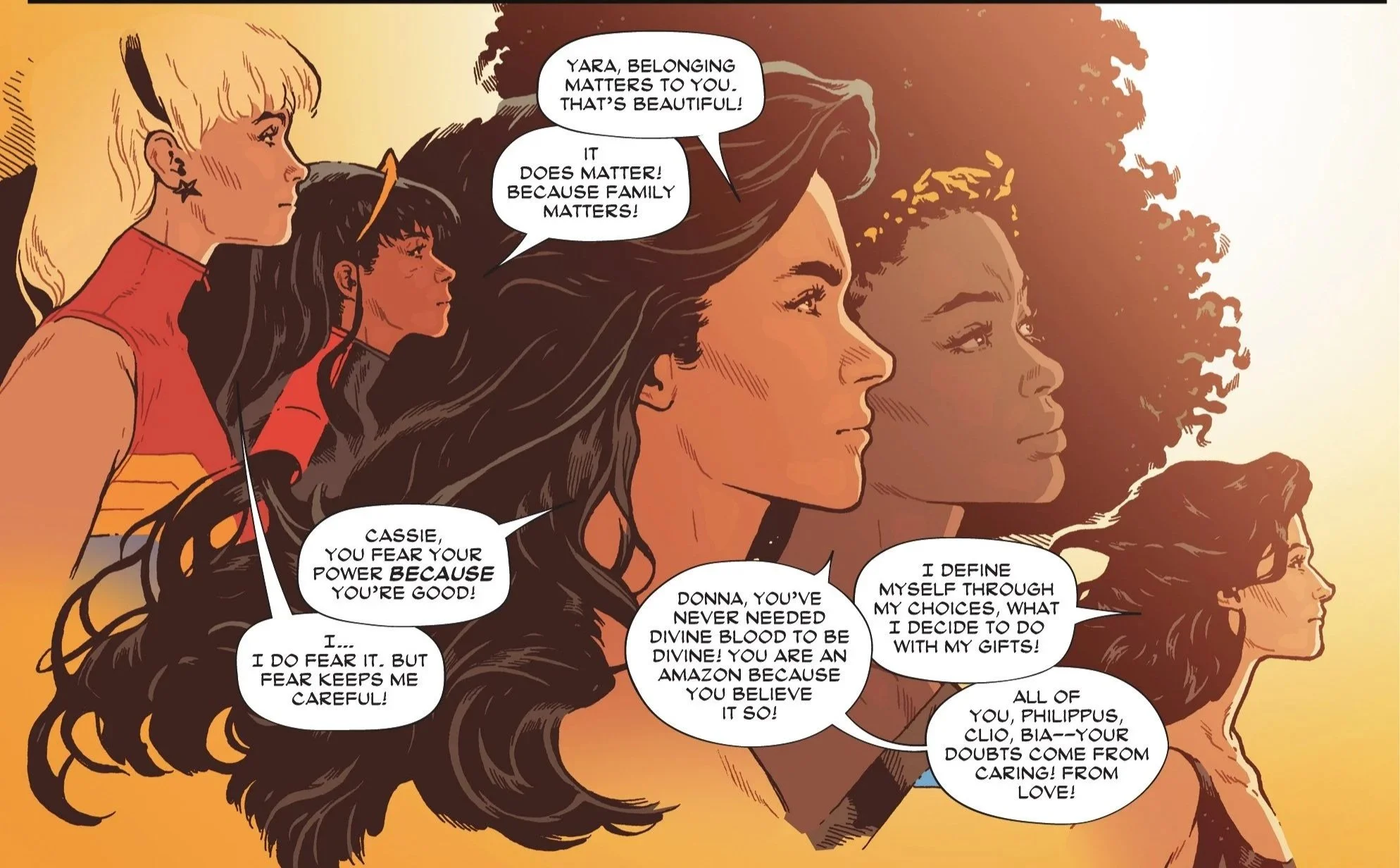
Diana tells each of her sisters why they’re stronger than their self doubts.
With universally relevant themes such as the strength and value of family, coupled with the affirmation that having self-doubts is not a sign of weakness, issue #30 of Wonder Woman is a great and refreshing positive change of pace. It serves as a departure from the heaviness of the ongoing title as of late and honestly works as a sort of preemptive salve heading into the Wonder War itself. That conflict will no doubt put the greatest heroine of comics through the wringer once more.