
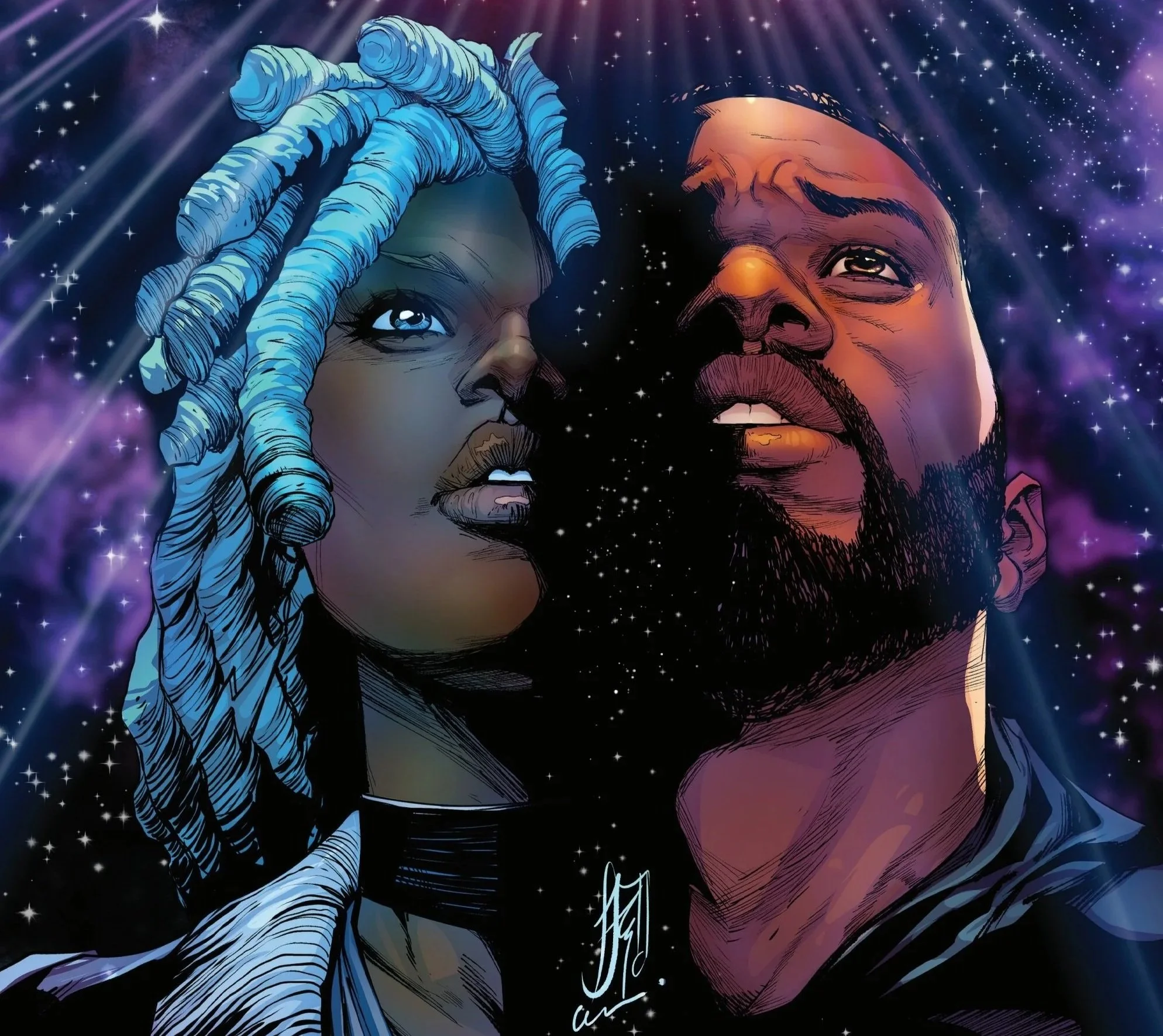
It has been two years since Ultimate Black Panther started its run alongside the rest of the revitalized Ultimate Marvel Universe. Far from smooth sailing, we have seen a lot of potential, some sparse great moments, and a whole lot of frustration along this journey. And now, finally, at the end of it all, with Ultimate Black Panther #24, we finally get an ending to the overarching Wakandan epic from Bryan Hill and company. The tale of the god metal of the nation, its hopes and promises being tied to a land at the mercy of mystic powers, and the potential to overcome it all, still stands tall by the end. This is true even if the road to get there has been uneven and bumpy, to say the least.
While the previous issue was all about the action, the tone of this one true finale is that of introspection. It is a quieter, more somber, and even hopeful ending than expected, even as an all too familiar and all new threat looms in the background. Nevertheless, Ultimate Black Panther #24 does manage to wrap up every trailing plot point from across the series in a more or less definitive manner. As far as finales go, while it may not be the most original or even the best, it is certainly satisfying for long-time readers of the series who get a sense of closure for several arcs. This remains true even if the potential for a far more interesting sequel or new story arc than what we got is teased and kept so firmly out of reach by the impending end of the Ultimate Universe.
Time As Testament
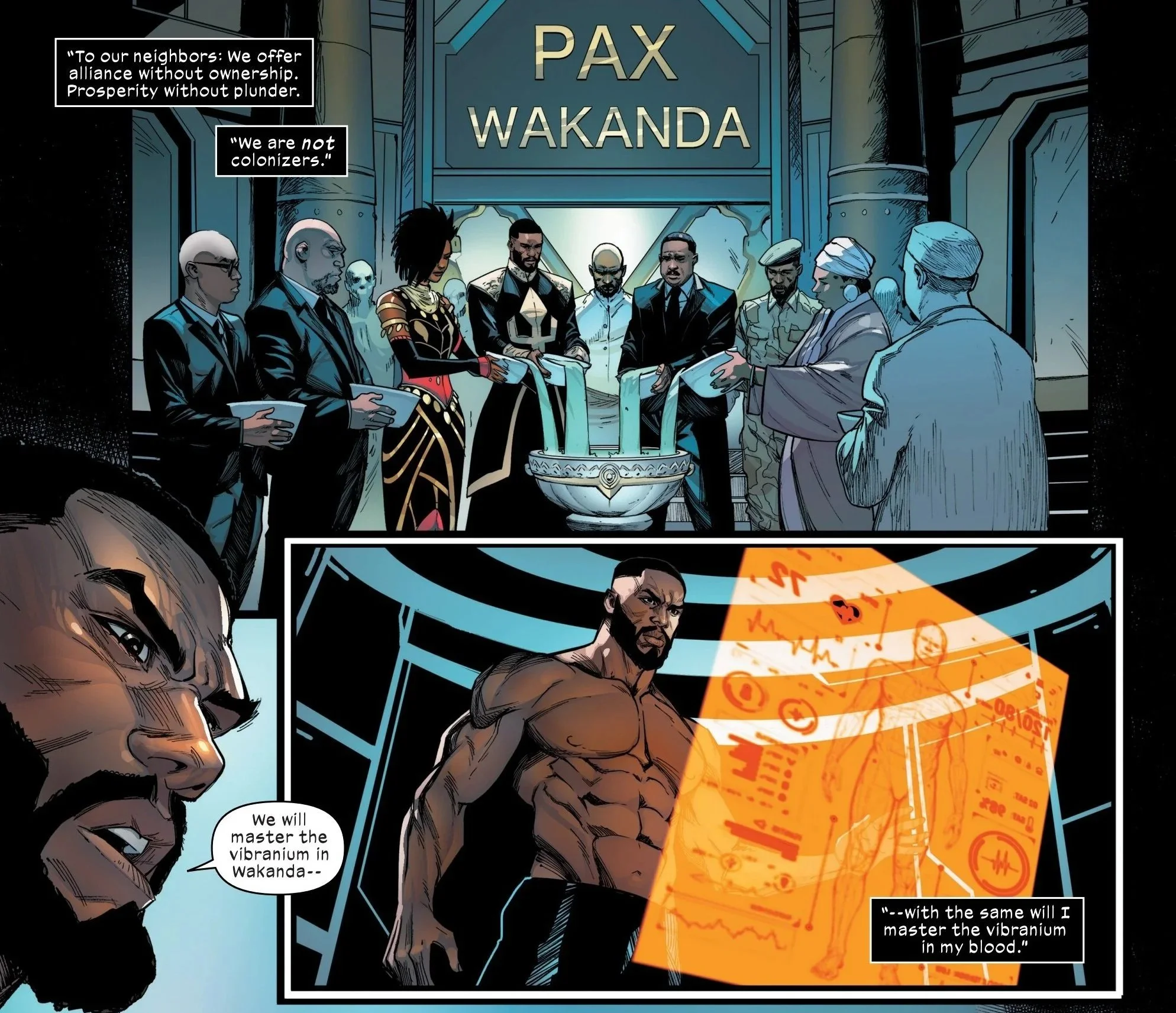
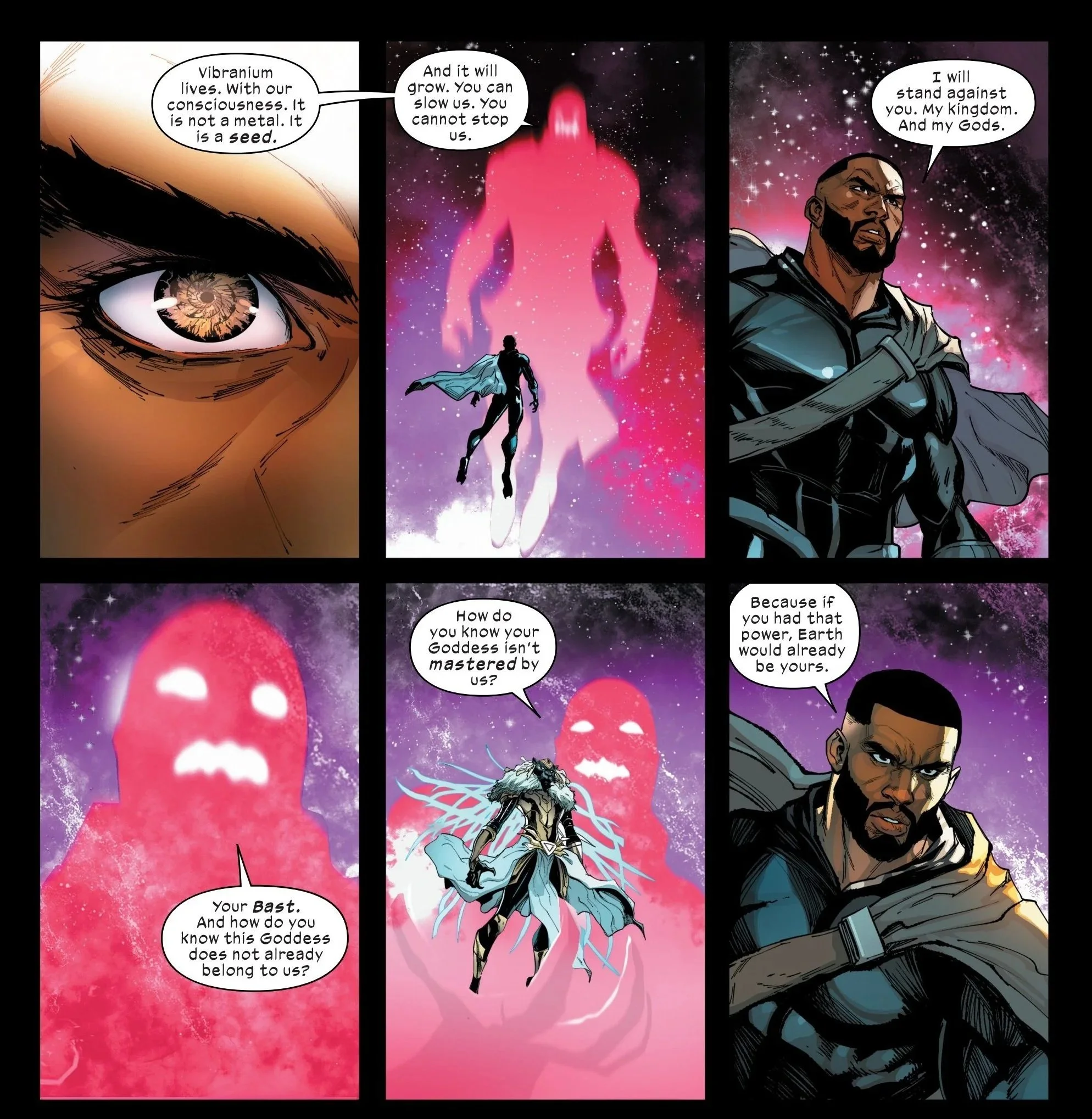
In a complete inverse from the more high-octane action of the previous issue, this book takes the action down and focuses more on emotion. T’Challa finally confronts the Progenitors on their own turf in their special plane of existence. With all the secrets of their power within the vibranium now laid bare, T’Challa offers the one thing he now believes in: peace. After everything he has suffered and fought through, he stays his rage for the good of the nation, even as he knows that the Progenitors will not honor these demands. And true to form, they do not.
Before taking his leave of the realm, T’Challa promises that even if he himself will not endure or play pawn to the greater prophecies of the Progenitor, Wakanda instead will be a rejection of everything the alien invaders stand for. And so it was written, and so it will be.
Following his escape from the realm of the Progenitor with help from the still alive but bodily deprived Sorceress Supreme, Inan, T’Challa gets to work over the months that follow. He opens up Wakanda to the world. He provides peace, shares resources across the continent, and ensures that cooperation, not isolation, is the new Wakandan ethos. This is a Pax Wakanda.
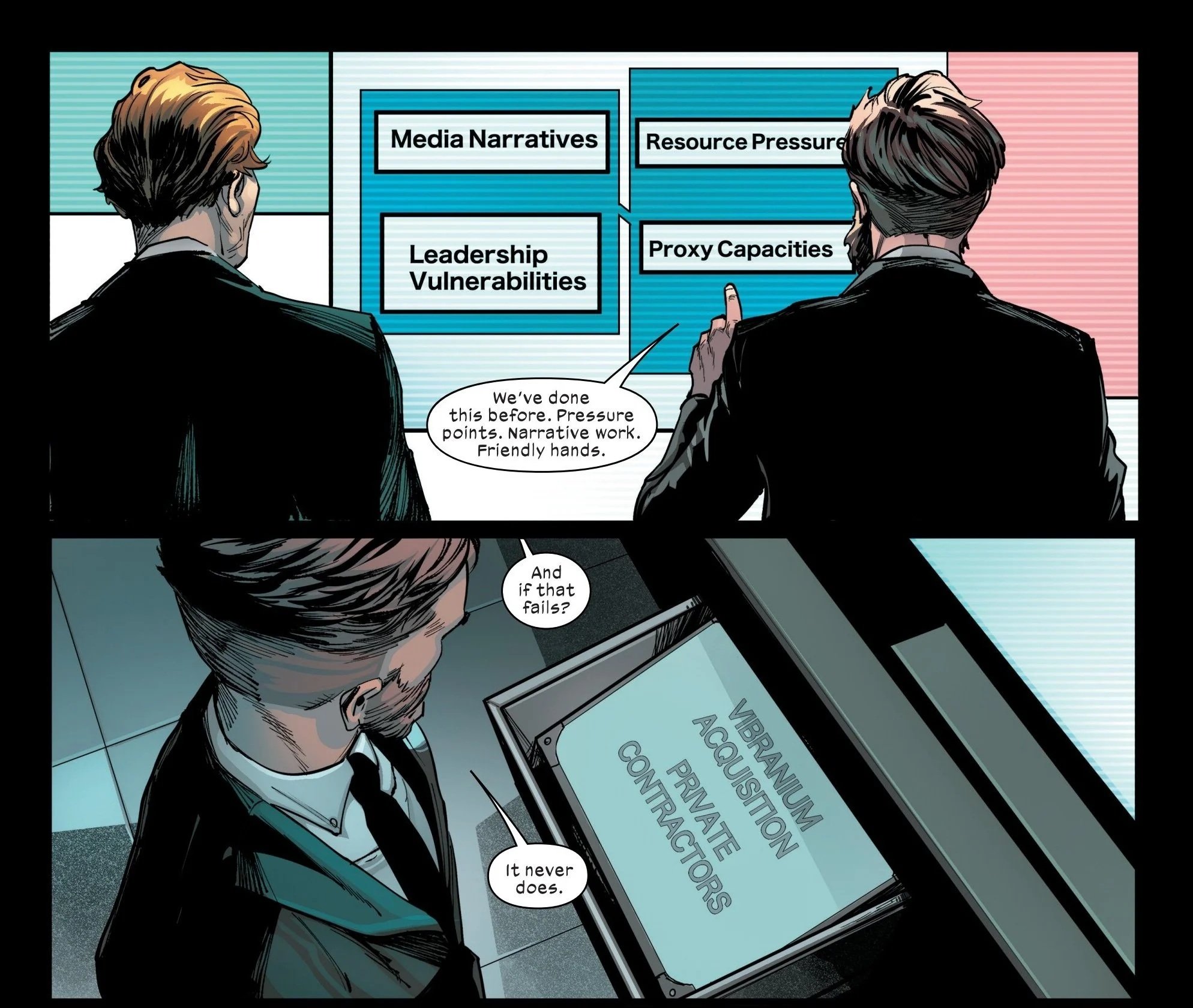
But even as Wakanda grows into a continental (and global) uniting force for peace, other, more nefarious forces from the old world order of the Maker are uneasy. The North American Union (true to its real-world counterpart) sees the balance of power shifting out of its control and seeks to crush the growth of Wakanda before it can happen. This is a genuinely tantalizing tease for a story to come that we might never even get.
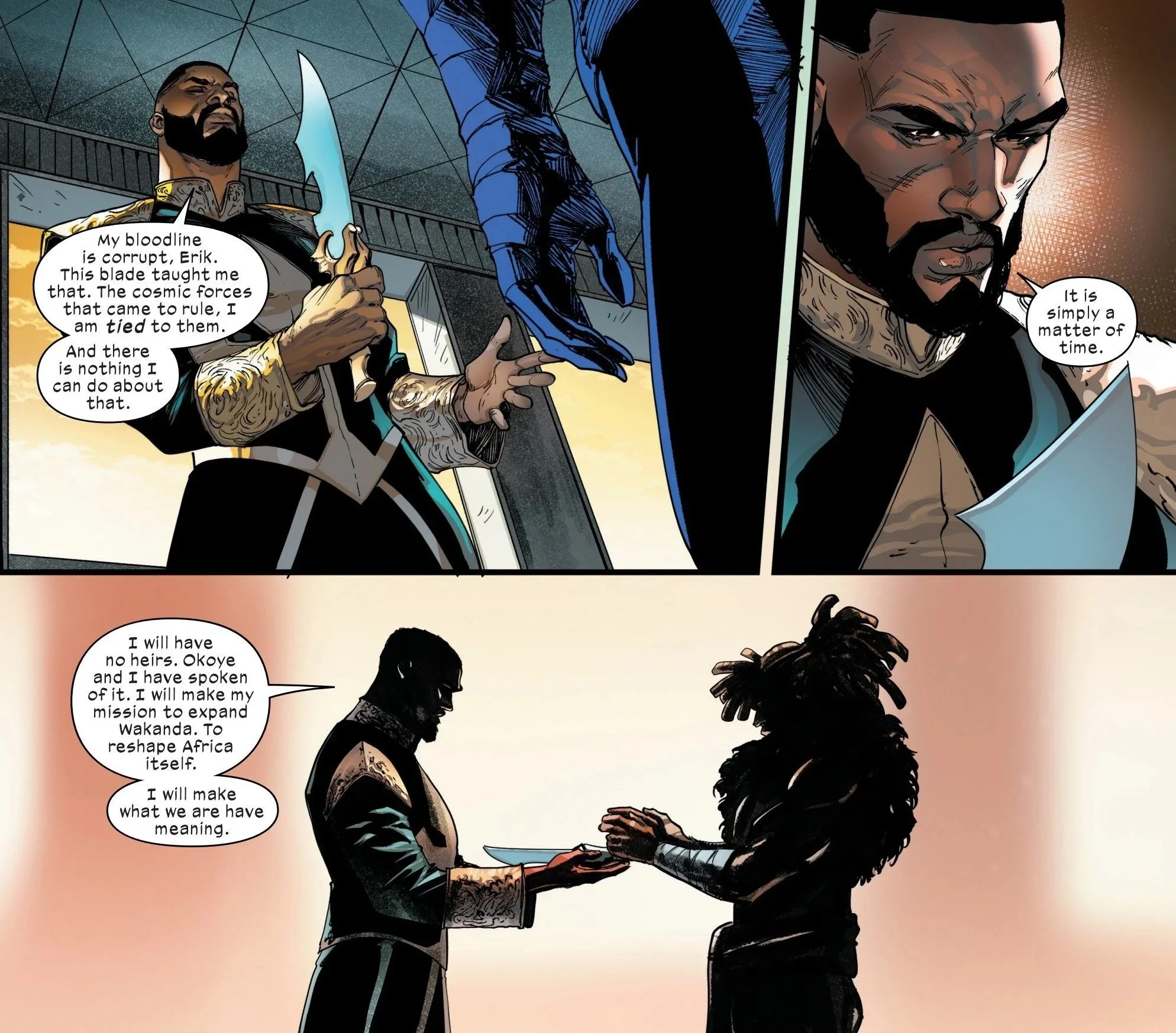
At the end of the book, and this series as a whole, T’Challa knows that he cannot rule forever and that the curse of the ties of his bloodline to the Progenitors will always be a looming threat to his people. So at the end of this book and this run, T’Challa does what he has always meant. To be no one man above the nation, he entrusts his close friend Erik Killmonger to make the ultimate choice for him when the time comes. For Wakanda. For the world.
A Promise Unfulfilled…For Now
For a series that has been truly plagued with horrible pacing and genuinely little differentiation from its 616 counterpart, Bryan Hill does hold up his end to bring the series to a close on a high note. Every single plot thread since issue one is comprehensively addressed, offering closure for anyone who was a day one reader and invested enough in the story. It is kind of admirable that this issue chose to forgo an all-out climactic battle in favor of a more stoic, yet utterly hopeful ending, even if that hope is promised to be fleeting. T’Challa choosing to throw away the arrogance of isolation and embrace an open world of cooperation is great after everything Wakanda has been through, even if the plot feels like (once again) a retread of old Black Panther story arcs.
The confrontation with the Progenitors at the start of the issue, while visually striking, is also narratively rich. It presents the idea that T’Challa chooses one last attempt at peace before making his plans to thwart these seemingly godlike entities. It is very in-line for the character, showcasing a resolve that makes him so beloved across generations, especially in the face of annihilation. Against the odds, he is always ready to remain unblinking and come out ahead. And the best part is he does this through unity, not force. This is the complete anathema to the overarching lust for conquest of the Progenitor. T’Challa, as he rightfully puts it, refuses to be the colonizer that these alien gods demand him and his nation to be. He refuses to be a slave to vibranium, a slave to his base impulses, or a slave to conquest. T’Challa spiritually, literally, and cosmically rejects all of this. He instead chooses to forge a nation beyond closed borders to create a world order that extols unity more than anything. It is an uplifting message, even as deep down both the readers and T’Challa know that even this will come at a cost.
While this is an issue strongly focused on time, legacy, and building systems that carry forward the good work long after good men have faded away, a scene in particular at the end stands out. T’Challa and Killmonger are just talking, with T’Challa seeking the aid of Killmonger for a task that even he cannot do on his own. I cannot honestly say this moment is earned because I genuinely wish both these characters had a deeper relationship in this run. However, the moment T’Challa trusts the sense of duty of Killmonger enough to tell him that only Killmonger can be relied on to end the curse of the Progenitor in the most final way possible is pretty satisfying. It is a great way to end this entire book on a pointed note, and it is a moment that is sure to leave a lasting impression.
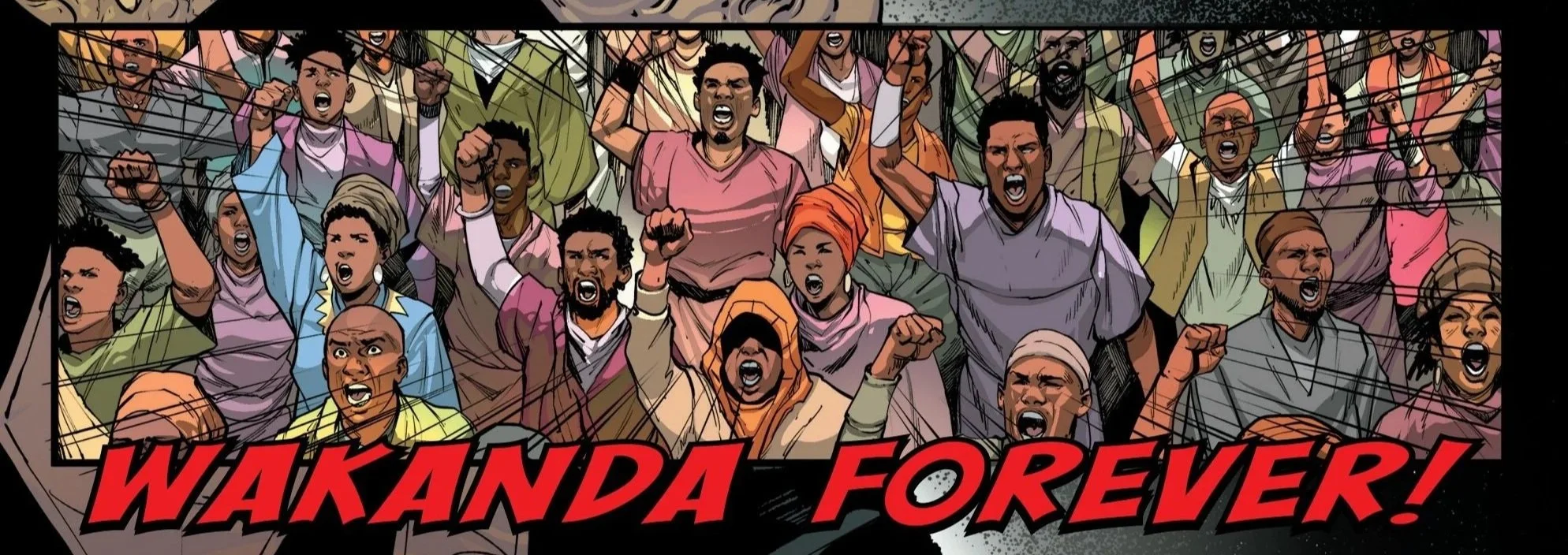
However, even this finale leaves some sore spots in the end. Despite such a strong focus on Wakanda expanding and growing, the overall tale of Ultimate Wakanda and its King is still a familiar beat, just in fast-forward. While the living Vibranium may have been an original concept, it is still wrapped up in a "rah-rah" feel-good ending that we have seen repeated over decades in Black Panther media. Even the entire focus on "Wakanda Forever," though thematically resonant in the narrative of this finale, still feels like the echoes of playing nostalgia hits to elevate things in a slightly undeserving way. It is ironic if you think about it. For a story that is so set on looking toward the future, Bryan Hill still chooses to root his story in the quagmire of the past while preaching a future that is going to end along with the Ultimate Universe.
Truly, the greatest travesty on this front is the overarching tease of the North American Union now interfering in the growth of Wakanda as a global leader. This promise of a story that is actually compelling, that feels like something that hits a little closer to home, is frustratingly out of reach. This is especially true when you consider the rhetoric used by the agents of the Union to both describe Wakandans (racist rhetoric that we are sadly all too familiar with) as well as a host of contingency plans to effectively shatter the nation in a myriad of geopolitical ways. Those are all storylines that are, honestly, far greater than almost anything presented in this run as a whole.
Whether it was by the own choices of Hill or editorial cutting out his creative license to develop this in future arcs, the fact remains that it is personally infuriating that anyone on the creative team thought that teasing something of this scale and social relevance in the final issue of the series was something acceptable. It is honestly almost criminal that one of the only truly original and compelling ideas and the potential it held was strangled in the crib for twenty-four issues of lazy nostalgia bait.
A New World, A New View
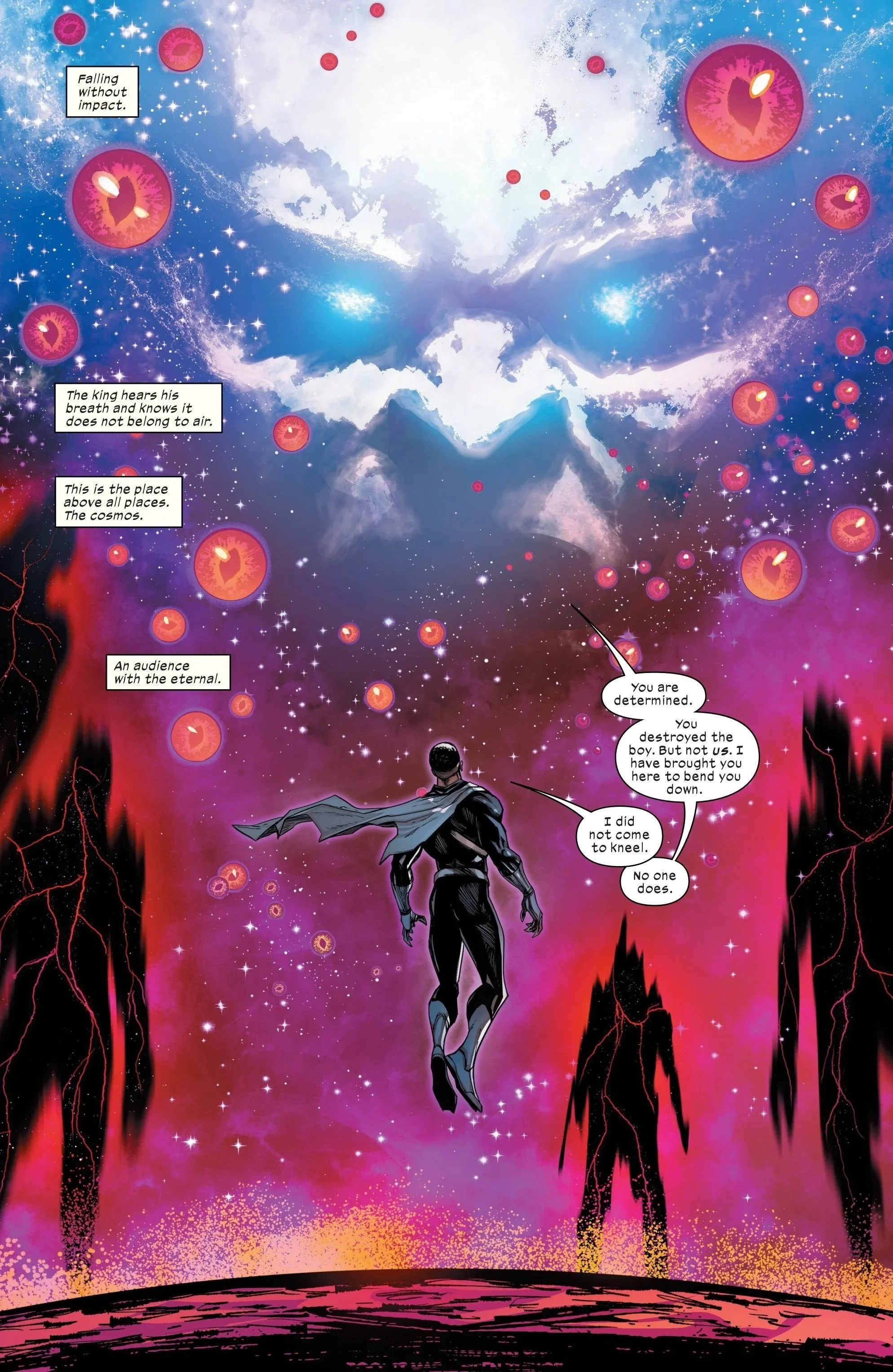
Unlike the story, however, the art by Stefano Caselli is locked in and ready to play like it is the Last Dance. Take it as hyperbole or do not, but Caselli presents his best work of the series here. He shows that he excels in repose as much as he does in action. There is a truly grand and cosmically uplifting quality to the art, presenting both the alien and the material with equal awe and respect. Both kingdoms crafted by mortals and gods are given the distinct visual identity they embody.
The eldritch nature of the realm of the Progenitor howls with power and mystery, just like its inhabitants. And when T’Challa stands across from these profane horrors, you can still see in the visual language alone that even as a man, he is still mighty. This remains true even in the face of the divine. In short, it is aura-maxing to the extreme, and I am all here for it.
Meanwhile, the building of the continent-spanning ambitions of Wakanda is presented as truly awe-inspiring yet calculated. The will of T’Challa is emphasized through decisive visual action, with each act of nation-building shown with equal action from his allies to realize that goal. Whether it is the ghostly new aspect of Inan, the weather-powered magic of Storm bringing rains to colonies suffering from drought, or Wakandan agents of every stripe operating across their own specialized objects around the continent, the sense of scale is there for the eye to see and truly appreciate.
Every character is drawn at their best, and Caselli truly excels at capturing facial emotions and body language in a way that is just so compelling.
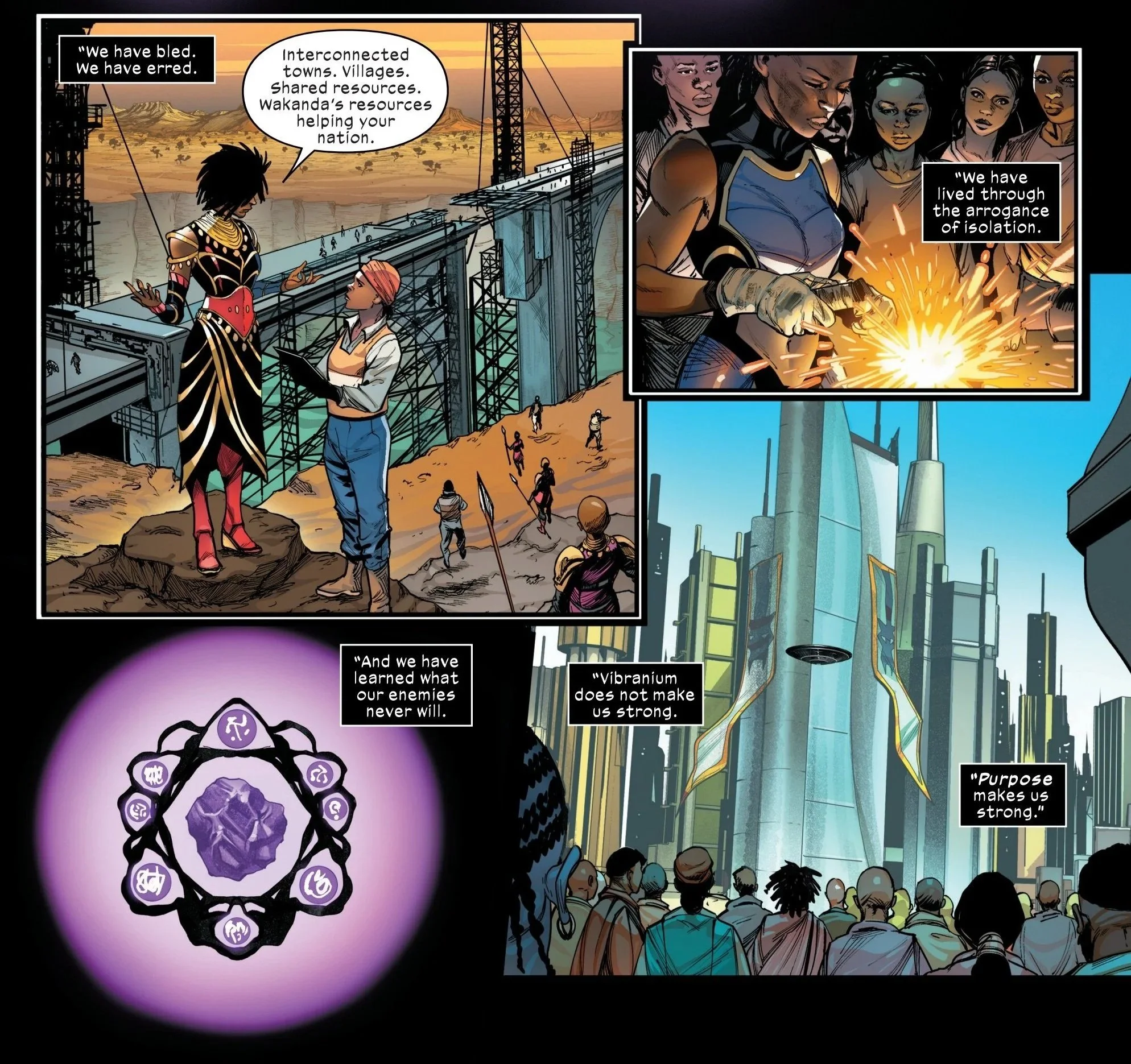
Rounding out the art are the impeccable colors by David Curiel, who uses a wild kaleidoscope of palettes across the length of this issue. From the raw energies of the realm of the Progenitor to the gilded majesty of the evolving empire of Wakanda, this is a book that is beautifully rich and bathed in its own unique hues that are fitting for a world that blends both the magical and the cosmic.
That being said, there does seem to be a hiccup of sorts with a seemingly unfortunately labeled map of Africa that shows certain countries not being where they are supposed to be. Is this a shoddily overlooked art and information faux pas, or is it just how things are in this Ultimate Universe? We will let you and the memes decide.
A Nation Robbed of Meaning
We cannot say if there will be a comeback. For right now, Ultimate Black Panther #24 (for better or worse) is the swan song of an epic story spanning two years. With some high ups and some truly abysmal downs, it is far from perfect. However, for the most part, like all cats, it lands on its feet in the end. There is hope at the finish line, and there is legacy and loss. All of these are certain to keep readers glued to the story of Wakanda and how that is visually represented here, which is genuinely beautiful.
What is both saddening and infuriating remains with everything left unfulfilled. With this issue and the things it promises in particular, it feels like so much was stolen from readers. It is the promise of this whole other, better series that chose to push boundaries without being nostalgia bait. Much like the final issue itself, it is hope that is tainted. This time, however, it is tainted by the follies of wasted potential and editorial suffocation rather than alien gods buried in corrupting metal.
Final Verdict: Ultimate Black Panther #24 is the purrfect ending to an otherwise imperfect run, establishing some compelling story beats while promising and then also robbing readers of something far greater in this swan song.