
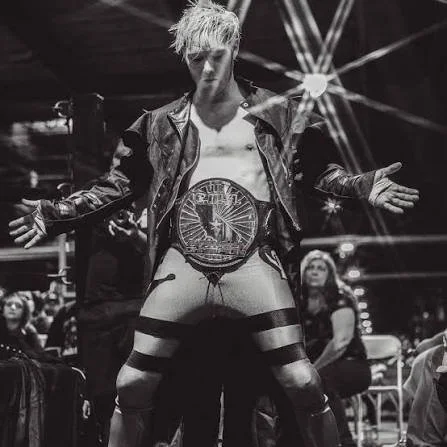
I like a great story as much as a great match, and Hoodslam is another promotion putting narrative in the center of the ring. For 16 years, the Oakland company has defied the notion that indie wrestling should look and feel like a small-scale version of the major televised productions. Daniel Torch, who currently wrestles there as Daniel T, knows that better than most. I got a chance to talk with him about his work with the bombastic Bay Area promotion, how it has changed over the years, and why some of its most devoted fans aren't really wrestling fans anywhere else.
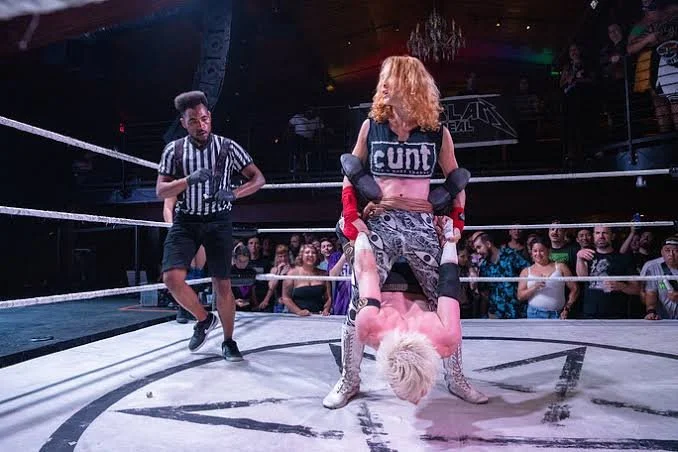
DARK Sheik, Hoodslam’s founder, sets up an opponent for a piledriver during a Hoodslam show
Dark Sheik founded Hoodslam in 2010, initially gathering wrestlers at Victory Warehouse for shows built around creative freedom and adult content. She was interested in ideas that didn't fit in with other promotions. Hoodslam quickly outgrew the Victory Warehouse and moved into the Oakland Metro Opera House, becoming part of the city's vibrant First Friday night life. Wrestling shared space with drinking, smoking, burlesque, and sideshow performances, plenty of profanity, and lots of oddball characters.
That reputation still follows Hoodslam, but veteran wrestler Daniel Torch says thinking of it only that way misses what the promotion has become. Torch has been wrestling around Northern California for more than fifteen years, and he’s followed Hoodslam from pretty much the start. Initially, he stayed on the outskirts. Straight edge and quiet, he was uninterested in smoky rooms packed with drunk folks. That version of Hoodslam didn't feel like his natural habitat. However, a venue change, which brought with it a no-smoking-inside policy, convinced him to take a closer look.
His first real foothold as a character came when Hoodslam needed somebody for a funeral. Torch remembers being told, “You're an emo kid; you love the dark. So he showed up, did the segment, and got invited back for three more dates. Soon he found himself alongside Rob Hands and Brooke Havoc during one of Hoodslam's periodic storyline resets. Dark Sheik's creative direction for him was less about inventing a wrestling gimmick than stripping one away. Stop asking how Torch the Wrestler would behave, essentially, and react more like Daniel actually would.
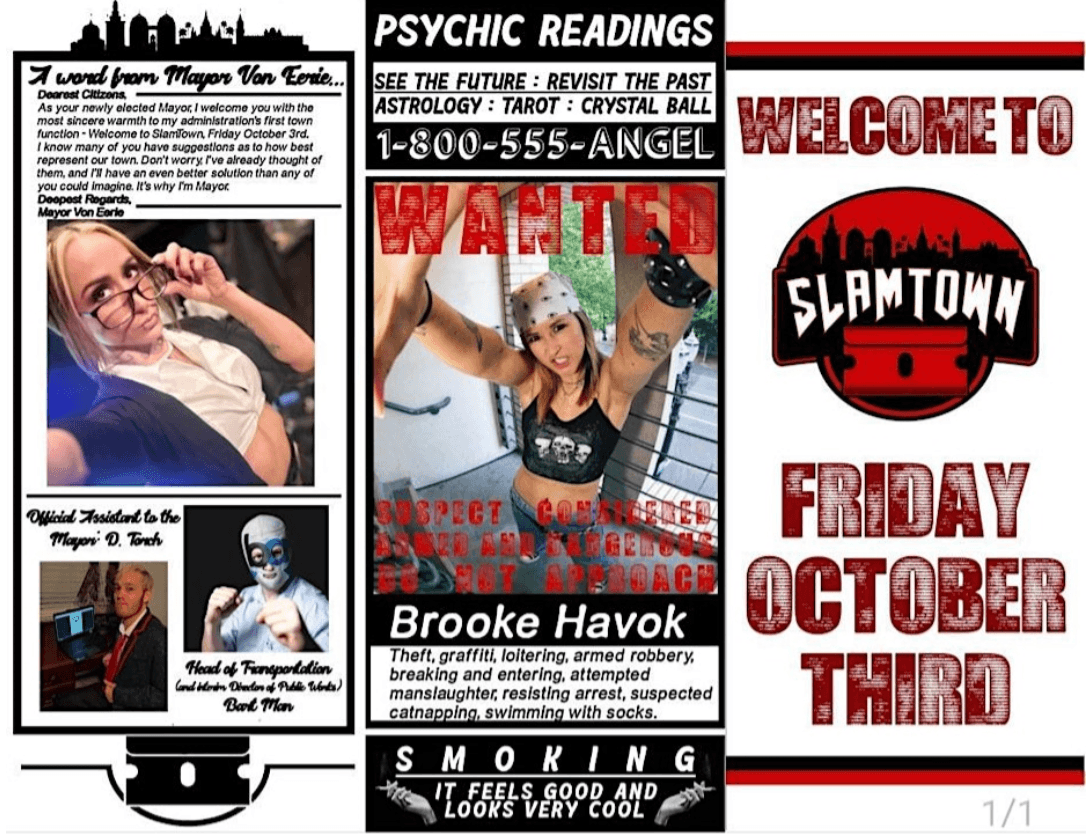
Promotional flyer for a 2025 event featuring Mayor Von Eerie and Brooke Havok.
That took some adjustment. Torch was accustomed to independent wrestling shows where the assignment was largely to go out and have a great match. He told me the match still matters, but Hoodslam might instead give him several story points that needed to land on a particular night because they mattered next month. Sometimes the wrestling is the center of the segment. Sometimes it's the mechanism that propels the storyline. More often than not, it’s both.
“Hoodslam has a Hoodslam crowd,” Torch said. Its fans will follow the story wherever it goes because they’re already invested in the characters and the world around them. Torch describes Hoodslam as “very comic book,” and that world has only become more elaborate over time.
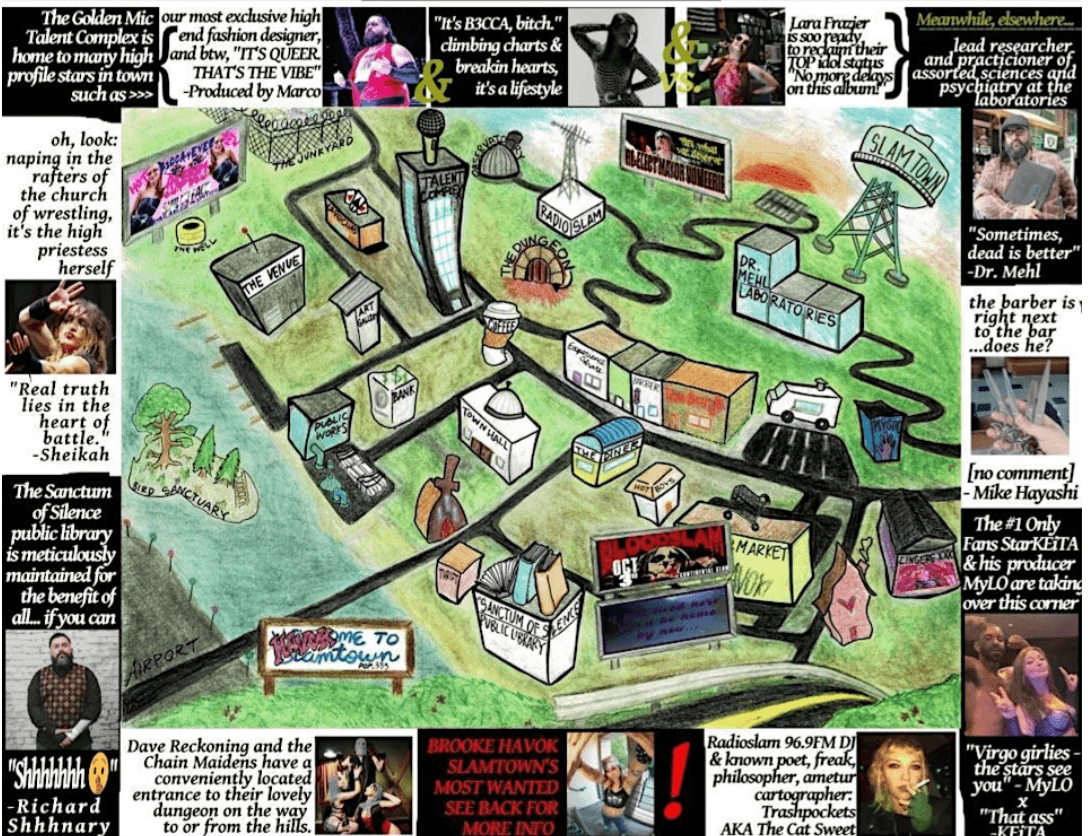
Hoodslam's current mythology centers on Slamtown, an alternate reality populated by distorted versions of existing Hoodslam characters. Anton Voorhees claims to remember another world, and Brooke Havoc becomes a graffiti-tagging hoodlum. Dave Reckoning runs a dungeon that’s also a bar. Richard Shhhnary tended the library. Dr. Mehl and Prisoner 420 eventually recovered memories, which allowed the pair to re-identify themselves as the Stoner Brothers. Other characters have slowly begun to realize something about their reality is distorted, with some catching glimpses of their past lives.
The current municipal government is one of SlamTown's major factions: Mayor Von Eerie, her SlamTown Justice Security Force, and Daniel T (Torch’s SlamTown identity), a perpetually overworked assistant to the mayor. Hoodslam’s site describes Daniel T as overworked and asks that you please be nice to him.
In that same comic-book style, people die, return, change identities and slip into alternate timelines. They also wrestle, occasionally because a supernatural or bureaucratic problem requires the kind of solution that can only be delivered with a powerbomb. The absurdity works because Hoodslam hasn't abandoned the wrestling underneath it.
Torch has watched the promotion move through several phases. The earliest warehouse shows were essentially wrestlers experimenting and entertaining themselves. Burlesque and sideshow acts later became part of the attraction. Torch says those elements helped bring people through the door, but the wrestling is what kept them around. Over time, Hoodslam itself became the draw: “The wrestling and the Hoodslam is why people are coming back,” Torch said.
The promotion has built enough loyalty around its characters and stories that the old party atmosphere no longer has to carry the show. In fact, some of Hoodslam’s regulars barely seem to belong to the larger wrestling ecosystem at all.
Fans crowding the ring during a live show in Oakland
Torch says he routinely meets people who don’t follow wrestling but know Hoodslam, and he sees fans at Hoodslam shows who never turn up anywhere else. Some are wrestling fans who happen to love Hoodslam. Others are simply Hoodslam fans. For them, Hoodslam isn’t a gateway to wrestling. It’s the destination. Torch describes that last group as “I just go to Hoodslam” fans.
For a promotion whose long-term slogan is “Fuck the Fans,” it has built an unusually committed collection of them, making it a particularly good recommendation for people who like the idea of wrestling more than they like conventional wrestling television. The obvious audience includes fans of comics, anime, horror, queer performance, punk, and DIY art. It's for people who like elaborate characters and stories and are willing and eager to set realism aside. The promotion has always made space for queer and trans performers, intergender wrestling, and characters who would have been flattened into stereotypes or simply excluded in more traditional environments.
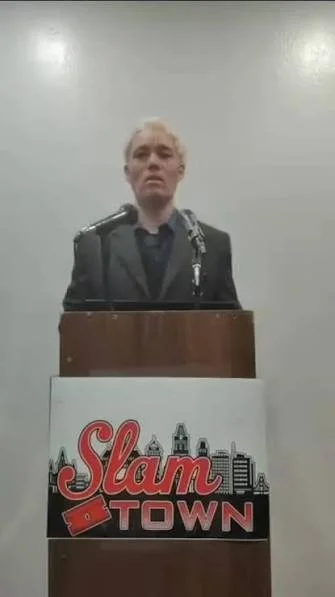
The overworked assistant to the mayor of SlamTown, Daniel T
This is a good promotion for that one friend who’s decided wrestling isn't for them. Torch says Hoodslam sometimes has to approach its audience differently because not everybody in the room is a wrestling fan. A spectacular sequence of moves means less if the viewer has no reason to care who's doing them. That's true throughout wrestling, but especially at Hoodslam.
“If they can identify with the character,” Torch said, “they're gonna attach to that faster than the wrestling.”
Fans who want their indie wrestling built primarily around great matches, recognizable feuds, and familiar wrestling logic may find Hoodslam a little hard to settle into. Hoodslam can deliver excellent wrestling, and often does, but it doesn't pretend that every match exists primarily to produce the best possible star rating. Sure, sometimes the point is the physical fight. Other times, though, the point is a man dressed as Sherlock Holmes needs to beat somebody into a position where he can interrogate him with a magnifying glass. Torch has done that too. Plenty of wrestling companies would consider that a problem, but at Hoodslam it's the show.
Hoodslam: How to Watch
Hoodslam/SlamTown: Revelations 8:28
When: Sept. 1, 10 p.m. ET / 7 p.m. PT
Where: Continental Club, Oakland, California
Where to watch: TrillerTV+
Revelations 8:28 was held Aug. 28 at the Continental Club before its Sept. 1 streaming premiere. TrillerTV lists Anton Voorhees, Lara Frazier, Ricky and Scotty Stoner, KEiTA, Dave Reckoning, Cooper Contra Costa, Sheikah, Daniel T, Sheriff Boone, Deputy Regular Rob and SlamTown Justice among the featured performers.
Revelations 8:28 is a good entry point for newcomers because a lot of the story revolves around characters trying to understand SlamTown itself.
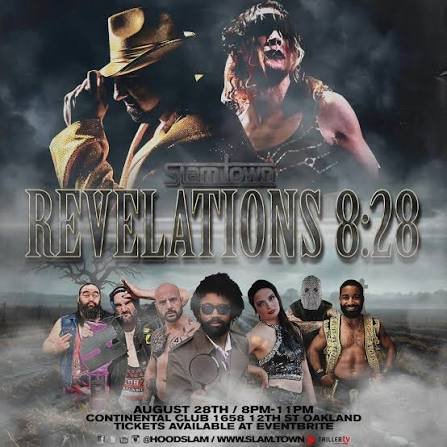
Wrestle Detective Cooper Contra Costa has been following a progression of increasingly strange leads. First, Anton Voorhees showed up claiming to come from another world. The Stoner Brothers recovered memories of previous identities. Sheikah wrote a banned book whose readers supposedly went mad after finishing it and were committed to the Asylum. In typical politician style, former Mayor Mike Rayne seems to know more than he’s letting on.
All those clues point to the same mystery. Residents remember another reality, and one word keeps surfacing from the alternate plane: Hoodslam.
Jenny Catlin is a writer from the Square States, covering racing, pop culture, professional wrestling, country and western, and glam metal music, obsession, sex, pornography, the real working class, indie press, and other obsessions. An award-winning essayist, she is a contributing writer at The Athletic and Denver-based Denverse Magazine. Find her on Substack and Instagram.