
Sin City was the destination this week for the general managers of MLB to meet, bringing with them the chaos of the baseball world. Will teams make any big splashes before MLB goes on lockout on Dec 1 or are they, like us, waiting to see what this sport looks like on the other side? Friends of the Comic Book Clique, it’s the MLB Weekly Report!
Let’s start with some Immaculate Grid fun:
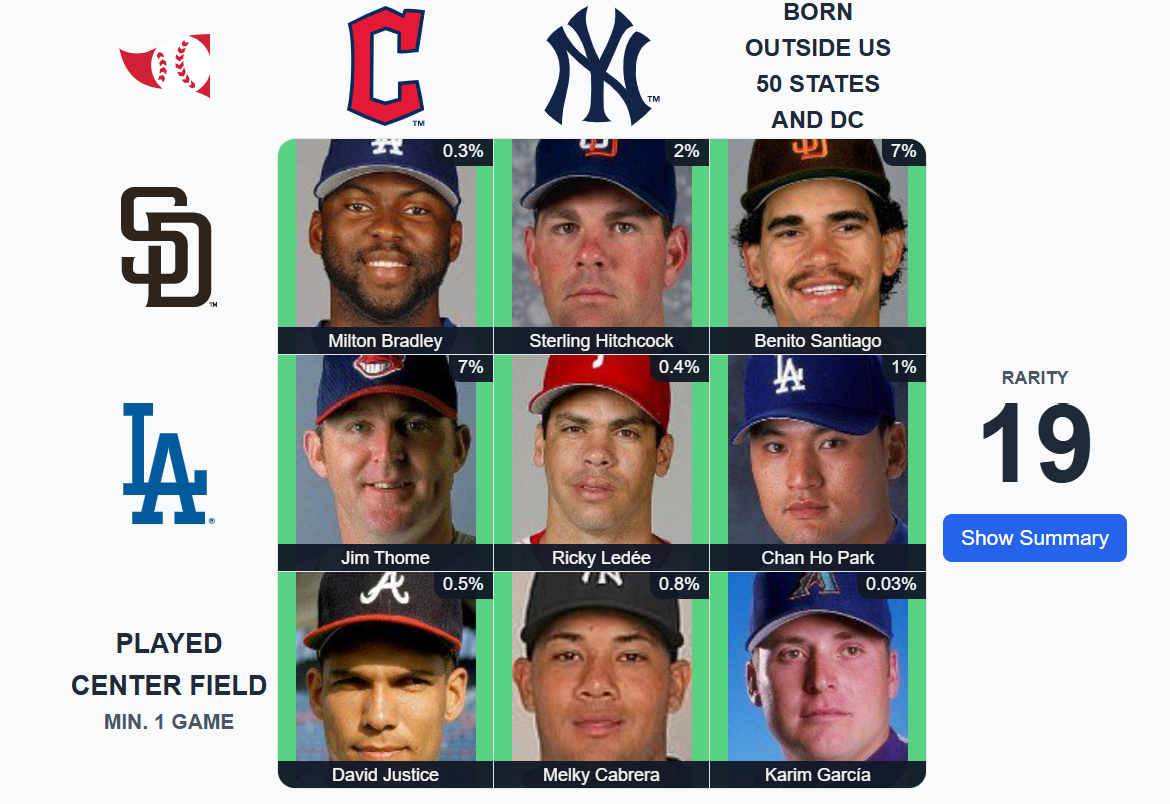
I always get a big kick out of answers that run two decibel points long - shout out to Karim Garcia. Steam was lost trying to figure out a Padre born outside of the U.S. without going very obvious so shout out to my fellow countryman, Benito Santiago!
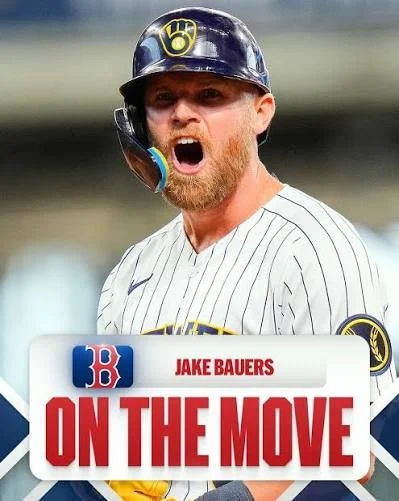
Image provided by MLB
The GM Winter Meetings took place this week in Las Vegas, Nevada and this busy week often produces the blueprint for free agent signings and trade frenzy we see in an offseason. With everyone’s least favorite L word not too far down the calendar, it’s much easier to believe teams will take the “wait and see” approach. Why commit to any contract without knowing how that contract is going to count against your payroll under whatever the new agreed upon terms between MLB and the Players Union will be?
That hasn’t stopped some teams from making moves to improve their roster and we even get a little “breaking news” as a free agent signing just dropped in the middle of me writing this article:
Boston nabs Bauers
First Baseman/Outfielder Jake Bauers signs with the Boston Red Sox on a four year, $58 million deal. The NLCS MVP goes to Boston having experienced career highs in just about every major offensive category, especially in on-base percentage (.389), slugging percentage (.484), OPS (.874) and on the production side with 26 home runs and 86 RBIs.
He’ll split time at first with Willson Contreras but likely DH in most games. His skill set, or maybe lack thereof, in the outfield likely won’t be showcased too often given that the Red Sox sport one of the better defensive outfielders in all of baseball.
However, the Red Sox aren’t signing Bauers for his glove. They’re signing him for his ability to get on base, an attribute we’ve seen over the last two regular seasons and this past postseason that is a major positive. On top of that, in the hitter friendly Fenway Park, Bauers should be able to match his overall production. This roster as-is does a decent job of getting on base, ranking 12th overall and adding Bauers should make them an easy top 10 team in this regard. What’s a little more concerning is the lack of production, ranking in the bottom ten for home runs and RBIs as a team. Home runs are not the defining characteristic of a good offense, the Brewers had less home runs than the Red Sox and we know how their story ends. The Brewers were second in RBIs and capitalized on their opportunities, including Bauers and his 62 RBIs with runners in scoring position, which would’ve led the Sox last season.
Overall, this is a solid signing that has upside, especially if Bauers can replicate his production from both the regular and post season. I don’t think the Red Sox are close to done as they have checked in on outfielder Seiya Suzuki and I imagine will be checking in on Randy Arozarena, and that’s without mentioning that they’ll be in the market for a starter.
A pair of relievers sign quick:
The first notable signing of the offseason came from the Detroit Tigers, signing right-handed reliever Emilio Pagan to a one year, $11 million deal this past Tuesday.
Pagan has spent the last three seasons with the Cincinnati Reds as their closer to varying degrees of success. His first season there was by far his worst and the following season, 2025, was his best. He spent a third of the 2026 season on the injured list with a nasty looking hamstring strain occurring in May but looked great in the second half of the season once he returned, collecting 18 saves on a 1.71 ERA over 26 ⅓ innings.
AJ Hinch and the Tigers will be looking for that second half Pagan to give the ball to at the end of the game, replacing future Hall of Famer, Kenley Jansen. This may not be the big splash pitcher Tigers fans really wanted to see (back), this is a decent piece to help a bullpen that was fairly average and wasn’t striking a ton of batters out, something Pagan does well.
In the NL, the crown jewel of the east Atlanta Braves gamble on a three year deal worth $35 million with Evan Phillips. Coming off Tommy John surgery in June 2025, Phillips returned to the Dodgers this past July for the second half of the season. He didn’t pitch terribly — a 31% strikeout rate over 26 innings, a 3.46 ERA, he did well.
I expected Phillips to sign but I’m not sure I expected him to sign so early. Ranked by bWAR last season, there are 36 relievers who all had higher production. And sure, for the Adrian Morejon or David Bednar types, they should and will wait for the market and its first few signings to help indicate what their contracts should look like. But if we’re reaching that low into the barrel and spending $12 million per year, I’m afraid to see what the rest of the class looks like. On the other hand, all I’ve ever done is try and doubt the Atlanta Braves and in return they’ve won 22 division titles and 2 World Series championships in my 35 year existence.
The Rest of the Hot Stove
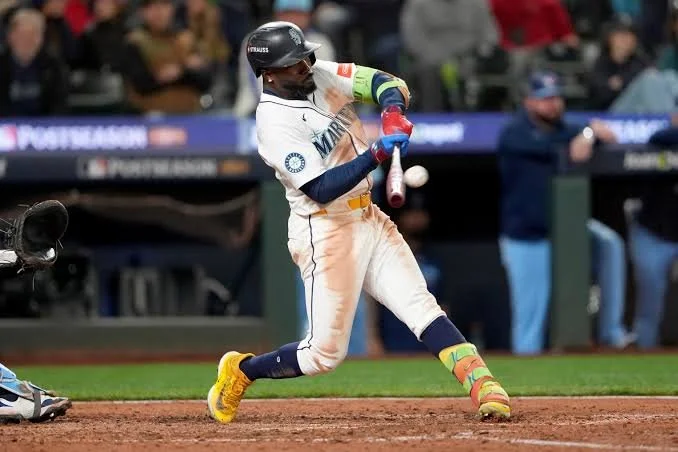
Right now, the rest of the hot stove consists of just about everyone but Jake Bauers. Tarik Skubal has six teams vying for his attention and, more importantly, his talents: The Los Angeles Dodgers, New York Mets, San Diego Padres and Toronto Blue Jays are the confirmed teams, with two mystery teams in the mix. For my money, I believe those mystery teams to be the Detroit Tigers and the Texas Rangers, more on the latter in a moment.
I still fully expect the Skubal sweepstakes to come down to the Dodgers and Mets. Even with new ownership looking to make an impact, the Padres have been throwing money at their problems since they gave Eric Hosmer $144 million back in 2018 and they’ve got nothing to really show for it; except more problems! I believe the Padres will be more calculated on who they spend their money on going forward. The Blue Jays, as always, will end up with the silver medal in free agency prizes, something they seem to share with the San Francisco Giants and the Tigers, as poetic as it would be, won’t push all their chips in.
That leaves us with the usual suspects and the mystery team Rangers. With their GM, Chris Young, exploring possibilities of trading some of the top heavy parts of their payroll, moving either Jacob deGrom or Nathan Eovaldi could go towards netting Skubal. Ultimately, I don’t think the Rangers will be trading either of those arms. Between getting the right package and either invoking their no-trade clause, it’ll prove to be difficult to get those deals done. The Rangers might be better for it, deGrom has shown to be healthy the last two seasons and Eovaldi might still have enough in the tank to get through one last season. Oh, and the usual suspects? They’ll just be bringing their checkbooks for Scott Boras to pick whose numbers look more crooked.
The most top heavy piece of the Rangers payroll belongs to Corey Seager. While he may not be making as much as deGrom is, his contract runs longer, all the way until he hits age 38 in 2032, making $31.5 million in each year. With 5 years, $155 million left on the contract and a no-trade clause to look out for, somehow, the first potential suitor has risen: The New York Yankees and that little league park sweet right field porch. As reported by Jon Heyman, the Yankees and Rangers have had talks and similarly to what I was getting at above, trading Seager could be more than a means to just bring the payroll down.
Trading Seager would put the Rangers in a position to comfortably go after a top bat like Seiya Suzuki, Randy Arozarena or Teruaki Sato. Signing the latter would be the highest risk as the formers are known commodities at the MLB level. What it would give them is a touch more flexibility in payroll, with Sato’s contract set to not be as large as either of the big bats on the market. I can’t repeat this enough, trading any of the Rangers top contracts will not be easy but they do seem at least ready to strike on big free agents, if they can. This team was fighting for a playoff spot in game 162 and may not need much to push them over the edge.
Those three names, Seiya Suzuki, Randy Arozarena and Teruaki Sato, are currently three dominoes standing in a line behind each other. Their markets all, relatively, look the same with the only difference being in Sato’s experience playing third base as well as the projection that, like Munetaka Murakami before him, he could end up a first baseman. The Phillies have been heavy favorites to land one of them with the Cubs, Mariners, Mets, Yankees, Red Sox and Rangers all right in the mix as well.
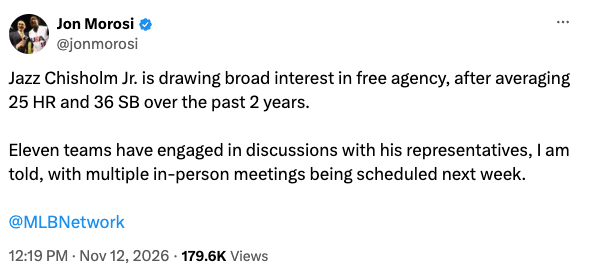
In the infield, the hot stove is heating up for Brandon Lowe and especially Jazz Chisholm Jr, as reported by Jon Morosi:
For Lowe, a reunion with the Pirates is on the table. A qualifying offer was extended so Lowe could accept the $23.15 million standard for this year and potentially work out a longer term deal with them after, something both teams are reportedly interested in. He could also decline and other teams, like the Blue Jays, Phillies and Yankees could squabble over what draft picks they’d be willing to lose to obtain the mighty, left-handed bat of Lowe. Hitting 30 home runs for the third time in his career was expected but the improvement defensively at second base is the more impressive part about his 2026 season. With the ability to have more of an effect on both sides of the game, Lowe could grab himself more years and money on his contract. To no surprise, I would love it if Lowe decided he’d like to suit up for 81 games a year at Citi Field, as much of a pipe dream it might be.
As for the former “MLB The Show ‘23” cover athlete, Jazz Chisholm Jr., his market is exceptionally hot. While he has the ability to set rather lofty goals , both defensively and as a baserunner, he ranks fairly high. With his +15 Outs Above Average, he ranked third behind JJ Wetherholt and NL Gold Glove winner, Brice Turang while setting a career high in steals with 41. Production wise is where we see some questions. For a left handed hitter, Yankee Stadium has to be heaven but when you produce a .742 OPS, it may start to look like hell. That OPS isn’t bad, it’s not too far off from the .800 mark that would constitute a good OPS. But, it is a steep drop from the near .900 OPS he held the year prior at home. Couple that with his strikeout rate increasing in each of the last three years and it becomes more clear why the Yankees seem more than OK to let Chisholm Jr. walk.
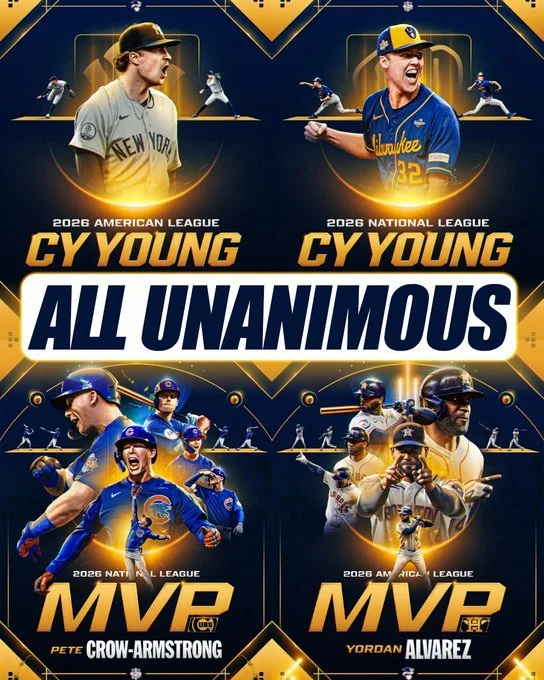
Image provided by MLB
Award season has wrapped up and while there weren’t a ton of shockers, we did see a bit of history. It is the first time ever both MVPs and both Cy Young Award winners win unanimously. While there was no debate who would be winning those awards there was some in what many find to be the most useless award the MLB hands out: Rookie of the Year.
AL MVP: Yordan Alvarez, DH, Houston Astros
Baseball’s most feared hitter wins the MVP, but not just. With his .316 batting average, he had the highest average not just in the American League but in all of baseball, taking home a batting title. He also led the league in on-base percentage, slugging percentage, OPS, intentional walks and walks overall. Alvarez fell two home runs and eight RBIs short of a triple crown, which would’ve been the cherry on top of the sundae filled with cherries. He joins teammate Jose Altuve and Hall of Famer Jeff Bagwell as the only Houston Astros MVPs.
It was evident early in the season that Alvarez was a frontrunner for the MVP award. His first half was better than a lot of players' full seasons, launching 31 home runs and driving in 70 runs by the Midsummer Classic and he didn’t fall too far off of his first half pace the rest of the way.
Alvarez, or Air Yordan, becomes the first full-time DH in the history of baseball, playing the second least amount of games in the field for a non-pitcher MVP winner. Some small social media outrage has sparked for the likes of Edgar Martinez and David Ortiz, past DHs who deserved similar respect that Alvarez has now obtained. This just goes to show how the game is evolving and I choose to see this as a positive.
NL MVP: Pete Crow-Armstrong, CF, Chicago Cubs
As a Mets fan, I once wished for the day I’d get to write that sentence above. Alas, the Mets stay MVP-less and the Cubs their ninth player to win the MVP award. This race, just like the past six seasons, came down to Shohei Ohtani and another player, with PCA playing the part this year and voters in complete agreement that he is the NL MVP.
Crow-Armstrong was great in 2025, breaking out and putting his name in the future MVP discussion. In 2026, he didn’t so much take a step forward as much as he dove headfirst into superstardom. PCA had the type of year that now puts him in the same air as Hall of Famers like Mike Schmidt, Ken Griffey Jr., Ivan Rodriguez and Joe Mauer; all players who have won an MVP, a Gold Glove, and a Silver Slugger (presumably) award while also being named to the All-Star team in the same season. That’s not even including the Hank Aaron Award in the NL that recognizes the best offensive player in the league and the NL Platinum Glove Award for the best defender in the league. He played in all 162 games, led the league in home runs, slugging percentage, OPS and runs offensively while also leading all of baseball with 26 outs above average and 23 runs prevented on defense.
Yordan Alvarez had a phenomenal year, a deserving MVP with nothing short of prolific hitting ability. Pete Crow-Armstrong had a legendary year that the history books won’t soon forget.
AL Cy Young: Cam Schlittler, New York Yankees
Another major award winner for a storied franchise, Cam Schlittler becomes the seventh Yankee to win the Cy Young Award. Much like the AL MVP this year, Schlittler’s trek to the award felt almost destined very early on. By the end of May, Schlittler was 7-2 with an ERA of 1.50, striking out 81 over 72 innings. He scuffled in June but had a second half that was much like the first two months of his season, slamming the door shut on the Cy Young race.
Schlittler finished the year leading the AL in ERA, ERA+ and bWAR, while tying with Cy Young runner-up, Dylan Cease, in strikeouts. He made all 33 of his starts with 20 of those being quality starts (six innings pitched or more, three runs or fewer allowed), just one shy behind Michael Wacha to lead the AL.
These awards have no bearing on anything that happens in the postseason but it’s worth noting that Schlittler did partially continue his dominance into the AL Wild Card game against Boston, solidifying himself as the best pitcher in the AL.
NL Cy Young: Jacob Misiorowski, Milwaukee Brewers
While Schlittler is the benchmark for starting pitching in the AL, Jacob Misiorowski showed to be the gold standard in all of baseball. The fourth and final unanimous award winner we’ll talk about, The Miz came to play!
Misiorowski didn’t just lead the NL in the following categories, he led all of baseball in ERA, ERA+, strikeouts and WHIP. While that isn’t a “Triple Crown” per se, for me it’s the Triple Crown of dominance. It’s essentially saying Miz gave up the least amount of runs while allowing the least amount of hitters to get on base and blew them away the most with his stuff. Much like his MVP counterpart, he showed flashes of promise and brilliance in 2025 that a Cy Young likely wouldn’t be too far into the future. To make that jump the following season just goes to show that Misiorowski has a right arm made of gold.
His season didn’t start so hot, with an ERA of 3.31 by the end of April but that just proved to be early day jitters. In his final 142 innings from May through the end of the season, Misiorowski’s ERA was 1.46. Pure dominance for just about the entire season.
He may have struggled to find his footing early in the season and once again under the bright lights of the postseason, at first, but he was able to turn it around just in time for the World Series. When it mattered most, Jacob Misiorowski planted his flag in MLB and proclaimed himself the best pitcher in baseball.
AL Rookie of the Year: Kevin McGonigle, INF, Detroit Tigers
He may not have done it unanimously but Kevin McGonigle was damn close. Receiving 28 of the 30 first place votes, McGonigle probably should’ve gotten them all but Cleveland Guardians rookie starter, Parker Messick, does deserve some recognition for the year he had as well.
I remember flipping through my MLB.tv subscription on Opening Day to see the Tigers take on the San Diego Padres. The 5-foot-9-inch third baseman didn’t really stick out to me, other than knowing he was a top prospect for Detroit making his MLB debut. By the end of that game, McGonigle had four hits, two of which were doubles and had driven in two runs. It was Opening Day but I had already seen the future. Kevin McGonigle was going to win Rookie of the Year.
McGonigle, playing through his age 21-22 season, showed the poise of a 10-year veteran from the start. He didn’t look lost at the plate, he very rarely made defensive blunders in the field and because of it, he did something that only Mike Trout in recent memory has done: lead the American League in bWAR.
In a rookie class filled with productive players like the aforementioned Messick, Payton Tolle and the monster power of Munetaka Murakami, McGonigle proved that being smaller and being younger than the rest did not affect the impact he had on every game this year.
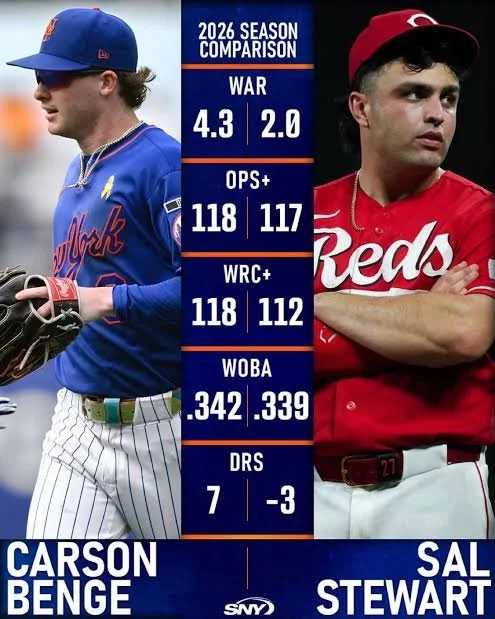
Image provided by SNY
NL Rookie of the Year: Sal Stewart, 1B, Cincinnati Reds
The only award to provide us with any real discussion with a winner that caused some online controversy. Sal Stewart took home the award after receiving 20 of the 30 first place votes with New York Mets outfielder, Carson Benge receiving seven and St. Louis Cardinals shortstop, JJ Wetherholt receiving three of the remaining first place votes.
Stewart provided the Reds with their best offensive production, leading the team with 32 home runs and 112 runs batted in, the latter placing second in the NL overall. Quite honestly, that’s where the accolades for Stewart stop. He played a below average first base, he is an awful baserunner but he sure did hit a lot of home runs (I mean, the Reds as a whole did, they ranked fourth in all of baseball).
My bias will show but I also wouldn’t have a hard time arguing that Carson Benge should be celebrating his win of this award. Benge was the first Mets rookie to have a 20/20 season with 20 home runs and 22 steals, all while providing defense worthy of Gold Glove consideration. Overall, Benge had the more balanced year. Wetherholt is close, especially considering he is the better defender at a premium position, but is edged out on offense by Benge.
Again, the Rookie of the Year Award is fairly useless. It’s nice to give accolades to the league’s rookies as a very vague, but hopeful barometer of what to expect in the future. Oftentimes however, the winners of this award just become the answer to a trivia question some years later, so I won’t harp on this too much longer.
AL Manager of the Year: Will Venable, Chicago White Sox
I thought this award would be a little more decisive, even with Kevin Cash rightfully getting first place votes. Venable, receiving 15 of the 30 first place votes, helped a Chicago White Sox team that has been historically one of the worst teams in baseball over the past several seasons and got them into the playoffs. That feat alone might be cause for a unanimous decision.
In his second season, following a 100-loss season, Venable made the most of a roster that looked like it had potential that would be unfulfilled. An offense that included the homegrown Colson Montgomery, Dodgers cast-off Miguel Vargas and the absolutely slept on Munetaka Murakami led the American League in runs scored. A bullpen that pitched more innings than any other bullpen in all of baseball that managed to rank eight in ERA.
Will Venable did what any good manager does: he got the best out of each of his players, whether they were a known entity or not.
NL Manager of the Year: Pat Murphy, Milwaukee Brewers
Another choice I thought would be unanimous but the right call was obviously made. Pat Murphy was, far and away, the best manager in baseball. His historic third Manager of the Year Award in a row would be enough to cement that but his World Series ring is in the picture too.
Murphy is beginning to pencil his name into the Hall of Fame. While this award is fairly young in the annals of baseball history (established in 1983), Murphy stands one more win away from reaching the top of the list. Currently, here is that list of managers with 3 or more Manager of the Year awards:
Tony La Russa (4)
Bobby Cox (4)
Buck Showalter (4)
Jim Leyland (3)
Dusty Baker (3)
Lou Pinella (3)
Joe Maddon (3)
Terry Francona (3)
Bob Melvin (3)
Pat Murphy (3)
A list that contains Hall of Famers in La Russa, Cox and Leyland mixed with potentially soon to be Hall of Famers in Baker, Pinella and Maddon and I imagine Francona makes his way someday too. All of this say, Murphy is on track to stand with the greats.
He continues to be the most likable person, not just manager, in baseball. Endearing himself to both his organization as a whole and fans alike. His interviews are must watch TV at this point, whether he’s storing a pocket pancake for later or providing a sound bite for the ages, Pat Murphy is the pinnacle of managing a baseball team in our era.
In fact, there is no how can you not be romantic about baseball moment this week. Ending this with Pat Murphy is as good as it gets.