
This week’s Box Office Report is a day late because I wanted a chance to see The Social Reckoning before taking the time to do this article this week. This isn’t a project that I was particularly excited for, but when your film has Jeremy Allen White, Mikey Madison, Wunmi Mosaku, and Jeremy Strong delivering Sorkin dialogue you’ve at least garnered my interest.
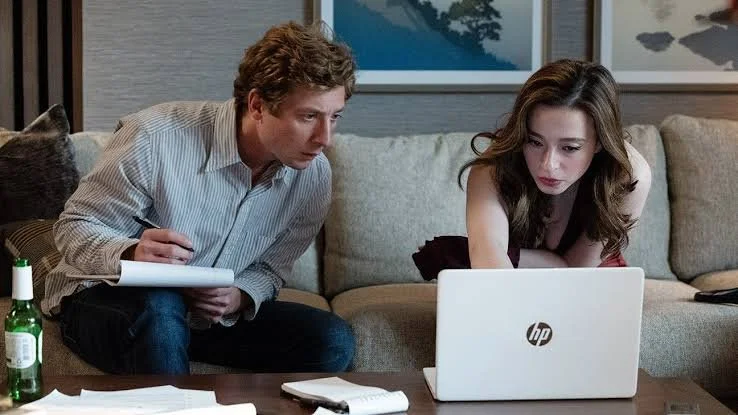
Jeremy Allen White and Mikey Madison in The Social Reckoning (photo credit: Sony).
I’m not as enamored with The Social Network as everybody else my age is. I think it’s a phenomenal, five star film, but in terms of Fincher, it’s easily behind Se7en, Fight Club, and Zodiac, and whether or not it’s better than Gone Girl generally depends on my mood. Such is life when you’re exploring an all-time great auteur, I guess. Basically, it’s a great movie but it isn’t one of those crucial gateway films for me that it is everybody else that I know. I did not see the need for a sequel, nothing Sorkin has done as a director has left me thinking he’s a competent director, and when you’re adamant your film is a spiritual successor that’s nothing like the beloved predecessor, it becomes a hard sell. But even those I knew who were ecstatic for a follow-up left underwhelmed when they saw it on the Thursday opening. This made me wonder why.
Having now seen the film, as I had a chance to finally go see it in the Dolby Cinema (my go-to PLF, I highly recommend) on Sunday night, it left a lot to be desired. The thing with Sorkin, and I’m ignoring Being the Ricardos and Moneyball considering those aren’t the kind of film he traditionally attempts to make, is that his films tend to have something to say that is reflective of the sentiment of the time that it’s in. Think A Few Good Men, The American President, Molly’s Game. They reflect what the feeling is of that era in ways other films of the time didn’t. Not only does The Social Reckoning entirely miss the boat on that, but it does so in a way that completely wastes its characters and actors behind them, which is unfortunate for great performances out White, Madison, and Bill Burr of all people, but he has nothing informative to say. We all know social media algorithms foster division in the same way that we all konw that there’s an epidemic of mental health issues amongst teenagers that directly correlates with the rise of social media. Essentially, he sits us down for two hours and puts us in rooms over the course of three years to tell us things we already know as if he’s presenting it as this monumental discovery, and its overall lack of substance would be permissible, especially since his dialogue is still sharp, if it was at least entertaining to look at, but it ultimately had, inexplicably, less style than it had substance.
Basically, Fincher’s ability to enrich each character in The Social Network and provide an aesthetic, not just visually but audibly (for instance, the directorial decision to have the characters speak faster) really breathe an explosive amount of life into the picture that matches the vibe of its era. That’s not found here. Nobody expected this to be as good as its predecessor, but it doesn’t feel as though it’s even in the same vein.
I also think that the audience that wants to go see a film about the inner-workings of Facebook just isn’t there the way it had been in 2010 when Facebook was the biggest player in its market. Facebook is put of normalcy now, and the fact that there hasn’t been a real reckoning for companies in Silicon Valley means that we all deal with the consequences of Facebook every day of our lives, making it permanently inescapable. At that point, why would somebody go to a movie to hear about how Facebook’s ruining their lives in ways people already know? There’s nothing that helps you escape on top of the fact there’s nothing that actually informs you of what’s happening, either.
It’s not surprising its reception is poor, and it finishing just inside the top five with a miniscule $5.5M on the weekend makes it one of the biggest bombs of the year, even if it won’t exactly garner that kind of coverage thanks to its opening weekend coming in the fallout of the opening weekend of Digger, which saw an approximated 60% drop, which is obviously not good and the film is going to lose hundreds of millions of dollars as we discussed last week, but having braced for a steeper drop, a $3M+ second weekend with its disastrous word-of-mouth isn’t as bad as it could have been.
Sorkin’s Molly’s Game star, Jessica Chastain, had a film open at number one this past weekend, and even that is an interesting and somewhat controversial story in and of itself. The film opened between $27M-$28M, which is excellent for what the film is, and continues the hot streak horror has been on this year. However, after seemingly showing high-confidence in their marketing, armed with an epic trailer attached to The Odyssey, they kept the film from press screeners. Pointing this out isn’t sour grapes from members of the press as much as it is the fact that hiding the film before its hyped up opening weekend is a sign that the word-of-mouth of the film isn’t going to go well. It’s not that they didn’t lift a review embargo until late to subdue the impact of the early response, it’s that they allowed for zero opportunity for an early response. How did this end up? One of the most hyped horror films of the year landing a rare, damning D+ CinemaScore, easily the lowest CinemaScore since we’ve started doing the Box Office Report, and audiences scores are sporting a 2.3/5 Letterboxd, 48% Popcorn Meter, and a 5.5/10 on IMDB. Suffice to say, they aren’t good. On a $20M budget and a global opening of $45M, it should easily turn a profit, but it should also see fewer legs than the jump scare we all saw in the trailer.
Verity saw a 64% drop, continuing a trend of Colleen Hoover adaptations being frontloaded. These films aren’t four-quadrant and rely almost exclusively on the BookTok demographic. The female audience is high-spending, but they’re also an audience that tends to prioritize seeing things as soon as possible. This film is firmly into profitable territory, giving Amazon MGM another win in 2026, which will be remembered as they year they welcomed theatrical exhibition with open arms. Moreso, this gives Anne Hathaway her fourth film of the year to make at least $100M.
The remainder of the top ten saw Resident Evil and The Heart of the Beast at numbers three and four, as well as Forgotten Island, Digger, and Primetime sitting at 6-8. There’s very little new to say this week about the holdovers, but perhaps the drops for Primetime have been larger than a lot of people anticipated. With it still yet to open in most major markets, it should still continue to do fine, we think. Forgotten Island will end up an animated cult classic, and its exploration within friendship amidst Filipino culture should make it a marquee streaming hit with its demographic, though its early Peacock exclusivitiy may force it to take a while to be revealed as such. It’s very imaginitive in its animation, but that just didn’t come through at all in any of its marketing.
Angel and the Badman, the latest from Angel Studios, opened at #9 with around $2M. It doesn’t seem like their pay-it-forward model could skew this film. We haven’t seen any Angel Studios films here at DSR, making it impossible for us to question why this particular movie deferred from their audience, however. Back in the top ten this week, The Odyssey, finishing the weekend in its 87th day, made aroudn $2M. This is a 54% increase from last week, but this as much an indictment on Digger as it is a reflection of The Odyssey. The Odyssey returned to IMAX theatres this week, and seems to be doing rather well in its attempt to expand its IMAX record.
Looking ahead at next week, it’s a loaded set of releases. Whalefall, starring Weapons castmembers Josh Brolin and Austin Abrams, promises to be exhilerating as a man tries to escape after being captured by a whale alongside a squid. Then there’s Misty Green, a new auteur driven film from…Chris Rock? Alongside that, Nathan Fielder’s experimental Elizabeth Holmes You Can See Everything goes wide amidst unreal hype compared to other modern documentaries. Sense and Sensibility opens, which feels like an Oscar-play that won’t go too well for Daisy Edgar-Jones, then there’s a commercial play that could go either way. Street Fighter certainly has its audience, and wrestling fans will be looking forward to seeing Cody Rhodes, Hirooki Goto, and Roman Reigns on-screen, but just months after Mortal Kombat bombed, it’s hard to imagine that a game that’s not as popular but targets the exact same audience will do much better, especially considering its lack of star power. But he last one made $100M in the ‘90s, so with how robust Skydance’s marketing has been, if it’s a good film, maybe it finds its audience.
Jameus Mooney is an entertainment writer for Comicbook Clique, having covered the entertainment industry for years. You can follow him on Twitter here, and Letterboxd here. You can also listen to his horror podcast, The 2:17 Horror Podcast, at the DeathArts XIII YouTube channel.