
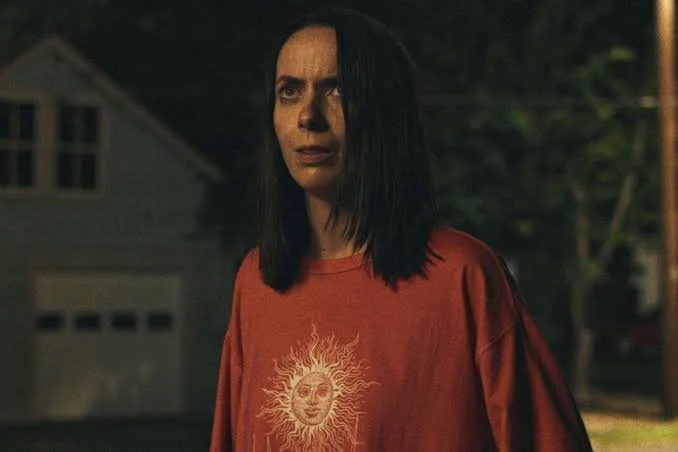
Kate O’Flynn, Widow’s Bay. (Photo Credit: Apple)
Apple TV’s horror-comedy Widow’s Bay broke the record for most Emmy wins by a comedy this year with 14. The only major comedy award it didn’t win on Monday was Best Actress in a Comedy Series, which it didn’t have an eligible actress, and even that award was fairly locked the moment Hacks announced a season five, considering Jean Smart ended up winning every television award throughout the duration of Hacks except for the 2026 SAG award, which went to Catherine O’Hara for The Studio, who had passed away during the voting eligibility period. Smart is now tied with The Mary Tyler Moore Show star Cloris Leachman and Seinfeld icon Julia Louis-Dreyfus for most Emmy wins of all-time. Speaking of The Studio, that had set the record for most Emmy wins by a comedy series last year for Apple TV at 13, FX’s The Bear, which isn’t even a comedy, had broken the record in each of the two previous years, and with O’Hara’s Schitt’s Creek in 2020 and The Marvelous Ms. Maisel in 2018, this record has been broken more times in the last ten years than it hasn’t exiting the ceremony.
In the past two years, Best Drama at the Emmys have gone to HBO’s The Pitt. Noah Wyle has gone back-to-back at the Emmys after sweeping the television awards in 2025. In 2024, Shogun set the record for most Emmy wins in a single season by a television show with 18. The biggest surprise of this years Emmys ended up being Allison Janney’s win for The Diplomat, who had the worst odds of winning of any actress nominated for Supporting Actress in a Drama Series. The issue that voters faced is that there were four women from The Pitt up for the award, meaning everybody who’s voting The Pitt for everything likely split their votes four ways, giving Janney, who also tied the record for most Emmy wins ever, an avenue to sneak in with the ‘we adore Allison Janney crowd.’ She did not have that avenue for season two of The Diplomat, where she was arguably much better becaues The White Lotus had to get four actresses in.
We are in a premiere age of television. On the comedy side, there are massive hits such as Apple TV’s Shrinking, where the beloved movie star behind Indiana Jones and Han Solo is doing the best dramatic work of his career while still maintaining a pure comedy aspect. There’s FX’s Only Murders in the Building where the most beloved comedy pairing since Stiller and Meara are doing a pure comedy within the context of the true crime craze. There’s legitimate, traditional network sitcoms that are going against streaming and keeping the most beloved genre of television comedy alive with ABC’s Abbott Elementary and CBS’ Ghosts. In the last few years we’ve seen Margo’s Got Money Troubles, and others sneak in at the Emmys but blank in any and all major categories, while Ted Danson scored major nominations in the television circuit for Man on the Inside but the show get shut out at the Emmys.
In a previous era where the only strong comedies on television that were leaving a lasting footprint were 30 Rock, Modern Family, and Veep, dominating the category is somewhat understandable. I love Superstore and The Middle as much as anybody, but those shows struggled with viewership and didn’t do anything to innovate the sitcom beyond what had already been done before it. But in a time where there’s more original American comedy than ever before, why is this becoming a much larger problem at hand now? Would it be that big of an issue if one show weren’t dominating exactly at the same time the same thing was happening in the drama section, exacerbating how consolidated these shows feel?

Leonardo DiCaprio in One Battle After Another (photo credit: WB)
This led me to explore the Academy Awards. I’ve covered the Oscar season the last two years, and over the last ten to fifteen years it’s been the same thing: you need one of BAFTA or SAG, the awards that have people who vote on the Oscars in their voting body, to win in lead at the Oscars. But in 2025 when Mikey Madison won for Anora and Adrien Brody won for The Brutalist over Demi Moore in The Substance and Timothee Chalamet in A Complete Unknown, they both won the BAFTA, which had been the final awards ceremony during Oscar voting. The supporting acting wins also matched, but Kieran Culkin and Zoe Saldana swept the circuit that season, so that’s par for the course. This year, with SAG being the final ceremony during voting, SAG went four out of four matching the Academy Awards. For whatever reason, the current trend is whichever industry body happens during voting.
So there are patterns that make it generally predictable. However, as I looked at the last four ceremonies, it’s been relatively the same thing. One Battle After Another wins Best Picture, Best Director, Best Supporting Actor, Best Adapted Screenplay, Best Editing, Best Casting. Anora wins Best Picture, Best Director, Best Actress, Best Original Screenplay. Oppenheimer wins Best Picture, Best Director, Best Actor, Best Supporting Actor, Best Editing, Best Score, Best Cinematography. These films all dominated the major categories, especially in categories that they probably should not have won. Take Anora, for example. The Academy gave Sean Baker four Academy Awards for producing, editing, writing, and directing. Was Baker’s directorial work better than Ed Berger’s for Conclave, was it more innovative than Coralie Fargeat’s for The Substance, or more difficult than Brady Corbet’s for The Brutalist? The screenplay itself was heavily improvised, including the home invasion scene, which is most people’s most memorable. Was that actuall well written or was the casting so well done that the cast breathed life into the Picture? Anora is a tremendous film well-worthy of Best Picture, and the argument isn’t that it shouldn’t have won Best Picture, but did it need to win out the entire night over some of the most beloved films of the decade?
All of those films, however, did lose in the acting categories. One Battle lost out in both actor for Leonardo DiCaprio and Supporting Actress for Teyana Taylor, the latter of whom many considered the odds-on-favorite heading in because she had won Critics Choice and the Globe, but again, industry awards matter when predicting Oscar winners. It also lost Best Supporting Actor for Benicio Del Toro, but considering it won that category for Sean Penn, we aren’t counting that loss for obvious reasons in this conversation. Anora lost Best Supporting Actor for Yura Borisov to a Kieran Culkin sweep. Oppenheimer lost in Best Supporting Actress for Emily Blunt to Da’Vine Joy Randolph’s remarkable performance, what may be the best supporting performance of the decade in any movie, in The Holdovers.
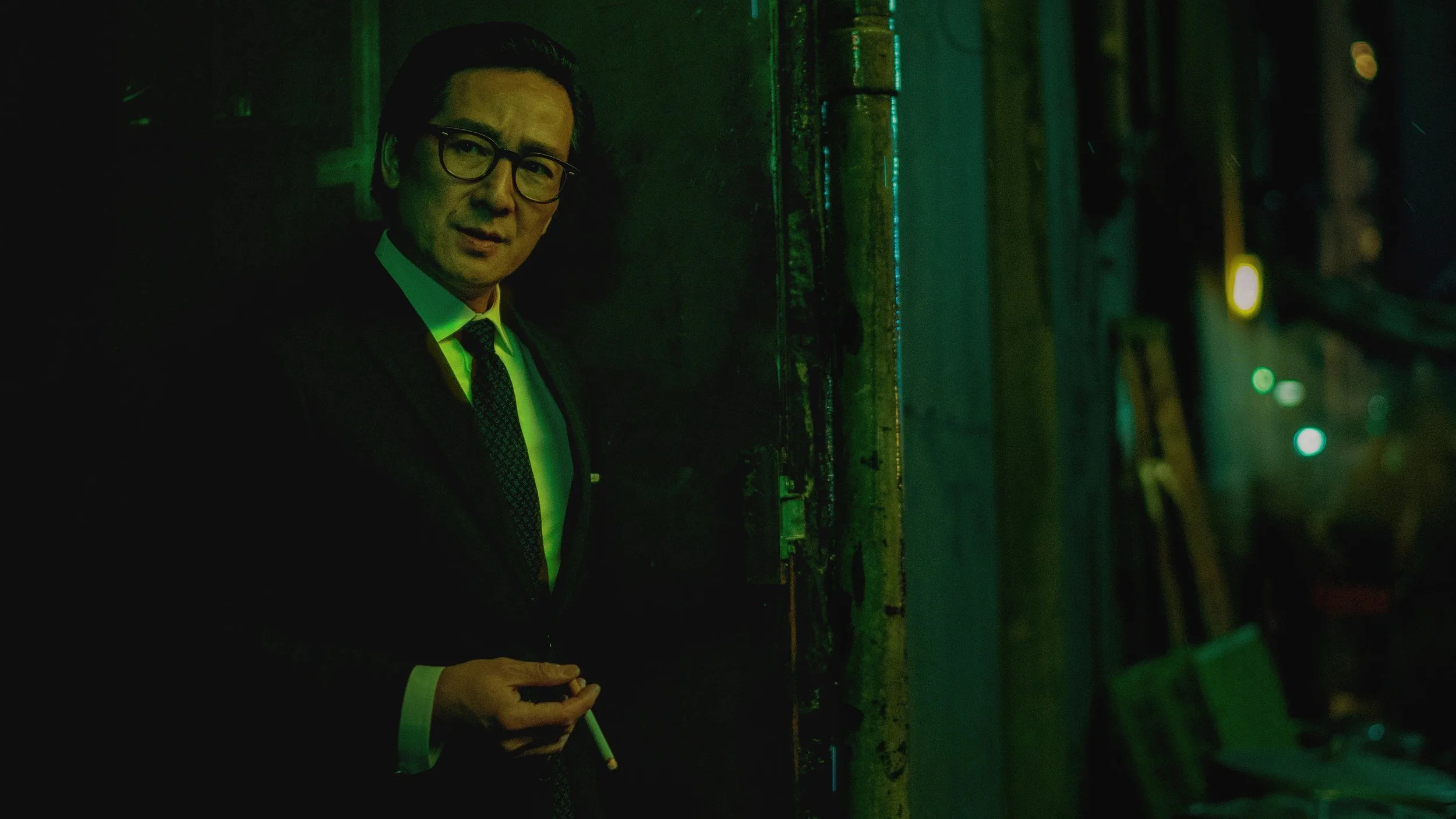
Ke Huy Quan, Everything Everywhere All at Once. (Photo credit: A24)
The real film that won everything is A24’s Everything Everywhere All at Once, in a ridiculous year that should have been far more competitive with films such as The Banshees of Inisherin and Tar. The film won Best Picture, Best Director(s), Best Actress, Best Supporting Actress, Best Supporting Actor, Best Original Screenplay, and Best Editing. The only major contender that lost was Stephanie Hsu, and it was a OBAA scenario where she lost to her co-star.
So, the film had the best acting of the year across the board, as well as the best editing, best directing, and best writing? The only major contender that lost was Stephanie Hsu, and it was a OBAA scenario where she lost to her co-star. Are we sure that it had the best acting of the year, or did the writing enrich their characters? Maybe it’s the other way around and the actors elevated the material because performances worthy of an Oscar generally do that. Is it well directed or did the editing room enhance things that are also on the director such as the pacing of the film? Was it the editing or the directing that made the multiverse element cohesive?
I struggle to believe that one film every year is so far above the rest of the pack. It made me wonder how things became this way, and it reminded me that this year was the first year that the Academy had a rule that to vote on a category, you’d have to watch every single film nominated in the category. The Academy did not have that rule. Kirsten Dunst, who had been nominated for 2022’s The Power of the Dog, had called out fellow Academy members for watching five or six movies and deciding they’d seen enough. Variety’s anonymous ballots every year have people admitting they didn’t watch films nominated.
If this is a thing in film, where each film only requires on average two hour viewing, I have to imagine with twice as many categories, very few members of the Television Academy are watching entire seasons that range from ten to twenty hours of their time. That’s the problem: in an era where streaming has made watchnig everything more accessible, the people who are obligated to watch it for a living feel as though they’re too good to do so.
Campaigns have always mattered. Award campaigns are essentially fundraising processes for the Academy that also serve as a marketing tool for the films and/or television shows. A studio puts the filmmakers and actors on the campaign trail and they’re all over television and the internet doing a massive second-wave of marketing so that people stream and/or buy the blu-rays, and give a legacy to a show or film that encourages to continually rewatch. These campaigns build interest in the ceremony itself, which then makes enough money from the broadcast through selling ads, licensing it to a network, sponsorships, et. al. to give the Academy massive funding for the next year. It works in harmony.
The problem is that every film or show nominated maxes out in their categories. Take the 2000 Academy Awards: sixteen films scored an acting nomination, whereas only twelve did so this year. Coattail nominations have become far more of a thing, and both supporting acting categories had one film score multiple nominations, and both films that did so were films that landed in a lead acting category as well. If we look at last years, multiple films scored at least three acting nominations, and all but one of the five in lead actor saw a co-star nominated with them, and the one that didn’t, Colman Domingo for his work in Sing Sing, had Clarence Maclin who just missed and was on the bubble the entire season.
1997 season had 65 films nominated, the 1998 season had 57 films nominated, 2000 season had 58 different films nominated. The last two years have both had exactly 50, 2022 had 52. Not a single year since the pandemic have we reached even 55 films nominated when the average was previously significantly higher. The nominees in 2000 for Best Makeup were Topsy Turvy, Bicentennial Man, and Austin Powers: The Spy Who Shagged Me. The makeup branch is still the reason we get some semblence of unique nominees, notably this year with Kokuho and The Smashing Machine, but is there a world where the modern Academy nominates something as ‘commercial’ as The Spy Who Shagged Me in 2026? Instead, we still nominated Sinners, which set the record for most nominations ever, and Frankenstein, which scored nine nominations. Last year, the nominees including The Substance, Emilia Perez, and Wicked. Granted, The Substance, Wicked, and Frankenstein are all robust in their makeup, it seems to be a lot more Best Picture heavy than it previously had been in any other era. Did Robert Downey Jr.’s ‘physical transformation’ actually warrant a nomination in makeup for Oppenheimer?
With how many nominations there are per year for the Emmys, I’m not going to do the math to breakdown the nomination aggregate and how it’s changed over time. However, with a new record every year for most nominations by a comedy or a drama, I’d venture a guess that the nomination totals have consolidated for them too.
With even fewer things for everybody to watch to prepare for these events, despite there being more films and television produced than ever and the programming being more accessible thanks to streaming, nobody that actually has a vote is watching these things, rather going by the campaign they hear the most about. For the Academy’s 2026 season, it was all about the banner year for Warner Bros! Sinners lands the most nominations, and even the major wins that don’t go to Warner Bros One Battle go to Sinners and Weapons. Apple TV put more money than anybody into their television campaigns than anybody the last two years, and suddenly they absolutely own the comedy department for whatever their big cult show is
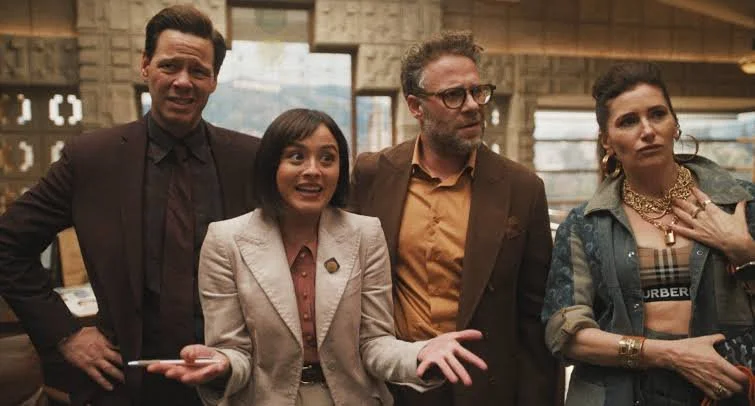
The Studio had just set the Emmy comedy record last year. (Photo credit: Apple)
I do wonder how much internet narratives, especially on Reddit with dedicated subs that seem to be generally hive-minded, especially in the Emmy comedy department, and on the Oscar sub, such as last year when they 'locked’ Jessie Buckley in for the Hamnet win and One Battle for Picture before anybody even saw the films, matter on top of the campaign because if you can’t escape talk that ‘this should win’ and you haven’t actually watched the films or shows, you’ll check the box. Even this year, the general consensus out of the festivals is that Julianne Moore has already locked a sweep en route to her second Academy Award for The Debut, and the season hasn’t even allowed the category to make itself clear. You can read our early Oscar predictions here, and believe me, we certianly gave creedance to that narrative. But I’m sure somebody a lot smarter making a lot more money than I do is currently doing a study on that in every major studio in Hollywood.
In inherently subjective mediums, it’s unfathomable that each voting body made up of different voters would have the same pool of nominees, and generally speaking, the same winners. It’s also incredibly improbable that one show or film would be, as a general consensus, better in every single aspect than everything else that comes out that year every single year. In an era of social media, everything has become so uniform because we’re told to think certain ways, and it’s hard to imagine that isn’t the explanation for why one show or film is namechecked for every single award in a time where people are afraid to be wrong.
Just some food for thought. As a viewer, it’s starting to become very monotonous throughout the night knowing exactly what’s winning the big prize because it’s winning every other prize. Did Matthew Rhys actually deserve two lead wins this year, or did nobody watch anything in the limited series category and decide ‘this Matthew Rhys’ year!’ While I truly think Jean Smart earned all five Emmys for Hacks, and think Deborah Vance is one of the greatest comedic characters of all-time, is there a world where Lisa Kudrow wins for an incredible performance in The Comeback if the Television Academy required Emmy voters to watch every show? Did they even watch either? Lana from Frasier has always been more beloved than Phoebe from Friends with the Emmys.
Jameus Mooney is an entertainment writer for Comicbook Clique, having covered the entertainment industry for years. You can follow him on Twitter here, and Letterboxd here. You can also listen to his horror podcast, The 2:17 Horror Podcast, at the DeathArts XIII YouTube channel.