
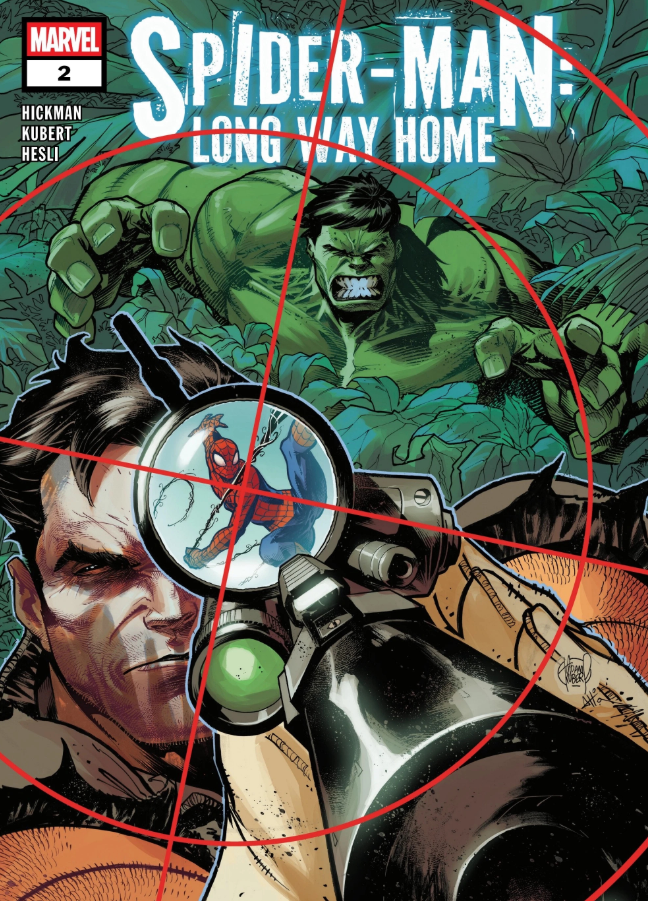
Spider-Man: Long way home #2
Writer: Jonathan Hickman
Artist: Adam Kubert
Colorist: Arthur Hesli
Letterer VC’s Ariana Maher
Spider-Man: Long Way Home presents an engaging standalone world, even if its title sounds strikingly similar to the 2019 film Spider-Man: Far From Home. The overall plot remains relatively straightforward: The Punisher and his team, Hydra, the Hulk, and S.H.I.E.L.D. are all locked in a multi-fractional clash to secure the story's primary MacGuffin, the Cosmic Cube. In the first issue, Castle's squad successfully retrieved the Cube by intercepting a Hydra assault on a secret research facility in the Nicaraguan jungle. The Punisher ultimately secured the artifact, but at the cost of his entire unit. Doorknob, the final surviving member, sacrificed himself to throw off the Hulk and give Castle enough time to escape.
Following those events, S.H.I.E.L.D. recruits Spider-Man to track down Castle and recover the Cosmic Cube. Meanwhile, Frank heads toward a friend's house to seek help, completely unaware of how closely Bruce Banner is tailing him.
Spider-Man: Long Way Home #2 picks up two days later. It introduces Sheppard, the recipient of Frank’s distress message, who is currently retired and living in a quiet suburban home with his dog. The narrative then transitions back to Spider-Man receiving a formal S.H.I.E.L.D. briefing on the Punisher's actions. So far, the series positions the Hulk/Bruce Banner dynamic as the main threat, places Spider-Man in the central heroic role, and frames the Punisher as an unpredictable wildcard whose true employer remains a mystery.
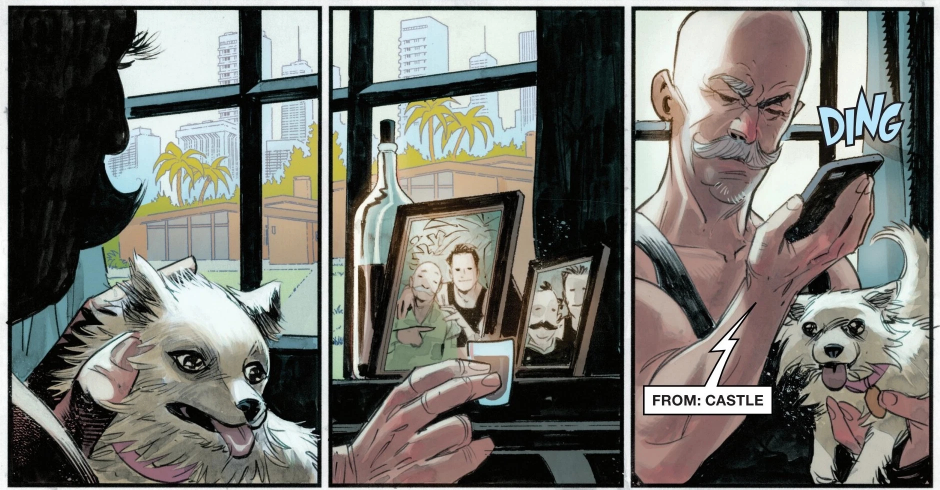
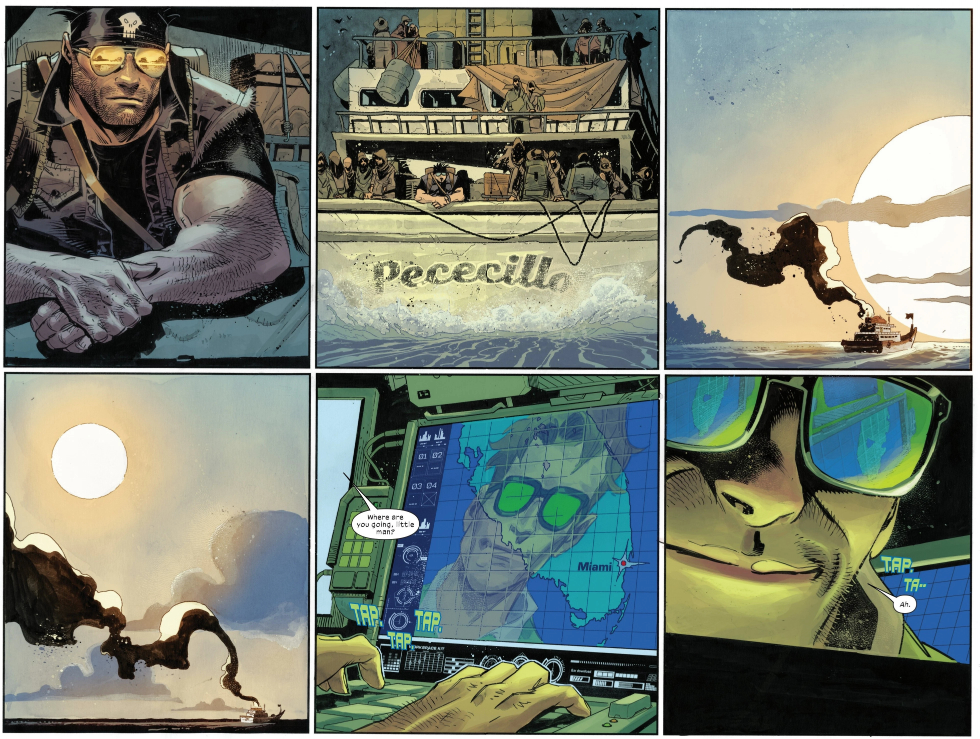
This dynamic is strengthened by Banner’s phone call to the Punisher, which delivers the most intriguing piece of information in the entire issue.
When Frank asks if Bruce was the one controlling the Hulk during the jungle battle, Bruce answers, "Yes, it was me, or better put, the me I always wish I could be." This line offers our first real insight into Banner's mindset. He remains an enigmatic figure throughout the scene, a feeling visually reinforced by his eyes hiding behind the green lenses of his glasses. Their brief, direct exchange provides just enough tension to build excitement for their next encounter.
Four days later, we see the Punisher arrive in Miami, hailing a cab and in the next panel, a cab arrives at Sheppard's home, with him reassuring his dog that it is Castle. The comic’s biggest twist lies here, as Banner steps out of the cab, asking for Castle’s whereabouts.
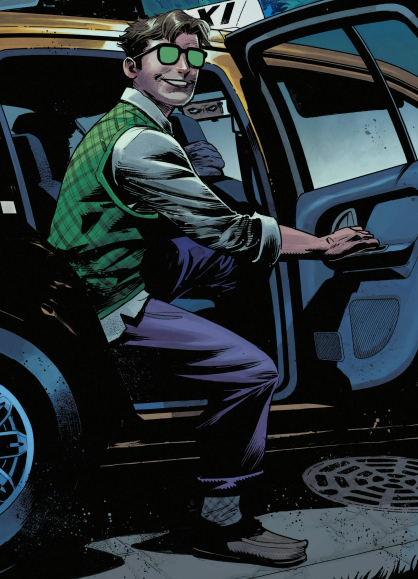
This twist is intriguing, yet it creates a slight plot hole. It remains unclear why Banner arrives four days after discovering Castle's destination unless he was intentionally waiting for Frank to arrive first, in which case his plan failed.
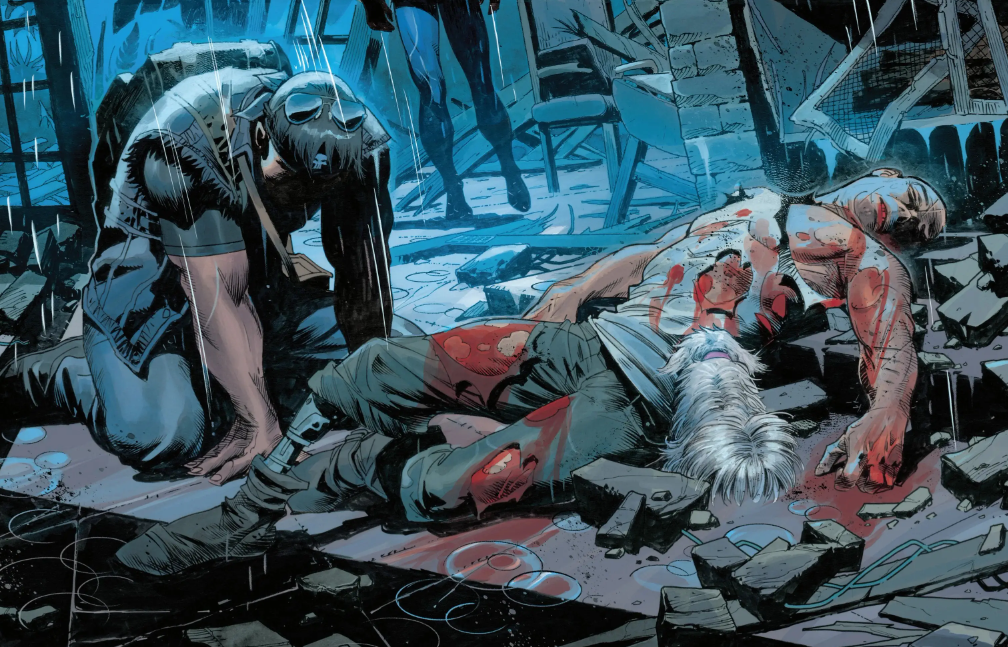
When Sheppard pulls a gun on Bruce, Banner transforms into the Hulk. The next page cuts to Spider-Man arriving at a destroyed house, which detail panels reveal as Sheppard’s residence. There, Spidey finds Frank kneeling over Sheppard’s bloodied corpse, with the dog sitting nearby. Fortunately, the dog is unharmed, preserving a subtle moral boundary for Banner’s villainous role.
Positioning Bruce Banner as the main antagonist serves as the series' strongest selling point, offering a fresh angle that keeps readers hooked. The story avoids portraying him as a reluctant antihero or an unwilling obstacle; instead, he operates as a cold, calculating villain who shows no guilt for his actions.
Above Sheppard’s body, written in blood across the fireplace, is the message: "YOU SHOULD HAVE GIVEN ME THE CUBE." Spider-Man sympathizes with Frank and promises to bring the killer to justice before asking for the artifact. Frank delivers the issue's final line: "You can’t **** have it."
While the twist involving Sheppard’s death works well, the Hulk's absence immediately afterward raises questions. If his goal was to secure the Cube, waiting for Frank to arrive would have made more sense. Future issues will likely clarify his motives.
Overall, the title feels like a marketing strategy to boost sales, especially given the market dominance of DC's Absolute line where Spider-Man remains Marvel's most dependable bestseller. The book spends far more page time on Frank and Bruce than on Peter Parker, making the title feel misleading.
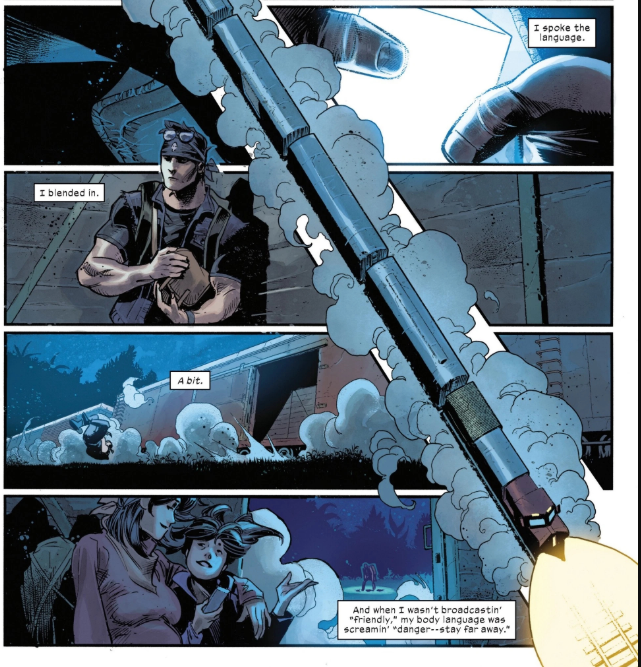
Jonathan Hickman’s narrative shines through the mystery surrounding Banner and Castle rather than its core MacGuffin. While the opening act is still setting up its dynamic pieces, the potential is clear. The dialogue flows naturally, and Frank’s inner monologue about blending in provides character depth without stripping away his mystique.
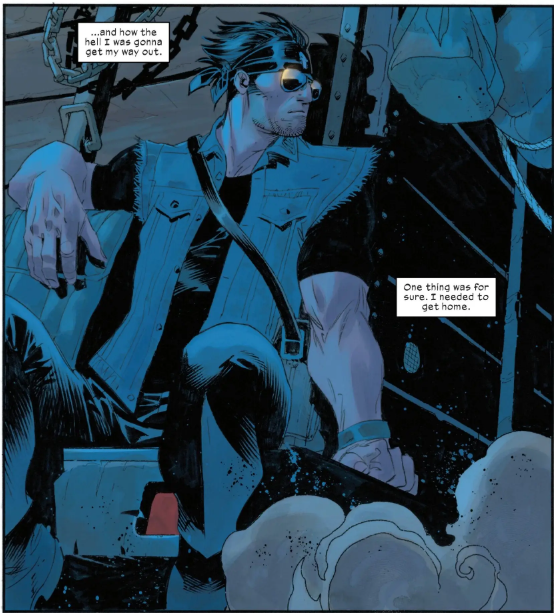
Adam Kubert’s artwork executes the script efficiently, focusing strictly on necessary story beats rather than elaborate visual flourishes. While clean and effective, this functional approach makes the pages visually pleasant yet somewhat forgettable. However, the diagonal panel layouts during Frank’s train ride to Miami stand out as a stylistic highlight. Arturo Hesli’s colors do not pop, but they complement Adam Kubert's overall lines well. His work shines through subtle details, most notably in Bruce Banner’s green glasses, which create a striking visual element. I also appreciate the wash of the black ink, keeping it in how its made by hand, rather than a digital color box.
Ultimately, Spider-Man: Long Way Home #2 functions more as a Punisher versus Hulk story guest-starring Spider-Man. Paradoxically, that shift in focus makes it worth reading. While the series has not fully taken off yet, it possesses immense potential, taking the time to establish character dynamics and lay down intriguing mysteries for future issues.