
SPOILER AHEAD!
Initial Thoughts
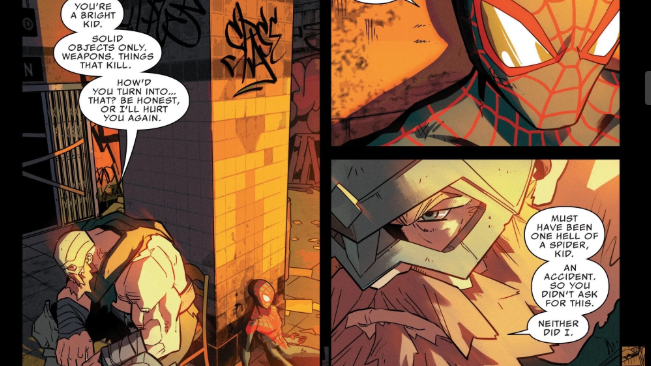
We finally learn The Revenant’s history and origin in Miles Morales: Spider-Man #3. Before the lightning, kinetic energy, or muscle, Martin Moore was just a man who got in over his head and got caught up in New York City’s street crime. Though only hinted at before, this issue lays everything bare, letting Miles see his father’s past and how this man from his troubled past is now back to reign chaos over his life and his family’s. How will they deal with this enemy, who will bring some of Jefferson’s unknown past to light for his family?
This was a fantastic issue and the best of the very short run so far. I really enjoyed it, and it flew by. I was pacing through it so fast that when I got to the end, I was really surprised it had ended. I was so invested in Martin Moore/Revenant's story that I flew through it. Bryan Hill finally gets to the meat of the story, and he not only makes The Revenant an empathetic character, but also makes Jefferson Morales the center of the problem. However, a good story has no black or white; it has gray, and Hill has set us up for a good payoff.
One Bad Day
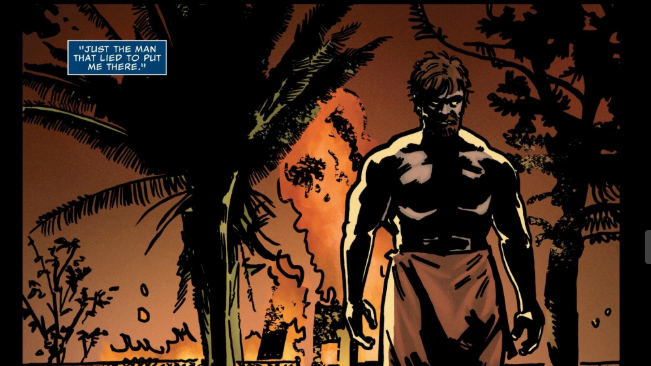
The adage is true: all it takes is one bad day. For Moore/Revenant, it was a bad day and a couple of months of torture. The issue focused on Moore, his plight, and how Jefferson’s betrayal turned him into a giant, mutated villain. Moore didn't become the Revenant; Fisk did, driven by his twisted sense of justice for anyone who crosses him. Giving a villain depth is always a good idea, because a two-dimensional character — especially a villain — makes a story feel much more well-rounded. Still, something there doesn't completely redeem Moore.
That little nugget left behind, which I think will steer the rest of the series, is that the Revenant knows who Spider-Man is and his relationship with Jefferson. He wants Miles to get a glimpse of who his old man used to be, and maybe that will be enough to make Jefersnon suffer. This still makes The Revenant a psychological bully. He does not believe in turning the other cheek, and believes that Jefferson and his family should be subject to the kind of torture that he went through. I still think there is a lot to be told about Martin’s story, especially because he left a family behind.
Just When You Think You Know A Guy
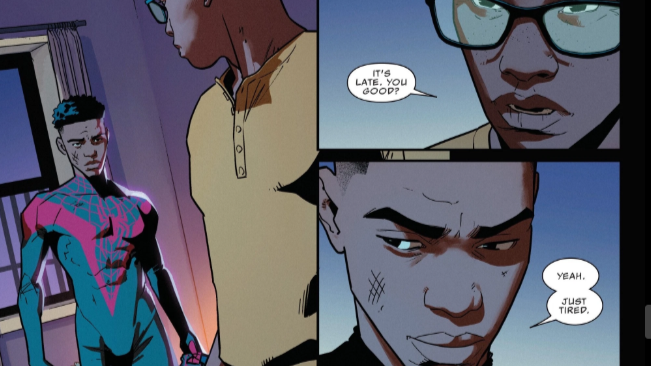
The best part of Miles Morales: Spider-Man #3 was how Bryan Hill turned the tables on Jefferson Morales, making him the true center of the family's new problem. After this issue, Martin Moore feels much more empathetic, and we can see his side of the story. This was a major takeaway, but it also served as the issue's peak. When Miles and Jefferson's interaction after Spider-Man met with the Revenant was cold, that was exactly what Moore wanted: to drive a wedge between father and son. Even more heartbreaking was Jefferson's interaction with Rio, where she asks if there is anything she needs to tell her. She feels like the man she knows might have parts of him she doesn't know.
Moore seems to KNOW who Spider-Man is, which is why he didn't fight back when Miles escaped his clutches, and it all seems to be part of his plan to plant a bomb within the Morales family. Moore wants Jefferson to suffer, and what better way to do that than to break up a family man's family? It's comics, so more often than not, things will return to the status quo. However, the relationship between Miles and his father, and even Jefferson and his wife, could be irreparably damaged.
A Cold Day in Hell
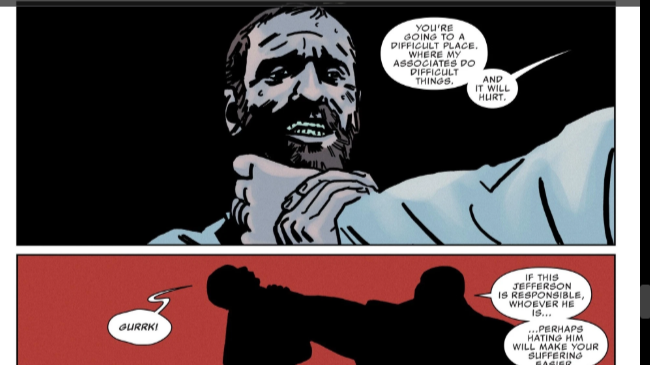
The two artists still work for me, as Nico Leon and Valentine De Landro keep shifting between the present in New York and flashbacks. The flashbacks continue what they have been doing in the past two issues, and I'm glad that even as we learn more about Moore and Jefferson’s past, it doesn't diminish the time they get in this series. De Landro does a fantastic job placing us in those flashbacks, and you know exactly where we are, even if it was decades in the past. The scene that will stick with me is when Wilson Fisk and Martin Moore have a tête-à-tête about Moore’s indiscretions against Fisk.
Bryan Valenza's coloring is cold and lonely, especially in those Fisk scenes. The landscape looks cold and unforgiving. Valenza's coloring really shines, as the darkness in that room feels endless and almost supernatural. I feel for Martin Moore. He seems like a guy who was in the wrong place at the wrong time, but it was of his own making. He was part of Fisk’s gang, after all. However, that was still an extreme measure for Moore to have paid for something he did not do. The art from all three artists makes it look that way. Great storytelling.
Final Verdict
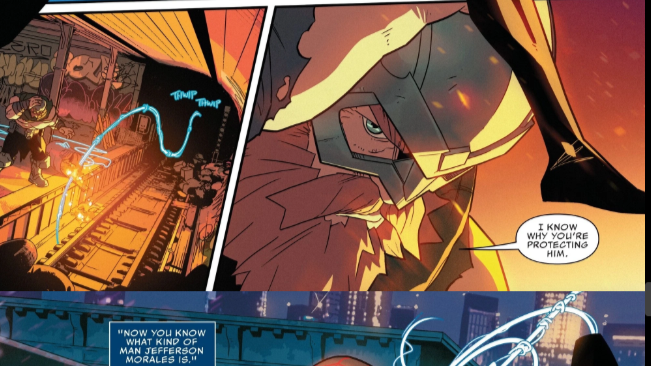
Miles Morales: Spider-Man #3 finally revealed the Revenant's origin story, and it's one of shame, torture, and revenge. Writer Bryan Hill gives us a legitimate reason to empathize with our villain and casts doubt on the father-son and husband-wife relationships that might never be the same. The tension building within the family will be at the center of this arc moving forward, and that is a strong creative route. The story has found its footing, and with the help of artists Nico Leon and Valentine De Landro, Miles Morales' Spider-Man is in good hands as a series.